
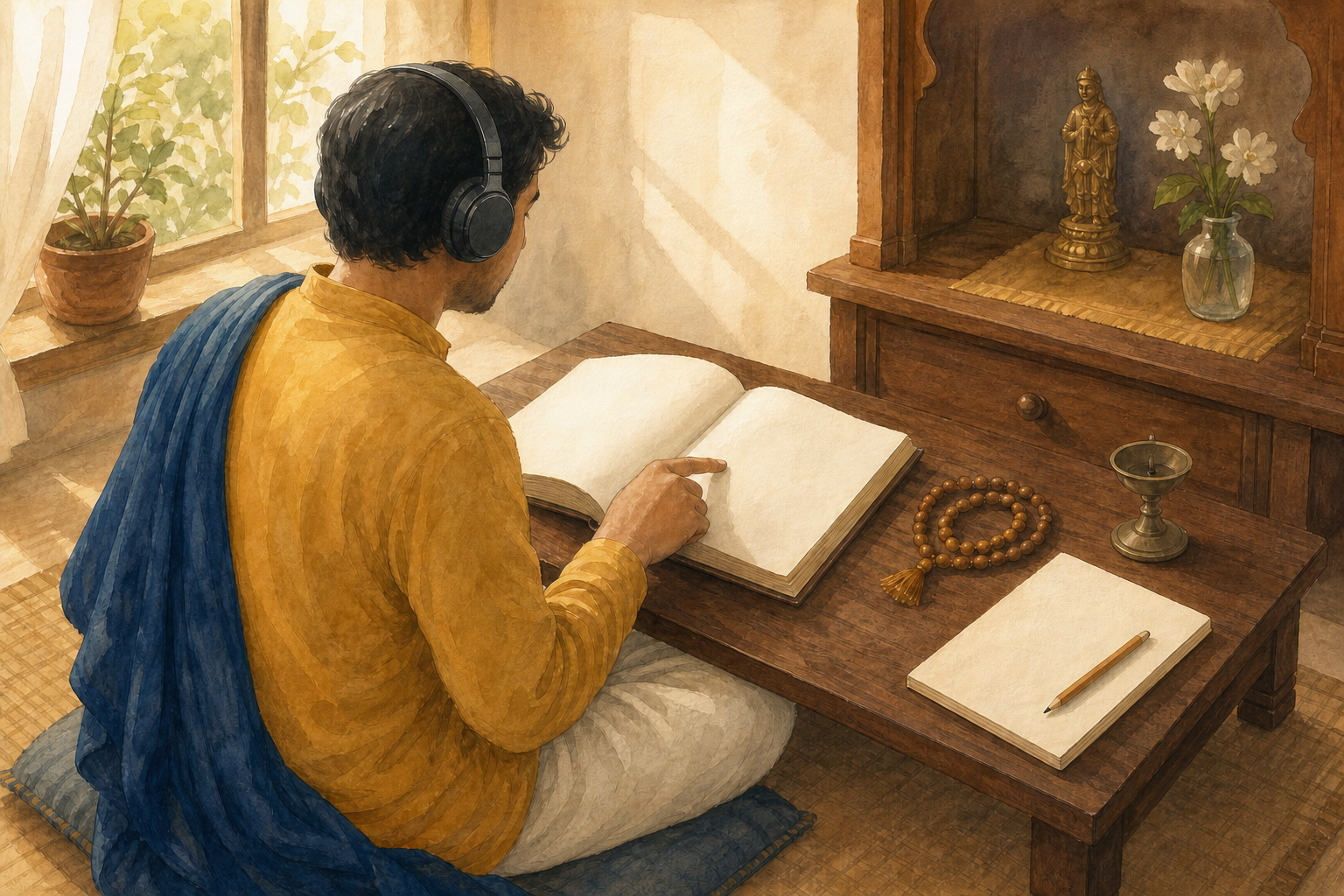
You have found a recording labelled CC Madhya 6.9-13, but the shorthand gives you no obvious starting point. Or perhaps you joined after the readings were already underway and worry that you lack the context to benefit.
The simplest way in is to keep the scriptural passage, the reader’s explanation, and your own response distinct. That turns devotional listening from background audio into a repeatable practice of hearing, inquiry, and remembrance.
Decode the passage locator before you press play

CC is the customary abbreviation for Chaitanya-charitamrita. Madhya identifies the Madhya-lila, the middle portion of the work. In the label CC Madhya 6.9-13, the first number identifies the chapter and the remaining numbers identify the verse range. You therefore want chapter 6, verses 9 through 13 of the Madhya-lila.
That distinction matters because 6.9-13 is not a recording number, calendar date, or running episode count. Open the correct passage in your chosen edition before listening. If your edition uses a slightly different visual format for chapter and verse numbers, retain the same textual locator rather than searching by the wording of a translation.
Not every reading arrives with a verse range. A 31 July 2026 CC reading names Nirakula and Jagarini Matajis and identifies ISKCON Los Angeles as its channel, while the 1 August 2026 session with Rambhoru Dasi specifies Madhya 6.9-13. When only CC Reading appears, do not infer the passage from a nearby date. Listen for the locator announced in the session and add it to your notes once it is clear.
The dates are adjacent, but adjacency alone does not prove that one recording continues the other. Confirm continuity through the passage numbers, the host’s introduction, or the sequence established within the program. This small check prevents you from attaching an explanation to the wrong verses.
Prepare a working page, not a pile of commentary

You do not need to master the entire Chaitanya-charitamrita before joining a Madhya-lila reading. You do need a stable place to record what was read and what remains unclear. Prepare that page with a simple sequence:
- Copy the textual locator exactly as announced.
- Record the reader’s name, the date, and the hosting channel when those details are available.
- Open one edition as your working text and keep it open throughout the session.
- Read the translation of the assigned verses before entering longer commentary.
- Write down the names, terms, or transitions you cannot yet place, without trying to solve all of them immediately.
Using one working edition keeps your attention on the reading. If the speaker’s wording differs from the translation in front of you, mark the difference and continue. A variation may come from another translation, a paraphrase, a remembered phrase, or an explanatory expansion. You can identify which afterward; interrupting every unfamiliar phrase usually costs you the larger thread.
Divide the page into three kinds of material:
- Text: what the assigned verses state in the edition you are using.
- Explanation: how the reader connects, interprets, or develops those verses.
- Response: the question, recognition, or practice implication that arose for you.
This separation is not distrust. It is disciplined hearing. It lets you receive a devotional explanation respectfully while preserving the ability to return to the precise passage that prompted it.
Listen devotionally without giving up textual precision

A good listener does more than collect inspiring sentences. Keep asking where each important point belongs. Is the reader translating the verse, paraphrasing commentary, supplying narrative context, drawing a theological conclusion, or proposing an application? These are all legitimate parts of a reading, but they do different work.
When a session has more than one reader, a handoff may also change pace, vocabulary, or emphasis. Do not mistake that shift for a change in the scripture itself. Keep the passage locator fixed at the top of the page, and place each explanation beneath the relevant verse or theme. This makes a shared reading easier to follow without turning the participants into competing commentators.
If a statement surprises you, capture its key term and its relationship to the verse. For a recording, note the playback position if the platform makes that convenient. Then continue listening. Afterward, return to the full paragraph, surrounding verses, and commentary rather than reacting to an isolated sentence.
Use questions that can actually be answered:
- Which words or events in the assigned verses support this explanation?
- Is this point stated in the text, supplied as context, or offered as an application?
- What prior event or relationship do I need to understand before this passage becomes clear?
- Does my uncertainty concern the translation, the narrative, or the theology?
A precise question can be taken to the surrounding chapter, a trusted teacher, or a later discussion. A vague sense of confusion usually cannot. Naming the kind of difficulty is therefore part of the spiritual discipline, not a distraction from it.
Turn the reading into a durable sadhana

The session is not finished when the audio stops. Close it by making a compact record in your own words. State what happened or was taught in the passage, preserve the point you need to revisit, and name an appropriate response. The response should arise from the text rather than from the emotional intensity of the moment.
- Meaning: write a plain statement of what you now understand.
- Inquiry: preserve the strongest unresolved question instead of hiding it behind devotional language.
- Practice: identify how the passage should affect your hearing, remembrance, chanting, humility, service, or conduct.
Keep the application proportionate. A short verse segment may clarify a disposition or reveal something worth contemplating, but it should not be made to carry a sweeping doctrine without its chapter and wider context. When the implication seems large, return to the surrounding text before settling your conclusion.
File your notes by textual locator rather than by date alone. Madhya 6.9-13 will remain findable even when you forget when you heard it. Place the reader and date beneath that locator as useful metadata. If a session begins without a visible verse range, leave the locator blank and complete it only after the passage is announced.
Before the next reading, reopen the previous page. Read the recorded meaning and unresolved question, then begin the new passage. This creates continuity even when the readers change, you miss a session, or the program does not publish a detailed title. Your anchor remains the Chaitanya-charitamrita itself.
Key takeaways
- Read CC Madhya 6.9-13 as Madhya-lila, chapter 6, verses 9 through 13.
- Do not assume that recordings on adjacent dates belong to the same textual sequence.
- Keep the verse text, the reader’s explanation, and your personal response distinct.
- Record the exact passage locator first; add the reader, date, and channel beneath it.
- When a title lacks a verse range, wait for the passage to be announced rather than guessing.
- End with a text-grounded meaning, a precise question, and a proportionate practice response.
For your next Madhya-lila reading, begin with the locator at the top of a clean page and the relevant verses open in front of you. That modest preparation will give the speaker’s words somewhere to land and give you a reliable path back to the scripture afterward.
References
- Dandavats — Nirakula & Jagarini Matajis – CC Reading – 7-31-26
- Dandavats — Sat 1 Aug 2026 – CC MADHYA 6.9-13 by Rambhoru Dasi
