
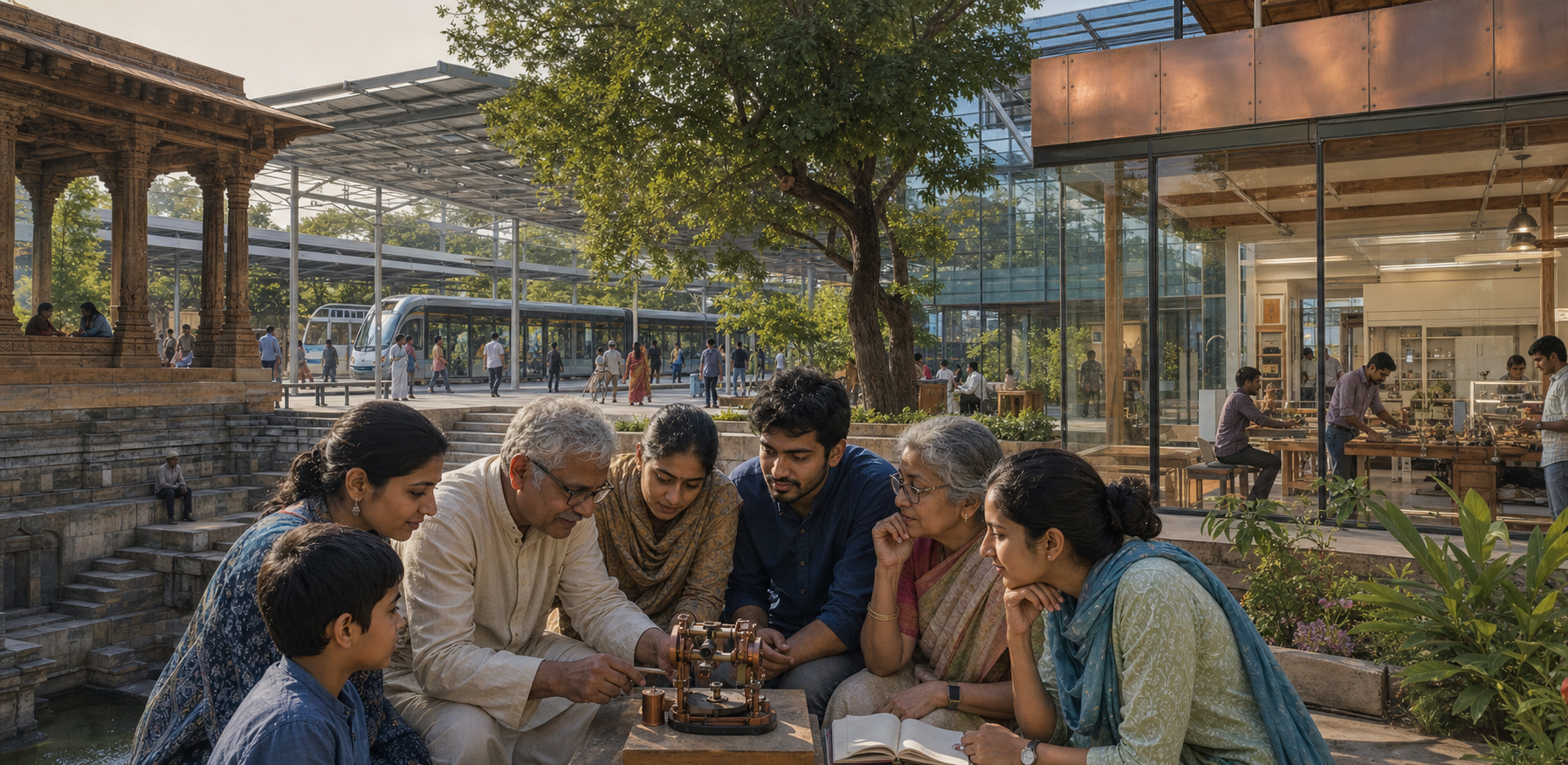
You may be trying to make a very practical choice: which technology to adopt, which language to educate your child in, what kind of development to support, or whether an inherited custom still deserves your loyalty. The pressure beneath each decision is often the same. Must you become more Western in order to become more modern?
No. You can accept a useful machine without importing the philosophy packaged around it. You can defend inherited wisdom without defending every inherited practice. The task is to separate scientific capability from cultural imitation, then judge both innovation and tradition through dharma.
Modernization is not the same as Westernization
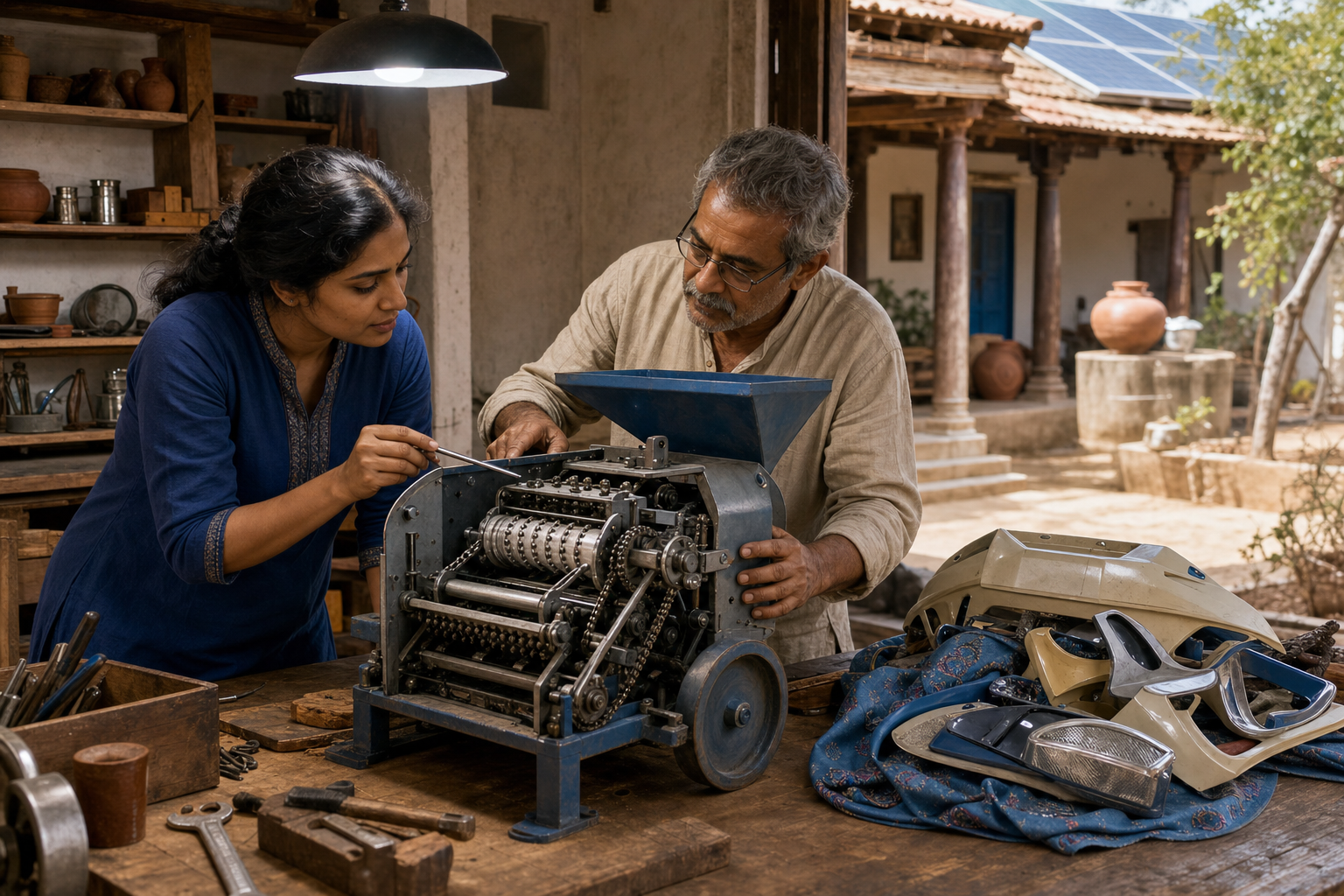
The first move is to stop treating modernity and Westernization as synonyms. Modernization describes a society increasing its ability to meet contemporary needs. Westernization means adopting forms associated with Western societies, whether or not those forms solve the problem at hand.
The distinction becomes obvious in daily life. A burger is not modern merely because it is foreign, just as a regional meal is not obsolete merely because it is inherited. The sensible questions concern nutrition, ingredients, affordability, convenience and local suitability. Prestige is not evidence. The same rule applies to clothing, entertainment, education, architecture and public policy.
Colonial rule gave Western social, educational and political arrangements institutional authority in Bharat. That history helps explain why an imported form can still appear neutral or advanced while an Indian form must first defend its legitimacy. But reversing the prejudice does not require rejecting everything Western. It requires judging every option by the same standard.
When you encounter something presented as modern, place it in one of three categories:
- A method of finding truth: observation, measurement, testing, criticism and revision. No civilization has a monopoly on these methods, and cultural pride is not a reason to weaken them.
- A practical tool: the internet, artificial intelligence, machinery or a new institutional process. Adopt it when it performs a worthwhile function and its risks can be governed.
- A value judgment: what counts as success, what kind of life deserves admiration, whose interests come first and which costs are acceptable. Technology cannot answer these questions for you.
Confusion begins when all three arrive as one package. A device may be effective while the consumer identity attached to it is unnecessary. An administrative technique may improve efficiency while the assumptions behind its goals remain open to challenge. Indian modernity starts by opening the package.
Use the two models as lenses, not stereotypes
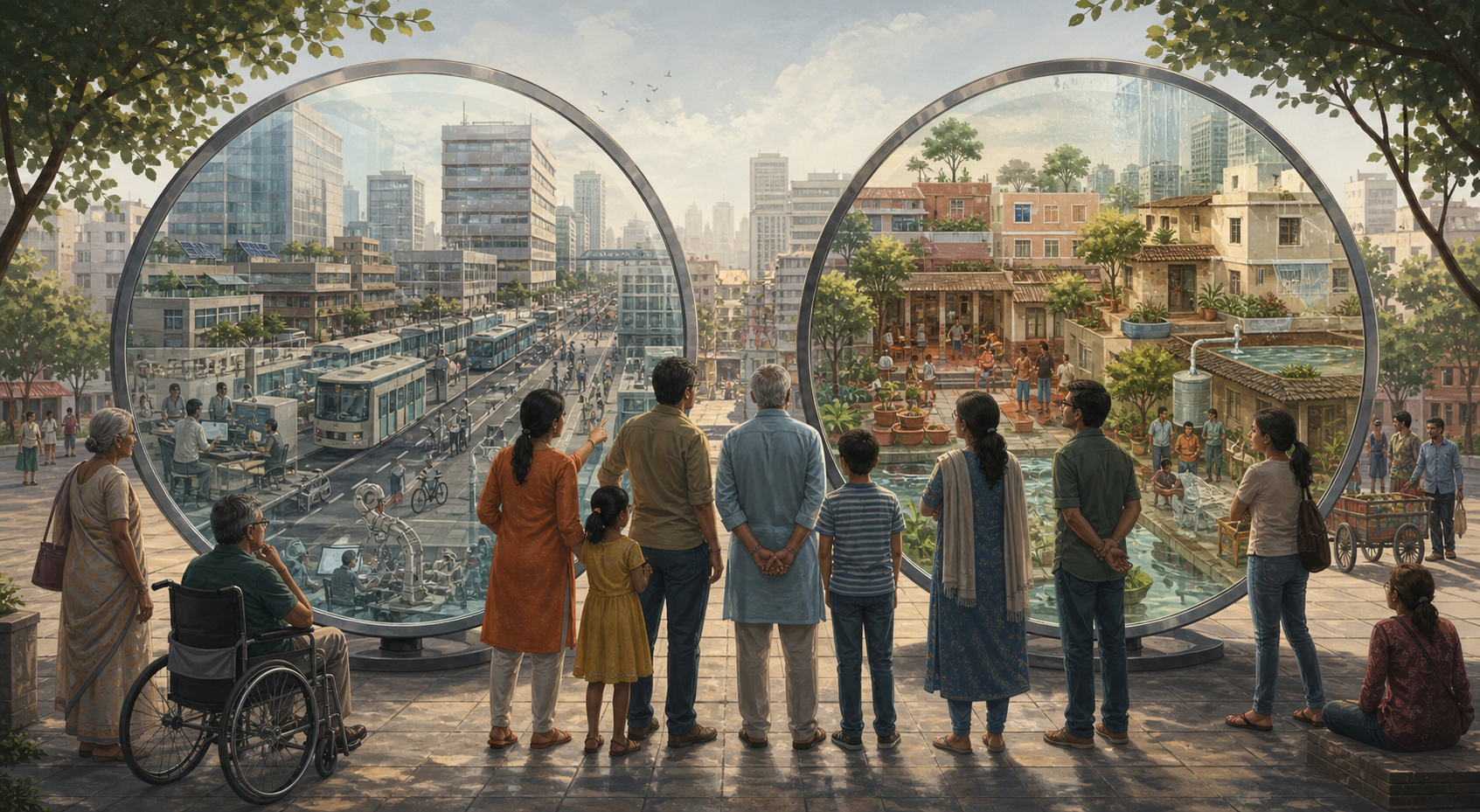
There is no single, uniform West, just as there is no single Indian opinion on progress. Western societies contain strong traditions of community, restraint and religious duty. Indian traditions contain vigorous arguments about liberty, reason and material prosperity. The comparison is useful only as a pair of ideal types: one identifies common modern defaults, while the other supplies a Bharatiya corrective.
| Decision | A common Western-modern default | A Bharatiya-modern corrective |
|---|---|---|
| Meaning of progress | More speed, production, consumption and technical control | Greater capability judged alongside human welfare, restraint, continuity and ecological consequence |
| View of the person | An autonomous individual whose choices and rights come first | A person with rights who also exists within relationships, duties and a wider moral order |
| Role of technology | Innovation is presumed desirable when it expands convenience or choice | Innovation must serve a defensible purpose and remain accountable to dharma |
| Approach to knowledge | The newest or internationally dominant system receives default authority | Every claim, imported or inherited, is examined, translated, tested and adapted |
| Economic strength | Access to global capital, products and large firms | Global exchange combined with domestic research, production, maintenance and bargaining capacity |
| Geography of development | The metropolitan city becomes the image of modern life | Technology also strengthens villages, local economies and decentralized institutions |
The right-hand column is not a demand to replace individual freedom with collective coercion or science with sentiment. It changes the order of judgment. Instead of asking whether an idea looks modern elsewhere, you ask whether it enlarges Bharat’s capacity to flourish without hollowing out the relationships, knowledge and moral disciplines that make flourishing meaningful.
Apply a six-question dharmic test before adopting or rejecting
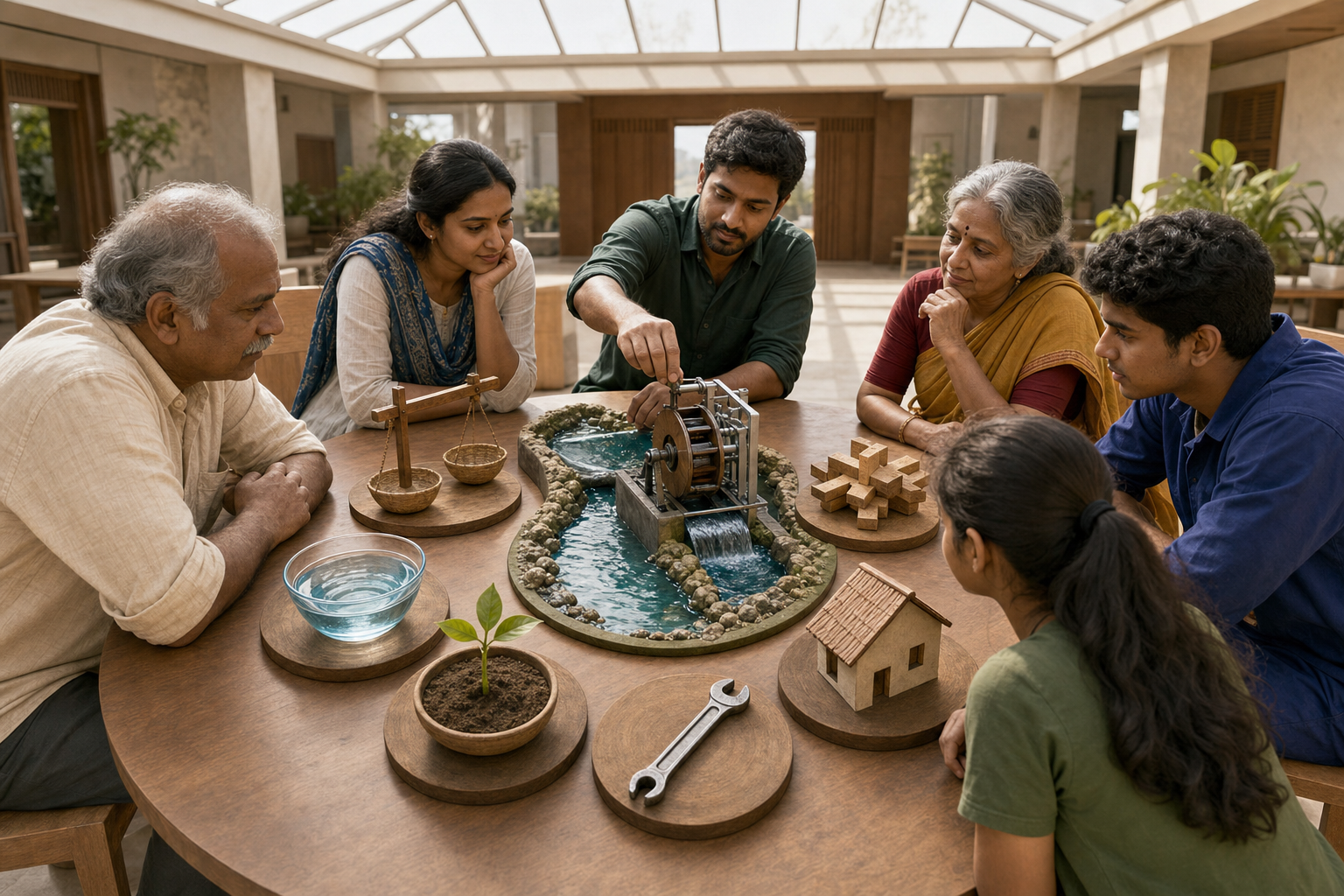
You do not need a national theory every time you evaluate a product, policy or custom. Write one clear sentence in response to each of the following questions. The exercise exposes prestige, dependency and nostalgia before they become substitutes for judgment.
- What exact problem are we solving? Name the outcome, not the fashionable means. A school does not need digital devices merely to appear advanced; it needs students to understand, inquire and apply knowledge. A village does not need a smart label; it needs identifiable improvements in services, livelihoods or access.
- What can we verify? Ask for evidence of function, cost and consequence. Apply this equally to a foreign product, a new scientific claim and a practice defended as ancient. Neither novelty nor antiquity proves effectiveness.
- Which part is the tool, and which part is the worldview? You may need the software without accepting permanent dependence on its supplier. You may value English as a bridge without treating English fluency as a measure of intelligence. You may adopt efficient management without making consumption the purpose of life.
- Who receives the benefit, and who carries the burden? Trace effects beyond the immediate user. Consider families, workers, local producers, future generations and the natural world. Dharma becomes practical when hidden costs acquire a moral claimant.
- Does the choice increase real capability? Ask whether Bharatiya institutions can understand, maintain, modify and eventually improve what they adopt. Buying access is not the same as acquiring knowledge. Self-reliance is strongest when it creates the ability to cooperate without helplessness.
- What should be preserved, revised or discarded? Separate an enduring principle from the historical form through which it was expressed. Preserve what remains truthful and life-supporting. Adapt what serves the principle imperfectly. Retire what survives only through fear, inertia or status.
Notice the warning signs on both sides
A decision is probably imitation when its main argument is that advanced countries already do it, when Indian alternatives are excluded before being tested, or when dependence is dismissed as the unavoidable price of progress. It is probably nostalgia when age is offered as proof, criticism is treated as disloyalty, or a symbolic revival is mistaken for restored capability.
The dharmic path is more demanding than either reflex. It asks you to be scientifically exact without becoming culturally submissive, and civilizationally confident without becoming intellectually complacent.
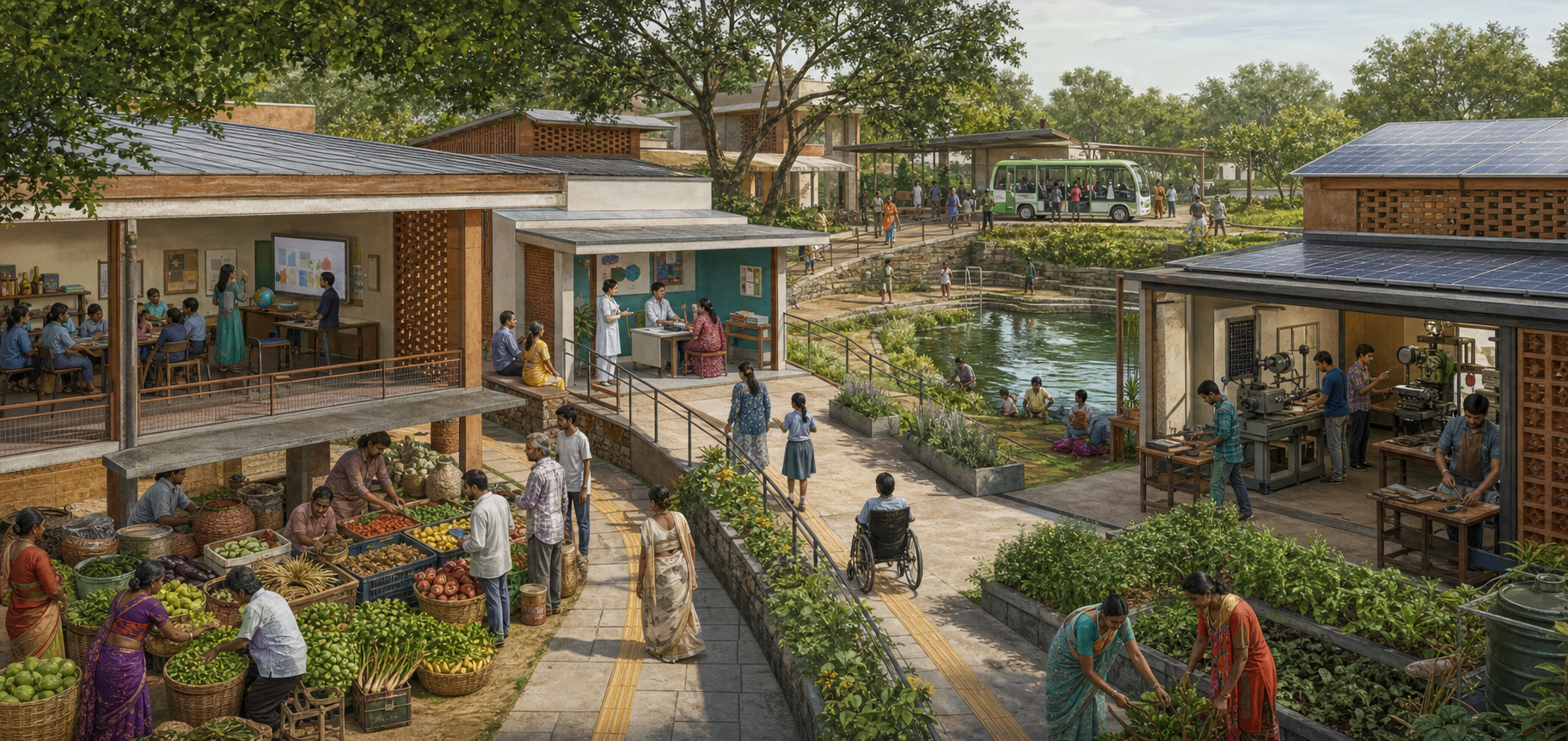
Make Bharatiya modernity visible in real institutions
Technology and artificial intelligence
Using advanced technology is fully compatible with a Bharatiya model. The decisive issue is governance. Before an AI system influences hiring, education, access to benefits or another consequential decision, ask who defines its objective, who can inspect its errors, who answers for harm and how an affected person can challenge the result. Efficiency cannot dissolve responsibility.
A dharmic technology policy would therefore connect technical performance with human dignity, accountability and environmental consequence. It would also ask whether local researchers and engineers are building lasting competence. Importing a powerful system may solve an immediate need; developing the ability to understand and improve it prevents the temporary solution from becoming permanent subordination.
Language, education and inherited knowledge
English can be a valuable bridge to international knowledge. It becomes a cultural dependency when access to science is unnecessarily tied to a student’s command of a socially prestigious language. A genuinely modern education system should develop scientific vocabulary, teaching materials and serious intellectual work in Bharatiya languages as well.
When evaluating a school or curriculum, ask whether students can explain a concept in the language in which they think most clearly, whether translation preserves technical precision, and whether experiments and reasoning matter more than borrowed terminology. The objective is not to push English out. It is to stop confusing linguistic hierarchy with intellectual merit.
The same discipline should govern engagement with the past. The Arthashastra, Ayurveda, astronomy and India’s nautical knowledge deserve study without inherited inferiority. They should not, however, be used as ceremonial proof that every contemporary question was answered long ago. Translate the relevant material, identify its claim, place it in context and test what can be tested. A living civilization converses critically with its inheritance; a museum merely displays it.
Industry, investment and self-reliance
Foreign companies and international cooperation are not inherently opposed to national strength. The important question is what remains after the transaction. Does Bharat gain research capacity, skilled employment, supplier depth, repair knowledge and room to innovate? Or does it gain consumption while critical decisions, intellectual capability and control remain elsewhere?
Use those questions when judging procurement, investment or industrial policy. The cheapest immediate purchase can be costly if essential maintenance, knowledge or future choices remain locked outside the country. Conversely, a local label alone does not make a weak product worthy. Atmanirbharta should mean demonstrated capability and greater freedom of action, not isolation from competition or protection from honest evaluation.
Villages and decentralized development
A model that recognizes only the large city as modern will treat the village either as a labour reserve or as scenery. A Bharatiya alternative brings internet access and modern agricultural methods into village development while allowing local communities to retain agency.
Judge a smart-village proposal by the service it improves, not the number of devices it purchases. Can farmers obtain useful knowledge? Can residents reach education and public services more easily? Can local enterprises participate in wider markets? Can the community maintain the system? If these questions have no answer, technology is serving the appearance of modernization rather than the people.
Rights, duties and cultural confidence
Indian and Western models are often reduced to a contest between duties and rights. That is too crude to guide a free society. Rights protect the person against arbitrary power. Duties govern how freedom is exercised toward other people, institutions and the natural world. A rights-only vocabulary can ignore diffuse obligations; a duty-only vocabulary can be misused to demand obedience from the vulnerable. Bharatiya modernity should hold both together.
Cultural confidence works the same way. Wearing Bharatiya clothing, speaking a Bharatiya language or celebrating a festival should never be treated as evidence of backwardness. Yet symbols alone do not create a modern civilization. Confidence becomes consequential when it supports excellent schools, ethical technology, capable industries, responsible citizens and institutions able to correct their own failures.
Key takeaways
- Modernization expands the ability to solve contemporary problems; Westernization adopts a culturally specific form. They sometimes overlap, but they are not identical.
- Accept scientific methods and effective technology on their merits. Debate the values, dependencies and definitions of success that accompany them.
- Test imported and inherited claims by the same intellectual standard. Cultural confidence should remove prejudice, not remove scrutiny.
- Pair rights with dharma. Protect individual freedom while making responsibility to community, nation and nature visible.
- Measure self-reliance by knowledge, maintenance, research and freedom of action, not by a local label or hostility to cooperation.
- Treat tradition as a living inheritance: preserve enduring principles, adapt their forms and release what no longer serves them.
Take the next decision in front of you and divide it into three columns: the tool, the purpose and the dependency it creates. Keep what demonstrably works. Reframe its purpose through dharma. Then reduce any dependency that prevents you, your community or Bharat from choosing the next step freely. That is how an alternative modernity moves from civilizational aspiration into ordinary practice.
References
