
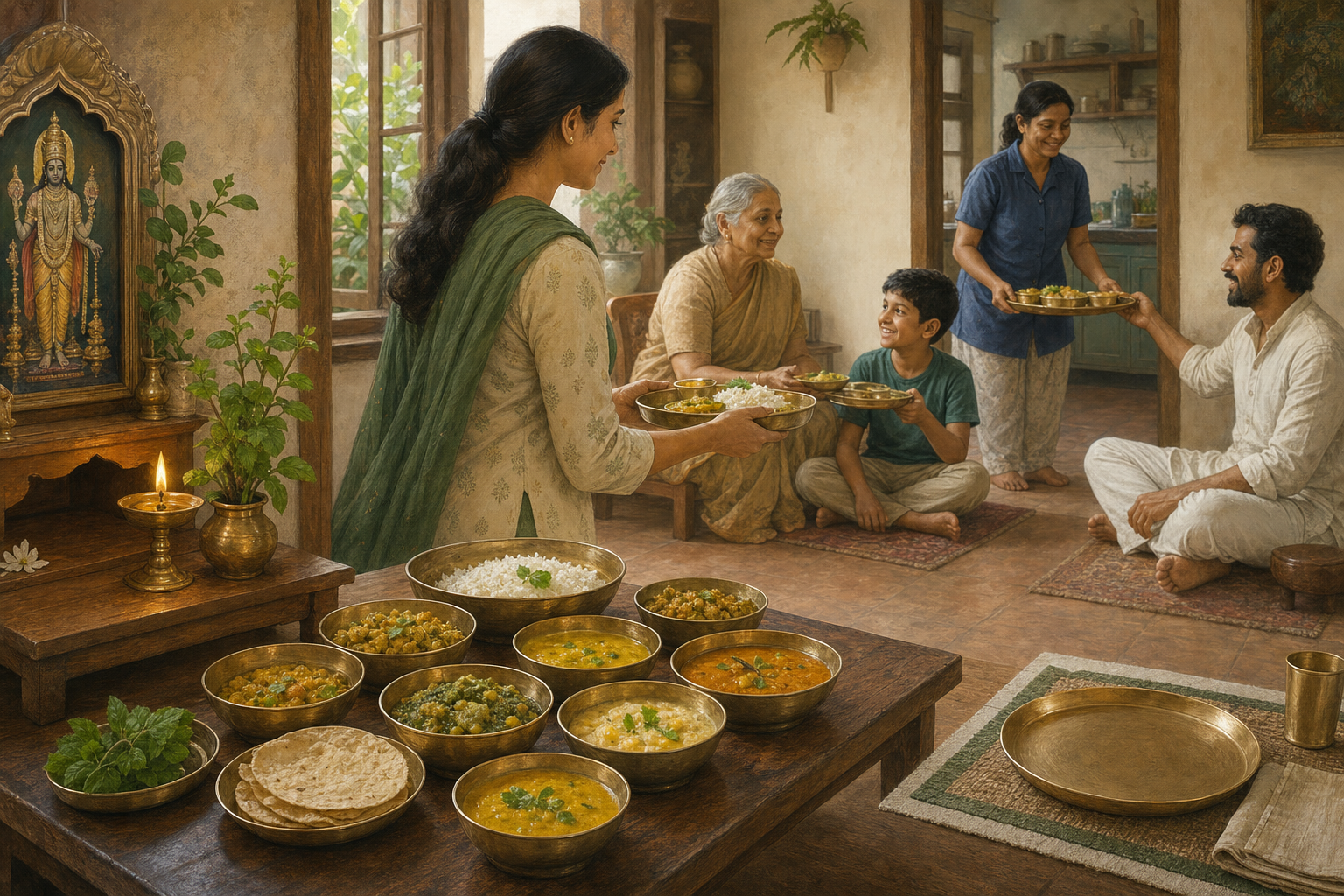
You may already light a lamp, recite a mantra, or offer food to your Ishta. The harder question comes a few minutes later: does that devotion still shape the kitchen when breakfast is late, a child needs attention, a household worker is waiting, or an unexpected guest arrives?
Nilobha’s answer is practical enough to use at your next meal. Remember Srimannarayana, offer what has been prepared, care for the people entrusted to the household, and receive your own portion with gratitude. Bhakti becomes durable when it determines the order in which ordinary things are done.
The sequence of the meal is the spiritual discipline
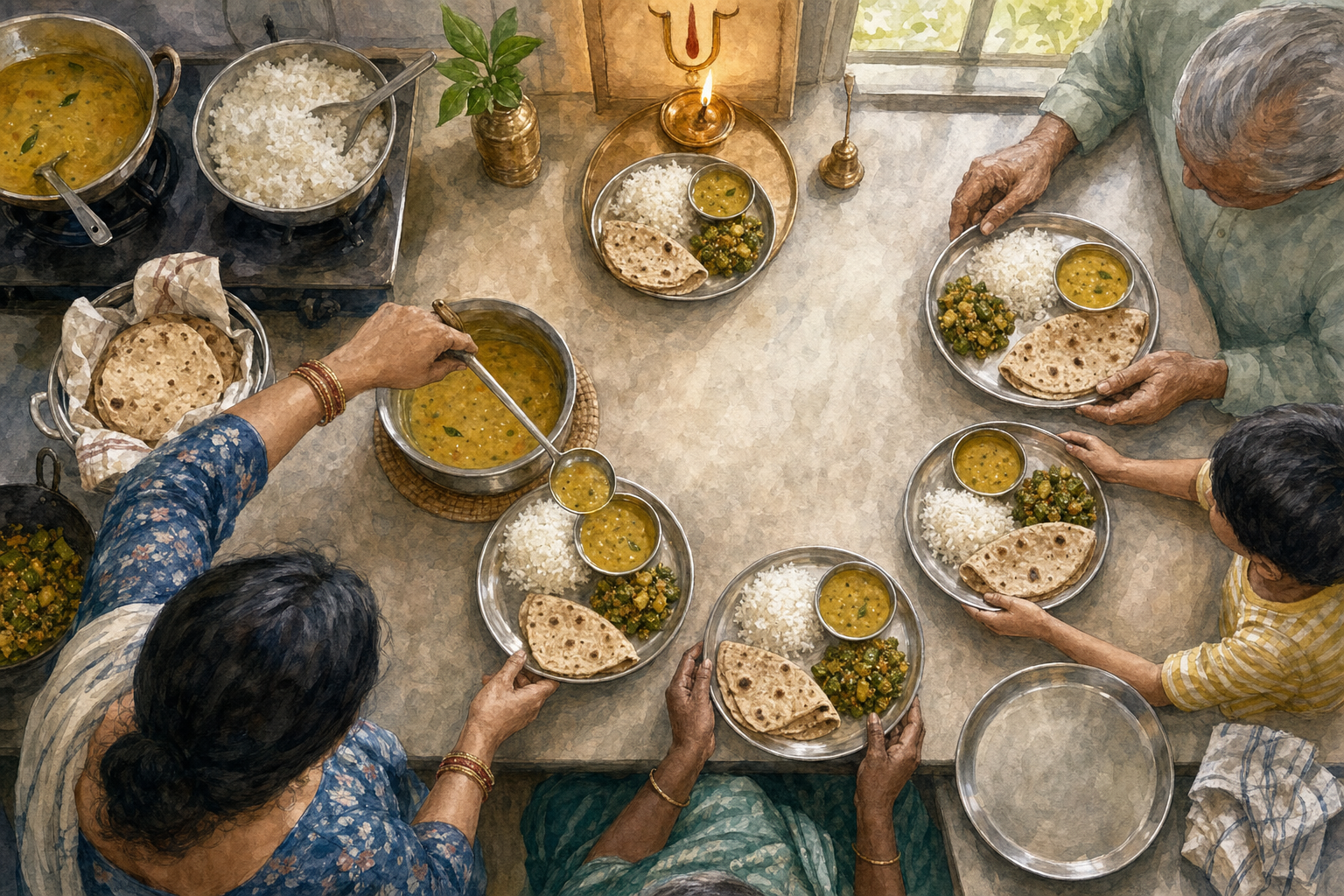
Nilobha is remembered for a precise household order of devotion and nourishment. Food was prepared with remembrance, offered to Srimannarayana as naivedya, distributed as prasada to the household servant and visiting devotees, and only then eaten by the householder. His life as the father of one daughter places this discipline inside grihastha-dharma, not outside family responsibility.
The order matters because naivedya and prasada are not merely two religious labels for the same plate. Naivedya is what you present to the deity. Prasada is what you receive back as grace. Between those two moments, the householder’s relationship with the food changes. What looked like private possession becomes something received in trust and meant to be shared.
- Preparation becomes smarana when the mind returns to the divine while the hands work.
- Offering becomes archana when food is consciously placed before the Ishta.
- Serving becomes dasya when the householder treats care as service rather than status.
- Eating becomes gratitude when the meal is received as prasada rather than claimed as entitlement.
This is why feeding another person first is more than etiquette. The person with authority accepts a delay in personal satisfaction so that a dependent, worker, or guest is not overlooked. Leadership is expressed through responsibility for nourishment.
That principle should not become a rigid performance. A young child, an elderly relative, an unwell person, or anyone who must eat at a particular time should not be made to wait so that the householder can reproduce a sequence mechanically. Meeting a genuine need is itself seva. The discipline concerns the order of attention: the responsible person checks who needs care before thinking only of personal consumption.
Make the practice durable on an ordinary weekday
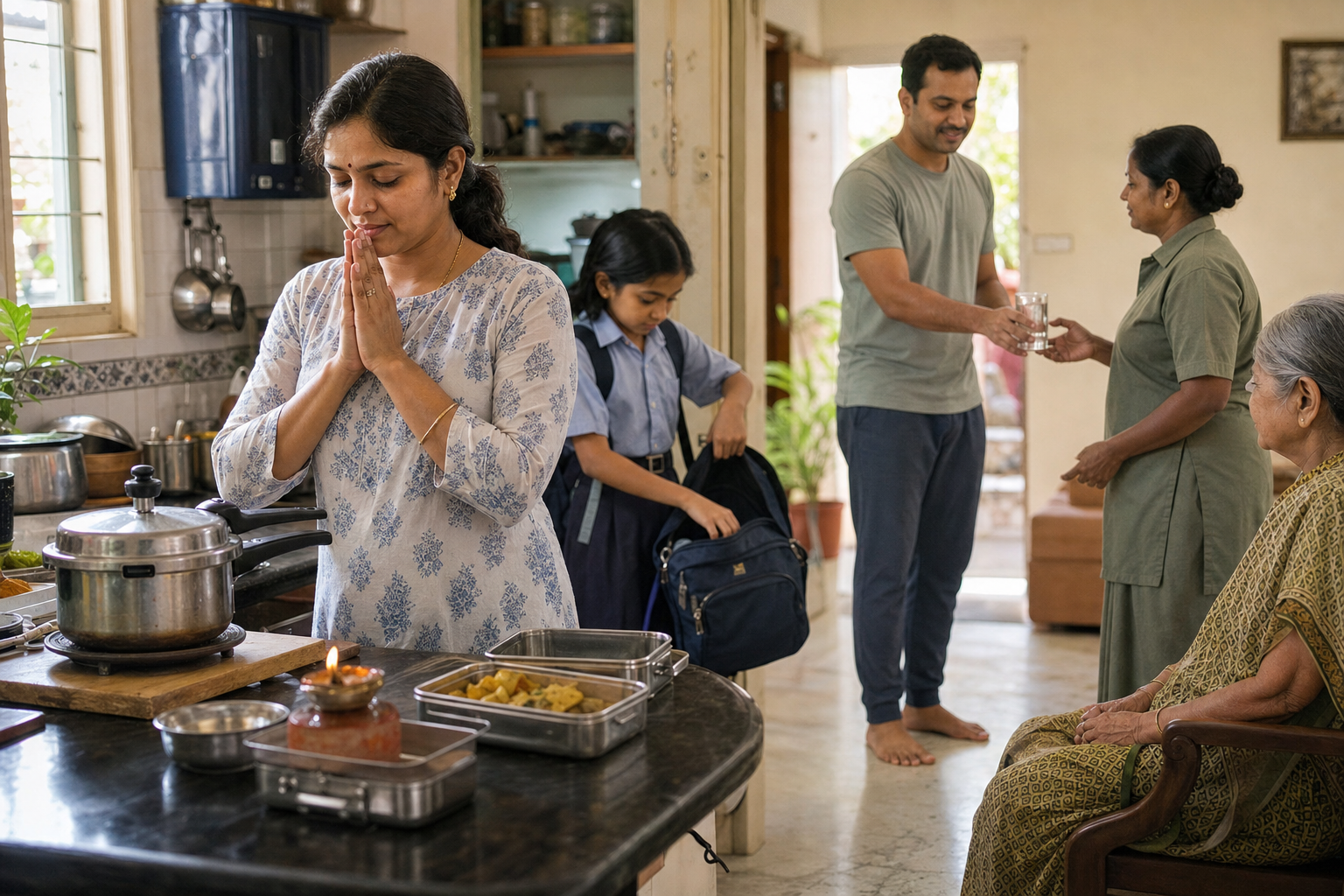
A household practice survives when its minimum form is clear. If it depends on a long ceremony, an elaborate menu, or every family member being present at once, it will disappear on the first difficult morning. Establish a form that can be observed without haste and expanded on quieter days.
- Choose a fixed cue. When the meal is ready, pause before distribution begins. Even a brief pause separates offering from automatic consumption.
- Place a clean portion before the Ishta. A Vaishnava household can address Srimannarayana according to its inherited practice. A family devoted to another form of the divine should preserve the names, mantras, and customs of its own parampara.
- Offer with attention. Recite the mantra your family uses, or make a simple verbal offering if no formal practice has yet been learned. Do not turn uncertainty about ritual detail into an excuse to omit remembrance entirely.
- Return the offered portion to the meal as prasada. The point is not to isolate holiness in one small bowl but to let the offering change how the whole meal is understood and distributed.
- Ask who is still waiting. Check children, elders, guests, household workers, and anyone whose schedule differs from yours. Offer food without coercing anyone to eat or participate in worship.
- Eat with gratitude. When circumstances permit, let the person directing the household meal serve themselves after others have been cared for.
Different schedules do not make the practice impossible. If a household worker eats later, reserve a proper portion before the food is depleted. Label it when necessary, especially if several people share the kitchen. If a family member leaves early, offer and set aside their portion rather than treating absence from the common meal as exclusion from prasada.
Hospitality also need not mean producing a feast. A simple meal offered without embarrassment is more faithful to seva than elaborate food accompanied by resentment. Keep one realistic household rule, such as making an additional serving available when possible or identifying a simple item that can be shared without disrupting the entire kitchen.
Children learn the practice most clearly through a small responsibility. One child can carry water, another can place the offering plate, and another can help with age-appropriate clearing or cleaning. You can anchor the meal with three questions: What have we received? Who has been served? What can we share? These questions make gratitude and responsibility visible without turning dinner into a lecture.
Nilobha’s role as a parent is important here. His devotion did not require abandoning the education, safety, or dignity of his daughter. For a contemporary parent, family duty and spiritual practice should strengthen each other. A child should see that worship makes adults more dependable, not less attentive to practical needs.
Serve people with dignity, not as symbols
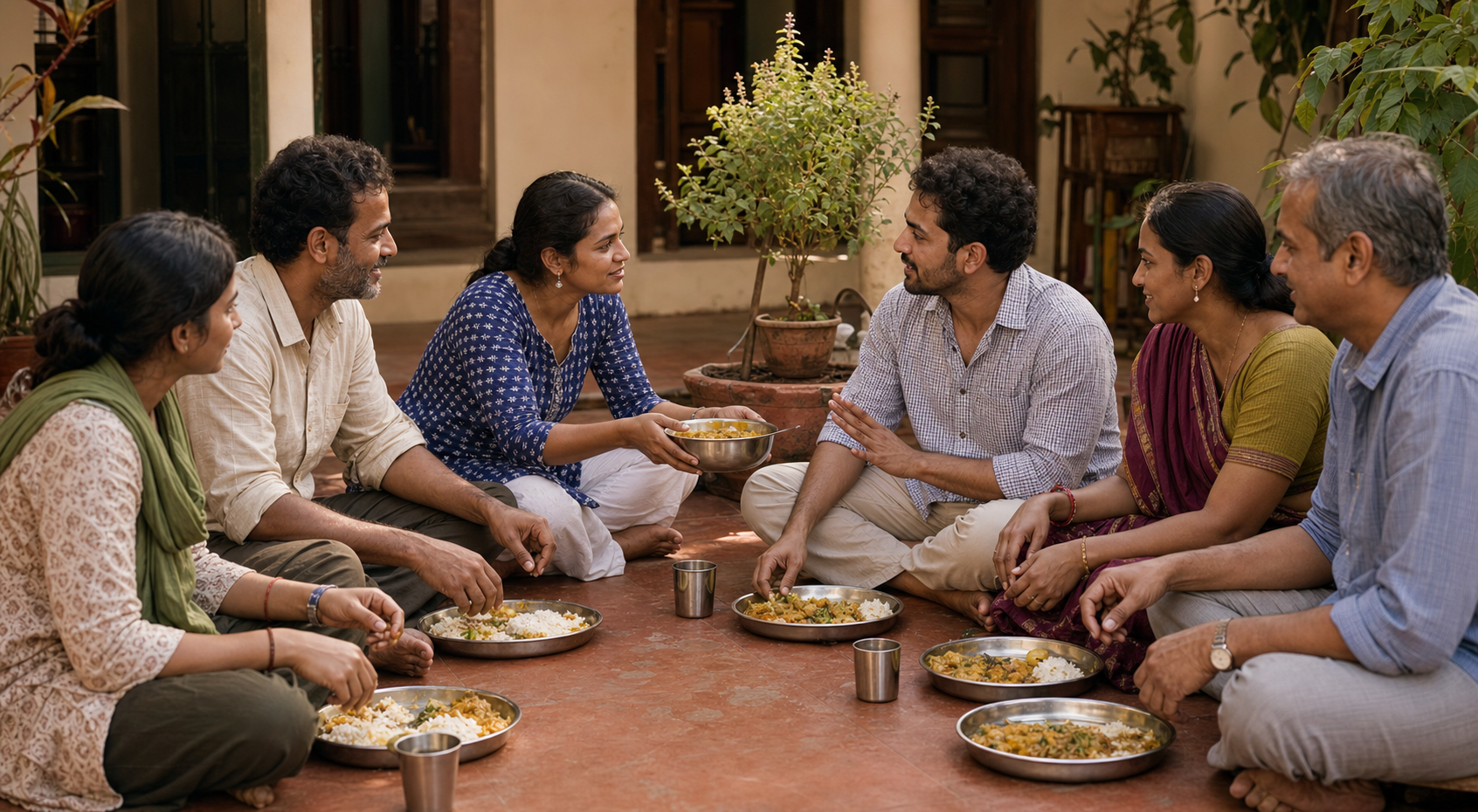
The historical language of feeding a servant first can be translated into a direct modern obligation: a household worker is a person to be respected, not a prop in someone else’s display of virtue. Timing alone does not make an act dharmic. The quality of the food, freedom of choice, manner of speech, and fairness of the wider relationship all matter.
- Offer food of the same acceptable quality that the household would eat. Seva is not a religious name for disposing of unwanted leftovers.
- Ask about dietary restrictions and preferences. Receiving prasada should not require a person to ignore an allergy, a health need, or a conviction.
- Make participation voluntary. A worker or guest can respectfully decline food or religious observance without being treated as ungrateful.
- Give the person enough time to eat. A plate offered without a reasonable opportunity to sit and finish it is hospitality in appearance only.
- Keep generosity separate from publicity. The recipient does not owe the giver a photograph, testimony, or public expression of gratitude.
- Do not use food or kindness as a substitute for agreed wages, rest, safe conditions, or other ordinary responsibilities.
The same examination belongs inside the family. If one person always plans, cooks, offers, serves, and cleans while everyone else speaks about seva, the visible ritual is resting on invisible labour. Share supporting tasks where circumstances allow. At minimum, acknowledge who performed the work and make sure that person is also served with care.
Atithi devo bhava asks the householder to recognise sacred worth in the guest. Nilobha’s discipline extends that recognition to someone working within the home. It softens hierarchy because the person with the greatest control over distribution refuses to make personal privilege the first claim on the meal.
You can test the integrity of the practice with one private question: if nobody saw this act, would the recipient still receive the same food, patience, and respect? If the answer changes when there is no audience, the household needs less display and more seva.
Scale household seva without losing its soul
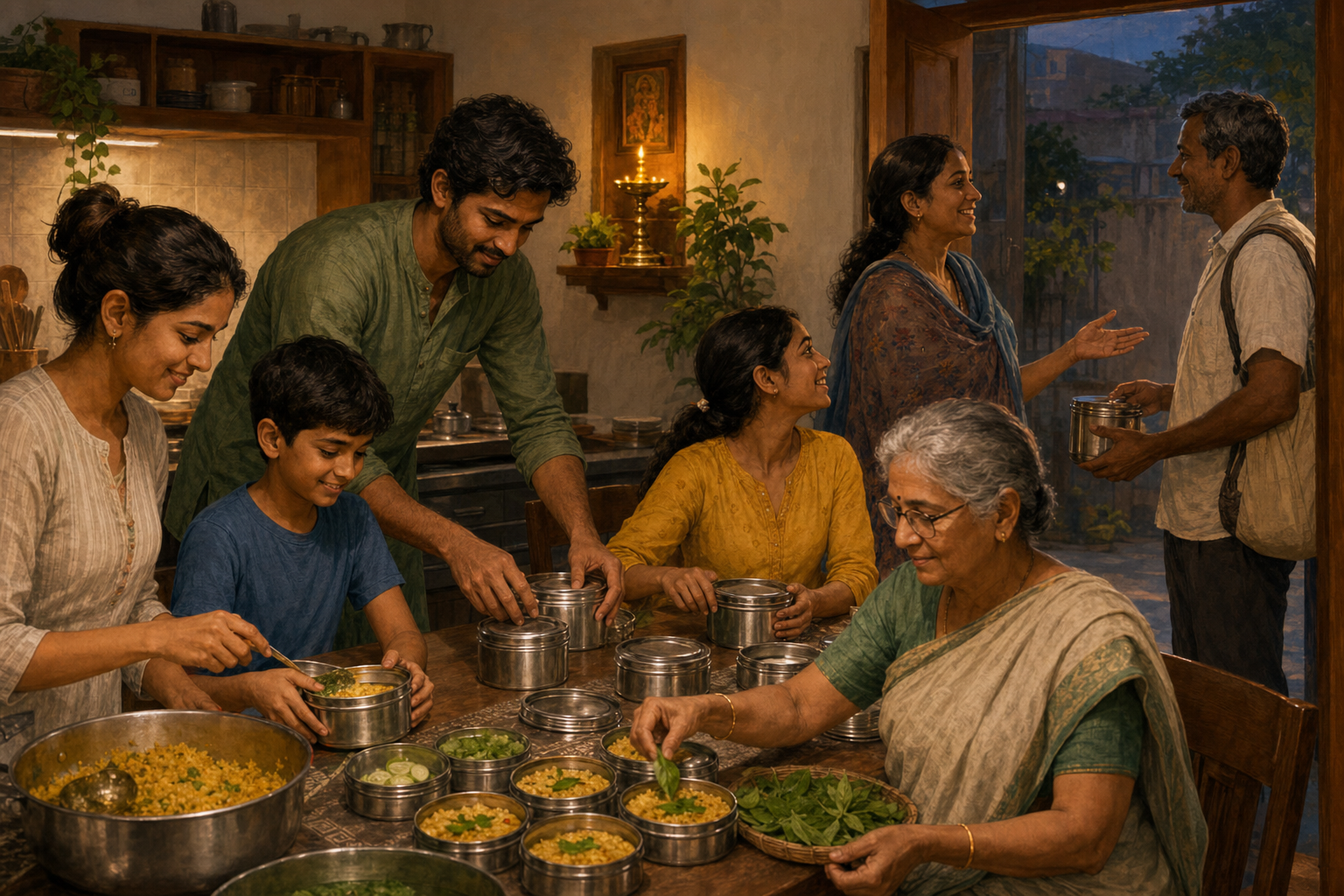
Once the household routine is stable, anna-dana can extend it beyond the front door. A family can support a periodic meal through a temple, monastery, gurudwara, Jain upashraya, or trusted community group. The scale may change, but the governing principle remains the same: those organizing the meal accept responsibility for the dignity and nourishment of those receiving it.
Sacred intention does not remove the need for competent organization. It makes competent organization part of the offering. Before holding a community meal, settle the practical questions that recipients will otherwise be forced to solve at the serving line.
- Write a menu and identify the ingredients clearly.
- Label known allergens and provide enough information for people to decide what they can safely eat.
- Set a budget and record costs so donations can be used transparently.
- Define serving roles before the meal begins, including who will welcome people, replenish food, provide water, and manage cleaning.
- Use an equitable queue. Status, wealth, caste, profession, or closeness to the organizers should not determine who is treated with courtesy.
- Plan portions and the handling of remaining food so that generosity does not become careless waste.
- Make feedback easy to give, especially for people whose dietary or accessibility needs were missed.
This operational care is not separate from bhakti. An unlabeled dish may exclude a person with a dietary restriction. A disorderly queue may allow the confident to advance while the hesitant are overlooked. A vague budget may weaken trust even when every organizer began with a sincere intention. Seva must be legible in the recipient’s experience, not only in the giver’s motive.
The wider dharmic family offers distinct expressions of this ethic. Sikh langar institutionalizes seva and nourishment without making social status the measure of a participant’s worth. Buddhist dana directs attention to the intention and attachment involved in giving. Jain practice joins almsgiving to ahimsa and disciplined care. These traditions should not be flattened into interchangeable rituals, but their shared moral grammar is unmistakable: restraint, generosity, humility, and non-harm give devotion a social body.
A community kitchen shaped by these values does more than distribute calories. It creates a dependable place where people are noticed, workers are respected, donations are accounted for, and service is not reserved for those considered socially important. That is household dharma growing into lokasangraha, the welfare and cohesion of the wider community.
Key takeaways
- Nilobha’s central discipline is an order of attention: remember the divine, offer the food, care for others, and then receive your own share.
- Naivedya becomes a household ethic when prasada is distributed with responsibility rather than treated as a private ritual object.
- Serving a household worker first has meaning only when the person also receives choice, good food, adequate time, fair treatment, and respect.
- A child learns grihastha-dharma by seeing adults turn authority into care and by receiving an age-appropriate role in the meal.
- When anna-dana grows beyond the home, menu planning, cost records, allergen labels, equitable queues, and waste control become forms of seva.
- Hindu, Sikh, Buddhist, and Jain practices retain their distinct forms while converging on the principle that spiritual discipline must become compassionate conduct.
At your next shared meal, do not try to redesign the entire household. Make one change that everyone can recognise: set aside the offering, pause for remembrance, check who still needs to be served, and reserve your own portion until that responsibility has been met wherever circumstances permit.
Keep that order long enough for it to become normal. When the family no longer experiences sharing as a special event, the kitchen has begun to function as a place of bhakti.
References
