

You may find Parabhava printed in a Tamil calendar, a Telugu Panchangam and a Malayalam almanac, yet encounter different New Year dates. That is not automatically an error. The traditions can share a cyclical year-name while using different rules to decide when observance begins.
To plan your household celebration or read an annual prediction correctly, settle three questions first: Which calendar does your family follow? Which city is the calculation for? Are you seeking a festival date, a general forecast or a muhurta for one consequential event? Those distinctions prevent most of the confusion surrounding Parabhava 2026-2027.
Why Parabhava begins on more than one date
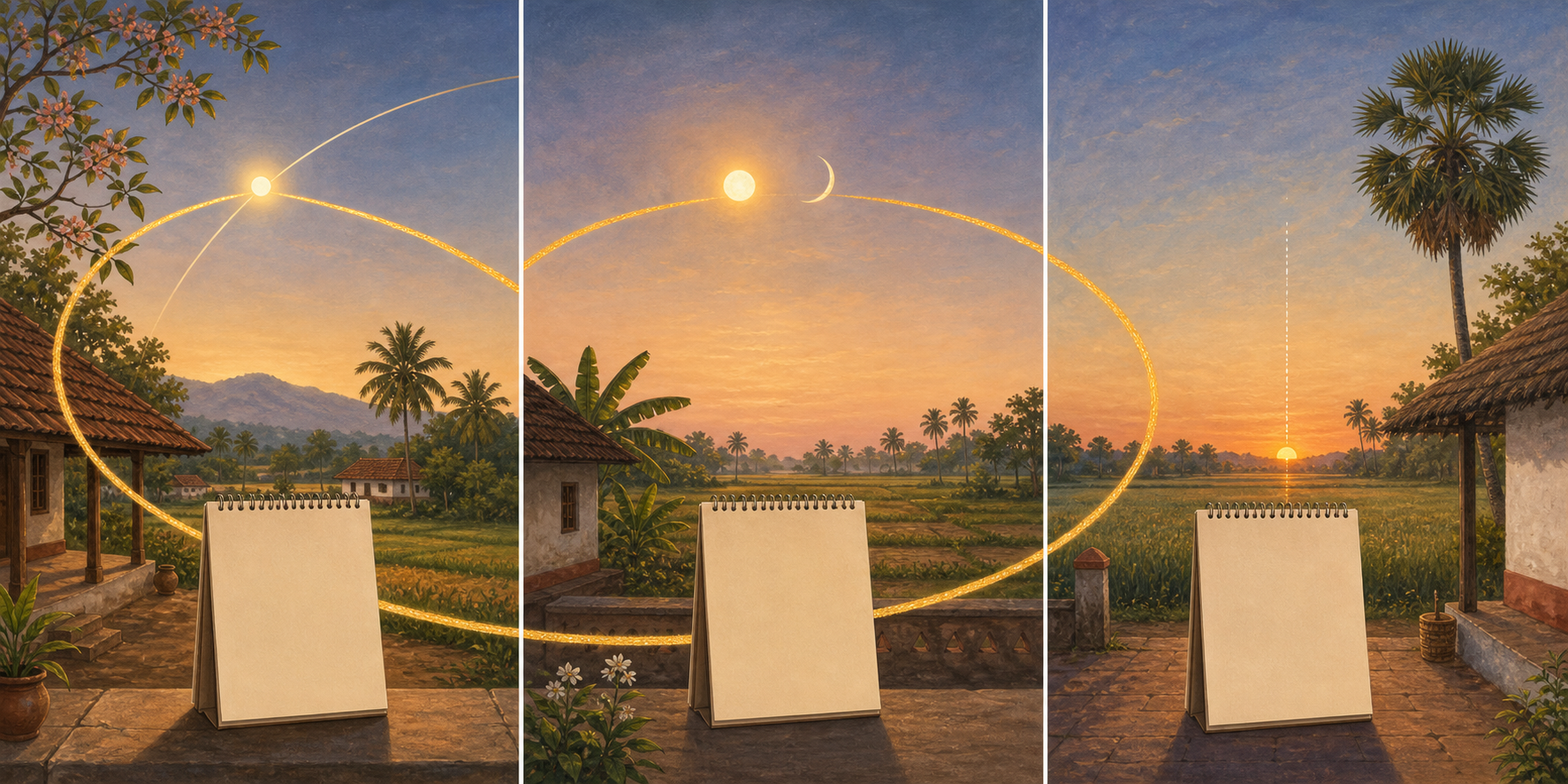
Parabhava is the traditional name assigned to this year in the 60-year Samvatsara cycle. The name identifies a period within a recurring cultural system; it does not create one universal civil midnight at which every regional calendar must turn. The starting date still comes from the astronomical and ritual rules of the calendar you use.
| Calendar or observance | What marks the transition | Parabhava timing relevant to 2026 | What you should use |
|---|---|---|---|
| Tamil Puthandu | The Sun enters sidereal Mesha, opening Chithirai | 14 April 2026 | A Tamil Panchangam calculated for your location |
| Kerala Vishu | Mesha Sankranti and the first day of Medam, subject to Kerala’s sunrise rule | 15 April 2026 in Kerala, because the ingress occurs after local sunset | A Kerala Panchangam for the place of observance |
| Ugadi reckoning | The regional lunisolar New Year | Sri Parabhava Nama Samvatsaram begins at Ugadi and extends approximately through March 2027 | The Panchangam of your Telugu, Kannada or other applicable regional tradition |
| Kerala civil year | Chingam 1 in the Kollavarsham system | Chingam begins in August-September, distinct from Vishu’s solar threshold | Use it for civil-year reckoning without treating it as a replacement for Vishu |
Puthandu and Vishu therefore need not fall on the same Gregorian date even though both are connected to Mesha Sankranti. In Kerala’s 2026 calculation, the ingress comes after sunset, so the principal Vishu observance moves to the following sunrise. Tamil Puthandu remains associated with 14 April under its applicable convention. The calendar rule, not the shared astronomical phrase alone, decides the festival day.
The sidereal point matters too. These Panchangams reckon Mesha against the sidereal zodiac, which places this solar transition around mid-April rather than at the tropical Aries point familiar from many Western calendars. If an app places Aries at the March equinox, it is probably answering a different calendrical question.
Location is part of the calculation, not a decorative setting. Sunrise, sunset and the local clock can change the observance when an ingress falls near a boundary. If you live in Toronto, London, Singapore or another diaspora city, do not mechanically copy the date and time printed for Chennai or Kochi. Select a Panchang that explicitly accepts your city, time zone and regional convention.
Key takeaways
- Parabhava is a Samvatsara name, not one globally uniform New Year instant.
- Puthandu falls on 14 April 2026, while Vishu is observed on 15 April 2026 in Kerala under the local sunset-and-sunrise rule.
- Ugadi, Puthandu and Vishu should each be dated through the Panchang tradition that governs that observance.
- Your city matters whenever sunrise, sunset or Sankranti timing determines the ritual day.
- A festival calendar tells you when to observe; rashi, nakshatra and individual-chart methods answer different astrological questions.
Choose the right forecast: rashi, nakshatra or muhurta

A date problem and a prediction problem require different tools. A Panchang settles the local ritual calendar. Varuda Rasipalan gives a broad annual orientation through the twelve rashis. Nakshatra Phalam reads the year through your janma nakshatra, or birth star. A personal kundali is needed when you want judgment tailored to your own birth pattern and circumstances.
Use the following sequence rather than asking one method to do every job:
- For Puthandu, Vishu, Ugadi, vrata or festival timing, begin with a place-specific regional Panchang.
- For the year’s broad areas of growth and discipline, read the slow graha transits from your rashi.
- For a second personal lens, read Nakshatra Phalam by your janma nakshatra, not by a Western Sun sign and not by choosing the star whose description sounds most attractive.
- For a marriage, griha pravesh, upanayanam or another major samskara, ask a qualified local scholar to consider the event, place-specific Panchang and relevant individual charts.
- For property, investment, health, legal or career decisions, establish real-world viability first. Astrology can help you choose a reflective framework or timing preference, but it cannot replace medical care, legal review, financial due diligence or a sound contract.
Nakshatra and rashi readings may emphasize different matters because they are not duplicate calculations. Nakshatra Phalam can incorporate Kandaya Phalam, tara-bala, chandra-bala and major transits across the 27 birth stars. Rashi-based annual guidance arranges those transits through twelve houses from the applicable rashi. Some nakshatras also cross a rashi boundary, so the pada can refine how a general statement applies.
If the two readings appear to disagree, do not average them and do not keep only the more pleasant prediction. First separate the life areas involved. A rashi reading may stress professional discipline while the nakshatra reading highlights family responsibility; both can operate without contradiction. Treat an overlap as a priority worth planning around. Treat a genuine conflict as a reason to consult the complete birth chart before making an important choice.
You should also resist assigning too much power to the word Parabhava itself. A cyclical year-name is a mnemonic and cultural marker, not a sentence imposed on everyone born under every possible chart. Dharmic astrology is most useful when it sharpens attention, restraint and responsibility. Ethical effort remains more important than a dramatic interpretation of the year’s name.
The three slow-moving patterns that shape the year

Annual forecasts lean heavily on Guru, Shani and the Rahu-Ketu axis because their slower movements establish the background against which shorter monthly changes occur. They describe an astrological climate, not a guaranteed event list.
| Graha movement | Broad Parabhava theme | How to use it |
|---|---|---|
| Guru begins in Mithuna and later enters Karka | The emphasis moves from communication, skills and exchange toward learning, nourishment, shelter and emotional foundations. Guru is exalted in Karka. | Use the earlier phase to gather information and build competence. Use the Karka phase to strengthen the foundation that must support growth. |
| Shani remains in Meena for most of the Tamil year | Long commitments, sober self-examination, spiritual discipline and the testing of vague assumptions come forward. | Choose repeatable routines, document obligations and remove promises that have no workable structure. |
| Rahu-Ketu move from Kumbha-Simha toward Makara-Karka in late 2026 | Attention shifts from networks, visibility and identity tensions toward duty, status, home and emotional security. | Before the shift, audit which groups and ambitions deserve your attention. Later, clarify the boundary between public responsibility and household stability. |
The exact transit date can vary with ayanamsa and Panchang convention, especially when a graha is close to a sign boundary. Do not invent precision by copying a date from a calendar that does not identify its calculation method. For a ceremony or contractual deadline, use one named Panchang consistently and verify the relevant local time with the scholar advising you.
These slow movements are not enough for monthly muhurta. Budha, Shukra and Kuja move more quickly, while retrograde periods and the Moon’s position can alter shorter windows. That is why a favorable annual theme does not make every day equally suitable. Annual astrology helps you decide what deserves sustained attention; a daily Panchang helps you examine when a particular act may be undertaken.
A practical rashi map for Parabhava 2026-2027
Use the rashi identified in your Vedic chart. The first two columns below follow Guru’s movement from Mithuna to Karka; the third carries Shani’s continuing discipline from Meena. Read each row as a planning prompt, not as a promise that an event must occur.
| Rashi | While Guru is in Mithuna | After Guru enters Karka | Shani discipline and a useful response |
|---|---|---|---|
| Mesha | Skills, communication, networking and short journeys receive emphasis. | Home, property questions and inner stability become more prominent. | Shani in the twelfth calls for expense control, adequate rest and regular spiritual practice. Build a financial and time buffer before expanding domestic commitments. |
| Vrishabha | Savings, speech, nourishment and family resources deserve attention. | Study, certifications, writing and purposeful travel can gather momentum. | Shani in the eleventh rewards realistic, structured participation in networks. Choose one durable alliance or skill path instead of chasing every opportunity. |
| Mithuna | Confidence, initiative and the ability to advise others come forward. | Income structure, savings and responsible speech become central. | Shani in the tenth demands professional standards, records and boundaries. Put important decisions and deliverables in writing. |
| Karka | Expenses, rest, private study and unfinished inner work need care. | Exalted Guru in Karka supports education, visibility and renewed initiative. | Shani in the ninth favors serious long-range learning and mature relations with teachers. Prepare quietly in the first phase, then advance the plan with a defined curriculum or milestone. |
| Simha | Networks, senior guidance and collaborative gains are favored. | Private preparation, retreat and controlled spending become more important. | Shani in the eighth emphasizes resilience, research and intergenerational planning. Secure records and agreements while support is strong, then protect reserves. |
| Kanya | Career advancement through teaching, advice or process excellence is highlighted. | Networks, peer recognition and institutional gains can mature. | Shani in the seventh tests fairness, timelines and shared duties. Define ownership and acceptance criteria before entering a partnership. |
| Tula | Higher study, dharmic inquiry and purposeful travel expand perspective. | Leadership and professional responsibility become more visible. | Shani in the sixth rewards patient work on routines, records and disputes. Build the operating system before accepting a larger title. |
| Vrischika | Research, shared resources and careful documentation require depth. | Teachers, higher learning and merit-building actions receive support. | Shani in the fifth asks for disciplined creativity and patient mentorship. Audit shared financial obligations, then commit to one serious course or teaching responsibility. |
| Dhanu | Partnerships, contracts and public-facing work receive emphasis. | Safeguards, compliance, shared finances and confidential matters require care. | Shani in the fourth brings household, property and elder-care duties into focus. Clarify partnership terms early and obtain qualified advice for insurance, tax, legal or property matters. |
| Makara | Work systems, service and sustainable routines need improvement. | Client relations, diplomacy and committed partnerships strengthen. | Shani in the third rewards repetition, documentation and timely communication. Standardize the work before increasing the number of people who depend on it. |
| Kumbha | Study, teaching and creative problem-solving are stimulated. | Daily efficiency, maintenance and workload discipline become prominent. | Shani in the second stresses budgets, ethical speech and durable resources, while Rahu can scatter attention. Limit the year to a few measurable priorities. |
| Meena | Home learning, environmental balance and domestic foundations come forward. | Education, children, refined arts and creative expression receive support. | Shani in the first asks for sober self-assessment and steady life architecture. Protect a weekly rhythm that can survive busy and quiet periods alike. |
The most useful line in your row is often the least glamorous one. Guru may describe where expansion appears possible, but Shani identifies the structure without which that expansion becomes difficult to sustain. If a favorable period encourages property, partnership or professional growth, the practical response is still documentation, affordability, consent and due diligence.
Rahu and Ketu add another reason to review the plan near late 2026. Kumbha and Simha themes initially heighten questions of networks, recognition and relational clarity. As the axis moves toward Makara and Karka, public duty and domestic security need to be renegotiated. Schedule a review rather than assuming the priorities chosen at the start of Parabhava will remain unchanged all year.
Turn the calendar and forecast into an annual practice
You do not need a stack of competing predictions. One accurately labeled calendar and one written plan will give you a clearer basis for action. Set them up before the New Year gathering:
- Write your tradition and city at the top of the page: for example, Tamil Panchangam for Toronto or Kerala Panchangam for Kochi. This prevents you from silently mixing regional calculations.
- Record the actual observance you need. Mark Puthandu, Vishu or Ugadi under its own convention rather than creating a synthetic date from all three.
- Verify your rashi and janma nakshatra from a reliable birth chart. If the birth details or star are uncertain, do not guess from personality descriptions.
- Create three headings for the year: strengthen, restrain and serve. Put Guru-related development under strengthen, Shani-related limits under restrain, and one family or community duty under serve.
- Add only the major dates that require individual timing. Marriage, griha pravesh, upanayanam and similarly significant rites deserve place-specific muhurta assessment instead of a generic auspicious-day list.
- Review the page when Guru changes sign and when the Rahu-Ketu axis shifts. At the beginning of each month, use your chosen Panchang for faster graha movements, chandra-bala, tara-bala and daily muhurta where relevant.
Let the New Year ritual correct the tendency to treat astrology as fortune consumption. The Vishu Kani places light, grain, a mirror, sacred learning, wealth and divinity in one field of vision. Its symbolism joins clarity, sustenance, self-examination, wisdom, material stewardship and devotion. Kaineettam then directs prosperity outward through giving. Different households need not adopt identical forms to retain that dharmic sequence: see clearly, examine yourself, accept responsibility and share what you can.
Before Parabhava arrives, put your calendar tradition and city in writing. Then choose one foundation to strengthen, one excess to restrain and one act of seva to sustain through the year. That modest discipline will serve you better than a dozen decontextualized predictions.
References
- DharmaRenaissance Blog – Varuda Rasipalan 2026-2027 (Parabhava): Deep-Dive Puthandu Predictions, Rituals and Auspicious Windows
- DharmaRenaissance Blog – Nakshatra Phalam 2026-2027: Definitive Predictions for 27 Birth Stars in Sri Parabhava Samvatsaram
- DharmaRenaissance Blog – Vishu 2026 Malayalam New Year: Exact Date, Kani Rituals, Kaineettam, and Cultural Insights
