
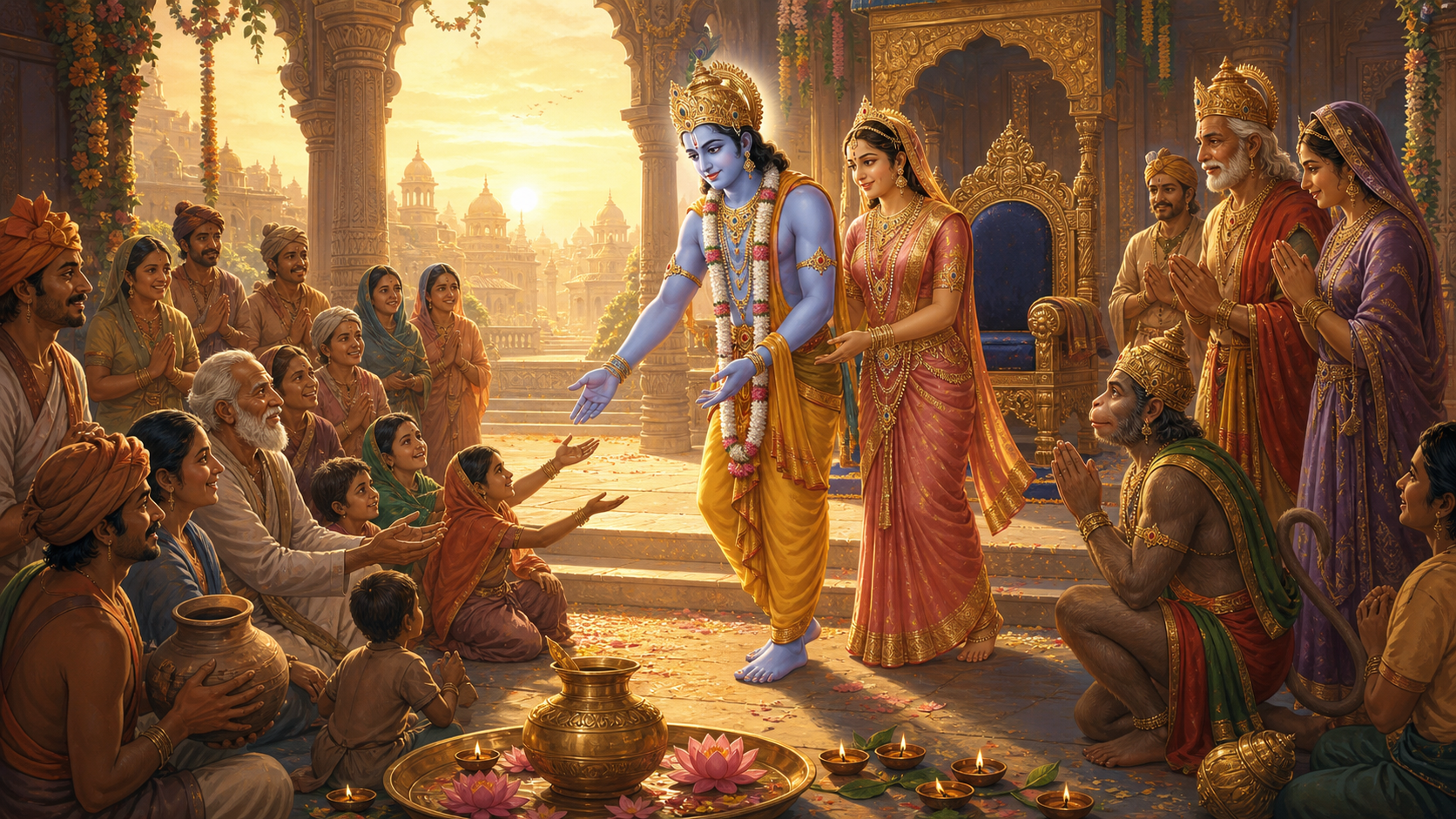
If Rama Navami in your home has become a familiar sequence of puja, bhajan, and prasada, you may still be left with a sharper question: what is the festival asking you to become?
The answer lies in the movement from Rama’s birth to Sita and Rama’s marriage and then to Rama’s coronation. Worship leads into relationship; relationship leads into responsibility. Bhakti is what carries that sequence from the temple into the decisions you make as a parent, professional, community member, or person entrusted with authority.
Key takeaways: birth, covenant, and responsible rule
- Rama’s kingship begins with restraint. His authority matters because it remains answerable to satya, dharma, promises, relationships, and public duty.
- Rama Navami, Sita Rama Kalyanam, and Rama Pattabhishekam form an ethical sequence: receive life as sacred, bind yourself through right relationship, and exercise responsibility for the good of others.
- Bhakti does not replace ethical judgment. Listening, singing, remembrance, surrender, and seva train you to remember dharma when a real decision becomes costly.
- Rama-rajya is best used as a standard of conduct, not merely as a slogan. Its practical tests are truthfulness, justice, compassion, service, and self-restraint.
- A useful Rama Navami sankalpa should name one duty you can actually fulfil. Review it on Dasami, when the coronation turns devotional feeling into accountable action.
The festival sequence explains what makes power legitimate
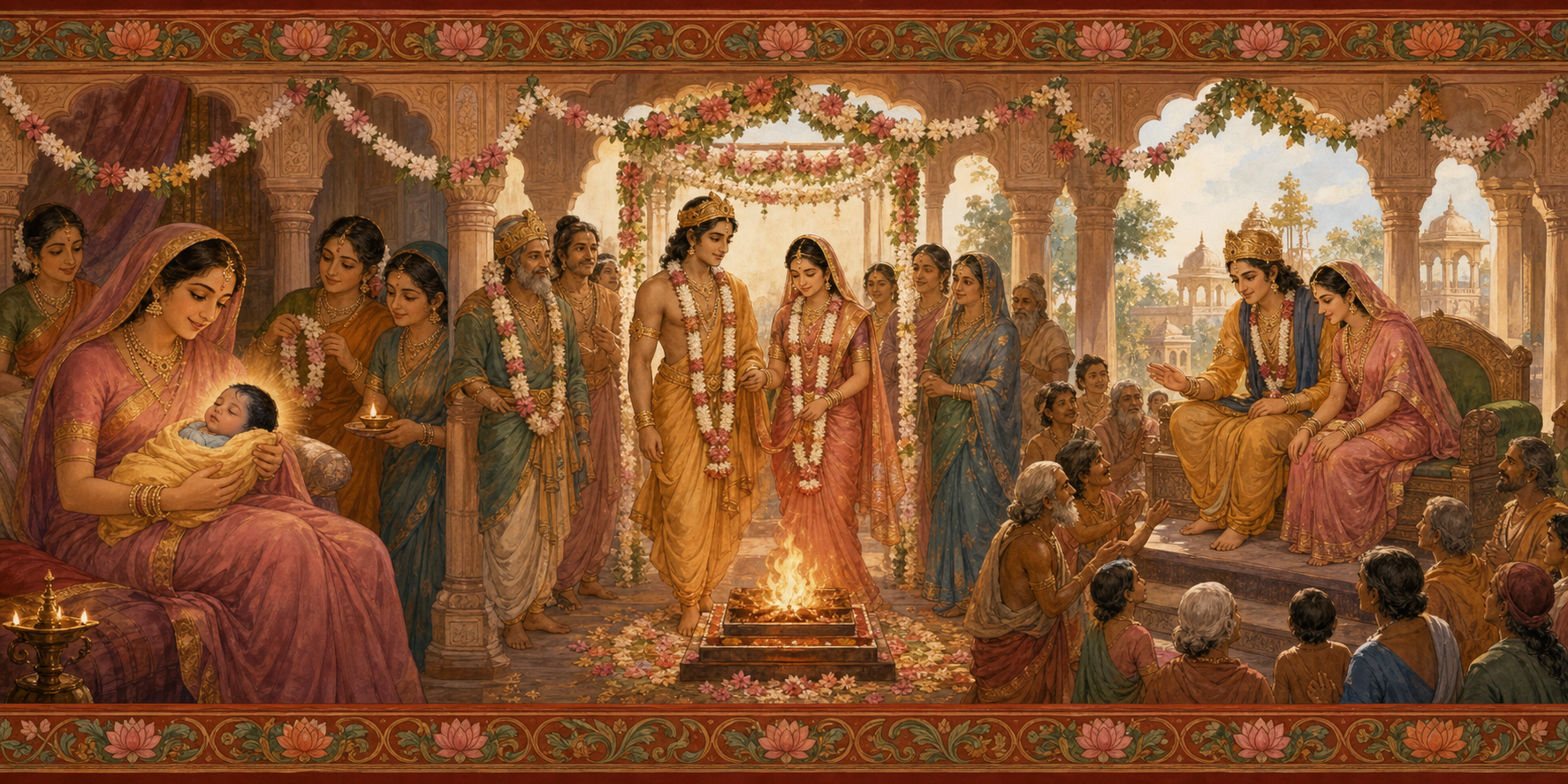
Rama Navami is often approached as a celebration of divine birth. That is true, but incomplete. At Bhadrachalam, the festival places Rama’s birth, the Sita Rama Kalyanam, and the Pattabhishekam within a carefully ordered Vaishnava ritual world. The sequence itself teaches: power cannot be understood before relationship, and neither can be separated from sacred obligation.
Navami: begin with the source of authority
Rama’s janma-puja is associated with Madhyahna, the middle portion of the day. At Bhadrachalam, devotees align the sankalpa and worship with the local panchang and temple instructions because Navami is a tithi, not simply a fixed civil-calendar date. If you are observing at home, verify the timing used by your temple or family tradition instead of assuming that every published timetable applies to your location.
The deeper point is easy to miss. Rama first appears as a gift before he is acclaimed as a ruler. Authority is therefore received, not self-created. This changes the question you bring to the puja. Instead of asking only, “What blessing do I want?” ask, “What has been entrusted to me, and what does its rightful use require?” Your answer might concern a child, an elderly parent, a team, family resources, a community role, or simply control over your own speech.
Kalyanam: bind authority to relationship
The Sita Rama Kalyanam is not an ornamental pause between Rama’s birth and coronation. Its ritual grammar includes sankalpa, purification, kanyadanam, garland exchange, auspicious recitation, talambralu, and mangalyadharana. The union presents dharma together with shakti: rightful order joined to the sustaining power without which that order cannot live.
This is a necessary correction to solitary ideas of leadership. No ruler, manager, householder, or activist sustains an order alone. Before making a consequential decision, identify the relationships that make your authority possible. Who carries the hidden work? Who bears the risk? Whose trust gives your decision legitimacy? If those people are invisible in your reasoning, the Kalyanam has exposed a weakness in it.
Bhadrachalam makes the connection between devotion and civil responsibility especially visible. The State’s offering of Mutyala Talambralu places temporal authority before a sacred model of kingship. The symbolism is not that government becomes divine. It is that civil power acknowledges a moral order above personal possession and political convenience.
Pattabhishekam: treat coronation as the beginning of duty
At Bhadrachalam, Rama Pattabhishekam follows the Kalyanam on Dasami. The coronation brings daya, nyaya, satya, and seva into public view: compassion, justice, truthfulness, and service. A crown does not release Rama from moral limits. It makes his accountability more extensive.
This is why Dasami deserves a place in your observance even if your household normally stops after Navami. Navami can awaken devotion, but Dasami asks what that devotion will govern. Choose one decision that falls under your authority and review it through four questions: Is it truthful? Is it fair to someone without influence? Does it preserve compassion without abandoning duty? Does it make you serve, or merely make others comply?
Rama’s kingship begins with limits, not command
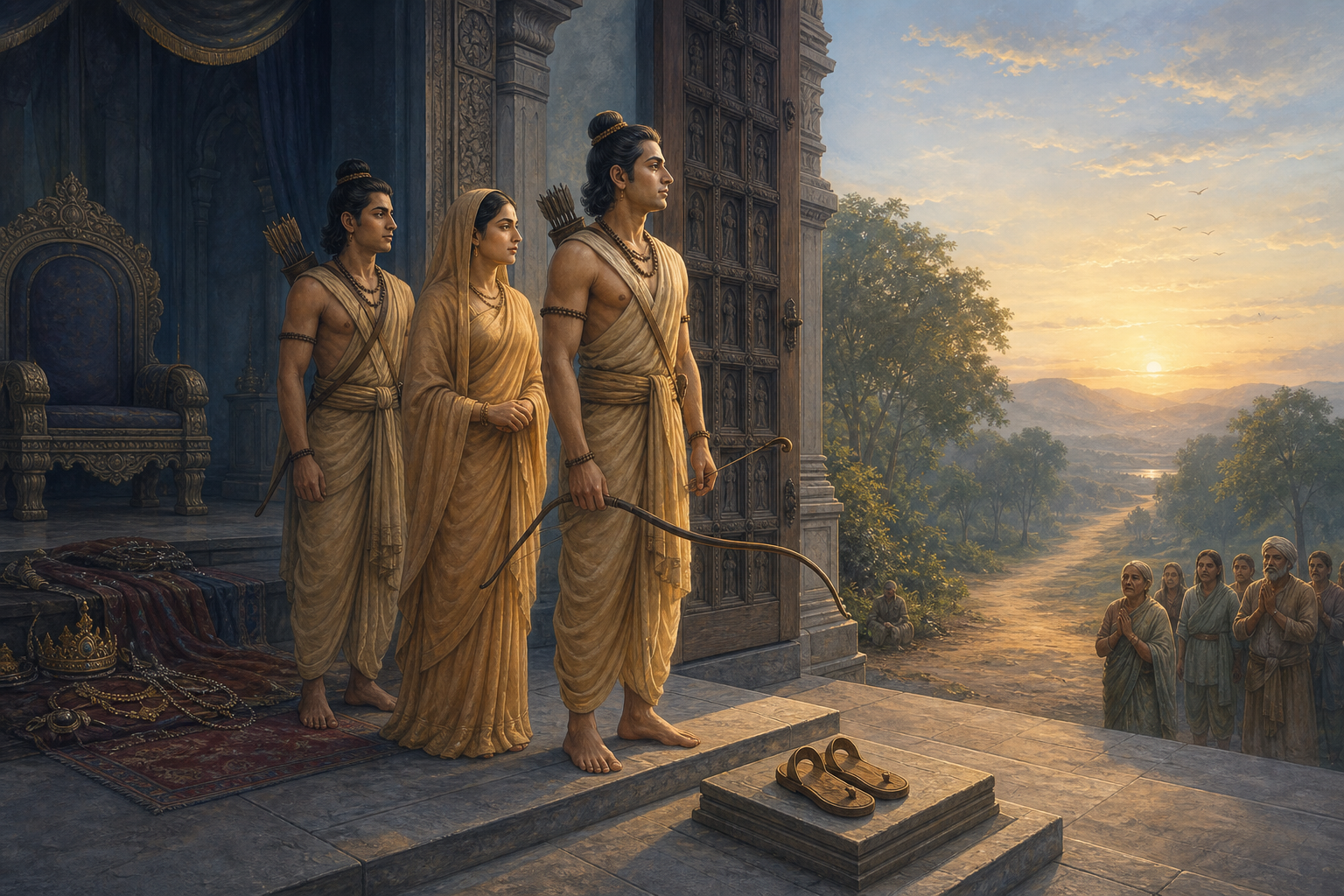
Maryada Purushottama is sometimes reduced to a picture of perfect control. Maryada actually directs attention to bounds: the lines created by duty, promise, role, kinship, and moral order. Rama is exemplary because he acts within those bounds even when obedience costs him personally.
The Valmiki Ramayana makes this demanding rather than effortless. Rama grieves, deliberates, becomes angry, seeks counsel, and faces conflicts in which personal affection and royal obligation do not align. His humanity keeps rajadharma from becoming an abstract theory. You see what duty costs when the person performing it does not escape pain through omniscience or emotional detachment.
That portrayal gives you a practical test for authority. Be suspicious whenever your interpretation of duty protects all your preferences while transferring every cost to someone else. Rama’s moral world does not promise that the right decision will always feel clean. It does require the decision-maker to accept limits and to recognise the burden created by the choice.
The difficult episodes must remain inside this conversation. The killing of Vali from concealment, Sita’s Agni Pariksha, and her later banishment have generated ethical unease and extensive interpretation. The Shambuka episode also carries textual-historical disputes and is omitted or reframed in some later traditions. Bhakti does not require you to pretend that these questions are trivial.
Nor should every royal act in an epic be copied as a timeless procedure. An exemplar gives you virtues, tensions, and consequences through which to reason; an exemplar is not a mechanical instruction manual. You can revere Rama while asking what an episode reveals about public trust, the vulnerability of the innocent, the danger of social suspicion, and the terrible pressure placed on a ruler who identifies personal honour with public order.
When you face a conflict between role and affection, use this decision discipline:
- Name the duties separately. Do not hide competing obligations inside a vague appeal to dharma. Write down what you owe to family, institution, truth, and affected people.
- Separate principle from reputation. Ask whether you are protecting a genuine moral obligation or merely avoiding criticism.
- Locate the involuntary cost. Identify who will suffer without having chosen the sacrifice. Give that person’s interests real weight.
- Apply the rule beyond your own side. A standard that excuses allies and punishes opponents is loyalty disguised as justice.
- Accept your share of the burden. If authority gives you the benefit while everyone below you absorbs the cost, your decision has failed the test of seva.
- Remain answerable after acting. Rajadharma does not end when an order is issued. Watch the consequences and correct what can be corrected.
This method will not eliminate every moral conflict. It will prevent the language of Rama-rajya from becoming a decorative cover for convenience, domination, or nostalgia.
Bhakti makes royal dharma personal without making it private
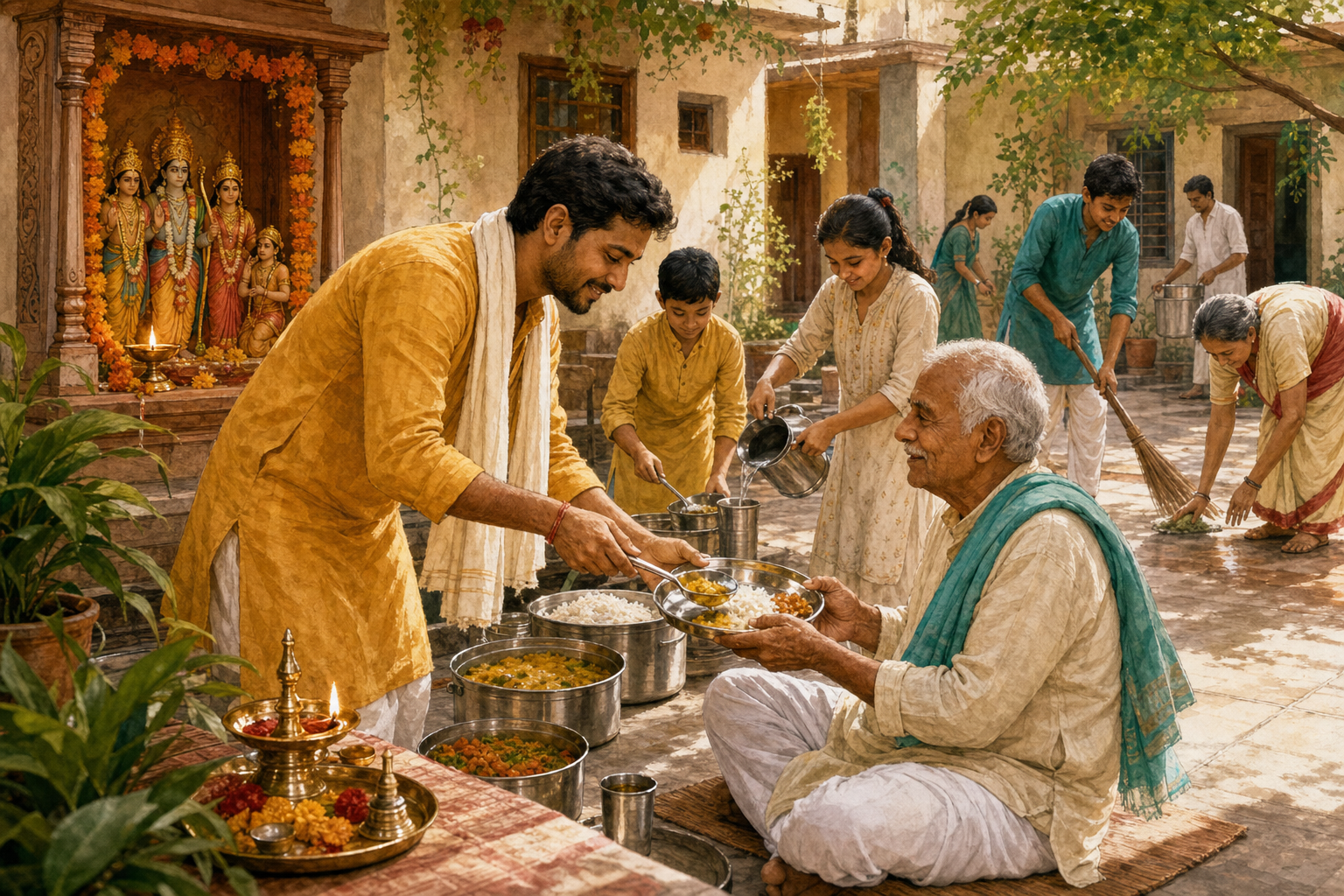
A king in an ancient capital can remain distant. A Rama addressed by name, sung to in the home, carried through the street, and remembered during distress becomes morally present. That is one of bhakti’s great transformations: it moves Rama’s dharma from admiration at a distance into a relationship capable of shaping conduct.
The historical movement from Valmiki’s ethically demanding royal hero to the explicitly divine and compassionate Rama of later traditions did not simply erase kingship. It changed how people entered it. The Tamil Alvars and Sri Vaishnava teachers emphasised surrender and divine compassion. Kamban’s 12th-century Ramavataram joined royal dharma to Rama’s divine purpose. The Adhyatma Ramayana turned the journey inward, presenting Rama in relation to both saguna and nirguna Brahman. Tulsidas’s 16th-century Ramcharitmanas placed Rama’s compassion, maryada, and Rama-rajya within an accessible vernacular culture of household and congregational devotion.
These are not interchangeable lenses. They can serve different spiritual needs:
- If you are facing a hard ethical decision, read a Valmiki episode slowly enough to notice grief, counsel, conflicting roles, and consequences. Do not rush straight to a defence of the final action.
- If guilt, helplessness, or pride is preventing honest surrender, a bhakti retelling can direct attention to daya and prapatti: grace does not depend on pretending that you are self-sufficient.
- If your central struggle is inward distraction, the Adhyatma approach lets separation, exile, recovery, and return become a map of the soul’s movement toward its source.
- If your family needs a shared practice rather than a solitary interpretation, Ramcharitmanas recitation, Sundara Kanda parayana, Rama-katha, or kirtana gives several generations a common devotional language.
The point is not to select the version that makes every discomfort disappear. It is to select the form of engagement that makes you more truthful, compassionate, and ready to serve. A reading that produces only certainty about other people’s faults has not yet become bhakti.
Bhadrachalam shows how this interior formation becomes communal. Vedic and Ramayana recitation, Rama-nama, processions, and the songs associated with Bhakta Ramadasu bring shravana, kirtana, and smarana together: hearing, singing, and remembrance. Hanuman’s presence adds the indispensable movement into seva. Devotion ripens when the name remembered in worship interrupts anger, vanity, or cowardice at the moment of action.
This also explains why Rama travels across the Dharmic family without forcing every tradition into one theology. The Buddhist Dasaratha Jataka presents Rama as a Bodhisattva associated with compassion, renunciation, and right conduct. The Jain Paumacariya preserves Rama as an exemplar of ahimsa by having Lakshmana, rather than Rama, kill Ravana. In the Guru Granth Sahib, Ram can signify the all-pervading One beyond form. The shared ethical vocabulary is real, but so are the doctrinal differences. You honour Dharmic unity more faithfully by recognising both.
For a mixed audience or inter-Dharmic gathering, begin with the virtue being cultivated rather than claiming that all traditions tell the same story. Compassion, self-restraint, truth, remembrance, and service provide genuine meeting points. Uniformity is unnecessary.
Build your observance around one accountable duty
You do not need to reproduce a temple Brahmotsavam at home. Temple rites follow Agamic disciplines, authorised priests, established murtis, and a local calendar. A household observance should be simpler and honest about what it is: a way of bringing your attention, relationships, and conduct into Rama’s presence.
A practical Navami-to-Dasami pattern
- Confirm the observance time. Use the panchang followed by your temple or family sampradaya. For Rama-janma worship, give particular attention to the Madhyahna period rather than choosing a time solely for convenience.
- Choose one passage and one practice. Read a portion of the Ramayana, undertake Sundara Kanda parayana, sing a familiar Rama kriti, or perform japa of a Rama name or mantra received in your tradition. Depth is more useful than an overcrowded programme.
- Name one entrusted responsibility. During sankalpa, identify a duty that is presently yours. Make it concrete: complete a delayed obligation, correct an unfair decision, speak truth without humiliation, share work that has fallen on one family member, or keep a promise you have been avoiding.
- Include relationship in the worship. Honour Sita Rama together, and let the Kalyanam prompt a conversation about mutual duties. A family may exchange akshata or sing together, but the meaningful offering is one commitment that reduces neglect or restores trust.
- Give bhakti a form of seva. Do something that serves a person without turning the act into self-display. Choose a task proportionate to your circumstances and complete it instead of making a grand, indefinite pledge.
- Return on Dasami. Light the lamp again and review the named duty. Decide its next action, who can hold you accountable, and when it will be completed. This is your practical Pattabhishekam: placing conduct, not ego, on the throne.
If you attend a public celebration, let the same discipline shape your conduct there. Follow queue instructions, make room for elderly devotees and families with children, keep baggage light, minimise single-use plastic, and treat the riverfront and temple streets as part of the sacred space. Darshan sought through disregard for other devotees contradicts the seva that Rama’s kingship represents.
Use Dasami as a leadership audit
You do not need a throne to exercise consequential power. Parents allocate attention. Employers distribute work and credit. Teachers judge. Volunteers control access. Community leaders decide whose concerns become visible. Even ordinary conversation can grant dignity or take it away.
On Dasami, select one area in which people cannot easily challenge you. That is where your commitment to rajadharma is most revealing. Examine the last decision you made there:
- Satya: Did you state the real reason, including the part that reflects badly on you?
- Nyaya: Would you accept the same rule if you had less status?
- Daya: Did you understand the human cost before deciding?
- Seva: What burden did you personally carry?
- Maryada: Which limit did you refuse to cross, even though crossing it would have been easier?
This is a more demanding use of Rama-rajya than invoking an idealised past. It asks whether truth, justice, compassion, service, and restraint are visible wherever you already possess power.
When the next Rama Navami comes, do not measure the observance only by how much worship you completed. Carry one named obligation from Navami into Dasami, place it under the discipline of bhakti, and finish it. That is where the crowned Rama becomes present in your life.
References
- DharmaRenaissance Blog – Sri Rama Navami 2026 at Bhadrachalam: Timeless Brahmotsavam & Soul-Stirring Sita Rama Kalyanam
- DharmaRenaissance Blog – From Mortal Hero to Sacred Ideal: Rama’s Journey from Valmiki to the Bhakti Age
