
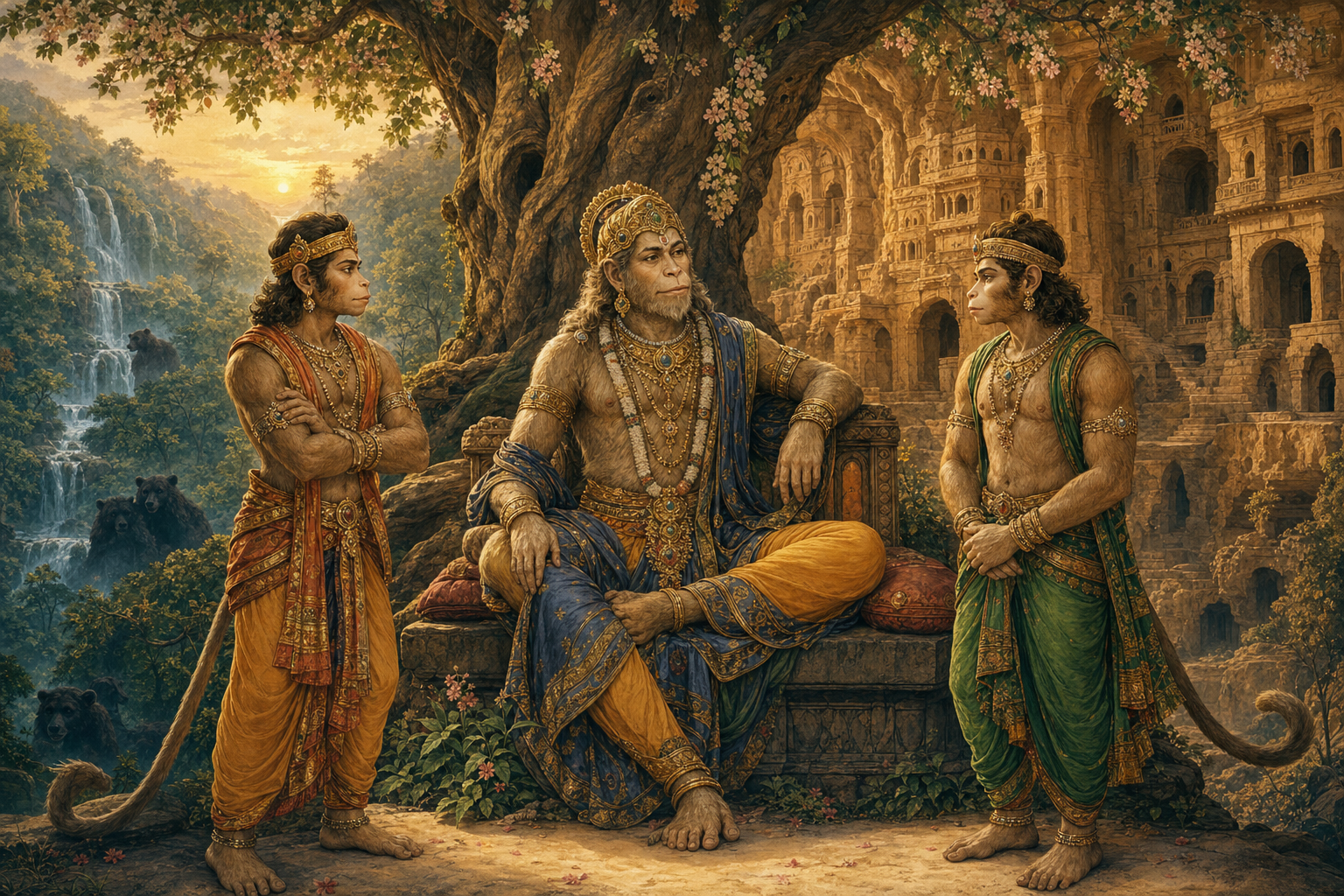
If you have encountered three apparently conflicting claims about Riksharajas – that this figure was the father of Bali and Sugriva, a bear-king, and a parent who temporarily took female form – you do not need to choose one slogan and discard the rest. You need to identify which layer of Ramayana tradition each claim belongs to.
The practical question is not merely, “Is this in the Ramayana?” Ask instead: “In which telling, what kind of parenthood is being described, and which details come from interpretation rather than narration?” Those three questions will let you discuss Riksharajas without flattening a plural tradition or claiming more than a particular telling supports.
The shortest reliable answer
Riksharajas, also rendered Riksharaja, belongs to the genealogy of Kishkindha’s royal house. The Kishkindha Kanda of the Valmiki Ramayana names Riksharaja as the progenitor of Bali and Sugriva. Later narrative streams supply a more elaborate birth account: Riksharajas undergoes a bodily transformation, Indra and Surya become associated with the conception of Bali and Sugriva respectively, and Riksharajas remains the parent who raises them.
These statements are not interchangeable. “Progenitor,” “divine father,” “birth parent,” and “guardian” answer different questions. A responsible explanation preserves those distinctions before drawing conclusions about lineage, gender or royal legitimacy.
Key takeaways
- The Valmiki Ramayana provides the genealogical baseline: Riksharaja is the progenitor of Bali and Sugriva.
- Kamba, Krittivasi and Purana-linked traditions expand the genealogy through transformation and divine-paternity narratives.
- Riksharaja most naturally reflects the Sanskrit riksha-raja, “bear-king”; Vriksharajas reflects a transmitted variant associated with vriksha, “tree.”
- A temporary change of bodily form, the technical term napumsaka, and a modern gender identity are three different matters. They should not be treated as automatic synonyms.
- Across the expanded cycle, Riksharajas matters because parental responsibility continues after the miraculous birth. Care, not anatomy alone, establishes the figure’s place in Kishkindha.
Separate three kinds of parenthood
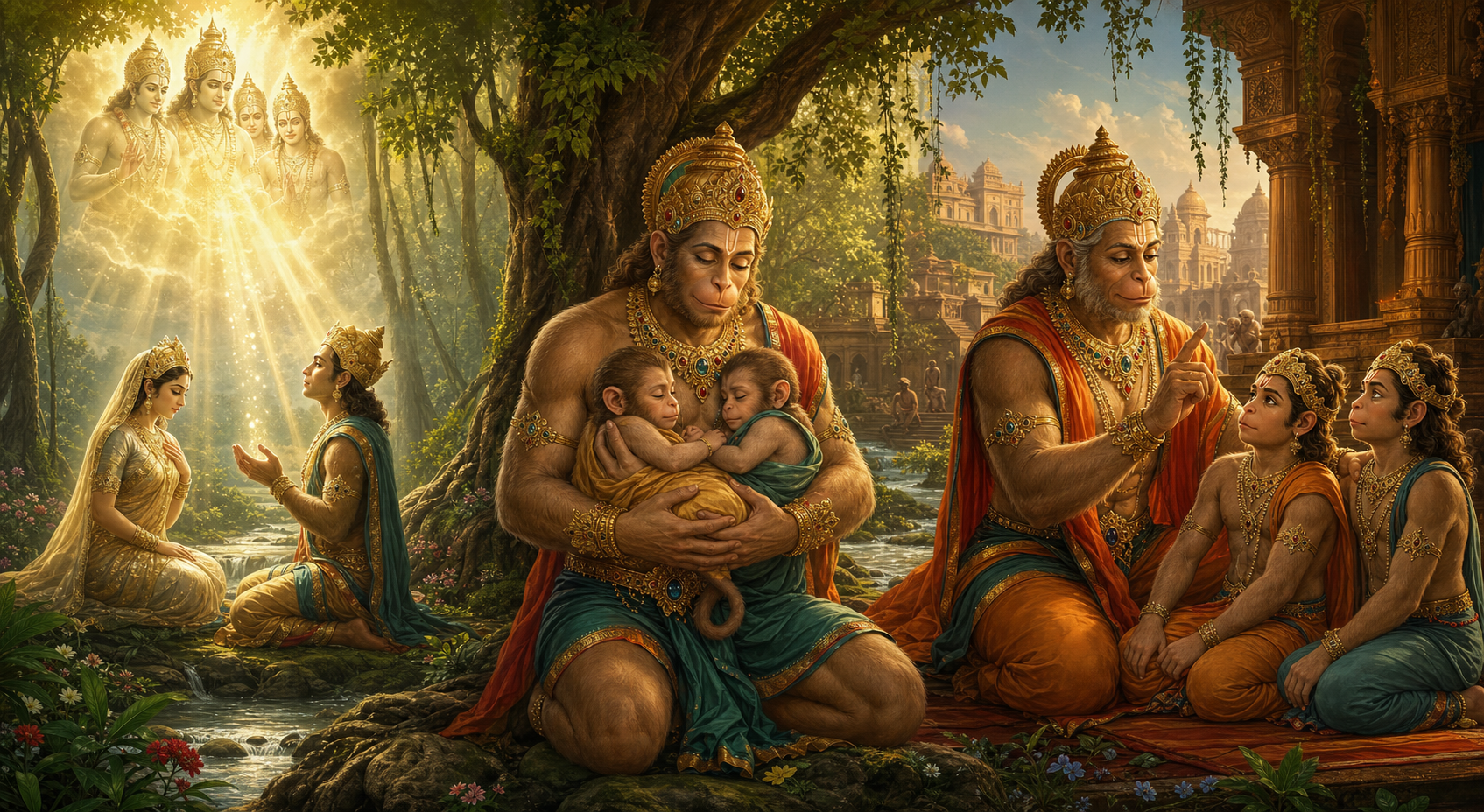
Much of the confusion begins when the English word “father” is expected to carry every part of the genealogy. It cannot. The traditions place at least three forms of parenthood around Bali and Sugriva, and each belongs to a different narrative level.
- Genealogical parenthood: Riksharaja occupies the ancestral position from which both brothers enter Kishkindha’s royal line. This is the safest point to retain when speaking broadly about the Valmiki tradition.
- Divine begetting: Expanded accounts associate Indra with Bali and Surya with Sugriva. This explains the brothers’ exceptional qualities and divine affiliations without necessarily displacing Riksharajas from the parental center.
- Social parenthood: Riksharajas raises and forms the two princes. The relationship therefore continues through protection, instruction and responsibility rather than ending with conception.
In the transformative account, Riksharajas temporarily assumes a female body at a liminal lake. The event may be framed as a curse or a blessing depending on the recension. Conception occurs in that form, and the births are connected with Indra and Surya. Riksharajas later resumes a male form but does not cease to be the parent. The continuity of care is the narrative fact that makes the episode ethically significant.
You can therefore say that Indra and Surya are the divine fathers in the relevant later tellings while also saying that Riksharajas is the progenitor, birth parent or guardian around whom the brothers’ upbringing is organized. There is no need to manufacture a contradiction unless a particular text insists that these roles exclude one another.
There is one further distinction worth keeping. Guardianship in a narrative is not automatically identical to a formally documented adoption under Dharmashastra. Dharmic jurisprudence recognizes adoption, including the datta relationship, and accommodates more than one way of establishing kinship. That wider background helps modern readers understand why care-based parenthood is intelligible within a Dharmic setting. It does not authorize us to assign Riksharajas a specific legal status that the telling itself does not name.
When you introduce this genealogy to someone else, use “progenitor and guardian” as the broad description. Add “birth parent” or “divine fathers” only after identifying the relevant narrative stream. This small discipline prevents a regional elaboration from being presented as though every Ramayana recension narrates it in the same way.
Read the name before deciding between bear and tree

The spelling is not a decorative detail. In Sanskrit, riksha means “bear,” so riksha-raja means “bear-king.” Vriksha, by contrast, means “tree.” The forms Riksharaja, Riksharajas and Vriksharajas can look almost identical after transliteration, copying and oral transmission, but the added consonant changes the apparent meaning.
Riksharaja is the form favored by most critical editions and older commentary, and “bear-king” also fits the Ramayana’s inclusion of bear allies such as Jambavan. Vriksharajas nevertheless occurs in regional manuscript and oral settings. A transmitted variant deserves to be recorded; it should not silently replace the more firmly attested form.
Four checks will keep the name from carrying more weight than it can bear:
- Preserve the spelling you actually have. If an edition prints Riksharaja, do not modernize it to Vriksharaja because a tree-based explanation seems attractive.
- Ask whether the spelling belongs to a named edition or an unsourced retelling. A one-letter variant copied through modern summaries is not automatically a separate ancient tradition.
- Do not infer family ties from the title alone. “Bear-king” does not prove that Riksharajas is biologically related to Jambavan.
- Do not turn a lexical observation into historical certainty. The title may indicate an animal identity, a clan designation, an office or a literary classification. The word alone cannot decide among them.
The last point matters because Vanara and Riksha groupings can be read on more than one level. Within the epic world, they belong to its richly imagined forest peoples and allied hosts. A historical reading may see memories of forest communities or inter-clan federations beneath that literary geography. That possibility is useful when thinking about Riksharajas as a mediator between allied groups, but it remains an interpretation, not proof that the Ramayana is secretly using zoological language as a simple code for named historical tribes.
If your immediate purpose is devotional reading or basic identification, “Riksharaja, the progenitor and guardian of Bali and Sugriva” is enough. If your purpose is textual comparison, preserve the Sanskrit distinction between riksha and vriksha and record which recension supplies each form.
Handle the transformation and gender language carefully

Riksharajas is sometimes introduced today with a single modern identity label. That can make the figure seem immediately familiar, but it often merges three separate questions: what happens to the body in the story, which classical category a tradition applies, and how a person would identify in contemporary language.
The bodily event is the clearest part. In the expanded birth narrative, Riksharajas enters or encounters a liminal body of water, assumes a female form, conceives the two children through divine agency, and later returns to a male form. Depending on the version, the change is connected with a curse or a blessing. The precise mechanism and moral tone must therefore be tied to a recension rather than announced as a universal Ramayana detail.
The classical term napumsaka requires even more care. Sanskrit grammatical, legal and social vocabularies did not always divide embodied life into only two modern categories. Napumsaka could cover a range of meanings that translators may render as neuter, androgynous, third-gender or neither conventionally male nor female. Its force depends on genre and context. No single English label reproduces every classical use.
- Metamorphosis describes a narrative event. It tells you that bodily form changes within the story.
- Napumsaka is a context-dependent classical category. Its occurrence does not by itself settle how that body or social position should be translated.
- A contemporary gender identity describes a person’s enduring self-understanding within a modern vocabulary. Assigning one retrospectively requires an argument, not just a visual similarity between categories.
This distinction protects the tradition in two directions. It prevents the transformation from being erased because it complicates a rigid account of gender, and it prevents an ancient figure from being recruited too confidently into a present-day category. You can recognize genuine gender complexity without pretending that Sanskrit terms and modern identities correspond word for word.
Other Dharmic images and narratives – Ardhanarishvara, Shikhandi and Arjuna’s Brihannala phase among them – show that variation in embodiment was not foreign to the sacred imagination of Bharat. They are not interchangeable examples, however. Ardhanarishvara expresses a theological unity of Shiva and Shakti; Shikhandi and Brihannala have their own narrative settings; Riksharajas belongs to the genealogy of Kishkindha. Comparison can reveal a civilizational capacity to contemplate embodiment beyond a crude binary, but comparison should not dissolve the characters into one generic category.
The most defensible ethical conclusion is also the least sensational: Riksharajas’s authority as a parent survives a change of bodily form. The story locates parental dharma in sustained responsibility. That does not make anatomy irrelevant to the birth episode; it means anatomy does not exhaust the meaning of kinship.
Caregiving belongs to the political history of Kishkindha

Riksharajas can look peripheral if you count only battlefield appearances. The figure becomes central when you trace causes rather than page space. Bali and Sugriva inherit power, enter a devastating fraternal conflict, and determine whether Kishkindha can become Rama’s ally. The person who forms those brothers stands upstream of that political history.
Later interpretive portraits associate the princes’ formation with physical discipline, forestcraft, martial skill and counsel. These details should not all be represented as a verbatim curriculum from the Valmiki Ramayana. Their value is explanatory: royal ability is formed before it is tested. Strength without discipline becomes dangerous; prudence without courage becomes ineffectual; loyalty without judgment can serve adharma as readily as dharma.
The divine affiliations sharpen that contrast. In symbolic readings, Bali’s connection with Indra evokes sovereignty and immense martial force, while Sugriva’s connection with Surya evokes illumination, order and discernment. Treat these as interpretive associations, not equations that explain every decision either brother makes. Bali is not merely “Indra-energy,” and Sugriva is not automatically righteous because he is linked with Surya.
What the genealogy does establish is complementarity. Kishkindha needs power, judgment, loyalty and the capacity to negotiate reciprocal protection. Sugriva’s later alliance with Rama joins those capacities to a larger dharmic purpose: finding Sita and mobilizing the Vanara forces. Riksharajas’s parental role provides an ethical way to understand that political infrastructure. A kingdom is prepared not only through coronations and battles, but through the long formation of those who will command it.
This is where the story becomes practical for a reader who is not resolving a philological debate. The elder who teaches without seeking a throne, the adoptive parent whose fidelity gives a child social confidence, and the mentor who disciplines talent before it becomes power all perform civilizational work. Their influence may be difficult to see at the moment it is exercised. Its consequences appear later, when a community faces exile, succession, conflict or alliance.
How to read or teach the episode without overclaiming
- Write down the exact claim. “Riksharaja is the progenitor of Bali and Sugriva” is not the same claim as “every Ramayana narrates their miraculous conception.”
- Name the textual layer. Distinguish the Valmiki genealogical baseline from Kamba, Krittivasi and Purana-linked elaborations. If you do not know the recension behind a detail, say “in later traditions” rather than guessing.
- Label interpretation as interpretation. A lake as a symbol of liminality, Indra as sovereign force, Surya as clarity, or Vanara society as a historical confederation can illuminate the narrative. None should be smuggled in as an uncontested textual statement.
- Keep vocabulary proportional to the evidence. Use napumsaka when discussing the classical category, “temporary female form” for the described transformation, and modern identity terms only when making an explicit comparative argument.
- Return to narrative consequence. Ask what the detail changes. Here it changes how you understand parenthood, the formation of Bali and Sugriva, and the foundations of Rama’s eventual alliance with Kishkindha.
A careful three-sentence retelling you can use: Riksharaja is remembered in the Ramayana tradition as the progenitor and guardian of Bali and Sugriva. Some later tellings explain their births through Riksharajas’s temporary transformation and divine paternity associated with Indra and Surya. Since these details vary by recension, their shared ethical center is the parental responsibility through which the princes of Kishkindha are formed.
The next time you meet a dramatic claim about Riksharajas, place the name of the telling beside it before accepting or rejecting it. Then ask whether the claim concerns genealogy, embodiment, divine affiliation or upbringing. That habit takes only a moment, but it turns a culture-war slogan back into serious engagement with the Ramayana’s layered inheritance.
References
