
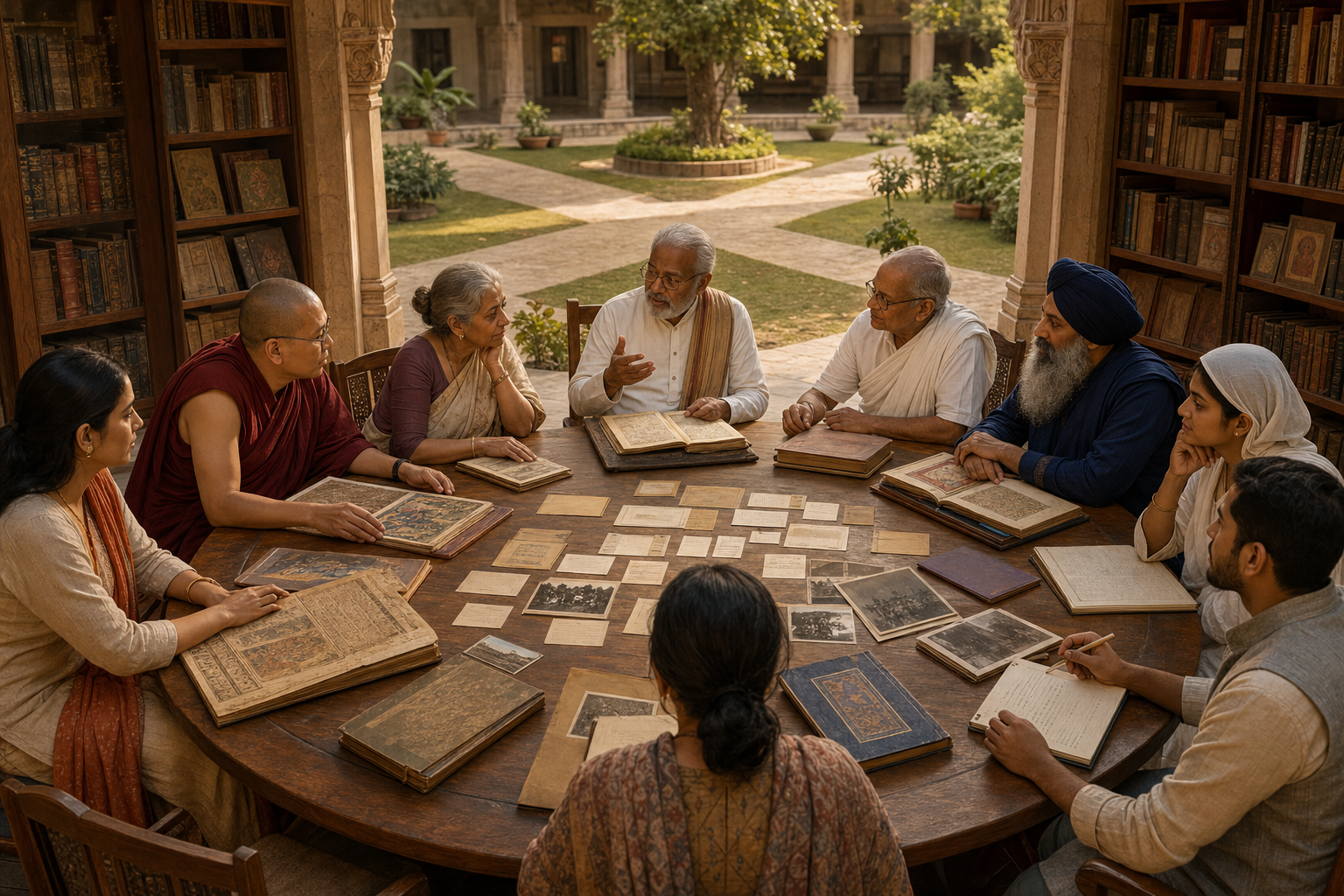
You want Hindu, Buddhist, Jain, and Sikh communities to recognize their civilizational kinship. Yet you may also worry that a unity program will flatten real differences, turn sacred traditions into slogans, or give the loudest speaker authority they haven’t earned.
That tension is healthy. Cultural unity becomes credible when scholarship makes each tradition more intelligible, not less distinct. The practical task is to create encounters in which people study carefully, speak truthfully, serve together, and leave able to represent their neighbors fairly.
Compare relationships, not isolated religious words
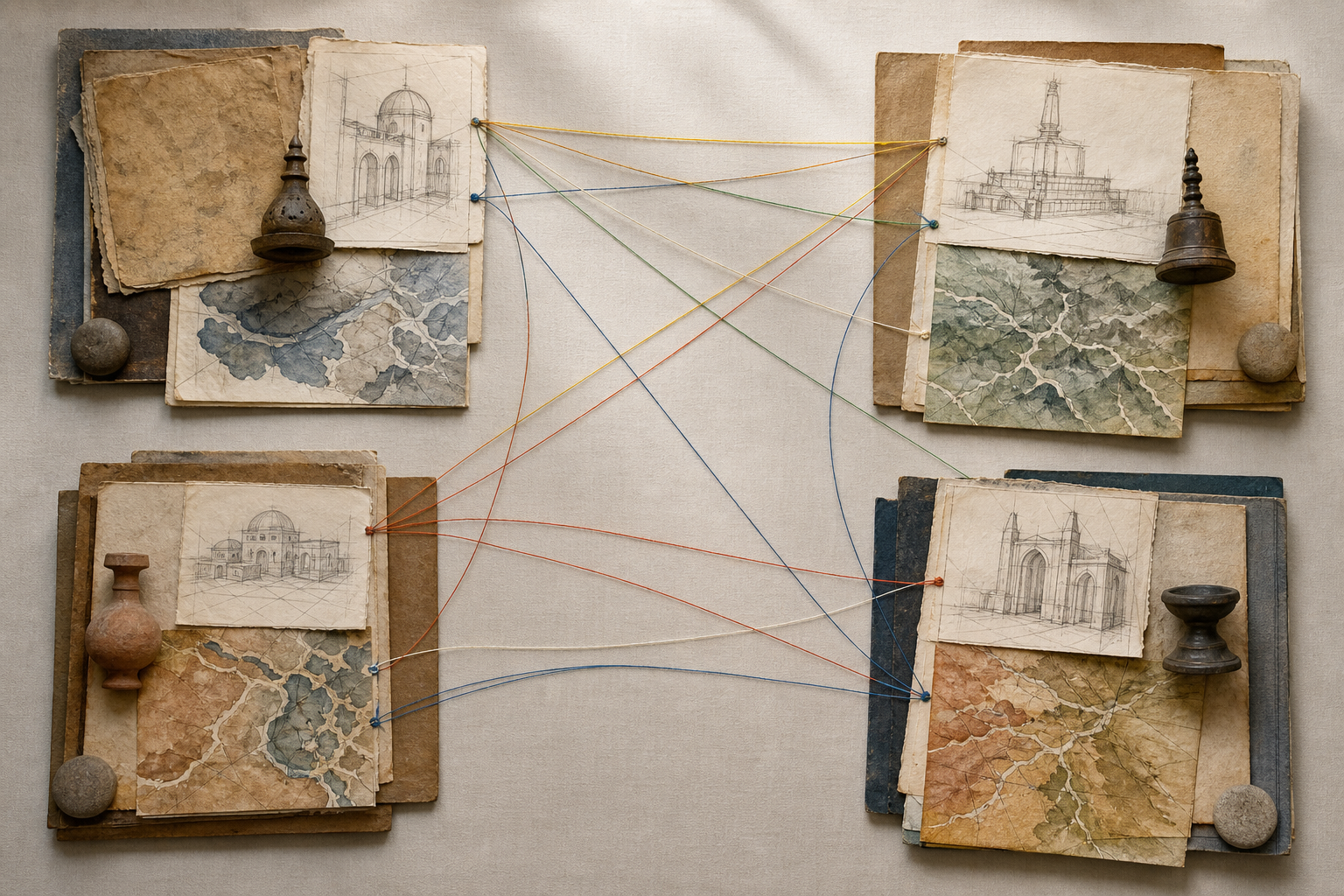
Dharmic traditions share an ethical neighborhood. Truthfulness, compassion, restraint, non-harm, disciplined practice, and service recur across Hindu, Buddhist, Jain, and Sikh life. Their historical learning cultures also joined intellectual work to character formation through gurukulas, pathshalas, mathas, viharas, commentarial lineages, sangats, and gurdwaras.
But a shared ethical concern does not make every doctrine interchangeable. Ahimsa has an especially exacting place in Jain ethics. Buddhist karuna operates within teachings concerned with suffering, conduct, and liberation. Hindu accounts of dharma and lokasangraha emerge through multiple schools and scriptural lineages. Sikh seva is inseparable from remembrance, truthful labor, sangat, and the social discipline embodied by langar. The family resemblance matters, and so do the differences.
The common mistake is to compare English nouns. Two passages may both contain the word “compassion” while locating its meaning in different views of the self, agency, liberation, obligation, and community. Translation can reveal a connection, but it can also conceal the conceptual structure underneath it.
For every term you compare, record the following:
- The original term and script. Preserve Sanskrit, Pali, Prakrit, Gurmukhi, or another relevant language alongside transliteration.
- The textual location. Name the work, passage, edition, and translation. A floating quotation cannot carry serious interpretation.
- The lineage or interpretive setting. A Vedantic reading is not automatically the Hindu reading, just as one Buddhist, Jain, or Sikh commentator cannot exhaust a whole tradition.
- The practice attached to the idea. Ask what a practitioner is expected to do, refrain from doing, remember, contemplate, or cultivate.
- The boundary of the comparison. State where the traditions converge, where they diverge, and where the available evidence does not justify a conclusion.
This discipline protects unity from two opposite failures. Sectarian polemic exaggerates difference until relationship becomes impossible. Sentimental universalism erases difference until relationship becomes meaningless. Good scholarship refuses both.
Jain anekantavada is particularly useful here when applied with precision. Many-sided reasoning does not mean that every claim is equally true. It asks you to recognize the standpoint and limits of a statement, while syadvada encourages appropriately qualified claims. In a shared forum, that means saying, “From this text and interpretive lineage, we can establish this much,” rather than declaring a final verdict on another community.
Use five disciplines to keep learning tied to dharma

A reading group can accumulate information and still deepen vanity, factionalism, or suspicion. A more reliable model joins vidya, sadhana, seva, sangha, and shraddha. These are not decorative Sanskrit labels. Each corrects a predictable weakness in cultural work.
- Vidya: study with structure. Begin with a bounded question, relevant primary passages, responsible translations, and commentarial guidance. Distinguish textual evidence from historical reconstruction, inherited interpretation, and your own inference. If those categories blur, confidence will outrun knowledge.
- Sadhana: respect the practiced life of an idea. Dharmic knowledge is not merely material to extract from a text. Ask how recitation, meditation, ethical vows, simran, kirtan, pratikraman, samayik, bhakti, or another discipline forms the person who receives the teaching. Participants need not imitate practices outside their commitments. They do need to understand that doctrine and disciplined life illuminate each other.
- Seva: make learning answerable to a human need. Turn a seminar into a useful glossary, a script class, free tutoring, a searchable transcription, an oral-history collection, a library catalog, or an accessible reading guide. Service reveals whether scholarship can clarify and preserve something beyond the scholar’s reputation.
- Sangha: submit interpretation to other minds. Include a language specialist, a person familiar with the relevant lineage, a careful editor, and members of the community being represented. Peer review tests reasoning; community review catches descriptions that may be technically polished but unrecognizable to practitioners.
- Shraddha: build trust through intellectual conduct. Cite what you used, mark uncertainty, correct errors publicly, and interpret an opponent’s position in its strongest recognizable form. Faithfulness here means honesty, restraint, and compassion rather than immunity from questioning.
The five disciplines work as checks on one another. Vidya without humility becomes display. Sadhana without examination can harden into untested certainty. Seva without learning may repeat errors. Community without review can reward conformity. Conviction without restraint can turn a discussion about dharma into an exercise in domination.
You can therefore diagnose a struggling initiative by asking which discipline is missing. If meetings generate heat but no reliable material, strengthen vidya and review. If the work is meticulous but reaches nobody, add seva and public access. If participants know facts yet caricature one another, repair the discussion ethic before expanding the curriculum.
Build a study project around one answerable question

“Dharmic unity” is too large to function as a syllabus. A useful project begins with a question narrow enough to investigate and important enough to change how participants act. You might examine how disciplined non-harm shapes speech, how remembrance becomes service, or how different traditions connect learning with humility.
Use the following workflow for a community course, conference panel, youth program, or independent study circle:
- Write the question before choosing speakers. This prevents the program from becoming a collection of unrelated presentations or a contest among personalities.
- Define the scope honestly. State which periods, languages, texts, sects, and communities you can address. Do not use “Hindu,” “Buddhist,” “Jain,” or “Sikh” as if each named one internally uniform position.
- Assemble a source packet. Where relevant, include primary passages, a declared translation, brief historical framing, and selected commentary. Label modern interpretation as modern interpretation.
- Add a language lane. Show the original script, transliteration, a literal gloss where useful, and the smoother interpretive translation. Participants can then see where an English rendering has already made a philosophical choice.
- Adopt a discussion covenant. Require participants to distinguish fact, inference, interpretation, and devotional conviction. Before criticizing a position, they should restate it in terms its adherents could recognize.
- Create a public output. Produce an annotated reading list, recorded lesson with captions, bilingual glossary, teaching module, archive description, or community service connected to the theme.
- Invite correction before publication. Ask knowledgeable readers from the represented traditions to flag missing context, mistranslation, false equivalence, and claims that exceed the evidence.
Do not force every tradition into every question. Equality of dignity is not the same as symmetry of evidence. A project becomes less inclusive, not more, when it invents a parallel teaching merely to complete a neat chart. Say when a comparison is illuminating, when it is partial, and when it should not be made.
Watch for the failure modes that sound most agreeable
The most damaging errors are not always openly hostile. Some arrive in language that sounds generous:
- “Every tradition teaches the same thing.” Shared virtues do not erase different accounts of reality, liberation, authority, or practice.
- “This quotation proves the tradition’s position.” A passage without genre, context, commentary, and translation history rarely bears that weight.
- “The English term is neutral.” Words such as self, faith, duty, meditation, and liberation can hide major interpretive decisions.
- “A representative has spoken for the community.” A speaker can offer a situated account, not ownership of every internal school and historical period.
- “Service makes accuracy less important.” Good intentions do not repair a mistranslated teaching, a corrupted transcription, or a misleading archive record.
A facilitator should interrupt these moves calmly and ask for a narrower claim. That is not pedantry. It teaches participants how to disagree without misrepresentation.
Make the scholarship usable after the gathering ends
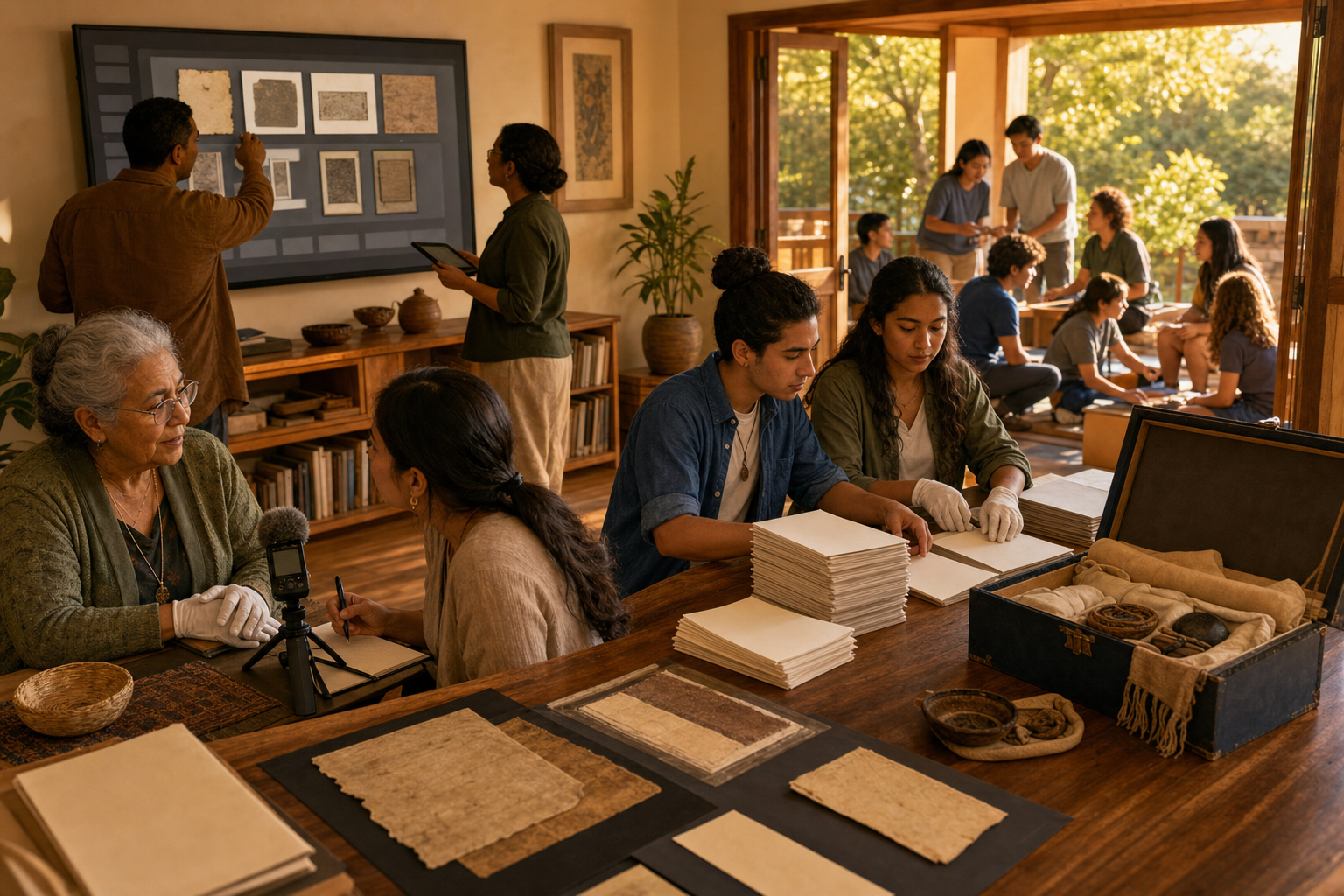
A conference, launch, or study circle can create genuine enthusiasm and still leave no durable cultural inheritance. The difference lies in what happens to the text, recording, glossary, or curriculum afterward. Preservation begins before publication, not when files become difficult to find.
Preserve the text as text
For Gurmukhi and other Indic scripts, keep the original script in Unicode rather than treating a page image as the final digital object. Declare the transliteration system, normalize text consistently, embed appropriate fonts where the format requires it, and retain a searchable layer in the PDF. A responsive EPUB serves readers on smaller devices.
Optical character recognition should be audited against representative pages before it becomes part of a public corpus. Script quality, damaged print, unusual type, and mixed-language pages can all affect recognition. Never allow unreviewed OCR to masquerade as a reliable edition.
Give future readers enough information to find and judge it
A book or digital collection needs more than a title and upload button. Depending on the format, use an ISBN for a volume, DOI identifiers for suitable chapters or datasets, ORCID identifiers for contributors, and library-ready records using standards such as ONIX 3.0, MARC 21, or Dublin Core. Record the edition, language, script, contributors, rights, publication state, and correction history.
FAIR principles offer a useful test: can the material be found, accessed under clear conditions, exchanged through workable formats, and reused without guessing what it is? A versioned repository and an explicit license make later correction and teaching use far safer than circulating unlabeled files through private message threads.
Design access as part of scholarship
Accessibility is not a layer to add after the intellectual work. Use structural headings, meaningful link text, alt text for informative images, captions or transcripts for recordings, readable contrast, and navigable document structure. WCAG 2.2 AA, searchable PDFs, responsive EPUB files, audio options, transliteration notes, and bilingual summaries provide concrete design targets for reaching readers with different needs and levels of script literacy.
Accessibility should support progression rather than quietly displacing the original language. Side-by-side transliteration can welcome a beginner; an advanced pathway should help that learner acquire the script itself. This matters because Sanskrit, Pali, Prakrit, Gurmukhi, and other Indic languages do more than carry interchangeable content. Their vocabularies and grammatical distinctions shape what a reader is able to notice.
Measure transmission rather than applause
Attendance tells you whether people came. It does not tell you whether knowledge moved into community life. Use a layered set of indicators:
- Immediate uptake: registrations, educator requests, completed script lessons, repository use, and requests for the teaching material.
- Continued use: reading circles formed, library holdings, citations, syllabus adoption, corrections submitted, and reuse by community educators.
- Cultural continuity: sustained language-learning cohorts, preserved oral histories, improved local catalogs, mentored translators, and new archival or service projects.
We would judge a unity initiative by a harder standard than visibility: can participants explain a neighboring tradition more accurately, can learners reach the relevant texts more easily, and has the work created something trustworthy that another community can use?
Key takeaways
- Build unity through accurate relationship, not claims that all Dharmic traditions are doctrinally identical.
- Compare original terms, textual settings, interpretive lineages, lived practices, and the limits of each parallel.
- Join vidya, sadhana, seva, sangha, and shraddha so that learning produces humility, review, and public benefit.
- Begin with a bounded question and finish with a useful output that knowledgeable community readers can correct.
- Preserve original scripts, declare translations and transliteration, audit OCR, document versions, and design for accessibility.
- Measure success through durable learning, language transmission, archives, mentorship, and service rather than event visibility alone.
Your next step is to choose a question that matters locally and an output your community can actually use. Name the traditions and lineages you can represent responsibly, invite the right readers to challenge the work, and publish the result in a form that can be corrected and preserved.
Cultural unity becomes real when a Hindu, Buddhist, Jain, or Sikh participant can leave the encounter rooted in their own tradition, more accurate about the others, and better equipped to serve alongside them. That is a demanding standard. It is also one worth building for.
References
- DharmaRenaissance Blog – From Humble Beginnings to Enduring Eminence: Scholarship, Faith, and Dharmic Unity
- DharmaRenaissance Blog – World Punjabi Conference 2026, Ludhiana: A Landmark Book Release Uniting Dharmic Heritage
