
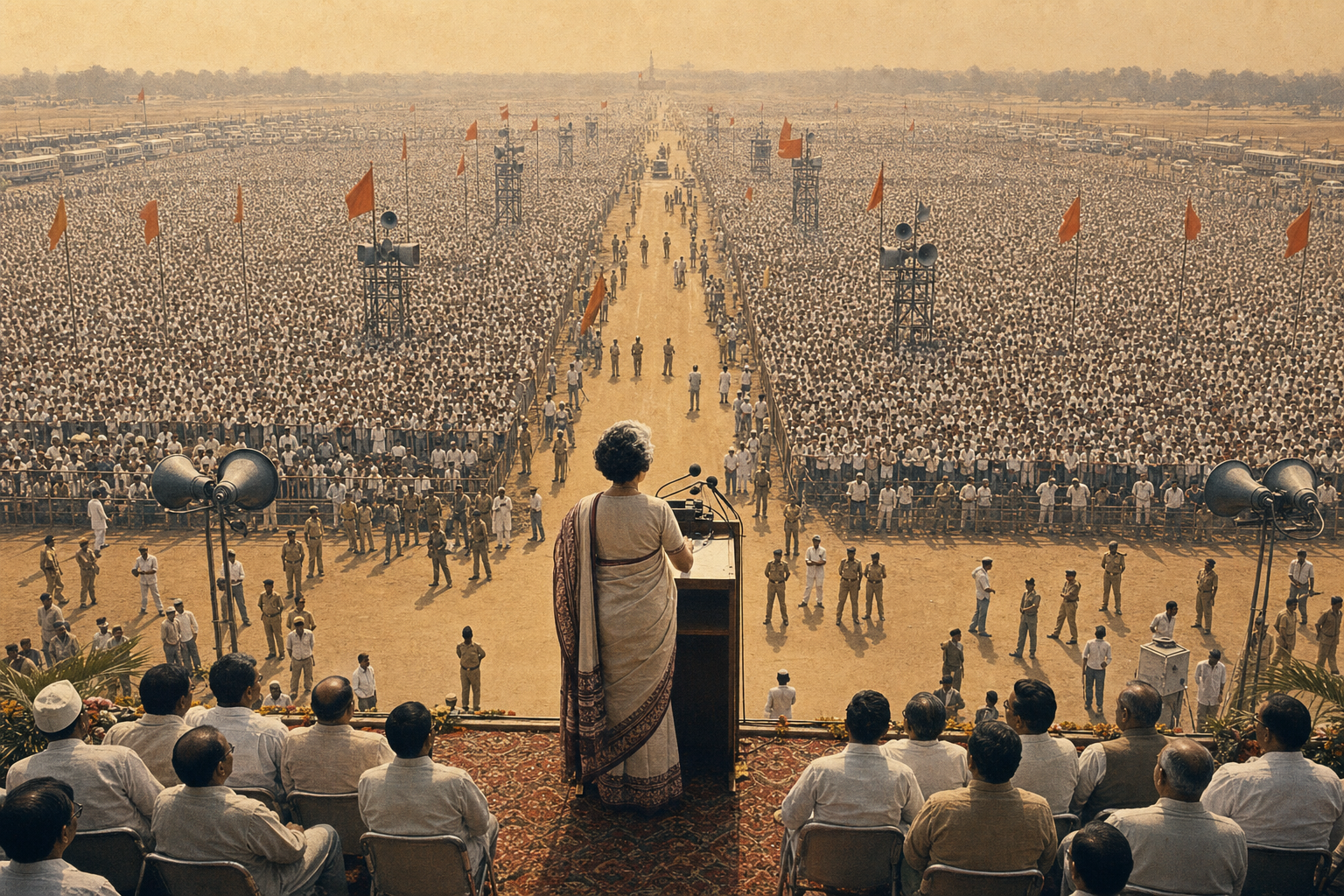
You see an archival photograph of a packed maidan: buses at the perimeter, flags above the crowd, a leader alone at the centre of the stage. The tempting conclusion is that the image proves overwhelming popular support. It may show real enthusiasm, but the image alone cannot tell you how that enthusiasm was assembled, directed or converted into political authority.
Indira Gandhi’s career is a particularly revealing case because mass rallies accompanied both democratic triumph and constitutional overreach. If you learn to separate organization, persuasion and consent, you can understand her politics without either dismissing voters as gullible or treating a cheering crowd as a blank cheque.
The crowd was evidence, but not the evidence it seemed to be
A mass political spectacle is more than a large meeting. It is an organized attempt to make scale, sound, symbols and synchronized response communicate a single proposition: this leader embodies the people and carries history’s momentum. That proposition may reflect genuine support, careful production or, as is usually the case, some combination of both.
The distinction matters when reading Indira Gandhi’s rise. The 1969 Congress split concentrated authority around her, while the 1971 ‘Garibi Hatao’ campaign and landslide Lok Sabha victory demonstrated the electoral force of a direct, leader-centred appeal. A complicated conflict inside a political organization could now be narrated as something morally simpler: an established order stood in the way, while the leader spoke directly for the poor.
This did not make every element of the appeal fictitious. Policies such as bank nationalization supplied a record on which supporters could build a claim of resolve. In later rallies, the outcome of the 1971 war strengthened the image of decisive leadership. Spectacle worked because it attached those recognizable acts to a larger emotional conclusion: competence in particular decisions became trust in the person.
When you encounter a rally image, therefore, separate three claims that the staging encourages you to merge. The crowd can demonstrate organizational reach. Its response can demonstrate enthusiasm among those present. Neither fact, by itself, establishes nationwide agreement, validates every policy or grants permanent moral authority. Treat each visible fact as evidence only for the narrow proposition it can actually support.
How the rally manufactured a direct bond
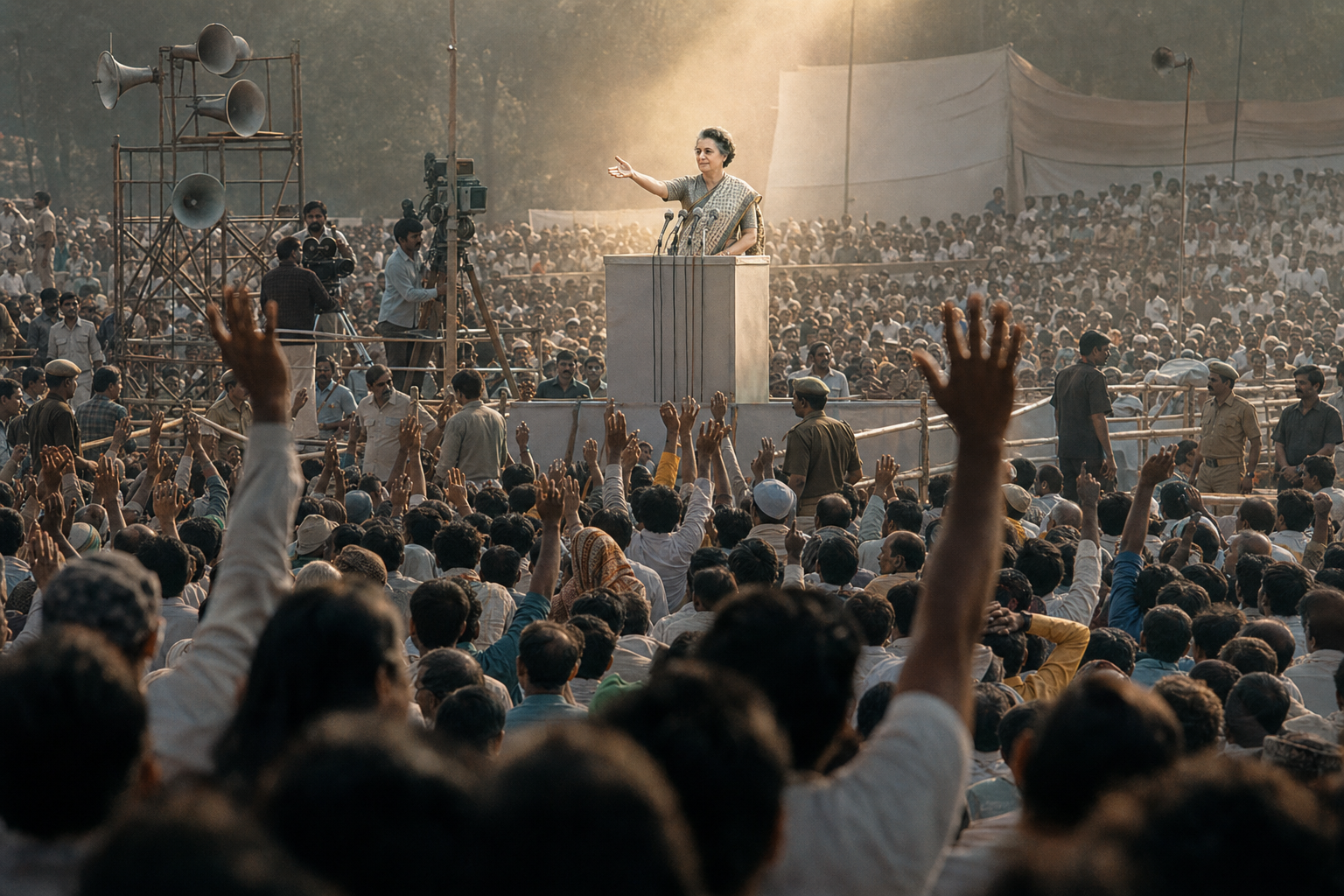
The decisive political work began before Indira Gandhi reached the microphone. Local committees and allied organizations arranged buses, guided people into designated areas and coordinated a sequence of speakers. Posters, handbills and loudspeaker vans established the message before the main event. The elevated dais, banners and backdrop then turned the venue into a visual argument about authority, unity and momentum.
- Recruit: Local networks identify supporters and make attendance physically possible through transport and coordination.
- Prime: Repeated slogans, posters and announcements tell participants what the occasion means before they arrive.
- Arrange: Crowd zones, sightlines, banners and the dais establish who is central and who is watching.
- Escalate: Preliminary speakers build grievance, hope and expectation until the principal leader appears as the answer.
- Extend: Newspapers, photographs and broadcast coverage carry the produced image to people who never attended.
This sequence helps explain why the final address has more persuasive force than the same words printed on a page. Stories and images of poverty create pathos. A record of major decisions creates ethos. A compact set of promises provides enough logos to make the moral appeal sound programmatic. Vernacular phrases, rhythmic delivery and call-and-response then invite the audience to participate in stating the message.
Participation is not the same as coercion. A person who accepts a bus ride can still hold an independent political view, and coordinated attendance does not make a crowd ‘fake’. It does mean that headcount measures the strength of a mobilizing network as much as spontaneous public sentiment. That is the precise conclusion you should carry away when an organizer, broadcaster or partisan account presents crowd size as self-explanatory proof.
The order of speakers deserves equal attention. When every earlier address defines the crisis and the final leader alone supplies the resolution, the programme has enacted a political hierarchy before anyone votes. Ask whether ministers, local candidates and party institutions appear as responsible actors, or merely as heralds. A movement that repeatedly makes every road lead to one person is teaching its audience how power ought to be arranged.
A slogan and a symbol can carry more than policy
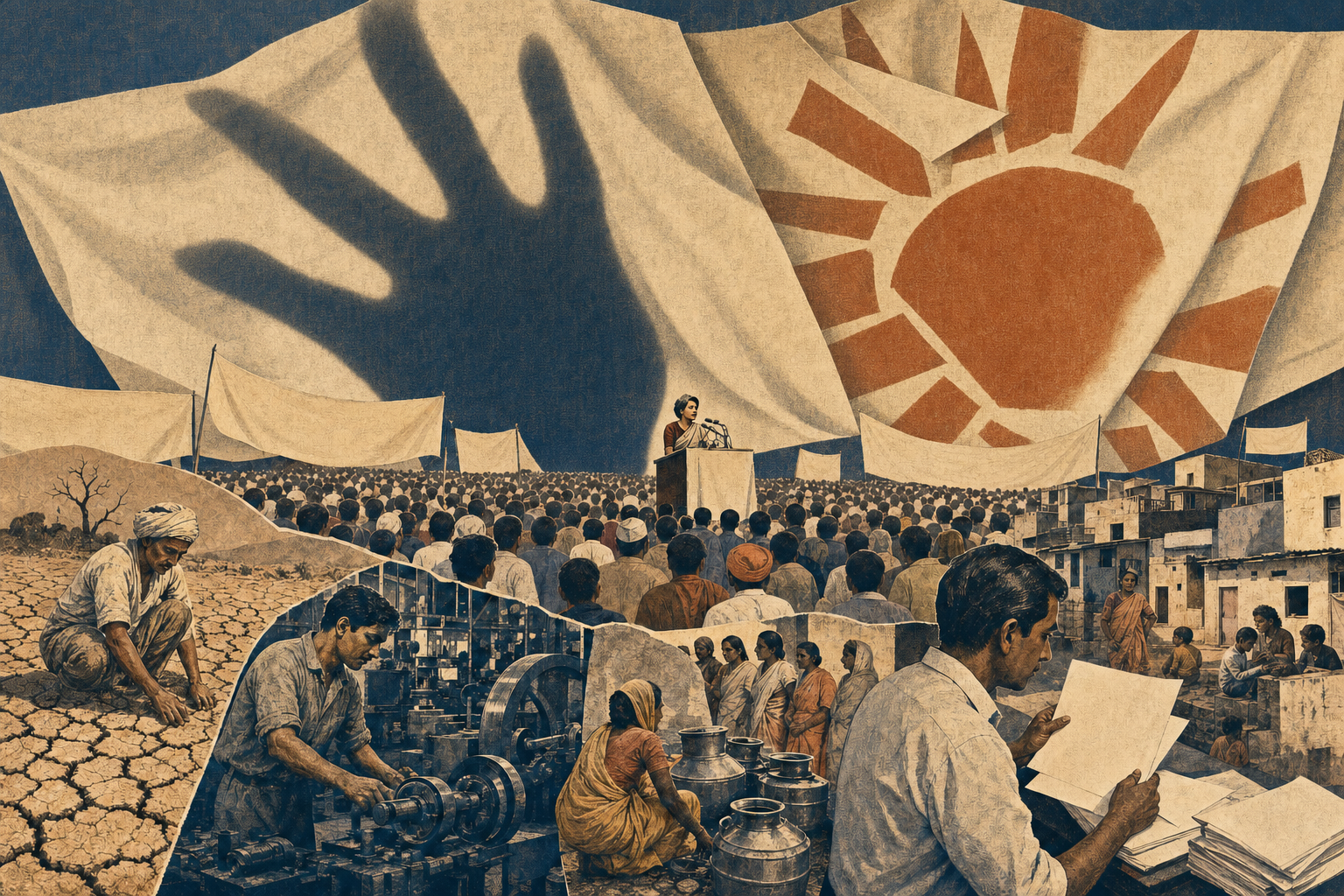
‘Garibi Hatao’ succeeded as political communication because it turned a field of difficult economic questions into a short moral imperative. You did not need to retain a detailed programme to remember which side claimed to stand with the poor. Its brevity was a practical advantage in a vast, multilingual electorate, but it also concealed the distance between naming an injustice and demonstrating that a policy would remedy it.
The most useful way to read such a slogan is to expand it into the questions it compresses. Who will act? What will change? Which institution is responsible? How will delivery be measured? What evidence would show failure? If the political message cannot survive that expansion, the slogan has replaced accountability instead of merely helping people remember a programme.
Visual symbols performed similar work. The cow-and-calf emblem dominated Congress imagery in the early 1970s, while the upright Hand acquired iconic reach after the late 1970s. In a multilingual society with historically uneven literacy, such emblems gave voters a stable mnemonic anchor. That is cognitive economy, not evidence of voter ignorance.
Yet symbols remain politically unstable. To supporters, an open palm could suggest reassurance, assistance and accessibility. To critics, its saturation could represent the reach of a hegemonic party. Narendra Modi’s 2014 phrase ‘Khooni Panja’ inverted the Hand’s reassuring meaning and turned an inherited emblem into an accusation. Once a party invests heavily in a symbol, its opponents can use the same familiarity to attack the legacy attached to it.
That afterlife reveals something important about spectacle. A symbol does not acquire power from design alone. Repeated appearances on stages, flags, ballots and backdrops make it part of political memory. When you see one, translate it into a full sentence: ‘This image asks me to believe that…’ Then compare that implied claim with the party’s conduct. The distance between the two is more informative than the symbol’s intended meaning.
Contemporary campaigns add social-media circulation, rapid-response messaging and digital targeting to this older grammar. A short clip can show the climactic cheer while hiding the recruitment, priming and speaker sequence that produced it. Examine what happened before the recorded frame and how the image was distributed afterward. The missing context is often where organization becomes apparent.
A democratic mandate cannot become a moral blank cheque
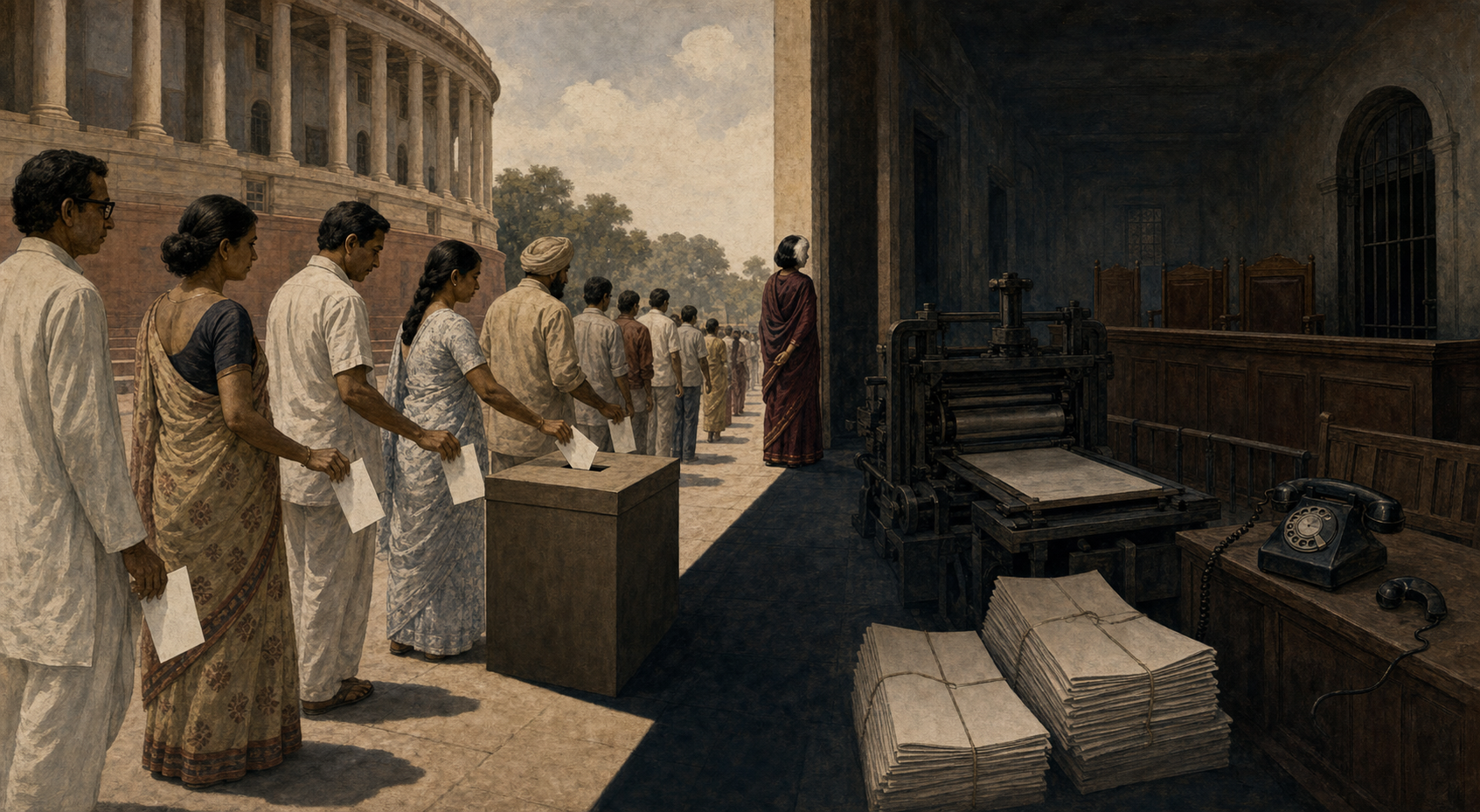
The 1971 victory rewarded a fusion of organization, welfare language and personal leadership. Success naturally encouraged more of the same. The danger emerged when a strong mandate, repeated symbolic affirmation and centralized executive confidence began to look interchangeable with continuing public consent.
The careful claim is not that rallies caused the Emergency. It is that leader-centred spectacle helped normalize a political imagination in which the ruler’s purpose could appear morally superior to institutional restraint. The 1975-77 Emergency, the Congress defeat by the Janata coalition in 1977 and Indira Gandhi’s return in 1980 expose the limits of any simpler story. A landslide did not authorize every later act. Voters could reject overreach, and their rejection did not prevent them from reconsidering the alternatives later.
This sequence should also stop us from portraying the Indian electorate as a passive mass. Repetition, synchronized cheering and identity cues can intensify belonging, but persuasion does not erase agency. The 1977 verdict showed that citizens could distinguish an earlier mandate from subsequent conduct. The 1980 return showed that democratic judgment is revisable rather than permanently settled.
The more enduring concern is the boundary between party and state. Critics of Congress dominance pointed to personality cults, administrative advantage and the wider influence of state broadcasters such as All India Radio and Doordarshan. The Election Commission of India’s Model Code of Conduct, developed from the 1960s onward, established norms concerning campaign behaviour, public spaces and undue advantage. Rules matter most when they keep public authority from becoming scenery, transport, amplification or implied endorsement for the ruling party.
Congress held power long enough for its choices to become precedents, but many leader-centred practices later spread across the party system. That makes institutional memory more useful than partisan amnesia. If you condemn the misuse of public machinery only when an opponent governs, you are defending a faction rather than a democratic norm.
Apply three tests whenever spectacle and incumbency meet. Identify who paid for the mobilization and media. Check whether officials, public broadcasters or administrative resources were made to serve a party narrative. Finally, ask whether opponents had a realistic opportunity to answer through comparable public channels. A rally may be fully legitimate while still deserving these questions; asking them is part of democratic participation, not hostility to popular politics.
A dharmic test judges political means as well as ends

A dharmic evaluation should not begin with the party label. It should ask whether the means used to acquire and preserve power remain answerable to truth, restraint, non-dehumanization and service. These standards are demanding precisely because every political camp finds it easier to apply them to its adversaries.
Satya: can the central claim be checked?
Truthfulness requires more than avoiding a literal lie. A slogan can use a real injustice while obscuring responsibility, trade-offs or results. Extract one factual claim from the speech and ask what evidence would confirm or disprove it. If every promise is framed as loyalty to the leader, gratitude for past action or suspicion of opponents, the audience has been denied the conditions needed for judgment.
Ahimsa: does the speech criticize without dehumanizing?
Ahimsa in public speech does not forbid forceful disagreement. It does require a boundary between attacking an argument or record and depicting fellow citizens as contaminating, subhuman or beyond civic concern. Notice whether the crowd is being united around a task or against a category of people. The first can produce collective agency; the second can make humiliation feel like participation.
Aparigraha: is power willing to accept limits?
Aparigraha brings restraint into political analysis. A leader may command genuine affection and still owe the public institutional limits. Look for willingness to distinguish party from government, tolerate criticism, share responsibility and submit claims to independent scrutiny. The refusal to monopolize every microphone, symbol and public resource is not weakness. It is evidence that office has not been mistaken for personal possession.
Seva: who is served after the stage is dismantled?
Service redirects attention from the leader’s performance to the citizen’s result. Name the promised beneficiary, the responsible institution and the outcome that should follow. Then return after the applause has faded and look for delivery. A rally that invokes the poor while making only the ruler more visible has dramatized seva without establishing it.
Key takeaways
- A large crowd proves mobilizing capacity and enthusiasm among attendees; it does not independently prove national consent.
- The sequence before the main speech matters because organizers can build a crisis that only the featured leader is allowed to resolve.
- A memorable slogan should be expanded into actors, actions, responsibility and measurable results before you accept its moral framing.
- Symbols gain power through repetition, but their meaning can be reversed by opponents and tested against the record attached to them.
- A democratic mandate is limited in time and scope; neither a landslide nor a leader’s popularity suspends constitutional restraint.
- A dharmic judgment applies satya, ahimsa, aparigraha and seva to allies and adversaries by the same standard.
At the next rally you watch, spend the first minute studying the event without sound. Identify the hierarchy of the stage, the repeated symbols and the response expected from the crowd. Then restore the sound and write down one checkable claim. Ask who can challenge it, what would count as failure and whether public authority has been confused with party authority. Do that before sharing the clip or treating its scale as a verdict.
References
