
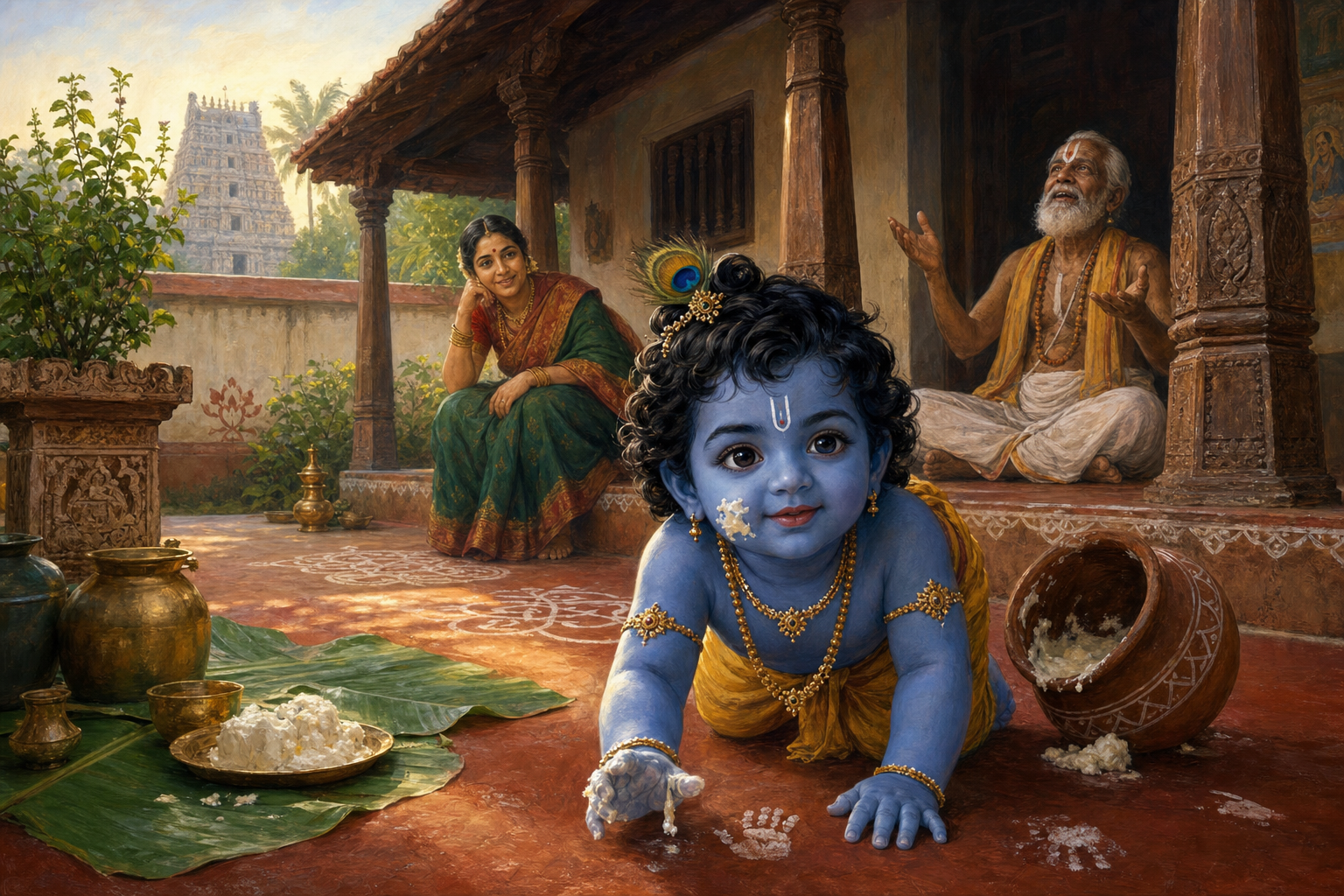
If your question is whether Surdas created the devotional world of the mischievous child Krishna, the short answer is no. Krishna’s childhood lilas were already part of Sanskrit sacred narrative, and centuries before the great flowering of Braj poetry, Periyalvar had made the crawling, butter-smeared child central to sustained Tamil devotional song.
That correction does not make Surdas less important. It helps you see a larger achievement: Bharat’s Bala-Krishna tradition was formed in layers. Sanskrit narrative supplied a shared sacred memory, Tamil bhakti placed that memory inside the emotional life of the household, and Braj poetry gave it another enduring regional voice. Knowing which layer contributed what is the key to reading the tradition without reducing it to a contest between North and South.
Key takeaways
- Child-Krishna narratives precede both Periyalvar and Surdas; the Harivamsa and the tenth skandha of the Bhagavata Purana already recount Krishna’s infancy and boyhood.
- Periyalvar belongs to the earlier Tamil Alvar tradition and offers one of the earliest surviving, sustained vernacular treatments of Krishna as a child encountered through parental love.
- His distinctive contribution is not merely describing a small Krishna. He makes feeding, protecting, blessing, correcting and worrying about God into modes of worship.
- Surdas, writing much later in Braj, brilliantly expands Bala-Krishna devotion through village conversation, complaints, teasing and maternal affection. He consolidates an inherited devotional world rather than beginning it.
- Chronology establishes that Tamil child-Krishna poetry came before Surdas. It does not by itself prove a simple, direct line of borrowing from one poet to the other.
What actually came before Surdas
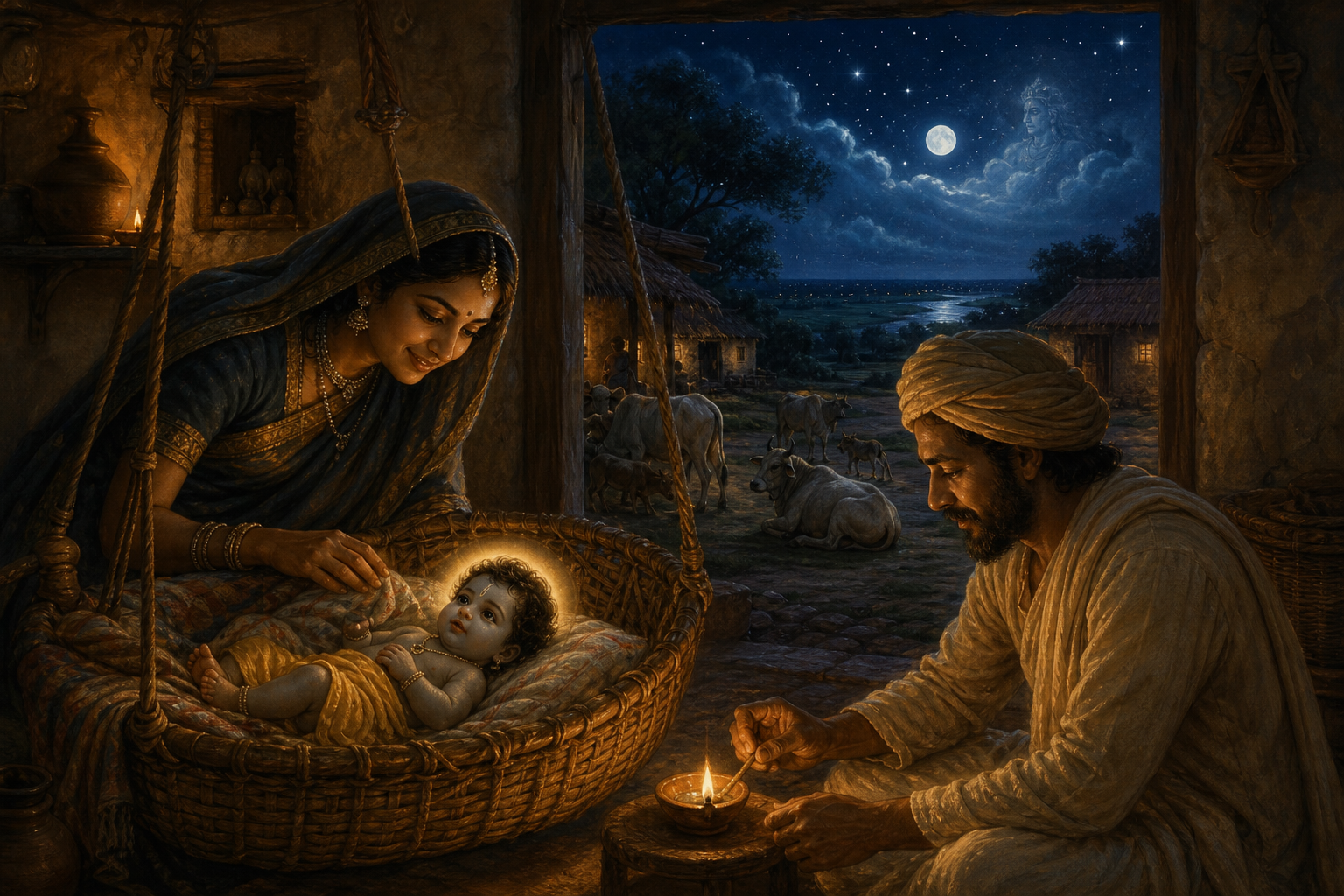
The word “origin” causes unnecessary confusion here because it can refer to at least three different things. You might be asking where Krishna’s childhood stories first appeared, where they first received an extensive vernacular poetic treatment, or which poet gave them their best-known North Indian form. Those questions do not have the same answer.
- The pan-Indic narrative layer: The Harivamsa and the Bhagavata Purana, especially its tenth skandha, preserve the sacred narrative framework of Krishna’s birth, infancy, cowherd life and playful transgressions. Periyalvar and Surdas therefore inherit Krishna’s childhood; neither invents it.
- The Tamil vernacular layer: The Alvars composed their Tamil devotional corpus between roughly the sixth and ninth centuries. Their hymns became the Nalayira Divya Prabandham, and Periyalvar stands out within this tradition for his sustained use of parental love toward Krishna.
- The liturgical layer: Sri Vaishnava practice placed the Tamil hymns beside Sanskrit sacred learning in lived worship. From the period of Ramanuja in the eleventh and twelfth centuries, temple recitation and festivals gave the poetry an institutional life extending far beyond private literary appreciation.
- The Braj flowering: In the fifteenth and sixteenth centuries, Surdas gave Krishna’s childhood an extraordinarily influential Braj voice. His Bala-lila poetry made maternal scolding, stolen butter, neighborhood complaints and the child’s playful defense unforgettable across North Indian devotional culture.
Periyalvar is traditionally identified with Vishnucitta of Srivilliputtur and is commonly placed around the eighth or ninth century, although his exact dating remains debated. That uncertainty matters when making narrow chronological claims, but it does not erase the broad sequence: the Tamil Alvar corpus substantially precedes Surdas.
You can now reject two opposite errors. It is inaccurate to say that child-Krishna devotion began with Surdas. It is equally inaccurate to say that Periyalvar invented Krishna’s childhood stories. The more defensible claim is precise: Periyalvar produced one of the subcontinent’s earliest extensive vernacular poetics of Bala-Krishna and made parental intimacy a governing devotional voice.
Periyalvar’s decisive move: the worshipper protects God
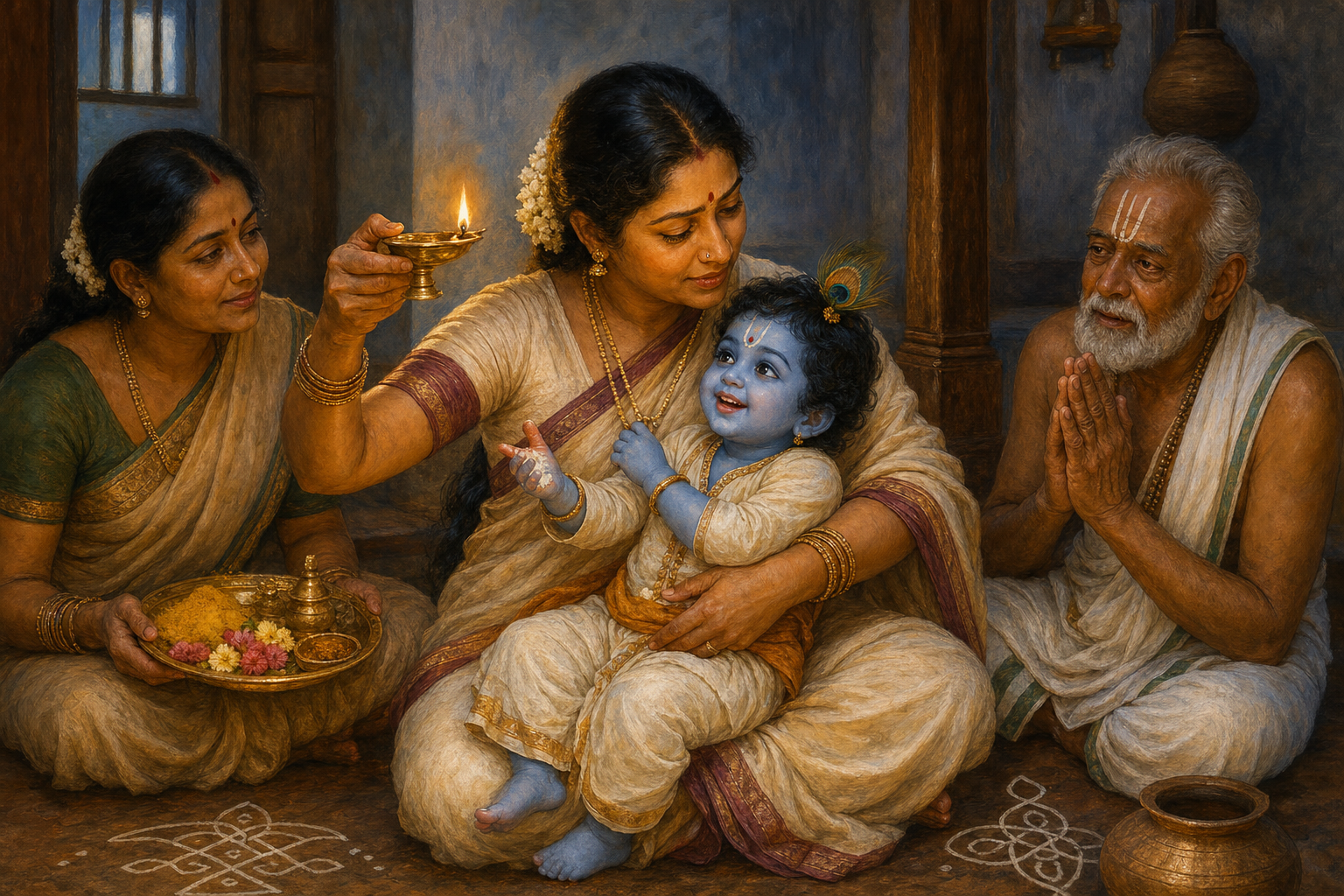
Periyalvar’s importance becomes clearest when you look beyond the presence of a child in the poem and ask what the devotee is allowed to do. In conventional petition, the vulnerable human asks the powerful deity for protection. In the Tiruppallandu, Periyalvar reverses that movement. The devotee pronounces a benediction upon the Lord, wishing the divine well for “many years.” The protector of the universe is addressed as someone whom love itself feels compelled to protect.
This is not a denial of Krishna’s divinity. It is a revelation of what divine intimacy permits. The omnipotent Lord freely accepts the position of a vulnerable child, and the devotee responds not only with reverence but with anxious care. Metaphysical greatness remains intact, yet it no longer prevents the worshipper from drawing near.
The Periyalvar Tirumoli develops this relationship through recognizably domestic actions. Krishna crawls through the courtyard as his anklets sound. Butter and curd mark his hands and face. Yasoda watches, worries, corrects, delights and tries to manage a child whose ordinary mischief continually discloses an extraordinary identity. These household scenes make care, nourishment, correction and play into a devotional discipline.
When you read these hymns, pay attention to the verbs rather than only the images. The theological force lies in cradling, feeding, calling, blessing, searching, scolding and protecting. A charming picture of a butter thief may produce affection. A sequence of caregiving acts does something deeper: it teaches the worshipper how parental love can become a way of knowing the divine.
This mood is called vatsalya-bhava, devotion shaped by parental tenderness. Later bhakti aesthetics would classify relational modes such as peaceful adoration, service, friendship, parental love and romantic love. Rupa Gosvamin’s Bhakti-rasamrita-sindhu became especially important to that later systematization. Periyalvar’s poetry, however, shows vatsalya already functioning as lived devotional grammar long before the taxonomy was formally elaborated.
That distinction helps you recognize Periyalvar’s particular tone. Tenderness is joined to protective anxiety. The mother does not merely admire Krishna; she fears for him, blesses him and reacts to every imagined danger. Surdas would later give great prominence to another side of the same intimacy: village gossip, accusations of butter theft, the child’s excuses and the affectionate collapse of discipline. Periyalvar’s recurring instinct is benediction; Surdas’s Braj world often comes alive through complaint and playful defense.
How a Tamil household vision became a pan-Indic inheritance
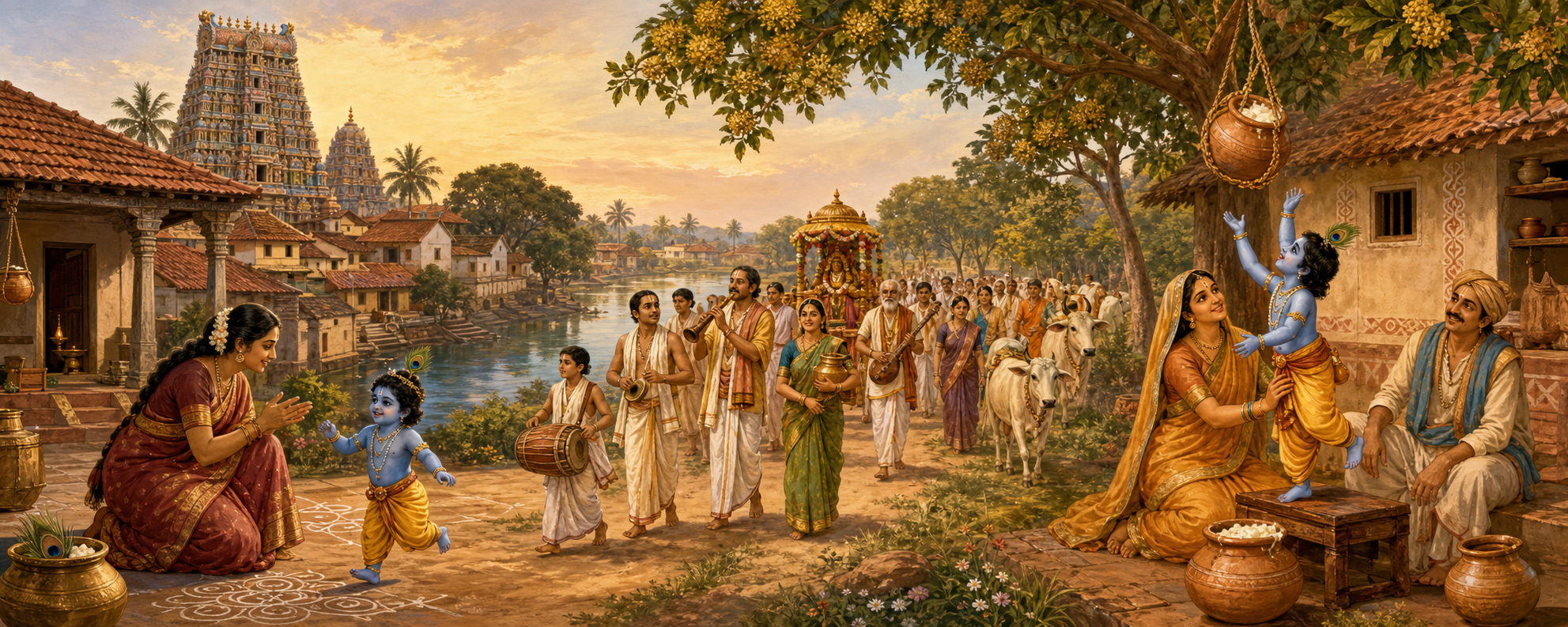
A devotional form does not travel only because one poet reads another. It travels through a whole religious ecology: memory, pilgrimage, worship, performance, visual art and the movement of communities. That broader model is more useful than imagining a single manuscript passing in a straight line from Tamil country to Braj.
Temple recitation gave the Tamil hymns a recurring public life. Sri Vaishnava liturgy, including recitation during Adhyayanotsavam and other festivals, ensured that the Divya Prabandham was heard as sacred performance rather than left on a shelf. Arayar recitation lineages, itinerant singers, pilgrims, merchants and scholastic exchange connected temple regions to wider routes across Bharat. Repetition in sacred time allowed emotional forms to travel even when language, melody and local custom changed.
Images carried the same devotional idea without requiring textual literacy. Chola-period bronzes of Navanita Krishna gave visible form to the butter-loving child. Temple murals placed his lilas before congregations. Performance traditions embodied his movement, mischief and vulnerability, while later forms such as Kathak and Ramlila’s Krishna-centered counterpart, Raslila, made divine play a shared dramatic experience. The child could be seen, carried, sung to and enacted.
These networks explain how Bala-Krishna devotion accumulated regional languages, melodies, foods and dramatic forms while retaining a recognizable emotional center. They make cultural transmission durable and plausible. They do not establish that Surdas directly copied Periyalvar, and no such claim is needed to appreciate the historical relationship.
The better model has three interacting parts. Sanskrit narrative provides the shared mythic structure. Tamil bhakti domesticates that structure through an early, sustained vernacular poetry of parental care. Braj bhakti renews it through another language, social landscape and performance culture. Each region receives, reshapes and returns something to the civilizational whole.
This is why “South before North” should remain a chronological clarification, not a ranking of spiritual worth. Surdas does not become smaller when Periyalvar is remembered. Periyalvar does not need to be turned into the sole inventor of Bala-Krishna devotion in order to receive his proper place. Bharat’s cultural unity is visible precisely in this capacity for continuity without uniformity.
How to read and practice this lineage without flattening it
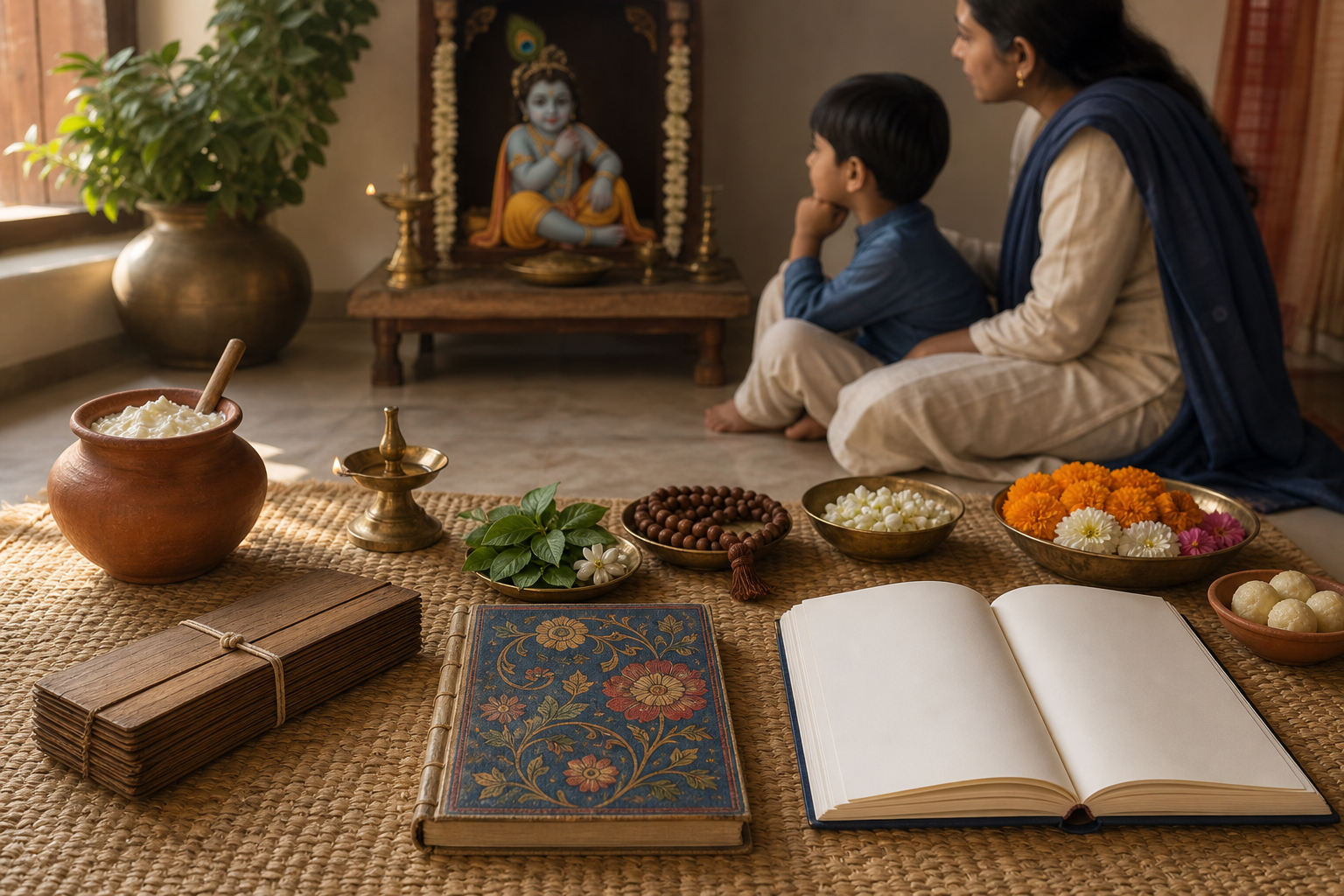
You do not need to become a specialist in Tamil or Braj to notice the tradition’s different layers. You do need to keep the speaker, emotional relationship and setting in view. A practical reading can begin with one familiar lila rather than an attempt to master every corpus at once.
- Choose one childhood scene. Butter theft works well because it appears within the shared Krishna tradition and brings domestic intimacy immediately into view.
- Locate its narrative foundation. Read the corresponding childhood material in the Harivamsa or the Bhagavata Purana’s tenth skandha. At this stage, identify the event, characters and theological disclosure.
- Turn to Periyalvar for the parental gaze. Notice what Yasoda or the motherly speaker sees, fears and does. Mark each action of care. Ask why a devotee who knows Krishna is supreme still feels driven to protect him.
- Then read Surdas for the Braj social world. Listen for neighbors, accusations, excuses, teasing and the mother’s inability to remain stern. Notice how the same divine childhood acquires a different public texture.
- Keep continuity and difference together. Do not force identical theology, voice or atmosphere onto both poets. Shared devotion does not require interchangeable poetry.
If you are introducing Bala-Krishna to children, ask concrete questions instead of turning every lila into a quick moral lesson. What makes Yasoda worried? Why does she scold Krishna and then soften? Why would someone bless the Lord who protects the entire world? Those questions help a child notice love, responsibility and paradox. Treating butter theft as divine permission for ordinary dishonesty misses the devotional logic; the transgression serves intimacy and lila, not a general rule of conduct.
If you lead a family or community observance, make the lineage audible. A Janmashtami program centered on Braj songs can include a translated or Tamil selection from Periyalvar, clearly identified by language and tradition. A bedtime retelling can pair Krishna’s mischief with the caregiver’s concern. A cradle song can be approached as prayer rather than decorative entertainment. The cradle, lullaby and act of tending are central to the theology of this devotional form.
When you teach the history, use a sentence precise enough to avoid both erasure and exaggeration: Surdas gave Bala-Krishna devotion one of its greatest Braj expressions, while Periyalvar had articulated a sustained Tamil poetics of parental love centuries earlier, drawing on older Sanskrit narratives. That formulation honors all three layers and claims no more than the historical sequence supports.
Begin with one scene this week. Read its sacred narrative, hear Periyalvar’s protective tenderness, and then listen to Surdas’s Braj playfulness. The change in voice will show you how a living dharmic tradition preserves its center while allowing every language to bring the child Krishna home.
References
