

You may meditate, recite Naam, study Vedanta, keep vows, or serve faithfully – and still become defensive the moment someone questions your judgment. That does not make your practice false. It shows you where the practice has not yet reached.
The central question is not whether you still use the word I. It is whether every thought, role, wound, achievement, and group identity must be defended as me or mine. Hindu, Buddhist, Jain, and Sikh paths diagnose that bondage differently. If you preserve those differences, each tradition can help you notice the same practical turning point: the moment a useful identity becomes a demand that reality obey it.
You do not need to erase the person who answers your name
You need a functional self. It remembers appointments, fulfils duties, protects dependants, learns from mistakes, and says no when a boundary is crossed. Liberation does not require you to become vague, passive, incompetent, or unable to distinguish one person from another.
The problem begins when that functional self is treated as your complete and final identity. A role then stops being something you perform and becomes something you must defend. A passing emotion becomes who you are. A preference becomes a moral absolute. A criticism of one decision feels like an attack on your existence. This is the practical difference between a working personality and egoic misidentification.
Use a simple test. Complete the sentence: If this is taken away, disproved, ignored, or criticised, I will no longer know who I am. Whatever appears in the blank deserves examination. It might be your profession, family position, intelligence, spiritual reputation, political camp, sect, suffering, or image as a good person. The role itself may be honourable. Compulsion to secure your existence through it is the bind.
Ego is therefore not the same as confidence. You can act decisively without egoic possession of the result. Nor is humility the performance of weakness. Repeatedly announcing that you are insignificant can be another way of keeping attention fixed on yourself. Healthy humility is more practical: you can see accurately, accept correction, act firmly, and release the need to be the centre of the event.
Modern cognitive language can describe part of this persistence without proving or disproving any tradition’s metaphysics. Default-mode activity helps assemble an autobiographical narrative. Predictive processing favours interpretations that fit prior beliefs. Reward learning reinforces reactions that protect a valued identity. Under stress, attention narrows and the first defensive story can feel like unquestionable truth. That is why intellectual agreement about egolessness is not enough. The habit is carried by attention, emotion, body, and conduct.
This also explains spiritual ego. A calm meditation, scriptural insight, austere vow, or act of seva is quietly converted into evidence that you are more advanced than someone else. The content sounds sacred, but the structure remains possession: my attainment, my purity, my lineage, my sacrifice. Do not condemn yourself when you notice this. Notice the appropriation, stop feeding it, and return to the discipline itself.
Four traditions do not mean the same thing by freedom
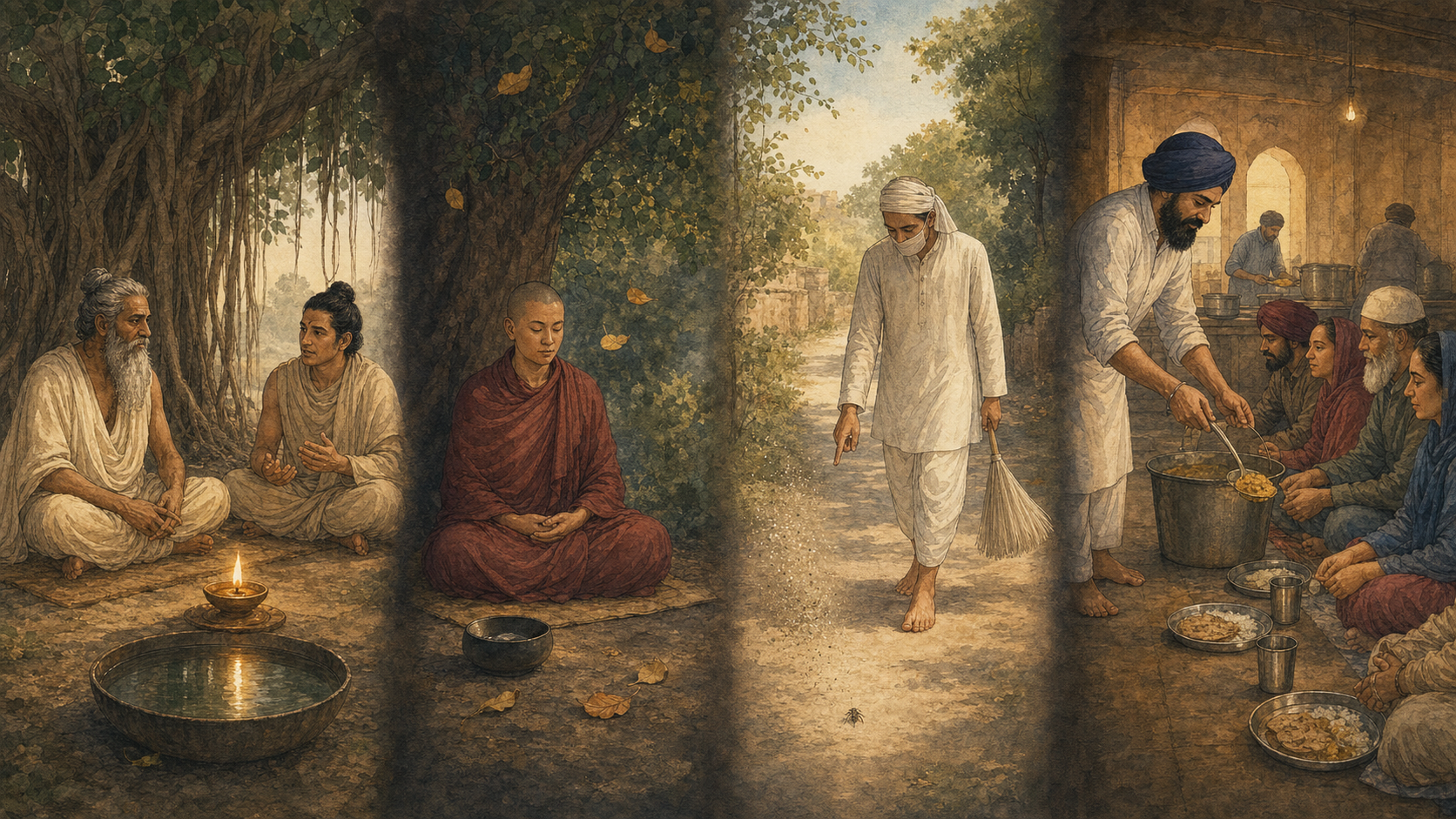
Dharmic traditions share ethical and contemplative ground, but they do not reach liberation by hiding their doctrinal differences. Vedantic inquiry into Atman cannot simply be renamed Buddhist anatta. Jain teaching about the jiva is not identical to either. Sikh release from haumai is inseparable from Naam, Hukam, the Guru’s wisdom, seva, and grace. The convergence is practical: suffering grows when experience is grasped through self-centred identification. The accounts of what is ultimately real remain distinct.
| Path or framework | How the bondage appears | What loosens it | A question for daily use |
|---|---|---|---|
| Yoga and Vedantic disciplines | Avidya permits asmita or ahankara to confuse the seer with body, mind, role, and reaction. Raga, dvesha, and fear defend the confusion. | Ethical restraint, attention training, japa or dhyana, witness-consciousness, discrimination, and action without possession of its fruits. | Can this thought, feeling, or role be observed? If so, must it be the observer? |
| Buddhist practice | Body, feeling, perception, mental formations, and consciousness are appropriated as I or mine. Craving and clinging renew the construction. | Ethical conduct, steadiness of mind, direct observation of impermanence, unreliability, and non-self, together with compassion and equanimity. | Can this experience arise and pass without being made into a permanent owner? |
| Jain practice | Moha and kashaya – passions such as pride, anger, greed, and attachment – obscure the jiva and sustain karmic bondage. | Vows, nonviolence, samayik, pratikraman, restraint, and the many-sided discipline of anekantavada and conditional expression. | From which standpoint is my claim valid, and what standpoint am I refusing to see? |
| Sikh practice | Haumai makes self-will central, seeks ownership and recognition, and resists Hukam. | Naam simran, kirtan, Gurbani, selfless seva, receptivity to the Guru, and grace. | Am I serving what is true and beneficial, or trying to make everything confirm my importance? |
In the Vedantic practices of drig-drishya discrimination, neti neti, sakshi-bhava, and panchakosha analysis, you examine everything that can be known as an object: body, breath, emotion, thought, intellect, and even refined states of happiness. The purpose is not to dislike these layers. It is to stop confusing them with unaffected awareness. Karma Yoga carries that insight into work. You still pursue excellence, but you do not make inner freedom conditional on applause or a particular result.
Buddhist investigation takes a different direction. Instead of searching among the five aggregates for a permanent owner, you watch each aggregate arise through conditions and pass. Contact is followed by feeling; feeling can condition craving; craving can harden into clinging and renewed becoming. The useful discovery is experiential: a sensation does not have to become a demand, and a thought does not require an enduring thinker who owns and obeys it.
Jain discipline adds an especially valuable correction to certainty. Anekantavada does not mean that every claim is equally true. It means that finite statements express a standpoint and must not be inflated into the whole of reality. Syadvada trains conditional speech, while samayik creates a period of equanimity and pratikraman brings honest acknowledgement of harm. These disciplines interrupt the ego before certainty becomes contempt.
Sikh teaching confronts haumai through remembrance and participation rather than self-absorption. Simran returns attention to Naam. Kirtan moves remembrance beyond private rumination. Seva tests whether devotion has become generosity in action. Hukam challenges the fantasy that personal will is sovereign, while grace prevents liberation from becoming one more achievement claimed by the isolated self. Grace is not an excuse for passivity; it makes disciplined effort receptive rather than possessive.
Choose the question native to your path and apply it repeatedly. Do not collect the conclusions of four traditions while avoiding the discipline of any one of them. Depth comes from sustained practice, ethical accountability, and competent guidance – not from assembling an impressive vocabulary.
Catch the ego between sensation and the story of me

Ego usually becomes visible after it has recruited speech and action. You notice it in the message you should not have sent, the credit you could not share, or the argument you continued after the point was settled. The more useful place to intervene is earlier, between the raw event and the identity story.
Patanjali’s klesha sequence and the Buddhist analysis of conditioned clinging offer two compatible practical warnings. Misapprehension permits identification; identification generates attraction and aversion; fear protects whatever has been labelled me or mine. In another vocabulary, contact gives rise to feeling, which can condition craving, clinging, and becoming. Neither sequence requires you to suppress the first sensation. Your work is to stop turning it automatically into identity and compulsion.
- Pause in the body. Before explaining the event, feel the jaw, chest, belly, hands, and breath. Let the exhalation remain gentle. This interrupts the rush from sensation into accusation.
- State the contact without a verdict. Say, A colleague questioned my decision, rather than They humiliated me. The first names what happened. The second may already contain mind-reading, identity threat, and a demand for retaliation.
- Name the pull. Is there grasping for praise, control, certainty, status, comfort, or victory? Is there aversion to embarrassment, ambiguity, correction, loss, or another person’s success? Naming raga and dvesha makes them observable.
- Find the identity claim. Ask what image must be defended. It may be I am the expert, I am always generous, people like us cannot be wrong, or even I am beyond ego.
- Apply your tradition’s corrective. Witness the thought as an object, observe its conditioned arising and passing, test your standpoint against another, or return through Naam to Hukam and service.
- Choose conduct after the heat drops. Ask what truthfulness, nonviolence, duty, compassion, and the welfare of all require. You may still correct an error, defend someone, refuse an unjust demand, or speak firmly. The difference is that action is no longer being chosen merely to repair an injured self-image.
Consider criticism. Ego hears, Your judgment was incomplete, and converts it into, You are worthless or The critic is an enemy. The functional self extracts the usable information, rejects what is false, corrects what is true, and carries on. Liberation is not never feeling the sting. It is becoming less obedient to the story built around the sting.
Good deeds present another test. After helping, notice whether the mind rehearses who should know, who failed to thank you, or how the act proves your superiority. Do not abandon the service. Release the internal claim over it. Anonymous or unadvertised seva can expose how much motivation depended on recognition.
Collective identity is subtler because belonging can serve legitimate duties. A Hindu, Buddhist, Jain, Sikh, national, family, or institutional identity becomes egoic when affiliation outranks Dharma. If you excuse cruelty, dishonesty, or arrogance from your own side while condemning it in another, the group has become armour for the self. A genuinely pro-Dharmic commitment must remain answerable to truth, restraint, courage, compassion, and justice even when that is inconvenient for the group.
Jain many-sidedness is particularly useful in such conflicts. Before forwarding a claim or attacking a person, ask which facts would weaken your preferred interpretation and what a fair opponent would say. This is not moral indecision. You can reach a firm conclusion after considering more than one standpoint. The discipline prevents certainty from hardening before inquiry has begun.
Build thirty days around ethics, attention, insight, and service
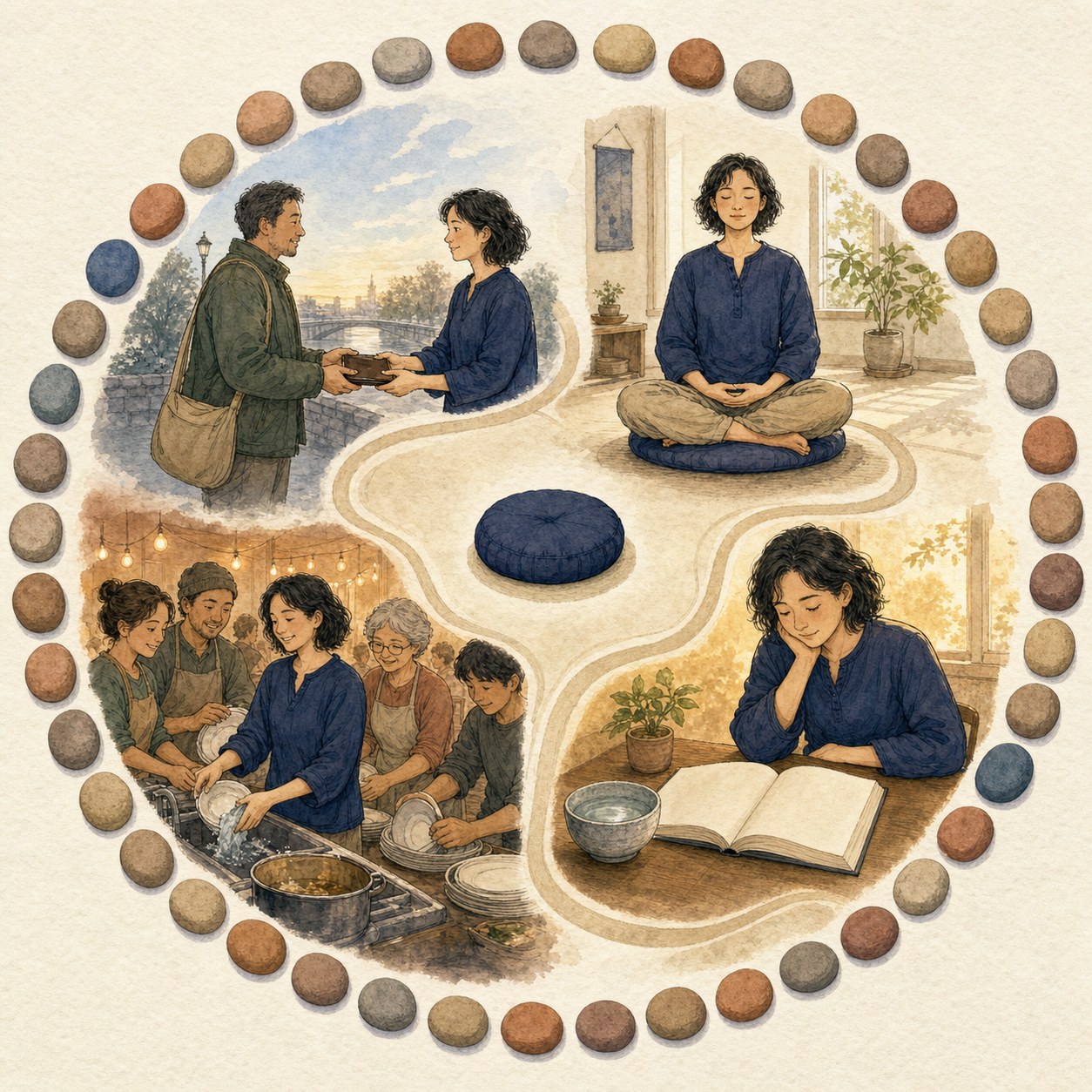
Trying to defeat ego through insight alone is unreliable. The mind can turn a profound doctrine into a new badge within minutes. Mature Dharmic practice therefore works in an order: ethics reduces agitation and remorse; attention reveals reaction before it takes over; insight examines misidentification; devotion and service loosen possession; honest review brings failures back into practice.
The shared scaffold
A demanding but workable thirty-day foundation can use the following structure. Treat the timings as a scaffold, not a claim that every practitioner must combine every lineage.
- Morning: five minutes of gratitude, ten minutes of gentle nadi shodhana, twenty minutes of your primary attention practice, and five minutes of metta or another compassion practice appropriate to your path.
- Midday: take two deliberate breathing pauses before predictable moments of reactivity. Add one mindful walk in which you feel the body and surroundings without rehearsing a personal story.
- Evening: practise japa, simran, breath awareness, or another rooted form of recollection for twenty minutes. Follow it with fifteen minutes of svadhyaya and a brief review of speech, intention, grasping, and harm.
- Weekly: give one hour to nishkam seva. Choose work that is actually needed, preferably where status and praise are not the reward.
- Throughout the month: moderate inputs that predictably inflame comparison, outrage, craving, or lethargy. Media and dietary restraint are supports for clarity, not purity contests.
If that schedule is not realistic, shorten the sittings without discarding the structure. Ten honest minutes repeated daily are more useful than an elaborate vow abandoned after several days. Keep ethics, attention, insight, and service represented somewhere in the week. Abhyasa matters because ego is a repeated pattern; it is not undone by one convincing idea.
Keep one path at the centre
A cross-Dharmic perspective should sharpen commitment, not produce a spiritual mixture with no governing discipline. Let one tradition supply your central vocabulary, ethical commitments, contemplative method, and qualified guidance.
- If your centre is Yoga or Vedanta, ground inquiry in yama and niyama. Use dharana or japa to steady attention, then apply drig-drishya discrimination, neti neti, or sakshi-bhava. Carry the result into Karma Yoga by acting fully without making peace dependent on the fruit.
- If your centre is Buddhist practice, protect sila, cultivate steadiness through shamatha or anapanasati, and investigate impermanence, dukkha, and anatta within present experience. Use metta and karuna so non-attachment does not become coldness.
- If your centre is Jain practice, let nonviolence and restraint govern the day. Use samayik for equanimity, anekantavada to challenge one-sided certainty, and pratikraman to acknowledge harm and reset intention rather than defending your moral image.
- If your centre is Sikh practice, return repeatedly to Naam through simran, receive instruction through Gurbani and kirtan, and test remembrance through seva. When personal control tightens, examine whether you are resisting Hukam or claiming ownership of what should be offered.
After the first thirty days, deepen rather than merely adding variety. Within the next phase, you might lengthen the insight practice native to your path, join kirtan or group meditation, establish a weekly samayik, or keep a half-day of silence each month. Choose what strengthens your root discipline. Novelty can become another form of raga.
When practice uncovers pain
Not every persistent reaction is solved by telling yourself that the self is unreal or that you should surrender more. Denial, projection, and rationalisation often protect unprocessed pain. Journaling, gentle awareness of bodily sensation, and honest conversation can reveal what abstract inquiry misses. The behavioural question is decisive: is practice making you more truthful, patient, responsible, and capable of warmth?
If meditation or breath practice repeatedly brings overwhelming panic, dissociation, traumatic memories, or loss of ordinary functioning, do not force longer or more intense sessions and call the distress purification. Use gentle, unstrained breathing, consult an experienced and trustworthy teacher, and seek a licensed mental-health professional when needed. Therapy and spiritual discipline can work together; neither should be used to dismiss the layer addressed by the other.
Community also matters. Healthy satsang makes correction possible, places Dharma above the charisma of a teacher, and does not treat honest questions as betrayal. A trustworthy guide points you back to practice and direct seeing rather than manufacturing dependency. Be cautious when a community rewards certainty, secrecy, personality worship, or claims of exceptional attainment while ethical conduct deteriorates.
Key takeaways: measure freedom where ego resists
Calm states come and go. Visions, intellectual certainty, devotional emotion, and refined concentration may be meaningful, but none gives you permission to ignore conduct. Use these tests because they examine liberation where self-image has less room to perform:
- The feedback test: Can you hear a correction, separate truth from hostility, and change without collapsing or retaliating?
- The credit test: Can another person receive praise for work you helped accomplish without your mind demanding repayment?
- The opposition test: Can you represent an opponent’s actual position fairly before rejecting it?
- The unseen-conduct test: Do truthfulness, nonviolence, restraint, and duty remain intact when nobody will know what you chose?
- The recovery test: After anger, fear, envy, or embarrassment appears, how quickly do you stop feeding it through rehearsal and justification?
- The service test: Does your practice make you more available to another person’s real need, or only more interested in your own spiritual condition?
- The identity test: Can you honour family, sampradaya, Panth, community, and Bharat without making ethical judgment conditional on who belongs to your side?
Keep a brief evening record for thirty days. Name one moment of grasping or aversion, the identity it protected, the action that followed, and the wiser action available now. Do not score yourself as pure or impure. Look for concrete changes: less time spent defending, fewer harmful words, faster repair after a mistake, steadier duty, and service with less demand for recognition.
Start with the recurring situation that most reliably makes you defensive. Choose one corrective question from your tradition, use it before your next response, and review the result that evening. Liberation may be the highest horizon, but your next honest pause is where the path becomes real.
References
