
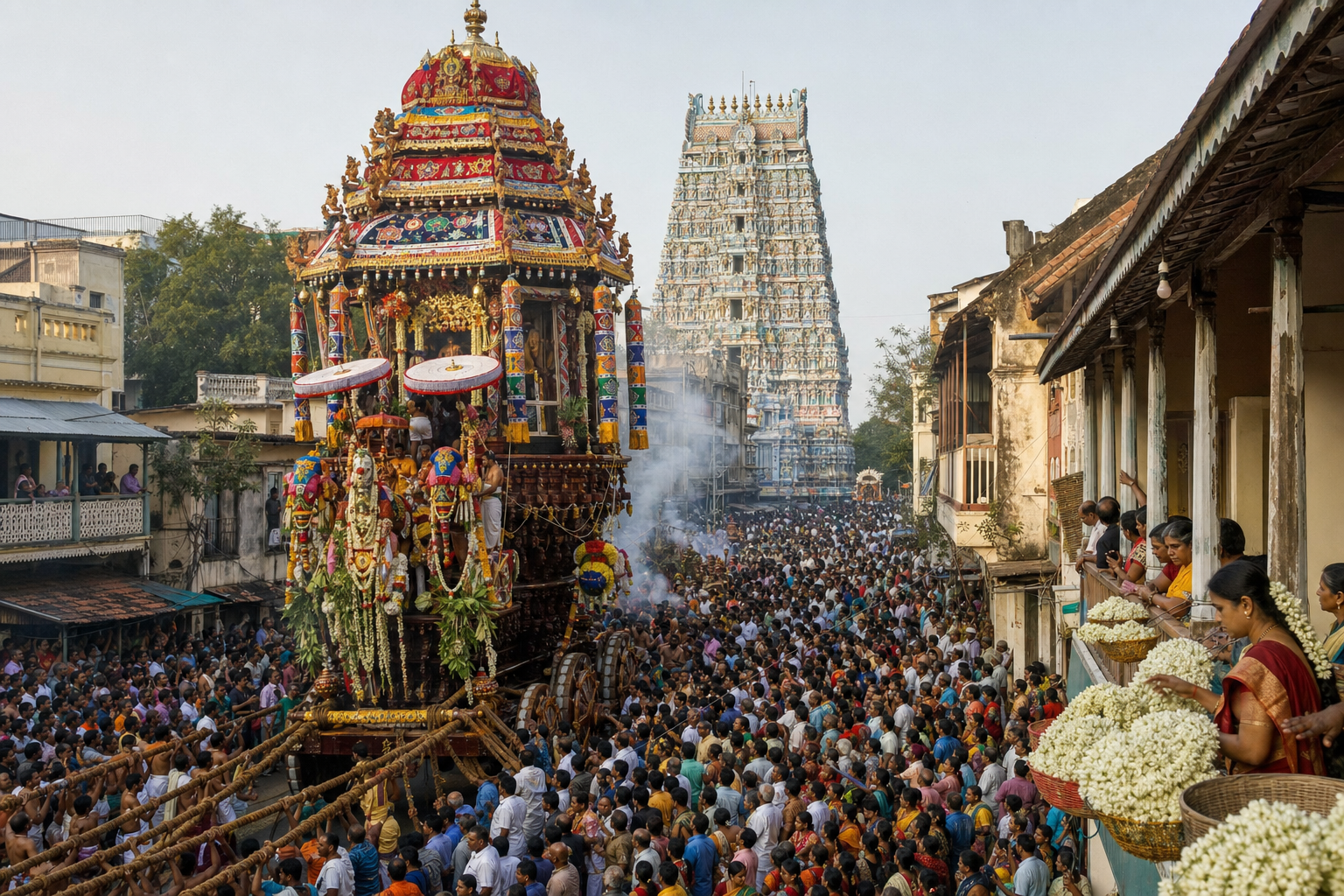
If you are trying to identify the most important day of Kapaleeswarar Brahmotsavam 2026, the answer depends on the darshan you wanted. The flag-hoisting opened the sacred cycle, the ther brought the scale of Mylapore’s public devotion into view, Arupathmoovar honoured the Shaiva saints, and Panguni Uthiram completed the festival through the divine union of Kapaleeswarar and Karpagambal.
The 2026 observance is now a historical event rather than an upcoming festival. Its confirmed ten-day span was March 23 to April 1, with Rathotsavam on March 29 and Panguni Uthiram on April 1. Those dates help you understand or document that year’s ritual arc, but they must not be reused for a later year.
The fixed 2026 calendar, and one date not to guess
Three anchors define the 2026 calendar. They also reveal an important limitation: the precise Arupathmoovar date and time cannot be inferred safely from the sequence alone.
| Observance | Confirmed 2026 timing | What it marked | Practical implication |
|---|---|---|---|
| Dhwajarohanam | March 23 at 7:30 am | Ritual opening of Brahmotsavam | You needed to be settled before the flag-hoisting to witness the transition into festival time. |
| Kapaleeswarar Rathotsavam | March 29 | The grand temple chariot’s circuit through the four Mada streets | This was the major choice for public scale, ther darshan, and collective participation. |
| Arupathmoovar procession | Announced locally closer to the event | Public honouring of the 63 Shaiva Nayanmars | The temple noticeboard and local administrative update, not an assumed date, had to control the plan. |
| Panguni Uthiram | April 1 | Festival culmination centred on sacred union | This was the clearest choice for kalyana-themed worship and the concluding theological emphasis. |
The daily vahana programme contained more detail than these anchors. Because individual timings followed ritual calculations as well as operational considerations, reconstructing a complete day-by-day schedule without the temple’s contemporary notice would create false precision. The responsible historical record is therefore exact where the dates are known and explicit where they are not.
Choose the observance by the darshan you value
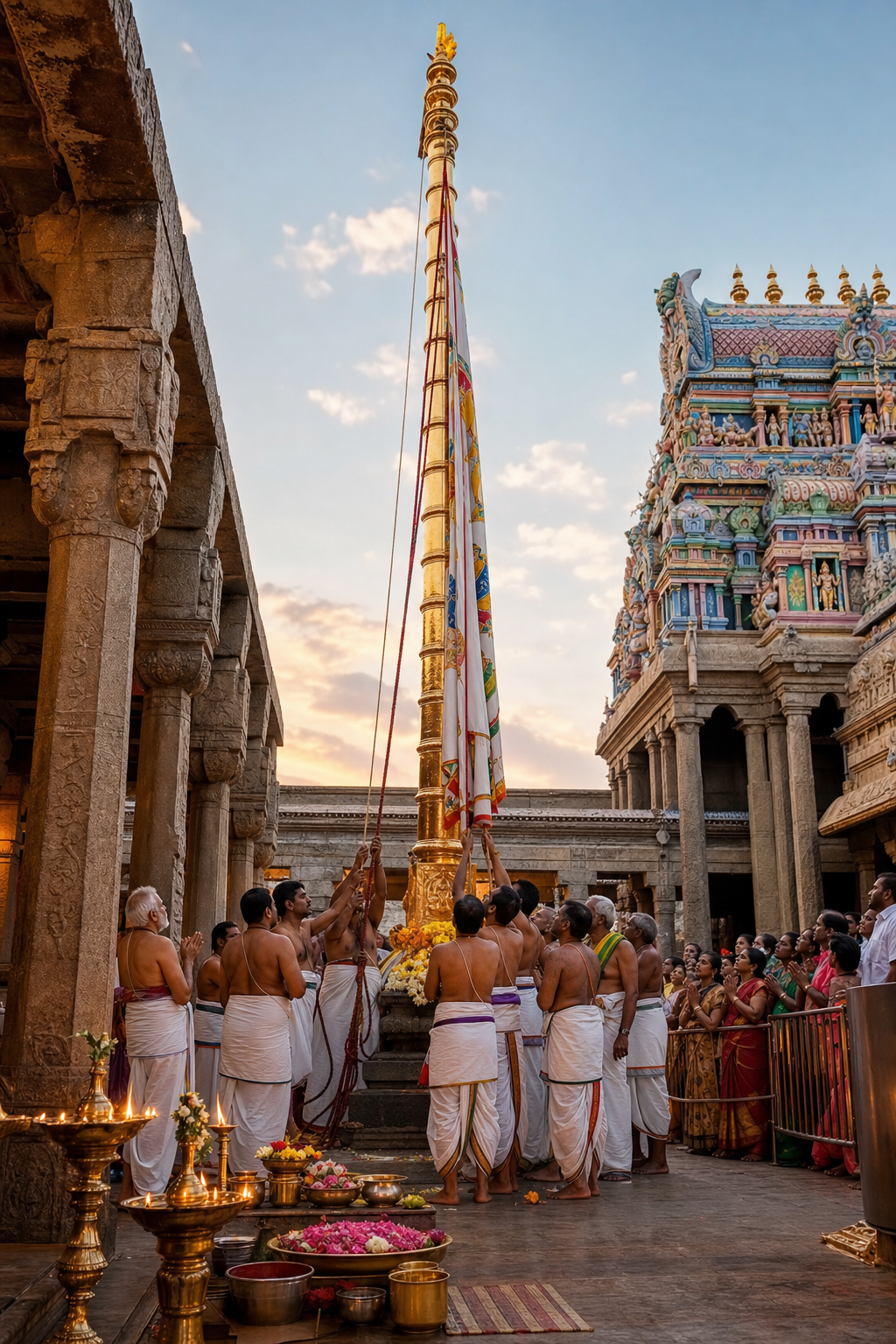
Dhwajarohanam: witness the threshold
Dhwajarohanam was not merely a ceremonial start time. Hoisting the sanctified flag on the kodimaram announced an intensified divine presence and opened the period in which Kapaleeswarar and Karpagambal would travel beyond the inner temple through Mylapore’s sacred street circuit.
This was the right observance for someone interested in how ordinary neighbourhood time becomes festival time. The key planning choice was simple: arrive early enough to be in place before 7:30 am rather than treating that hour as an approximate arrival target. Morning worship also suited elderly devotees, families with young children, and anyone who placed a quieter darshan above the density of the major street processions.
Rathotsavam: encounter the moving temple
On March 29, the monumental wooden ther carried the temple’s presence through the four Mada streets. Floral decoration, sacred imagery, chanting, drums, and the disciplined labour of devotees drawing the chariot made this the most visually expansive day of the 2026 festival.
Rathotsavam was the natural choice if you could attend only one observance and wanted to see Brahmotsavam as both worship and civic participation. Families commonly took positions along East and South Mada Streets well before sunrise. The practical lesson is that a prominent viewing place demanded an early start; arriving after the streets had filled meant accepting a more distant view rather than pressing through a settled crowd.
Drawing the ther is seva, not a contest for proximity. Rope access, movement, and crowd safety belong under the direction of volunteers. Keeping junctions and processional paths clear is itself part of respectful participation.
Arupathmoovar: stand within the Shaiva lineage
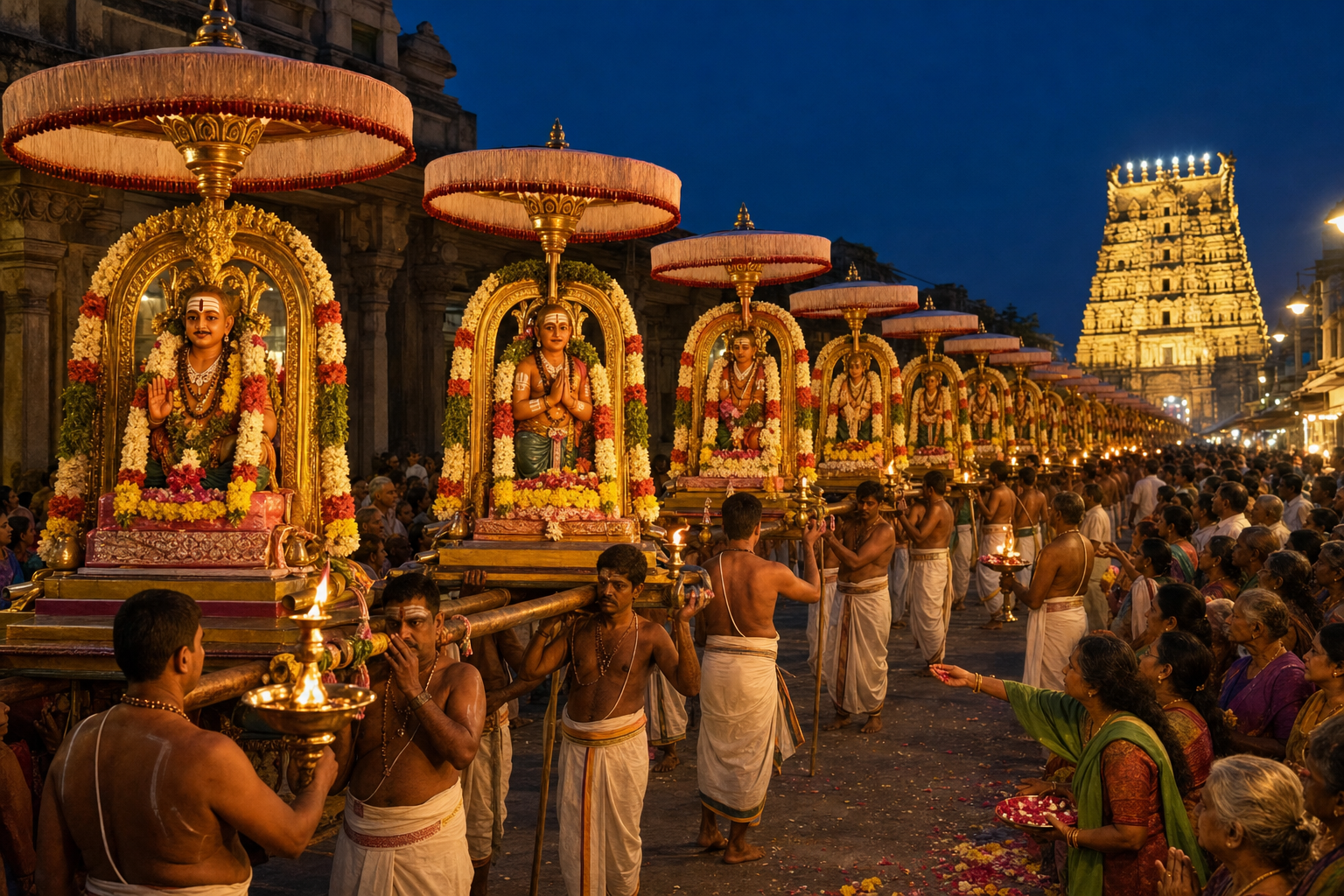
Arupathmoovar places the 63 Nayanmars at the centre of public memory. Their palanquins make the lives of the Shaiva saint-poets visible in the same streets through which the principal deities travel. The emphasis is not spectacle for its own sake. It is remembrance of devotees whose courage, humility, service, and surrender shaped Tamil Shaiva life.
This was the observance to prioritise if your interest lay in the continuity between devotional literature, temple worship, and a living community. It was also the day that most required schedule discipline. Since its precise 2026 timing was issued locally closer to the festival, assigning it a date merely because it usually occupies a familiar place in the sequence would be unreliable.
Panguni Uthiram: attend the culmination
April 1 brought the Brahmotsavam to its culmination under Panguni Uthiram, associated with the Uthiram nakshatra and the full-moon setting of the Tamil month of Panguni. In Mylapore, the focus rested on the divine conjugality of Kapaleeswarar and Karpagambal through special alankarams, kalyana-oriented rites, and heightened community participation.
This was the meaningful choice for a devotee approaching the festival through grihastha dharma. The sacred union presents household life not as a spiritual concession, but as a field for fidelity, mutual care, responsibility, and generative dharma. Comparable marriage associations include Siva and Parvati, Murugan and Deivayanai, Sita and Rama, and Andal and Ranganatha within Tamil Shaiva and Vaishnava memory.
How the ritual arc remakes Mylapore’s sacred geography
Brahmotsavam is best understood as a connected ritual movement, not a collection of unrelated processions. Dhwajarohanam invokes the festival presence. Daily pujas, homas, alankarams, and vahana outings give that presence a changing public form. The closing rites, including the lowering of the flag, return the temple and neighbourhood from intensified festival time to their regular rhythm.
The vahanas make theology visible. Nandi communicates steadfast adherence to dharma. Rishabha conveys strength and rectitude. Kailasa vahanam turns attention towards transcendence, while palanquins bring grace into an intimate and approachable form. When you follow the procession rather than observing only a stationary moment, these are the changes to notice: the deity’s presentation, the pace of movement, the accompanying music, and the relationship between each mount and the virtue it embodies.
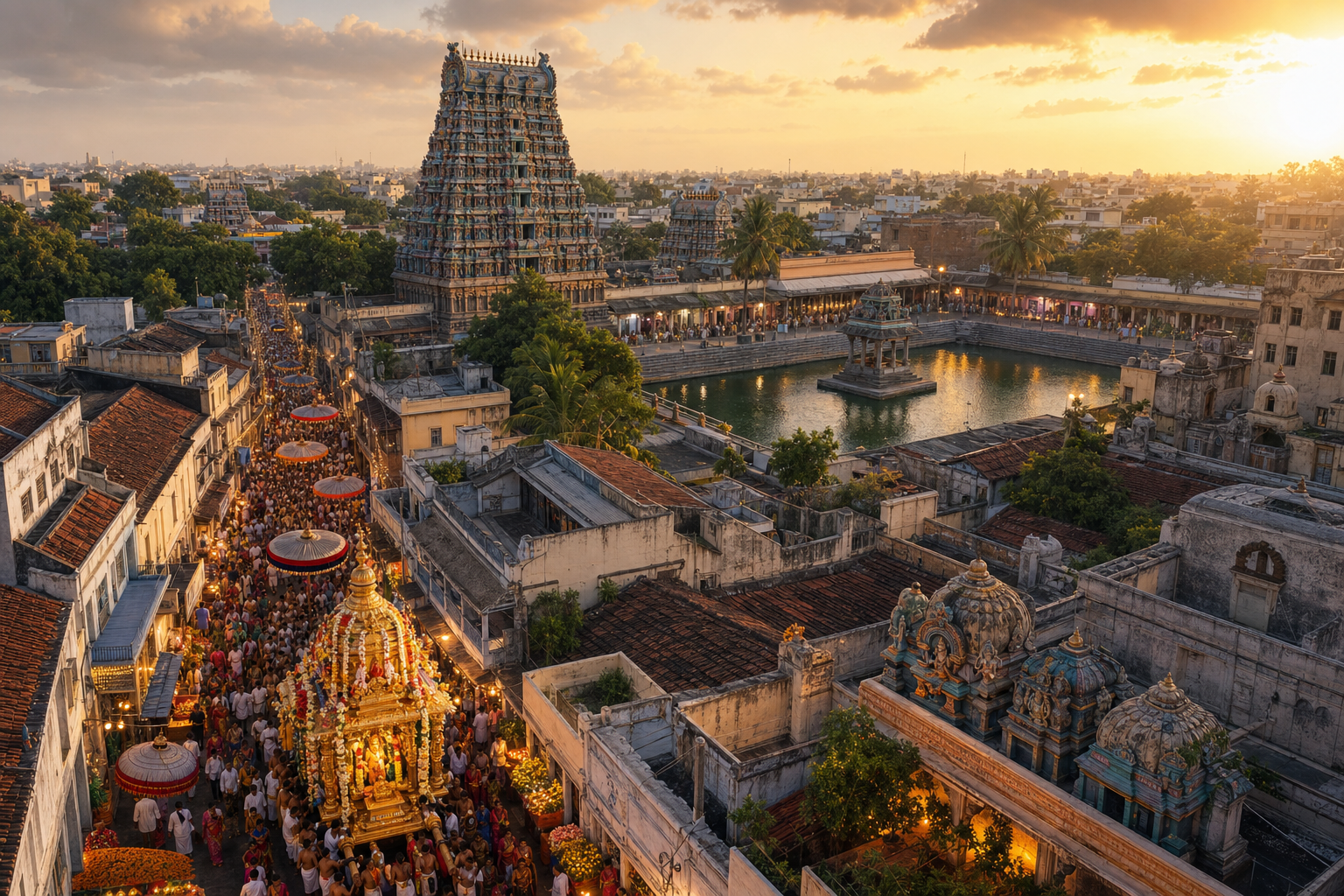
The four Mada streets are therefore more than a convenient route around the temple. The processions extend darshan to homes, shops, markets, and bylanes. The neighbourhood becomes a mobile sanctuary, allowing people who occupy different places in ordinary civic life to stand together before the same divine presence.
Mylapore’s cultural forms participate in this transformation. Kolams appear at dawn. Flower sellers adjust their hours to devotional demand. Nadaswaram and thavil are heard in their ritual setting rather than as detached performances. Local shops reshape their working day around the procession. The festival preserves heritage precisely because these arts, livelihoods, streets, and rites still function together.
Visitors from other Dharmic traditions need not erase real theological differences to recognise a shared ethical vocabulary. Fidelity, compassion, self-restraint, service, and responsibility have meaning across Hindu, Buddhist, Jain, and Sikh life. At Kapaleeswarar Brahmotsavam, those values become public conduct: making room for another devotee, accepting queue discipline, serving without seeking prominence, and protecting a common sacred space.
A practical way to navigate a major festival day
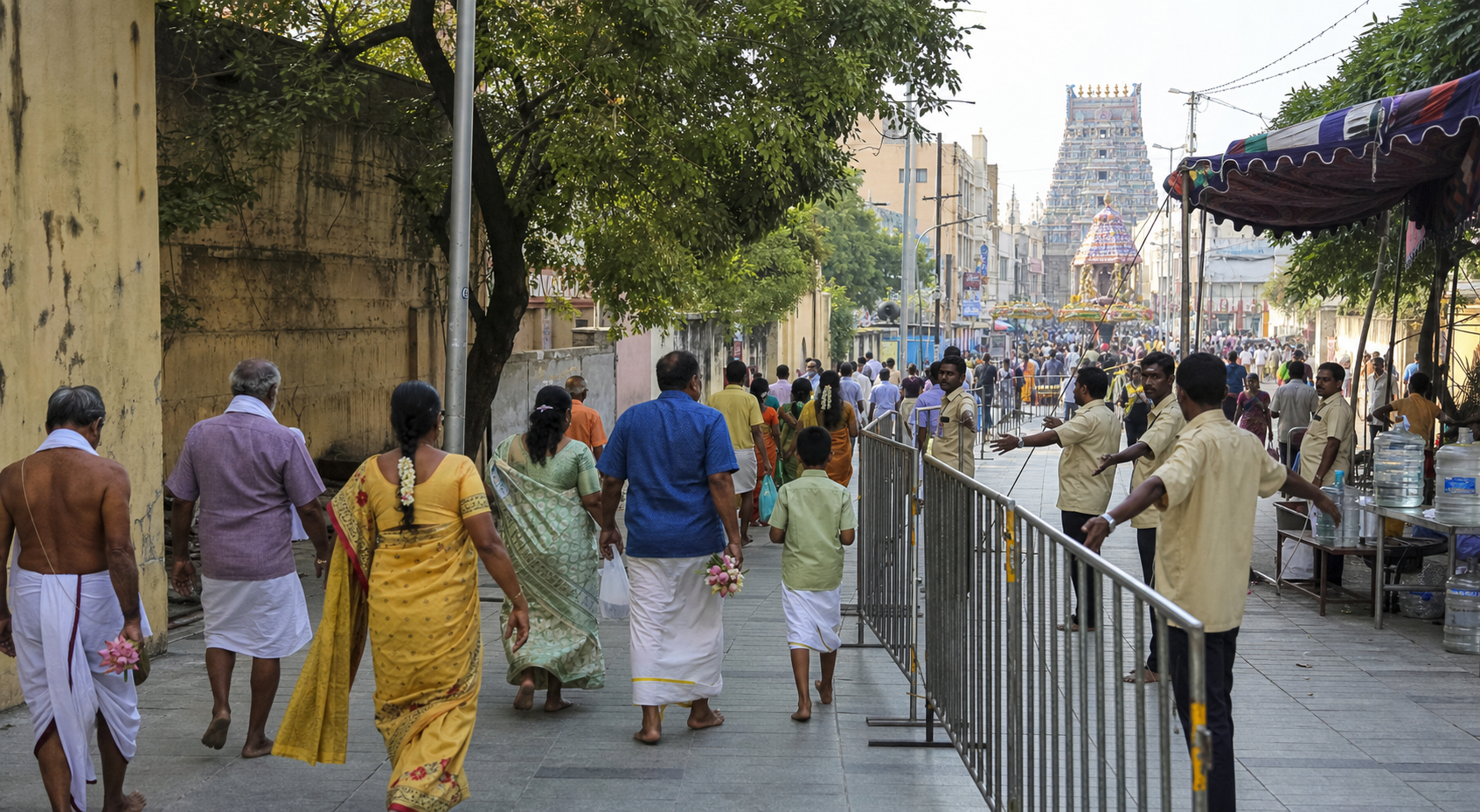
A workable Mylapore visit depended less on fitting in every activity than on respecting the day’s rhythm. The morning, afternoon, and evening demanded different choices.
- Use public transport for the final approach. Thirumayilai MRTS station and the Mylapore bus terminus are within walking distance of East Mada Street. Rathotsavam and Arupathmoovar normally bring traffic diversions and parking restrictions, so a private vehicle can turn the last part of the journey into the slowest part.
- Use the early morning for a calmer darshan. This is the better window for elderly pilgrims, young children, and anyone who finds dense processional crowds difficult. On the opening day, the 7:30 am flag-hoisting made an arrival before the rite especially important.
- Do not spend the hottest part of the day standing without purpose. Pause during the afternoon, rest, and hydrate. Comfortable footwear and modest clothing make repeated walking and waiting more manageable.
- Return for the evening vahana procession if sound and street worship matter to you. Illumination, nadaswaram, thavil, and larger public participation give the evening a more vibrant character than the generally contemplative morning rounds.
- Let local instructions override your preferred position. Follow temple signage and directions from priests and volunteers. Do not block sanctum queues, procession lanes, chariot access, or street junctions in pursuit of a closer view.
- Treat photography as permission-dependent. Rules vary by zone. Flash, intrusive equipment, and obstructive filming are inappropriate near the sanctum and in compressed processional crowds. Journalists and content creators should obtain permission where required and keep worship, not spectacle, at the centre of the record.
- Carry the principle of ahimsa into waste choices. A reusable water bottle and reduced use of disposable plastic lower the burden on a neighbourhood already handling exceptional footfall. Use designated disposal and segregation points where provided.
If members of your group have different crowd tolerances, do not force everyone into one schedule. A quieter morning temple visit and a later street-procession visit can be treated as separate commitments. Choose an agreed meeting point before the crowd thickens, and follow official movement instructions if access routes change.
For any future Brahmotsavam, preserve this method but discard the 2026 dates. First select the ritual experience you value, then verify that year’s temple notice, and only then arrange transport and arrival time. Lunar calculations and operating conditions make copied calendars unreliable.
Key takeaways
- Kapaleeswarar Brahmotsavam 2026 ran for ten days, from March 23 through April 1.
- Dhwajarohanam took place at 7:30 am on March 23, Rathotsavam fell on March 29, and Panguni Uthiram concluded the observance on April 1.
- The exact Arupathmoovar timing should not be guessed from those three anchors; it was issued locally closer to the procession.
- Choose Rathotsavam for the ther and the widest civic participation, Arupathmoovar for the Nayanmar lineage, or Panguni Uthiram for the festival’s theology of sacred union.
- For the busiest processions, public transport, an early arrival, hydration, and compliance with volunteer directions are part of responsible seva.
- The 2026 dates are an archival record, not a calendar for a later year’s Brahmotsavam.
If you are preserving the memory of 2026, begin with the three confirmed dates and leave uncertain details visibly uncertain. If you are preparing for a future edition, decide which form of darshan matters to you and verify the current temple notice before making the journey.
References
