
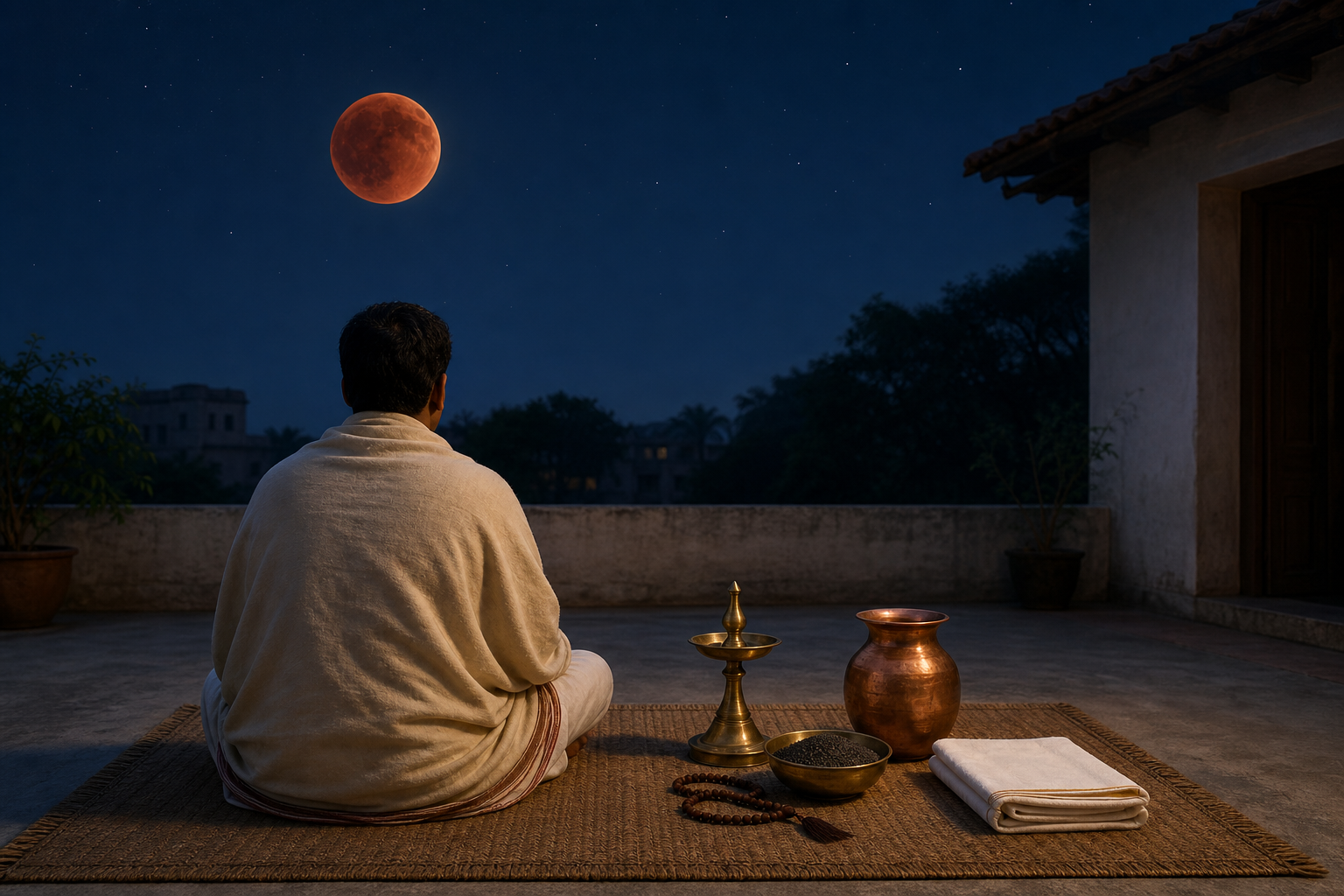
You have the date, but the harder question is practical: which timings do you use, when does sūtaka begin, what belongs inside the eclipse window, and how much of the traditional observance can you responsibly undertake?
For the lunar eclipse of 3 March 2026, the cleanest approach is to settle your local details first and then build a simple sequence around first contact, the eclipse period, and mokṣa. That keeps the observance faithful without turning it into a hurried collection of mantras.
Your local pañcāṅga determines the working timetable
A lunar eclipse occurs at Pūrṇimā when Earth’s shadow falls upon the Moon, but its visibility and contact times are location-dependent. The 3 March 2026 Chandra Grahana therefore does not have one universal ritual timetable that can be copied from another city.
Before writing your saṅkalpa, obtain the following from a reliable local pañcāṅga, temple notice, or observatory timetable:
- First contact, or prathama-sparśa.
- The time of maximum eclipse, or madhya.
- Mokṣa, the end of the eclipse.
- The locally observed lunar month, weekday, nakṣatra, and Pūrṇimā designation.
- The city and country where you will actually perform the observance.
The calendrical framework is Viśvavasu Nāma Saṁvatsara, Uttarāyaṇa, and Śiśira ṛtu. The lunar month is commonly identified as Phālguna, but regional calendar systems can differ. Insert the month, weekday, and nakṣatra supplied by your own pañcāṅga rather than treating the commonly used name as universal. A shorter saṅkalpa with correct details is better than a more elaborate one filled with assumptions.
Clouds do not alter the astronomical contact times. If the eclipse is visible for your location but the Moon is hidden by weather, follow the published local timings. If the eclipse is not astronomically visible where you live, ask your temple or ācārya whether your paramparā prescribes an observance there; practices are not identical across regions.
Turn the observance into four clear checkpoints
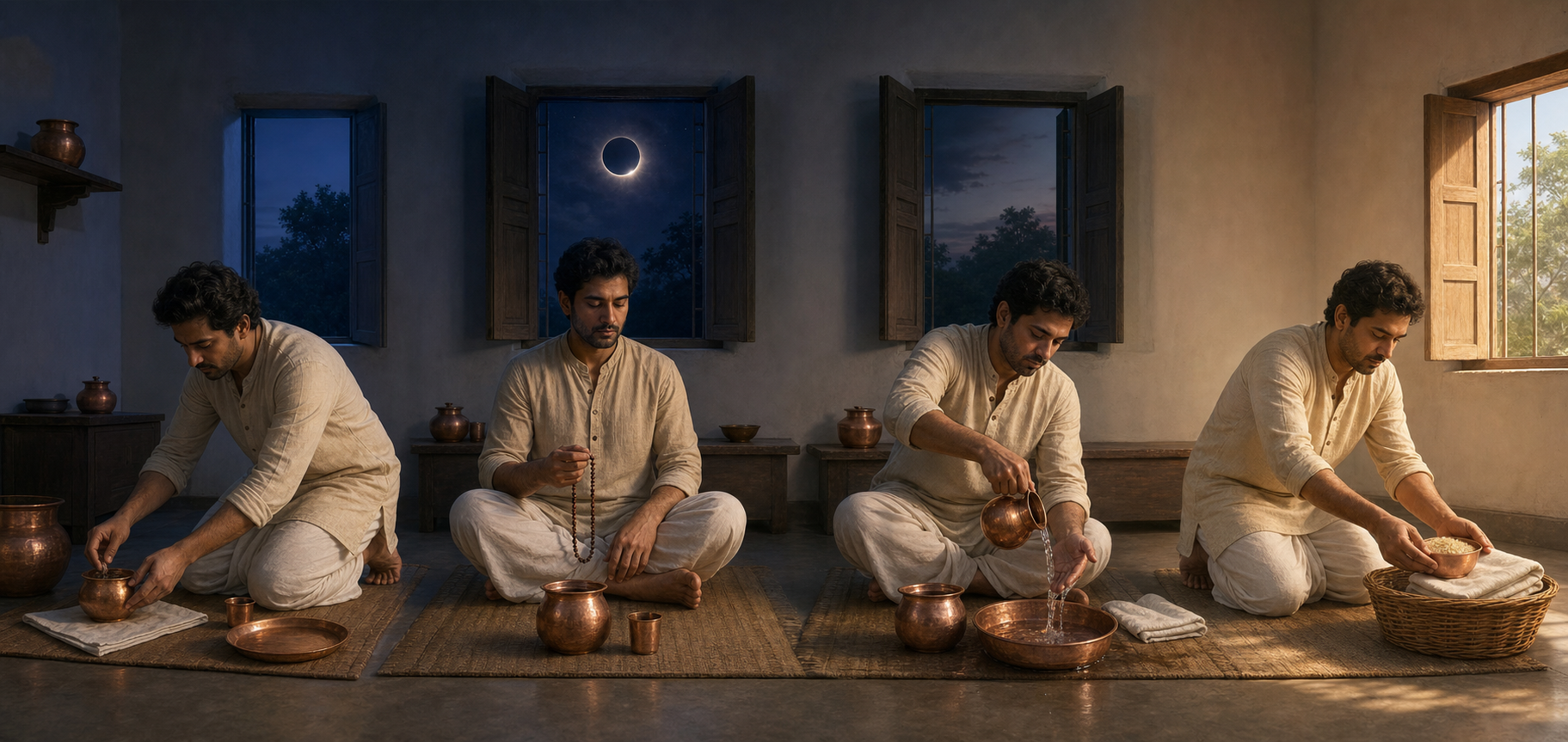
Many Hindu traditions begin lunar-eclipse sūtaka approximately nine hours before first contact. This is a common rule, not a universal one. Children, elderly people, those who are ill, and expectant mothers commonly receive relaxations. Your family or sampradāya may apply these rules differently, so decide the household practice before the window begins.
| Checkpoint | What to do |
|---|---|
| Before sūtaka | Record the local timings, finish food preparation according to household custom, clean the worship space, set out ritual materials, and choose your japa. |
| At or just before first contact | Perform ācamana, state the saṅkalpa, bathe according to your capacity and tradition, and begin japa. |
| During the eclipse | Continue mantra-japa or svādhyāya. Perform tilodaka-tarpaṇa if it belongs to your practice, and make or formally resolve the intended dāna. |
| At mokṣa | Bathe again, change into clean clothes, perform ācamana and samarpana, complete any deferred donation, and then resume food according to your custom. |
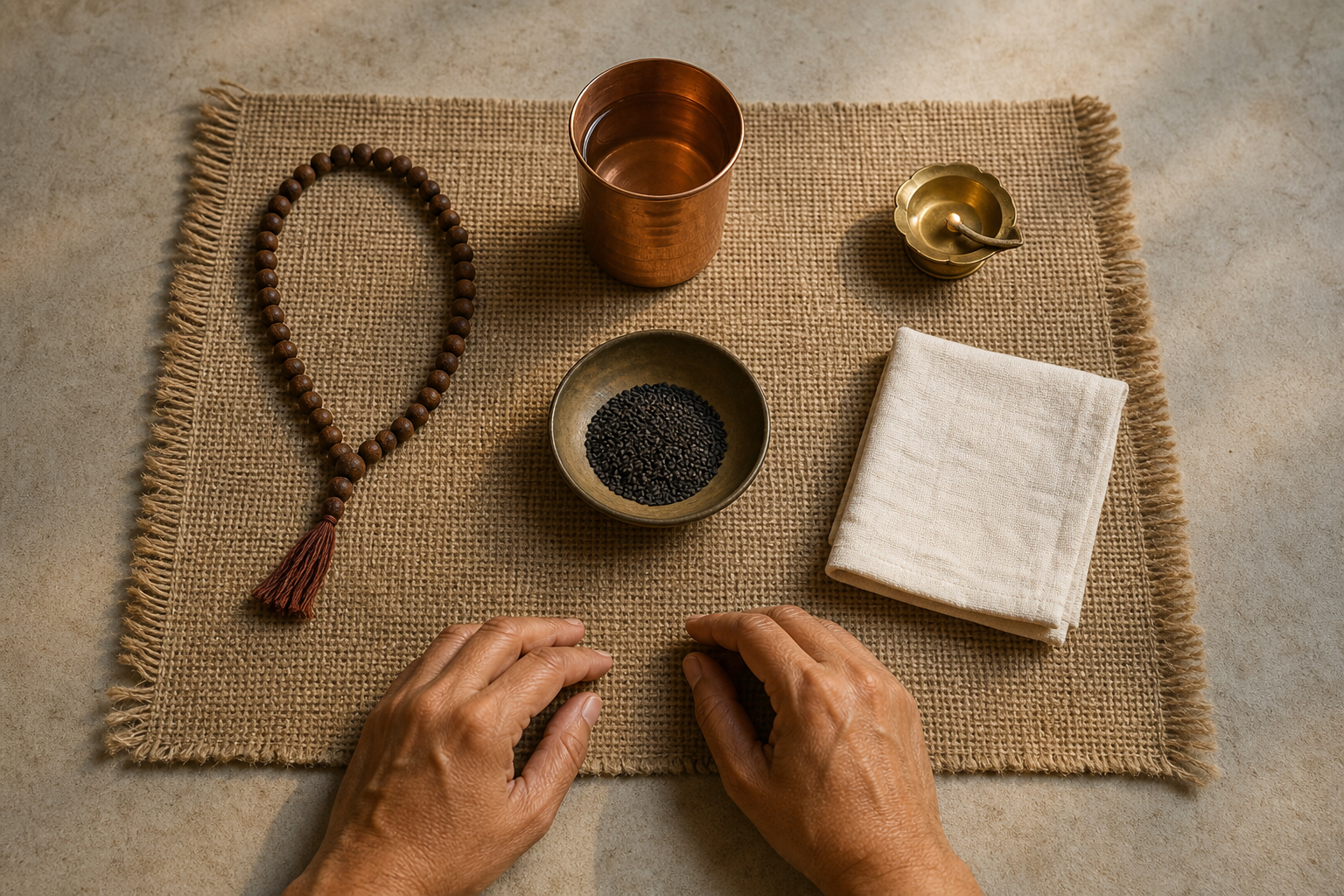
Prepare the physical items before sūtaka so the eclipse itself remains quiet. A practical kit contains:
- A printed or handwritten card with local contact times and pañcāṅga details.
- Kuśa or darbha, if used in your tradition.
- Black sesame and a clean, low bowl of water for tilodaka.
- Your mālā, text, or written mantra.
- Fresh garments for after mokṣa.
- A specific dāna item, or a settled plan for delivering it to a suitable recipient.
Households that observe food restrictions commonly avoid freshly cooked food after sūtaka begins. Prepared food may be protected with darbha or tulasī where that custom is followed. Do not let a household rule interfere with medically necessary food, hydration, or medication. Anyone covered by a health-related relaxation should use it and adopt a lighter practice such as seated japa or mental bathing.
Make the saṅkalpa match what you will actually perform
The purpose of the saṅkalpa is precision of intention. Include your local calendrical details and name only the rites you intend to complete. If you are not performing tarpaṇa, for example, remove tilatarpaṇa from the wording rather than promising an act you have not undertaken.
A concise working form is:
mama upātta-samasta-durita-kṣaya-dvāra śrī-parameśvara-prīty-arthaṁ, asmin viśvavasu nāma saṁvatsare, uttarāyaṇe, śiśira-ṛtau, [māse], śukla-pakṣe, pūrṇimāyāṁ tithau, [vāra-nāmni], [nakṣatra-yukte], [deśa-nāma-deśe], [nagara-nāma-nagare], [gotra], [nāma], chandra-grahaṇa-kāle snāna-japa-dāna-tilatarpaṇaṁ kariṣye.
Replace every bracketed field with the local value. If your paramparā begins with śrī-govinda govinda govinda, retain it. You may also identify the phase as prathama-sparśa, madhya, or mokṣa when the distinction is relevant.
For bathing before the observance and again after mokṣa, these traditional invocations may be used:
gaṅge ca yamune caiva godāvari sarasvati, narmade sindhu kāveri jale’smin sannidhiṁ kuru.
apavitraḥ pavitro vā sarvāvasthāṁ gato ‘pi vā, yaḥ smaret puṇḍarīkākṣaṁ sa bāhyābhyantaraḥ śuciḥ.
During the eclipse, choose one primary mantra that you can sustain attentively. There is no need to switch repeatedly merely to cover more material. Suitable choices include:
- Chandra bīja-mantra: oṁ śrāṁ śrīṁ śrauṁ saḥ candrāya namaḥ.
- Chandra Gāyatrī: oṁ candrāya vidmahe lakṣmī-vallabhāya dhīmahi tanno somaḥ pracodayāt.
- Mahāmṛtyuñjaya mantra: oṁ tryambakaṁ yajāmahe sugandhiṁ puṣṭivardhanam, urvārukamiva bandhanān mṛtyor mukṣīya mā’mṛtāt.
- Your iṣṭa-mantra or customary stotra: use this when it is the practice given by your guru or family tradition.
If the Moon is visible and your local custom permits arghya during the eclipse, offer water respectfully with oṁ candrāya namaḥ, arghyaṁ samarpayāmi. The physical offering should support the inward practice, not interrupt a settled period of japa.
Perform tilodaka-tarpaṇa carefully, then make dāna concrete
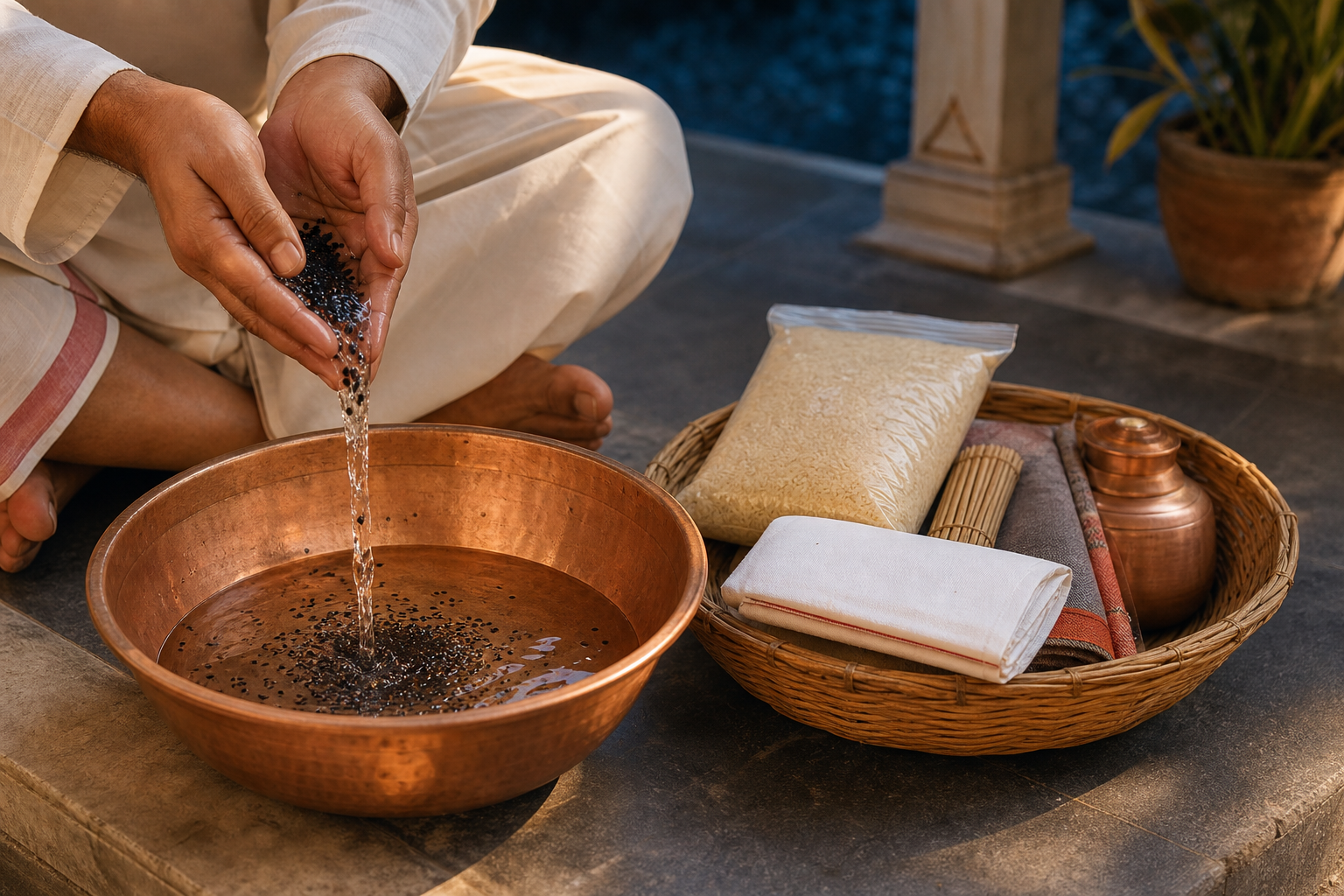
Tilodaka-tarpaṇa joins water and black sesame in an offering for the satisfaction of the pitṛs. Its lineage formulas and eligibility rules vary, so use the full ancestral sequence taught in your family when you know it. If you do not ordinarily perform tarpaṇa and are uncertain about the procedure, use a simple remembrance or seek instructions from your ācārya rather than improvising names and genealogical forms.
- Set a clean bowl of water and black sesame before you. Sit on darbha if that belongs to your practice, facing south where prescribed.
- Perform ācamana and state: asmin chandra-grahaṇe pitṛ-tṛpti-siddhy-arthaṁ tilodakena tarpaṇaṁ kariṣye.
- Add black sesame to the water and make each offering with the right hand in the customary tṛṇita, gently cupped form.
- For a generic offering, recite: oṁ pitṛbhyaḥ svadhā namaḥ. pitṝn tarpayāmi.
- Add paternal and maternal lineage formulas only as your tradition directs. If ancestral names are unknown, the generic pitṛ formula can still be used reverentially.
- Conclude with: etat-kṛtaṁ tilodaka-tarpaṇaṁ pitṛ-prīty-arthaṁ śrī-parameśvara-prīty-arthaṁ samarpayāmi.
A useful correction prayer after the offering is:
yad akṣaraṁ pari-bhraṣṭaṁ mātra-hīnaṁ ca yad bhavet, tat sarvaṁ kṣamyatāṁ deva prasādena parameśvara.
Dāna may be completed during the eclipse where permitted or immediately after mokṣa and the concluding bath. White items traditionally associated with Chandra include rice, milk, sugar, ghee, white cloth, silver, śaṅkha, and water. Choose something useful to the recipient and within your means. An inexpensive needed item is a sounder offering than an impressive object with no practical destination.
You may state the intention as:
idaṁ [vastu-nāma] dānaṁ śrī-candra-deva-prīty-arthaṁ [yogyāya] sampradadāmi. asyā dānasya phalaṁ sarvebhyo bhūtebhyaḥ hita-rūpaṁ bhavatu.
Replace vastu-nāma with the donated item and yogyāya with the suitable recipient. If food preparation or distribution conflicts with sūtaka, set aside the intention beforehand and make the actual handoff after mokṣa, bathing, and closure.
Questions that commonly change the plan
What if clouds hide the Moon?
Use the astronomical timings published for your location. Cloud cover does not move first contact or mokṣa, so you do not need to wait for a visual sighting before beginning or ending the timed observance.
What if you cannot bathe or maintain the usual food discipline?
Use the relaxation appropriate to your health and stage of life. Mānasa-snāna, a mental invocation of purificatory bathing, can accompany seated japa. A limited tilodaka offering may also be made while seated if that is physically manageable. Continue medically necessary food, water, and medication.
What if you do not know your ancestors’ names?
Do not invent them. Use the generic pitṛ formula with sincerity, or follow the non-specific ancestral wording taught in your family. The absence of recorded names need not prevent remembrance.
Do all Dharmic households use this Hindu grahana sequence?
No. Hindu sampradāyas themselves differ, and this sequence should not be imposed on other Dharmic paths. Buddhist and Jain practitioners may intensify lunar-day observances such as uposatha or poṣadha, while Sikh families may centre ardas, kīrtan, and sevā. Follow the discipline of your own path rather than borrowing ritual details without their framework.
Make a one-page observance card before you begin: write the local sūtaka time, first contact, maximum, and mokṣa; fill every saṅkalpa field; choose one primary mantra; and identify one real recipient for dāna. Once those decisions are settled, the eclipse period can be given to japa, ancestral gratitude, and quiet attention instead of last-minute searching.
References
