
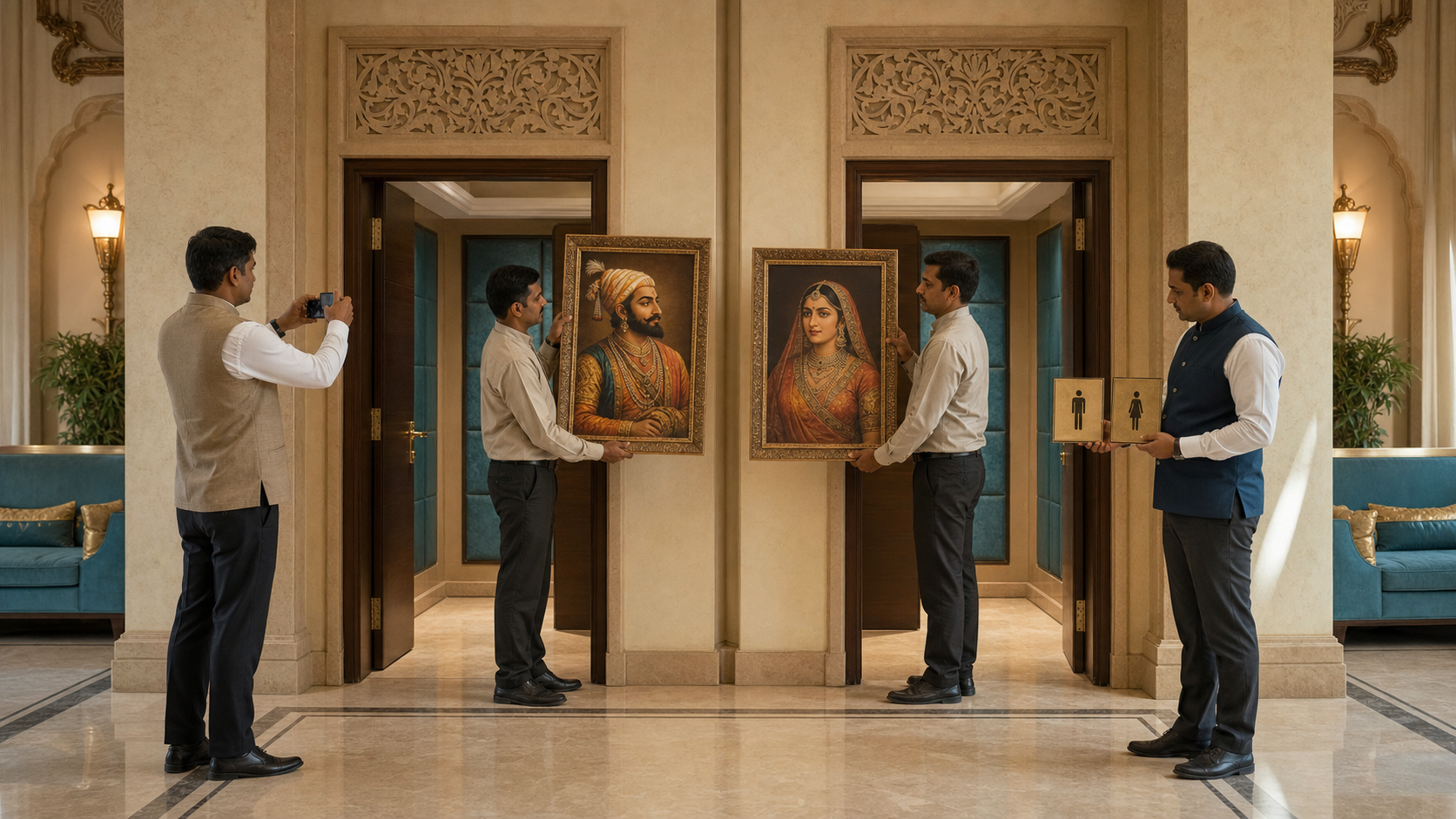
If you find a revered historical figure being used to mark a toilet, waste area, floor, or similarly degrading context, outrage alone will not secure a durable remedy. You need to document the placement, ask for a precise correction, and insist on a process that prevents the same mistake from returning under a different design.
The reported use of portraits of Chhatrapati Shivaji Maharaj and Maharani Padmini as men’s and women’s washroom markers at a banquet hall in Sikri, Haryana illustrates the problem. The most effective response is peaceful but firm: remove the imagery, replace it with neutral signs, establish responsibility for the lapse, and repair the decision-making process behind it.
Why placement can turn recognition into humiliation
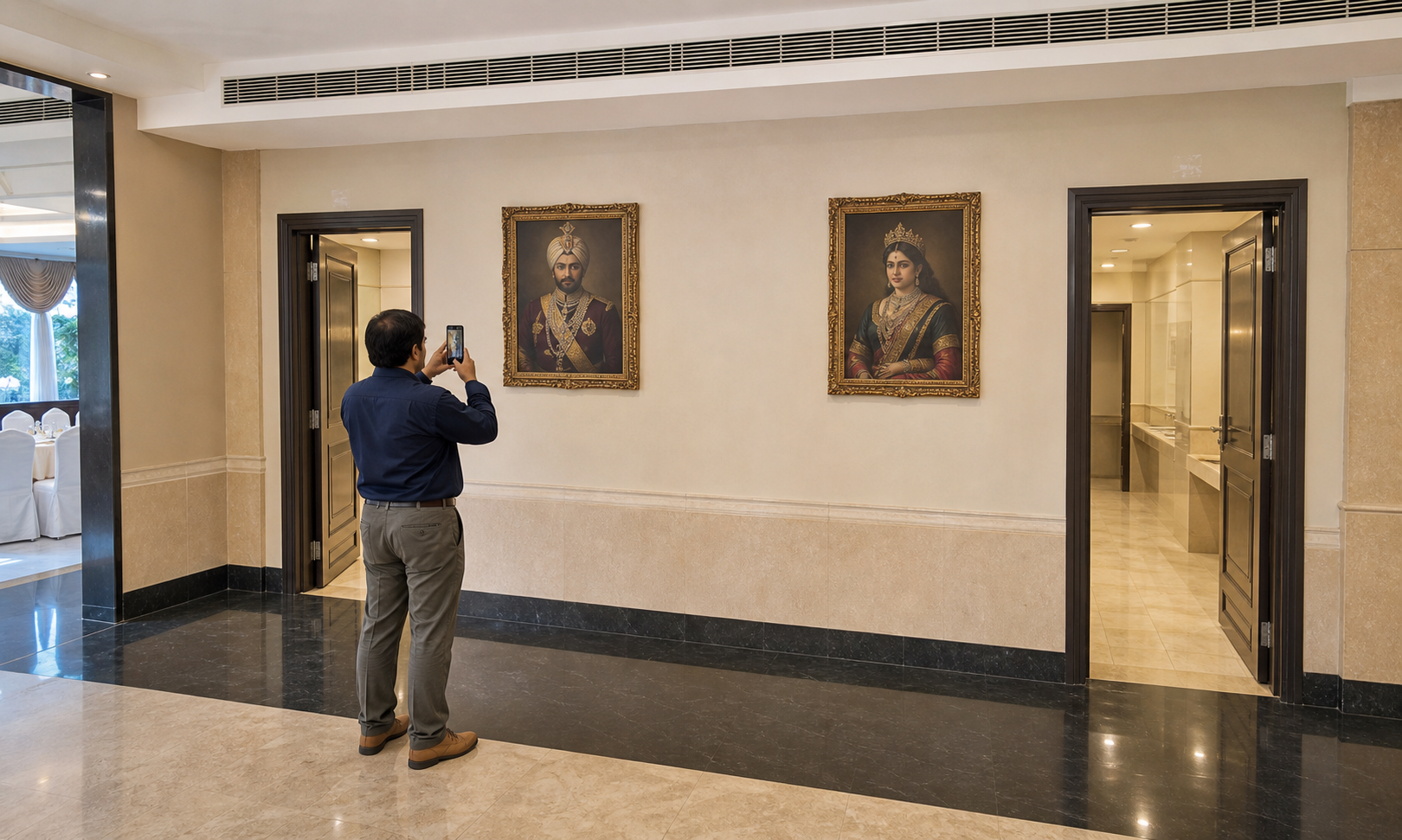
A portrait does not carry its public meaning independently of its surroundings. The same image can communicate reverence in a memorial hall, instruction in a classroom, or commemoration at a public event. Put it on a toilet door as a directional marker, however, and the image is no longer merely showing the person. It is being made to identify the facility.
That distinction is the heart of the matter. The objection is not that sanitation facilities exist or that ordinary human needs are shameful. The objection is that an honoured person has been converted into a visual proxy for a place associated with waste and bodily functions. An arrow, door, caption, and surrounding space combine to create an association that the portrait could not create by itself.
Chhatrapati Shivaji Maharaj is remembered for statecraft, military leadership, administrative ability, and protection of dharmic life. Maharani Padmini occupies an important place in Rajput memory and literary tradition as a figure of honour and civilizational resilience. People may debate particular historical or literary questions, but such debates do not make a degrading commercial use culturally neutral. Public meaning matters when a business turns a person’s image into signage.
Intent should be examined, but it cannot be the only test. An accidental insult still requires correction. At the same time, impact alone does not prove that a designer acted maliciously or committed an offence. Keeping those two propositions together allows you to demand accountability without making an allegation that the available evidence cannot support.
Before approving any use of a revered image, apply this three-part context test:
- Function: Is the image teaching, commemorating, decorating, advertising, labelling, or directing?
- Placement: Will it appear near waste, toilets, footwear, floors, disposable objects, or another setting likely to diminish it?
- Association: What will an ordinary visitor think the image identifies after seeing the caption, arrow, object, and surrounding space together?
If a design fails any one of these tests, do not publish or install it. Replace it with a neutral visual device. This rule should protect the revered figures of every community, not only the figures with whom the decision-maker personally identifies. Reciprocal respect is both a dharmic discipline and a workable standard for shared public spaces.
Respond in the order most likely to secure correction
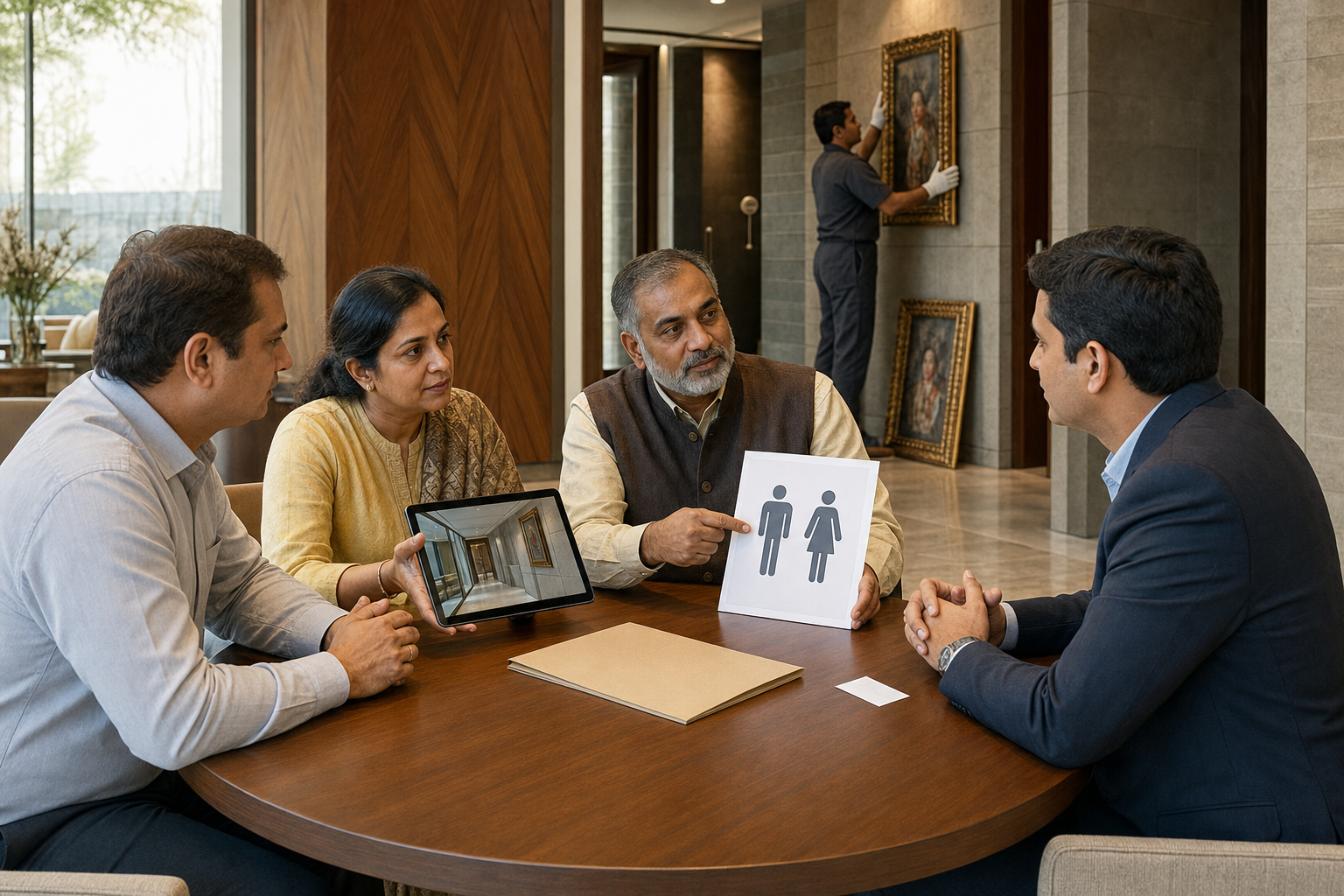
Your immediate objectives should be clear: verify what is present, stop the degrading use, obtain a suitable replacement, and create a record of the corrective action. The following sequence keeps attention on those outcomes.
- Document the complete context lawfully. Take one wide photograph showing the image, door, arrow, caption, and surrounding area, followed by a closer image showing the portrait or text clearly. Record the venue, location within it, date, and time. Do not enter an occupied washroom, photograph guests, trespass, or handle property that is not yours.
- Confirm what you are looking at. Determine whether the display belongs to the venue, an event organiser, or a temporary decoration contractor. This does not excuse the venue, but it identifies who can remove the material immediately and who must answer for the approval failure.
- Speak to the person who can make a decision. Ask for the duty manager, proprietor, event organiser, or facilities lead. Avoid turning a junior employee with no authority into the public face of the incident.
- Request an exact remedy. Ask for immediate removal or covering of the portrait, followed by replacement with text-only signs or neutral pictograms. A general demand to “show respect” is easy to acknowledge without changing anything. A specific removal-and-replacement request produces an answer that can be verified.
- Ask for written confirmation. Request confirmation that the material has been removed, that related signs elsewhere on the premises have been checked, and that future visual content will receive review before installation. Keep copies of emails, complaint numbers, and responses.
- Escalate proportionately if the venue refuses. Use the venue’s formal grievance channel first. Where appropriate, send the documented complaint to the proprietor, event host, relevant municipal or licensing authority, and a credible cultural organisation. Exact administrative jurisdiction varies, so identify the body that actually licenses or regulates the venue rather than sending accusations indiscriminately.
- Keep any public statement factual. Show enough context to establish what happened, but do not expose unrelated guests, junior workers, telephone numbers, home addresses, or other personal information. State what was displayed, where it appeared, what correction was requested, and how the responsible institution responded.
Posting first and verifying later can spread the offending image more widely, misidentify the responsible party, and make a quick correction harder. Give the responsible manager a short opportunity to remove an obvious misuse while you preserve the evidence. If the venue delays, denies what the photographs establish, or leaves the signs in place, the documented record gives a formal escalation substance.
A complaint that is difficult to evade
You can adapt the following wording: On [date and time], at [venue and exact location], I observed a portrait of [name] being used to direct or identify [facility]. The attached photographs show the complete placement and surrounding signage. This context is disrespectful to a figure revered for [brief, accurate reason]. Please remove or cover the image immediately, replace it with a neutral pictogram or text sign, inspect the premises for similar uses, and confirm the corrective action in writing. Please also identify the review measure that will prevent recurrence.
This wording separates observation from inference. It also asks four answerable questions: Was the image removed? What replaced it? Was the rest of the venue checked? What control changed? Those answers matter more than a vague expression of regret.
Make the legal distinction before alleging a crime
Disrespect, ethical misconduct, poor design, and criminal illegality are not interchangeable categories. A placement can be plainly unacceptable without automatically satisfying the elements of a criminal offence. You strengthen a complaint when you describe the observable facts accurately and avoid declaring a legal conclusion before intent and applicable law have been examined.
India’s constitutional and statutory framework distinguishes heritage duties, expression, protected national symbols, and deliberate attacks on religious feelings. Article 51A(f) places value and preservation of India’s composite cultural heritage among the fundamental duties. Article 19(1)(a) protects freedom of expression, while Article 19(2) permits specified reasonable restrictions. These principles supply an important civic framework, but they do not mean that every offensive design is automatically prohibited.
The Prevention of Insults to National Honour Act, 1971 specifically concerns the National Flag, the Constitution, and the National Anthem. The Emblems and Names (Prevention of Improper Use) Act, 1950 deals with specified protected emblems and names. Neither should be cited as though it creates a general prohibition covering every portrait of every historical personality.
Criminal provisions now consolidated under the Bharatiya Nyaya Sanhita may become relevant to deliberate and malicious conduct intended to outrage religious feelings; older discussions may refer to the corresponding IPC framework, including Section 295A. Applicability depends on the facts, the character of the image, the surrounding conduct, and evidence of intent. An insensitive toilet sign and a calculated campaign of religious provocation are not automatically the same legal case.
If you are preparing a formal grievance, police complaint, or legal notice, separate four things on the page:
- What you directly observed and documented.
- Why the placement creates a degrading association.
- What you asked the responsible institution to do.
- What the institution did or refused to do after receiving notice.
Do not describe an individual as malicious, criminal, or anti-Hindu merely because that conclusion feels plausible. Make such an allegation only when evidence supports it and, where legal action is contemplated, after obtaining advice on the applicable law. Threats, intimidation, vandalism, and harassment do not defend the icon’s dignity; they create new victims, weaken the original grievance, and may carry their own legal consequences.
Build a venue protocol that prevents the next misuse
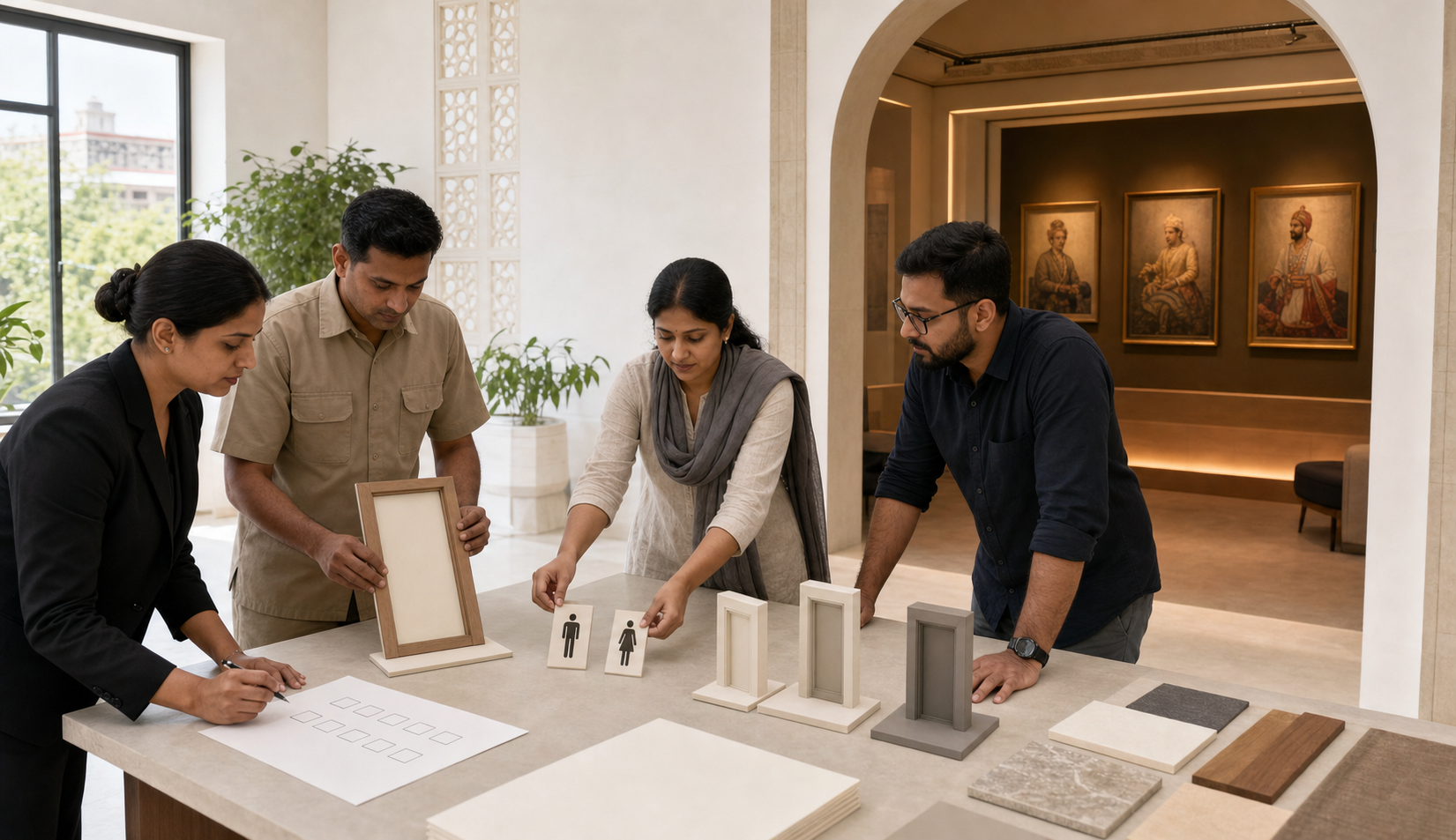
Removing one sign resolves the visible incident. It does not correct the process that allowed a decorator, marketer, or manager to approve it. A responsible venue needs a small visual-governance system that covers permanent signs, temporary event decor, digital screens, social-media creatives, and material supplied by outside contractors.
Use a neutral language for wayfinding
Toilets and other facilities should be marked with clear text and standardized pictograms, including ISO 7001-compliant symbols where suitable. Do not use deities, gurus, saints, national or historical personalities, community stereotypes, or recognisable individuals as substitutes for functional signs. A neutral symbol is easier to understand across languages and does not borrow a person’s identity to label a facility.
Flag both the subject and the setting
A review checklist should identify protected or sensitive subjects before anyone considers aesthetics. At minimum, flag deities, sacred symbols, gurus, saints, freedom fighters, rulers, national icons, and figures carrying deep community reverence. Then flag high-risk settings: toilets, waste bins, floor graphics, footwear-related surfaces, disposable material, and anything likely to be stepped on, stained, or discarded.
The combination is what creates the warning. A portrait may be suitable for an educational exhibition but wholly unsuitable as a door label. A sacred motif may be appropriate on a carefully maintained shrine wall but not on a disposable plate. Reviewers must examine the intended use, not merely approve a clean digital image detached from its final location.
Put one accountable person in the approval chain
The venue’s operating checklist should require:
- A named approver for all public-facing imagery.
- A final walk-through after contractors install signs and decorations.
- A clause requiring decorators and marketing vendors to follow the venue’s cultural-image policy.
- A record of the approved design and its intended physical location.
- A grievance contact that guests can find without confronting staff.
- Authority for the duty manager to remove or cover questionable material immediately while it is reviewed.
For permanent displays or culturally complex themes, a venue can consult local historians, educators, and representatives familiar with relevant dharmic traditions. Routine toilet signage does not require a committee; it requires neutral pictograms and basic judgment. Consultation is most useful where the imagery has a genuine educational or commemorative purpose and context must be interpreted carefully.
Make an acknowledgment prove that something changed
A useful institutional response contains four facts: what was displayed, whether it was removed, how it came to be approved, and what control has changed. It need not attribute malicious intent when none has been established. It should not hide behind intent either. “No offence was intended” does not answer whether the sign remains in place or whether another contractor can repeat the mistake next week.
Brief staff training should use concrete examples rather than slogans. Show employees how an image changes meaning when moved from a commemorative wall to a toilet door, floor, bin, or disposable object. Teach them who can authorize removal and how to record a complaint. Cultural sensitivity becomes operational only when a staff member knows what to notice and what to do next.
Key takeaways
- Judge the complete use of an image – its function, placement, caption, and likely association – rather than looking at the portrait in isolation.
- Document the full context lawfully, then request immediate removal and replacement with neutral text or standardized pictograms.
- Ask for written confirmation, a premises-wide check, and a changed approval control; an apology without those steps is incomplete.
- Do not confuse cultural disrespect with an automatically proven crime. Record facts, preserve evidence, and avoid unsupported claims about motive or liability.
- Reject threats, harassment, doxxing, and damage. A disciplined response protects both the dignity of the icon and the credibility of the cause.
- Apply the same contextual standard to revered figures from every tradition. Consistency turns cultural advocacy into a defensible public ethic.
If you are dealing with a live incident, begin with the full-context photograph and the written removal request. Do not let the matter end when the offending material disappears. Ask what replaced it and what review step changed. That is how a painful lapse becomes a durable standard: quick correction, sound evidence, accountable design, and a rule broad enough to protect the civilizational memory of every community.
References
