
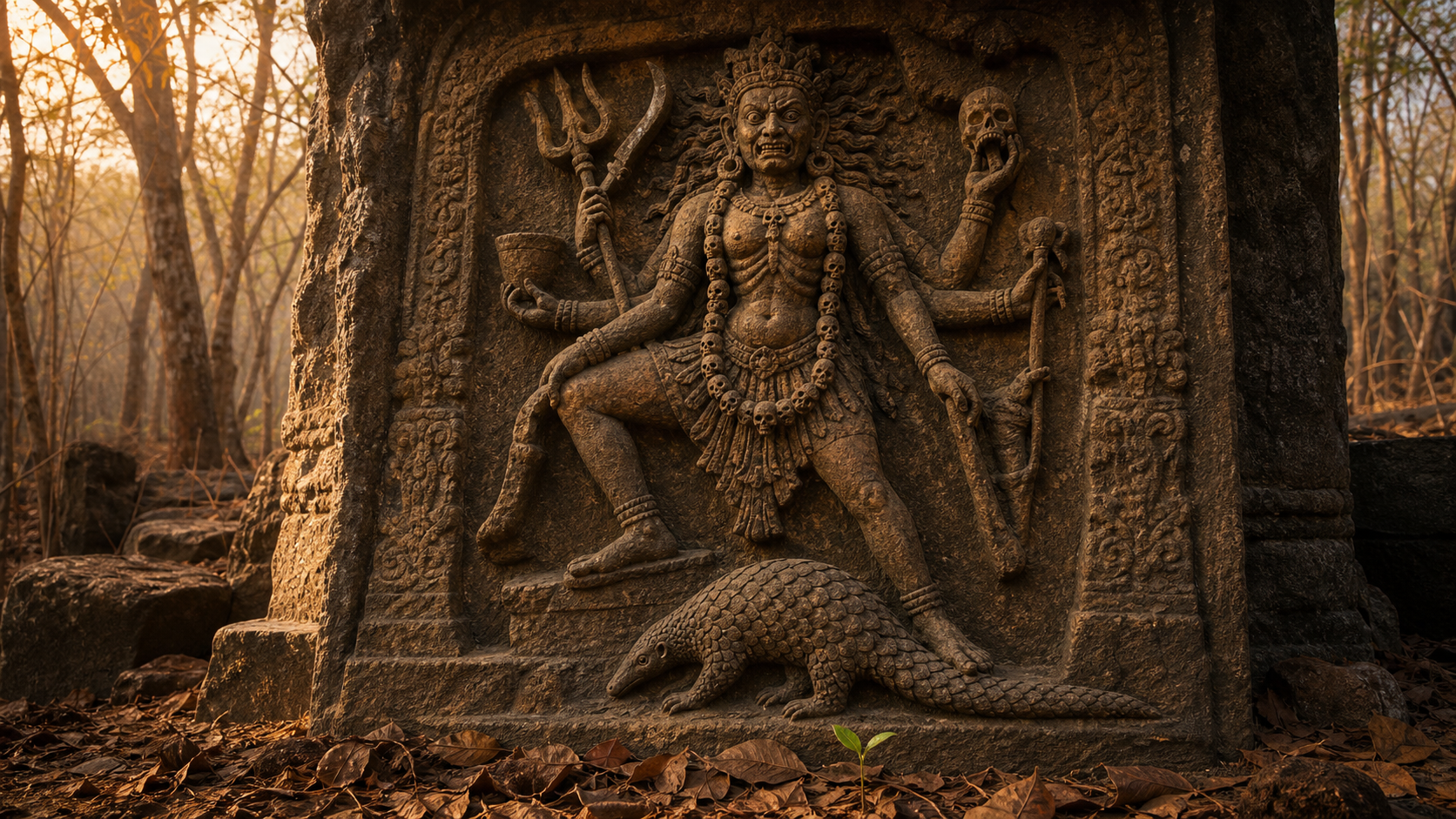
If a temple panel or museum photograph has left you wondering why a small, scaly animal appears beside Chamunda, begin with the stone rather than the symbolism. Overlapping scales, a narrow snout, and a long tapering tail point to an Indian pangolin – not an anteater in the zoological sense.
That correction does more than improve a label. It reveals how regional artists joined Chamunda’s theology of dissolution and protection to the living ecology around them. It also gives you a disciplined way to interpret sacred art without turning a plausible meaning into a scriptural certainty.
Identify the animal before interpreting it
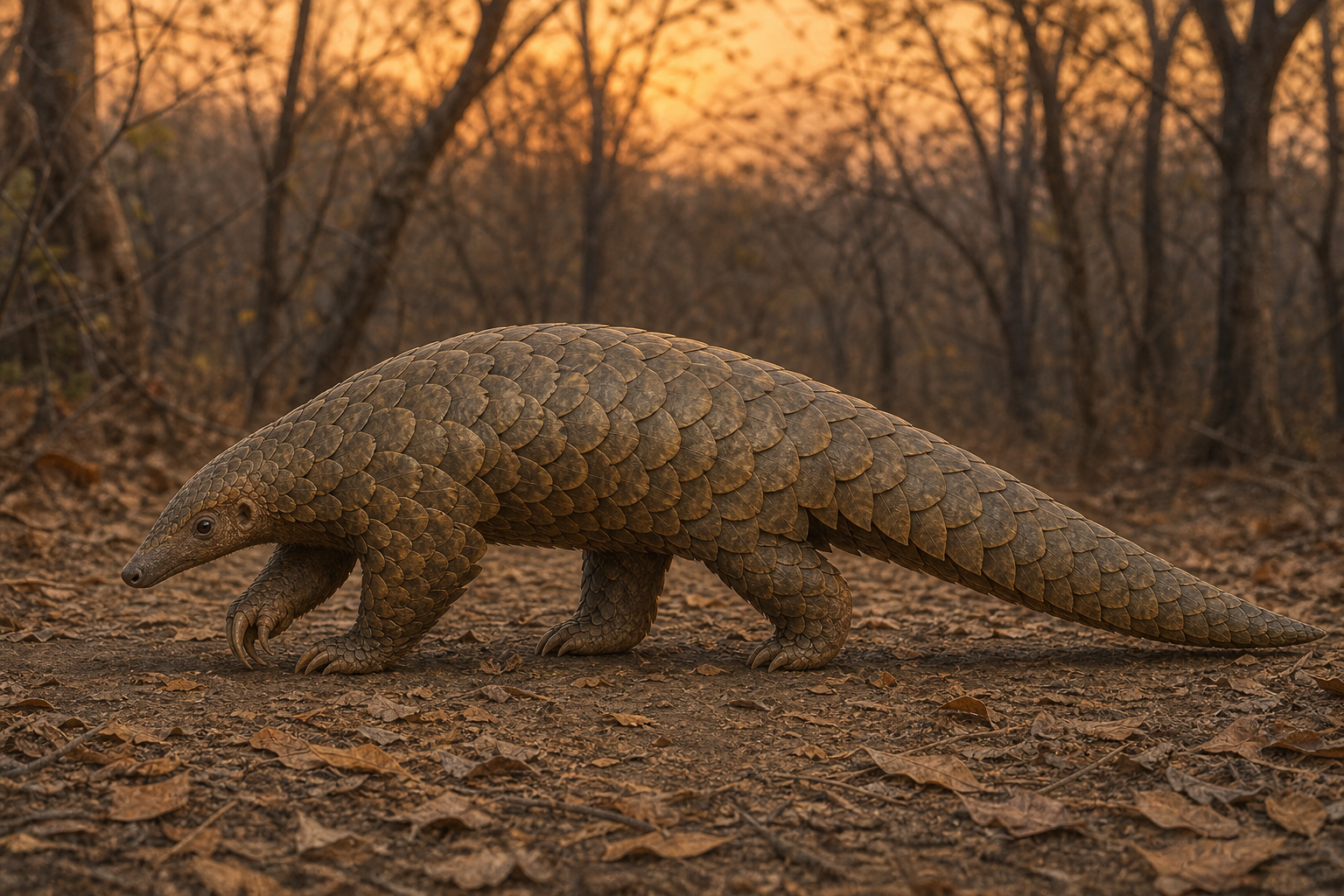
The word anteater is often the first obstacle. India has no true anteaters of the order Vermilingua and no native aardvarks. Older catalogues sometimes used anteater loosely for Indian animals that feed on ants and termites. In a Chamunda image, the two serious candidates are the Indian pangolin, Manis crassicaudata, and, in some cases, the sloth bear, Melursus ursinus.
| Feature to inspect | Probable pangolin | Probable sloth bear |
|---|---|---|
| Body surface | Overlapping chevrons, fish-scale marks, or clearly incised armor | Shaggy or roughly textured body without an orderly scale lattice |
| Head | Small head with a slender, tapering snout | Broader, heavier form |
| Body and limbs | Elongated body; scales are the strongest clue | Robust body, often with prominent claws |
| Tail and posture | Long, tapering tail; the body may curl or coil | Claw-forward, bear-like form rather than a scaled coil |
| Surrounding detail | A domed termite mound can support the identification | No single surrounding object establishes the species |
Weathering can remove precisely the details you need. A smooth, damaged animal should therefore remain an unidentified insectivore-like mammal rather than being forced into a confident species name. Use this short sequence when you inspect an image:
- Read the existing label, but treat anteater as historical shorthand rather than a final identification.
- Look for a repeated scale pattern before relying on the animal’s general silhouette.
- Trace the snout and tail. A narrow snout plus a long tapering tail strengthens the pangolin reading.
- Check for claws, shaggy texture, a curled posture, or a nearby termite mound.
- State a confidence level: Indian pangolin, probable Indian pangolin, or unidentified animal attendant.
Geography can support that judgement, but it cannot replace anatomy. The motif is especially plausible in central and eastern Indian Matrika imagery and in Deccan workshops attentive to local animals. Khajuraho, Bhubaneswar, the Yogini setting at Hirapur, and Hoysala friezes in Karnataka are useful contexts in which to look closely. A location tells you that a pangolin image is possible; visible scales, snout, and tail tell you whether this particular carving is one.
Keep observation, identification, and meaning separate
A convincing interpretation has three layers. The first is observation: what marks are actually present? The second is identification: which animal best fits those marks? The third is meaning: why might an artist have placed that animal beside Chamunda? Trouble begins when the third layer is used to manufacture certainty about the first two.
Textual restraint matters here. The Vishnudharmottara Purana, Shilparatna, Rupamandana, and the Odiya Shilpa-Prakasha emphasize such features as Chamunda’s corpse-seat, owl, and jackal. They do not explicitly prescribe a pangolin-like companion. You should therefore describe it as a regional attendant or associated animal, not automatically as Chamunda’s canonical vahana.
That silence does not make the animal accidental. Regional workshops could use familiar fauna to express wider Shakta themes. It simply changes the kind of claim you can responsibly make: the pangolin reading is an iconographic interpretation grounded in visible form, animal behavior, and theological context, not a rule quoted from a surviving manual.
Once that boundary is clear, several meanings become available:
- Consumption and purification: A pangolin methodically feeds on ants and termites. This can figure Chamunda’s destruction of accumulated samskaras and mala – the many small residues that harden into habit, confusion, and bondage.
- Protection: Its overlapping keratin scales form natural armor. Beside a goddess invoked as protective kavaca, those layers can evoke mantra and Shakti surrounding the devotee.
- Contraction and renewal: A threatened pangolin curls inward. The resulting compact form can recall the bindu, the seed in which expanded form contracts before another unfolding.
- Life at a threshold: A burrowing, nocturnal creature moves between exposed and hidden worlds. That behavior suits Chamunda’s command of liminal spaces, especially the cremation ground and the passage from fear to insight.
- Cosmic process in miniature: Ant and termite settlements are repeatedly built, broken, and rebuilt. A mound can therefore become a small visual field for srishti-sthiti-samhara – creation, maintenance, and dissolution.
- Fierce resemblance: The pangolin’s elongated feeding tongue can recall the protruding tongue of fierce goddess imagery. This is a visual analogy, not evidence that sculptors everywhere intended the same equation.
Do not load every possible meaning onto every carving. Let the visible emphasis guide you. Clearly carved armor makes protection the strongest reading. A tightly curled body foregrounds contraction and cyclic renewal. A termite mound brings construction and dissolution to the front. Selecting the one or two correspondences that the sculpture actually supports produces a better reading than reciting an entire symbolic catalogue.
Chamunda turns a natural detail into a theology of renewal

Chamunda’s setting explains why this particular animal can carry so much weight. In the Devimahatmya, she emerges from Durga’s brow and destroys the asuras Chanda and Munda. Her emaciated form, skull garland, corpse-seat, owl, jackal, and cremation-ground associations place her where ordinary categories fail: life and death, terror and refuge, ending and beginning meet in one form.
If you read only the skulls and corpse, you can mistake Chamunda for a celebration of death. Her samhara is better understood as the ending of forms that have exhausted their dharmic purpose. She cuts through adharma and attachment so that renewal is possible. Her frightening appearance expresses uncompromising protection, not cruelty for its own sake.
The pangolin makes that movement visible at a smaller scale. It enters dark places, consumes minute colonies, protects itself by contraction, and re-emerges. Its ecology does not prove a doctrine, but it gives an artist a locally intelligible grammar for purification, defense, and transformation. The animal is not decorative surplus. It helps translate an immense metaphysical process into a form that someone living within the same landscape could recognize.
This is one reason regional variation in Hindu art should not be treated as corruption of a fixed template. A pan-Indic goddess can retain her theological identity while a local workshop gives that identity the texture of a particular landscape. The constant is Chamunda’s power of dissolution and protection. The animal vocabulary can change with place.
When you encounter the ensemble, read from the whole toward the detail. First note Chamunda’s body, seat, weapons, companions, and setting. Then ask what the unusual animal contributes that the more familiar owl or jackal does not. The pangolin’s distinctive contribution is armored vulnerability: a shy creature survives not by dominating the landscape but by withdrawing into its own protection. That turns abhaya, fearlessness, into something subtler than aggression.
Make sacred ecology a practice of custodianship
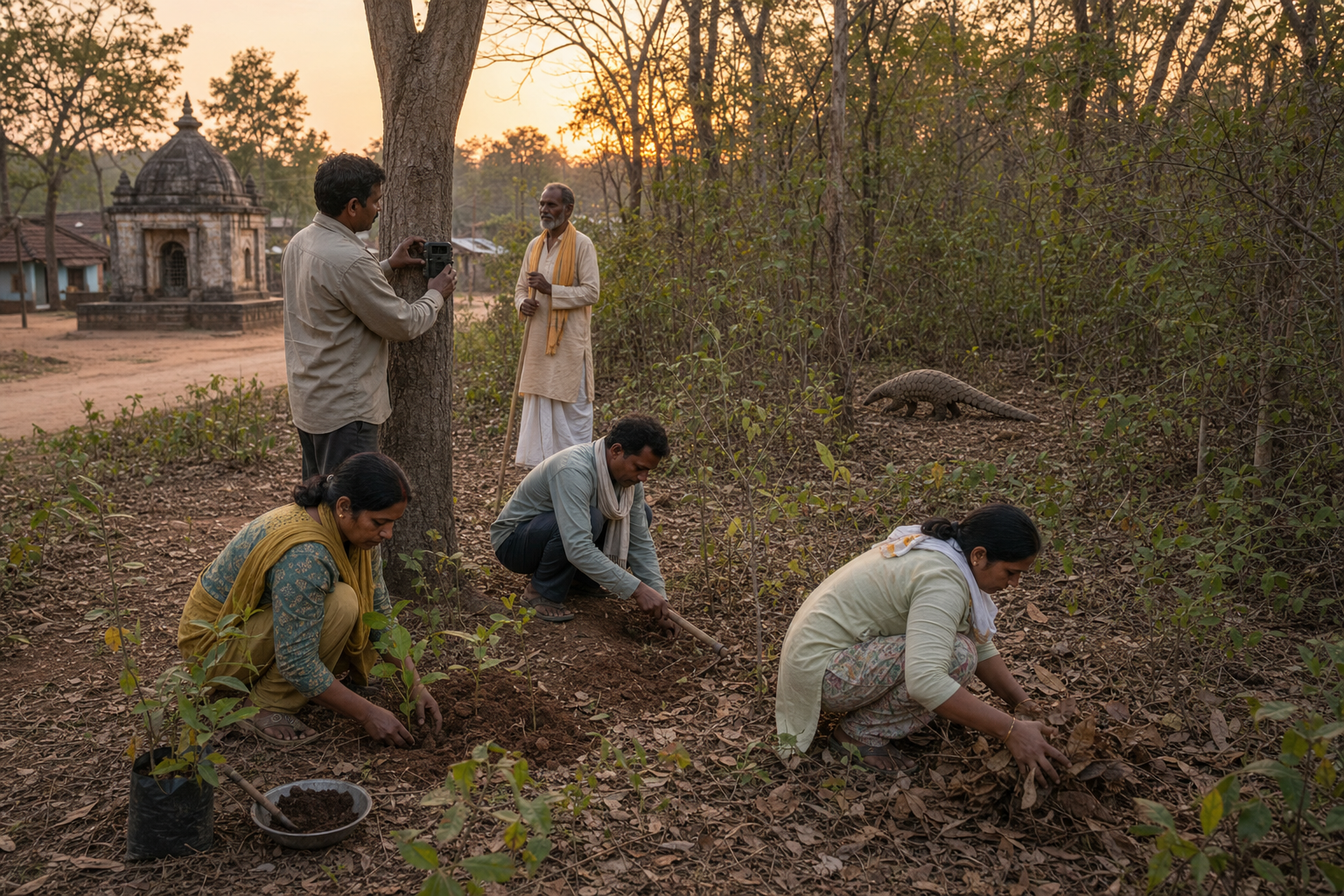
The identification has a consequence outside art history. The Indian pangolin is classified as endangered and is threatened by habitat loss and illicit trade. A sacred image that depends on the animal’s recognizable body cannot be separated entirely from the fate of living pangolins.
Sacred ecology begins with accurate attention. Calling the animal an anteater erases its place in Bharat’s fauna. Calling it a pangolin without examining the carving replaces one careless label with another. The responsible middle path is precise and transparent: name the probable species, show the anatomical basis, and retain uncertainty where stone damage or stylization prevents certainty.
A museum, temple trust, archive, or educator can use wording like this:
Probable Indian pangolin (Manis crassicaudata), shown as a regional animal attendant of Chamunda. The identification rests on its overlapping scales, narrow snout, and long tapering tail. Older records may call it an anteater. Because major iconographic manuals do not prescribe this attendant, associations with protection, dissolution, and renewal are contextual interpretations.
Suggested interpretive label
That label does four useful jobs. It corrects the zoology, explains the evidence, distinguishes an attendant from a prescribed vahana, and prevents symbolic interpretation from masquerading as textual certainty.
You can carry the same discipline into personal and community practice:
- For a temple or museum visit: If photography is permitted, record the whole panel and a detail of the animal. Note the visible scales, snout, tail, posture, and any mound before writing a caption.
- For an archive or social-media caption: Preserve the monument, region, approximate period if supplied by the institution, and current label. Use probable when identification remains uncertain.
- For teaching: Pair the iconographic discussion with the living Indian pangolin. Explain why its form mattered to artists and why the species now requires protection.
- For devotional conduct: Do not seek, purchase, display, or promote objects made from pangolin body parts. Reverence for the sculpted form is hollow if demand contributes to harm against the living animal.
- For a wildlife encounter: Do not handle the animal or confront suspected traffickers. Keep your distance and contact the appropriate local wildlife authority.
This duty can also be expressed across Dharmic traditions without pretending that they are identical. Chamunda is honored in Newar Nepal as one of the Ashtamatrikas within both Hindu and Buddhist religious worlds. Jain ahimsa, Buddhist karuna, and the Sikh disciplines of seva and sarbat da bhala offer distinct reasons to protect vulnerable life. Their convergence lies in conduct: reduce harm, serve the larger community of beings, and refuse to treat nature as expendable.
The strongest conservation message is therefore not that every tradition secretly teaches the same ecology. It is that each contains resources capable of moving its own communities from admiration to responsibility. Chamunda’s pangolin gives Hindu communities a particularly concrete starting point: care for the living being whose scales, posture, and habits helped sacred artists speak about the Goddess.
Key takeaways
- A scaly body, narrow snout, and long tapering tail make the Indian pangolin the strongest identification for many so-called anteaters beside Chamunda.
- A shaggy, robust, claw-forward animal may instead be a sloth bear; badly weathered carvings should remain explicitly uncertain.
- The pangolin is best called a regional attendant, not automatically Chamunda’s canonical vahana, because major iconographic manuals do not prescribe it.
- Its feeding, armor, curled posture, and threshold ecology can illuminate purification, kavaca, cosmic contraction, and the creation-maintenance-dissolution cycle.
- Symbolism should follow visible evidence. Use the carving’s clearest feature rather than assigning every possible meaning at once.
- Correct identification creates an ethical obligation: protect the endangered living animal as well as the sacred image that preserves its form.
On your next temple or museum visit, record three visible traits before accepting or correcting the label. If the figure is probably a pangolin, say why and preserve any uncertainty. Then take the final step the image asks of you: let recognition become protection.
References
