
Someone praises your teaching, your seva, or the way you guided them. You have two easy but unsatisfactory options: absorb the praise as personal property, or reject it so theatrically that the other person must reassure you. Neither response is humility.
Bhakti offers a cleaner response. Accept the person’s gratitude, place your contribution inside the chain of teachers and servants who formed you, and direct the appreciation back toward practice. A. C. Bhaktivedanta Swami Prabhupada demonstrated this in a few decisive moments. His example can change how you honor a guru, receive recognition, exercise authority, and judge whether a spiritual community is truly anchored in parampara.
What Prabhupada did in Vrindavan
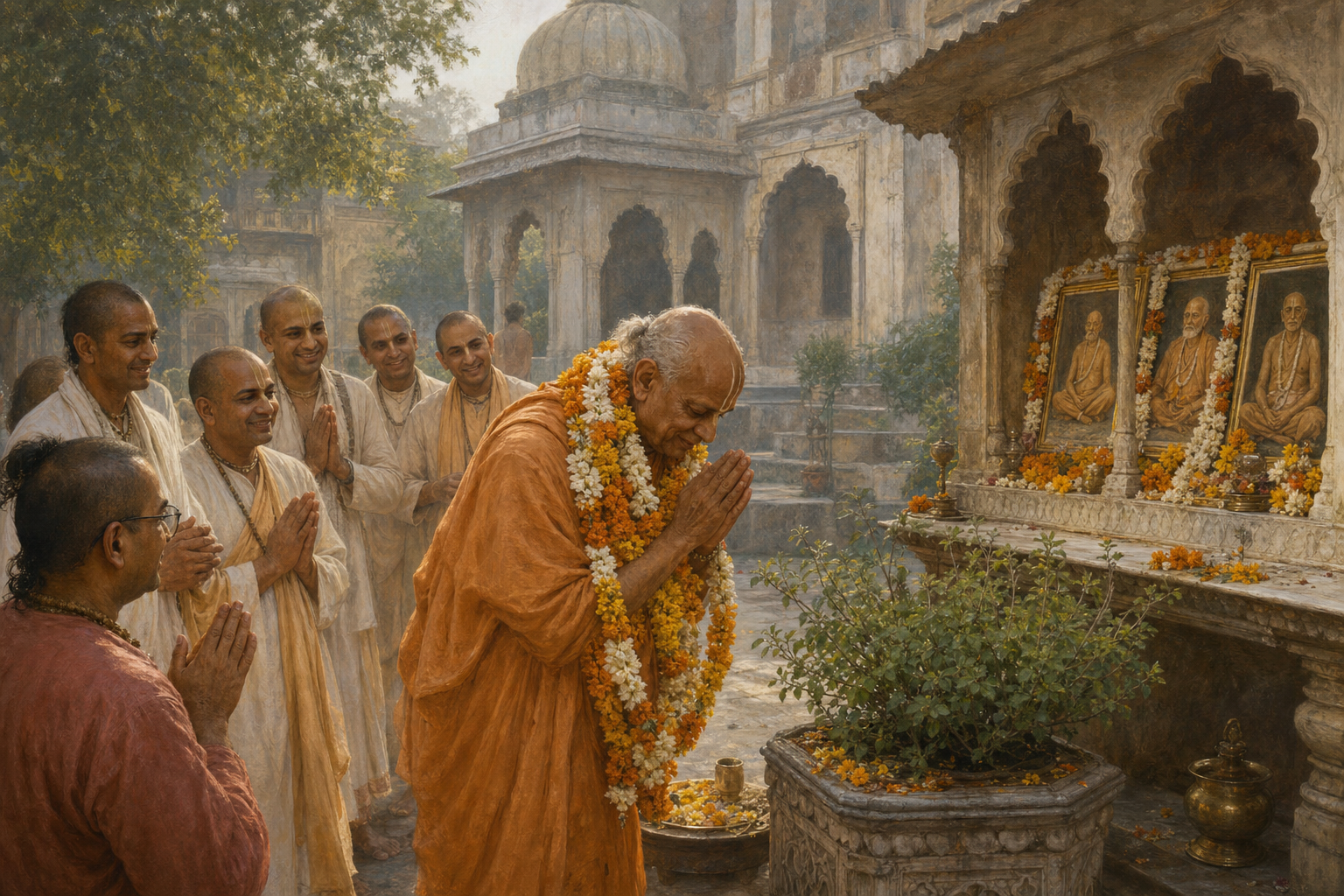
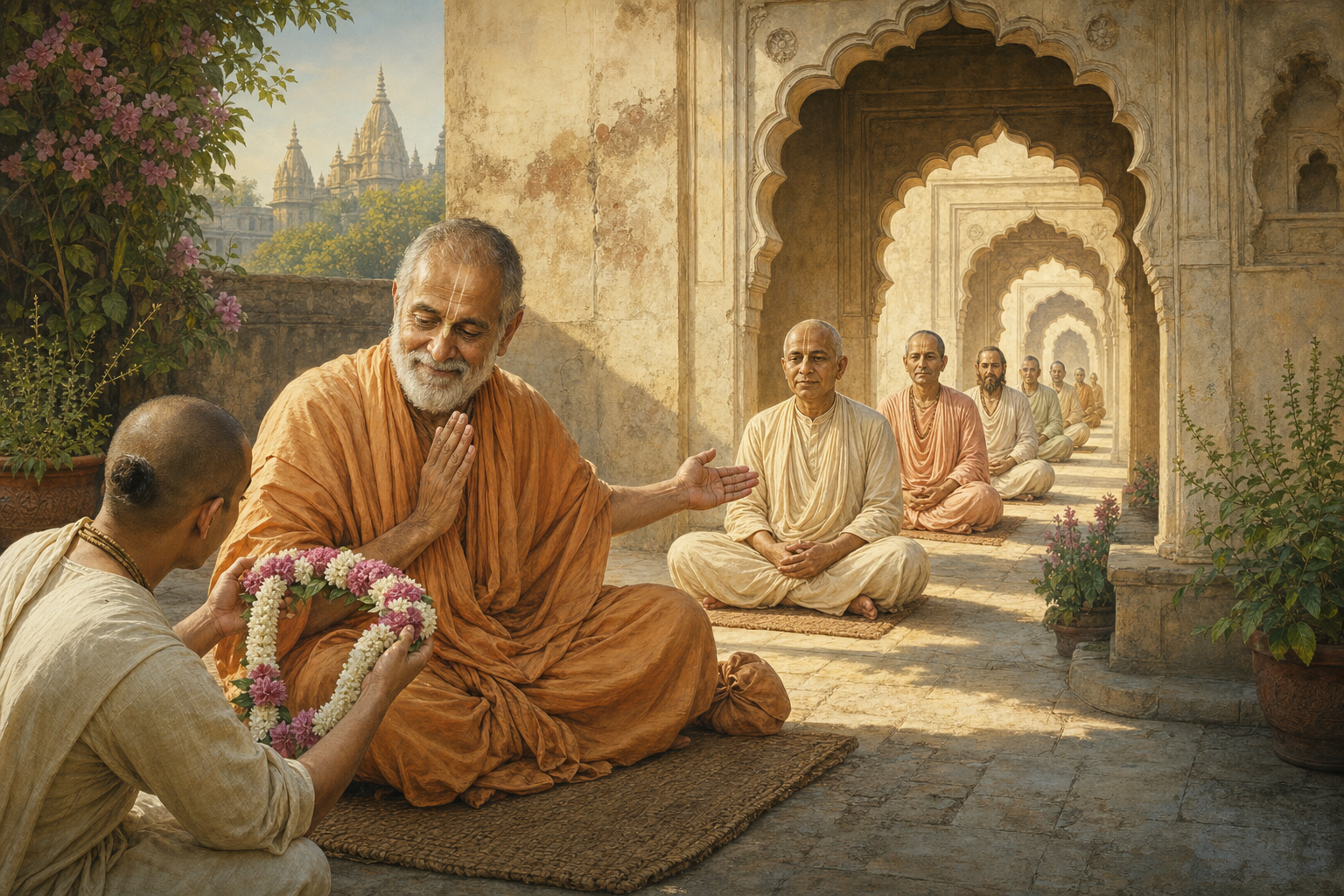
In Vrindavan in 1976, Ranjit Das, also known as Ranji Prabhu, approached Prabhupada to receive Gayatri mantra initiation. He offered pranams and began loudly glorifying his guru. Prabhupada immediately directed those words of honor to his own spiritual master, Bhaktisiddhanta Sarasvati Thakura.
Prabhupada did not rebuke the disciple for showing devotion. He completed the movement of that devotion. The respect reached the guru, but it did not terminate in the guru’s personality. It continued through the disciplic succession.
The setting gives the gesture additional weight. The Krishna-Balaram Mandir had recently been established, ISKCON was expanding, and seekers from India and abroad were gathering in Vrindavan for sadhana, study, service, and initiation. In a growing institution, the way a revered leader receives public praise becomes instruction for everyone watching. Prabhupada showed that spiritual authority is inherited as a responsibility, not manufactured as a personal possession.
There is an important asymmetry here. A disciple should not cite the guru’s humility as an excuse to withhold proper respect. Nor should a teacher cite the disciple’s duty of reverence as permission to collect honor around himself. The disciple offers respect sincerely; the teacher locates it within the lineage. Both actions are necessary for healthy guru-shishya conduct.
Parampara prevents reverence from becoming possession

Humility in this setting does not mean declaring yourself worthless. It means telling the truth about where your knowledge, discipline, and opportunity came from. You may have studied, sacrificed, taught, organized, or served with real effort. Yet the teaching was not invented by you, and its sacred authority does not begin with you.
Bhagavad-gita 4.2 describes spiritual knowledge as received through a succession of teachers. Bhagavad-gita 4.34 tells the seeker to approach a realized teacher through humility, sincere inquiry, and service. These two passages protect both sides of the relationship. The seeker does not treat spiritual knowledge as information to be extracted, while the teacher does not present inherited wisdom as a private revelation detached from those who transmitted it.
Gaudiya Vaishnava practice makes the relationship personal without making it self-enclosed. Gurvastakam trains the devotee to recognize the guru’s mercy as the means by which divine grace becomes accessible. That does not make the guru incidental or interchangeable. It makes his fidelity to guru, shastra, and Krishna central to why he is honored.
This distinction helps when you are deciding whether a teacher or community is lineage-anchored. Do not treat one modest sentence as proof of realization. Watch the repeated direction of attention. Are predecessors and scripture remembered when authority is exercised? Does admiration lead people toward chanting, study, ethical discipline, and seva, or mainly toward access and status? Does the leader accept responsibility for decisions, or use the lineage only when it lends prestige? A pattern tells you more than a performance.
The same civilizational instinct appears in distinct forms across the Dharmic traditions. Buddhists dedicate merit in relation to the lineage and the Three Jewels. Jain vinaya places disciplined humility toward the Tirthankaras and acharyas within right conduct. Sikh nimrata and seva turn the devotee away from self-importance and toward Guru-centered service. Their doctrines should not be collapsed into one system, but they share a practical warning: spiritual attainment becomes distorted when gratitude ends at the individual ego.
Diksha raises responsibility rather than rank

The fact that this exchange occurred around Gayatri initiation is not incidental. In ISKCON, Gayatri initiation typically follows Harinama initiation and marks a heightened commitment to mantra recitation, daily worship, regulated conduct, purity, and attentive service. It is not merely a ceremonial promotion.
The initiate becomes a custodian of sacred practice, not the proprietor of sacred sound. The mantra must be received, remembered, and practiced according to the instructions under which it was entrusted. Turning it into a badge, a spectacle, or material for self-advertisement reverses the purpose of initiation.
Prabhupada’s response also shows how mantra-diksha and siksha belong together. Diksha gives formal shape to the disciple’s practice. Siksha continually corrects the consciousness with which that practice is performed. At the moment a disciple was preparing to accept greater responsibility, Prabhupada demonstrated that greater spiritual access should produce greater gratitude and accountability, not a larger claim to distinction.
If you have received initiation or another serious spiritual responsibility, evaluate its fruit in ordinary life. Is your recitation becoming more attentive? Are you more dependable in service? Is your speech more careful? Can you serve when nobody notices? Are you quicker to acknowledge a mistake? These questions reveal more than a title, clothing, proximity to a teacher, or fluency in devotional vocabulary.
Practice upward redirection without false modesty

When you honor a teacher, praise the transmission
Make your appreciation specific. Name the teaching, discipline, or act of guidance that changed your conduct. Then connect that benefit to the tradition the teacher carries. You might say that an explanation of Bhagavad-gita 4.34 helped you approach seva more seriously, and thank the teacher for transmitting that instruction clearly.
Specific gratitude is usually more truthful than inflated claims about a teacher’s personality. It also helps other listeners understand what to practice. Proper praise should illuminate the path, not merely enlarge the reputation of the person standing on it.
When you receive appreciation, use three movements
First, acknowledge the person’s sincerity. Second, name the teachers, Vaishnavas, texts, and servants through whom the benefit came. Third, return attention to the recipient’s practice. A simple response could be: Thank you. Whatever helped you came through my guru, the Vaishnavas, and the teachings they preserved. Please let it strengthen your own sadhana.
You do not need to recite a long lineage formula every time someone thanks you. The point is orientation, not performance. Nor must you say that you did nothing when you plainly did perform a service. Denying your participation can sound humble while obscuring accountability. Recognize the work, but do not claim sole ownership of its source or fruit.
When you lead, audit where attention lands
After a class, project, festival, or meeting, ask two concrete questions. Whose greatness did people leave remembering? What practice did they leave prepared to undertake? If they remember only the speaker and cannot identify a next step in chanting, study, service, or conduct, the transmission has become too personality-centered.
Correct that tendency at the next opportunity. Credit the people who served, identify the teaching that guided the work, and give participants a definite practice to carry forward. This is especially important when your role gives you control over introductions, testimonials, photographs, titles, or public recognition.
When you make a mistake, do not redirect the blame
Honor may be passed upward, but responsibility for your errors remains with you. Parampara is not a shield behind which a leader can hide a poor decision. State what you did, identify the harm or confusion it caused, make the needed repair, and correct the practice that allowed it.
This distinction is one of the strongest protections against counterfeit humility. A trustworthy servant credits teachers for what is sound and accepts personal responsibility for what he has mishandled. Reversing that pattern – taking credit while distributing blame – is a warning sign, however devotional the language may sound.
Key takeaways
- Honor the guru fully, while remembering that his authority and teaching stand within parampara.
- When praise comes to you, acknowledge the giver, credit those who formed you, and direct attention toward practice.
- Measure initiation by deeper discipline, service, gratitude, and accountability rather than by social rank.
- Judge humility as a repeated pattern, not as a single modest gesture or polished phrase.
- Pass appreciation upward, but keep responsibility for your own mistakes.
The next time someone appreciates your class, seva, counsel, or leadership, pause before answering. Receive the kindness, name the lineage and servants behind whatever was useful, and give the person one practice to carry forward. That brief discipline allows gratitude to deepen without letting the ego claim custody of an inheritance it did not create.
And when you offer respect to a teacher, notice where he directs it. A guru rooted in parampara does not leave you staring at his personality. He helps you see the succession that carried the teaching to him, the duties it now places upon you, and Krishna as the purpose of the entire exchange.
References
