
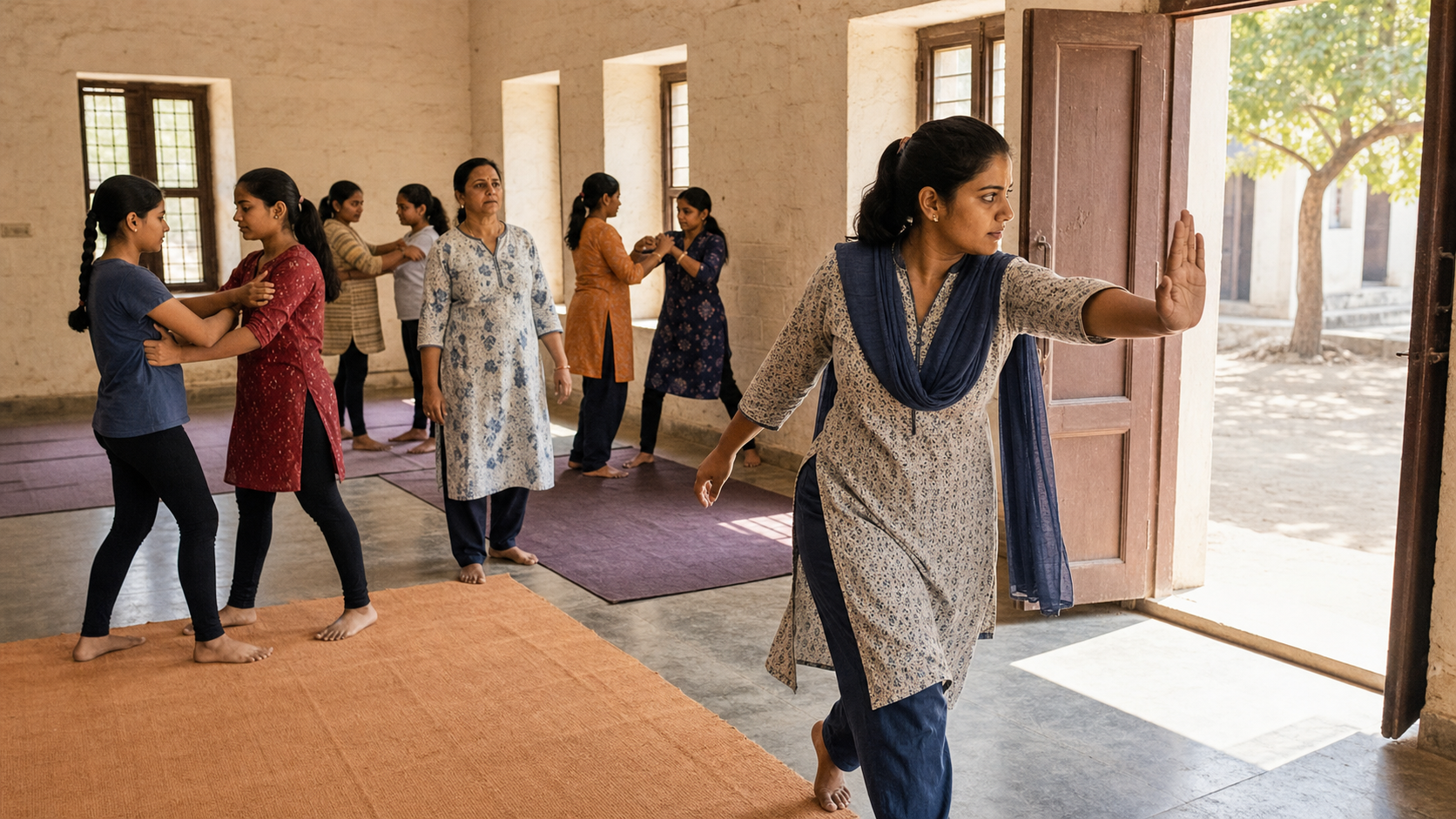
If you are considering a women’s self-defence programme in Jalgaon, do not ask whether a single session will make you fearless. Ask whether you will leave able to notice trouble earlier, state a boundary clearly, move toward safety, and activate the people around you.
The Jalgaon initiative announced for 7 March by the Ranragini wing of the Hindu Janajagruti Samiti, Nari Samarthyachi Navi Pahat, brings practical safety and dharmic heritage into the same programme. That pairing matters. Skill without judgment can become bravado, while heritage without practice can become decoration. Useful empowerment joins awareness, boundaries, escape skills, legal restraint, cultural confidence, and reliable community support.
Make escape, not victory, the test of self-defence
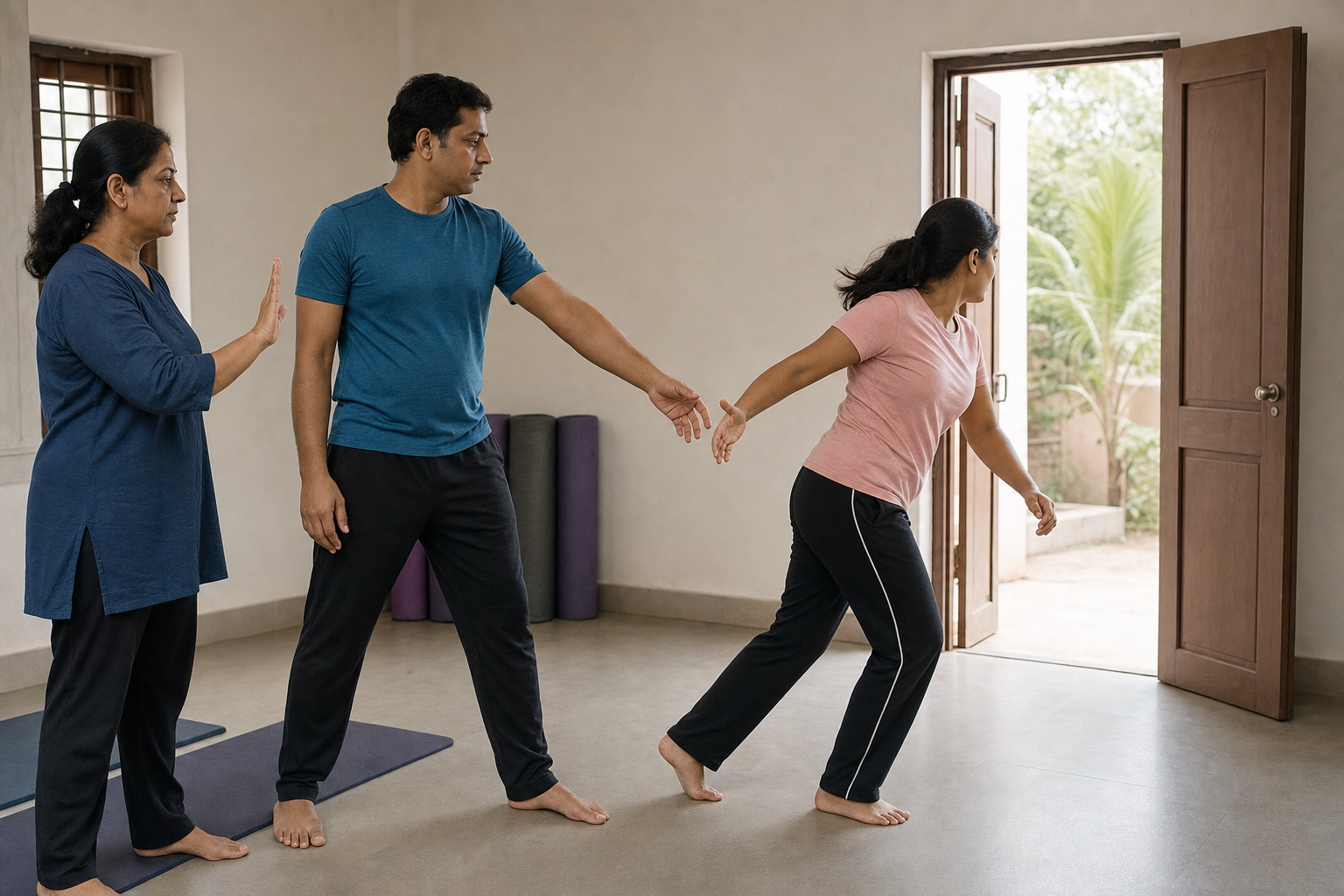
A self-defence encounter is not a contest that you win by overpowering someone. The useful sequence begins much earlier: prevent avoidable exposure, notice a developing problem, create distance, de-escalate when that remains safe, escape at the first workable opportunity, and use physical force only when an immediate threat makes it necessary.
This changes what you practise. A dramatic technique may look impressive in a demonstration, but it is less useful than recognising an exit before you need it, moving without losing balance, or speaking loudly enough to recruit a bystander. The goal is to get home safely, not to punish, prove courage, protect pride, or recover replaceable property.
The OODA loop offers a simple way to organise awareness under pressure. It is a repeating cycle, not a slogan to memorise:
- Observe: Notice exits, bottlenecks, nearby staff, groups of people, and changes in another person’s behaviour. Pay attention without staring or escalating the interaction.
- Orient: Ask what the situation means for you. Consider distance, barriers, your mobility, the safest route, and whether a trusted person can help.
- Decide: Choose the lowest-risk useful action available. That might be changing direction, entering an occupied shop, making a call, stating a boundary, or leaving immediately.
- Act: Move decisively, then observe again. If the person follows, blocks the route, or ignores the boundary, your assessment has changed and your response should change with it.
You can rehearse this cycle without frightening yourself. At a bus stop, market, parking area, stairwell, or community venue, quietly identify a safe direction and someone from whom you could request help. The useful state is neither distraction nor constant alarm. It is enough attention to notice change and enough composure to choose.
Boundary setting should also follow a progression. Create distance while you speak. Use short commands such as "Stay back" or "Do not touch me." Avoid lengthy explanations that invite an argument. Move toward a populated or protected place. If you need help, point to a particular bystander and give a direct task: "Call 112." A request aimed at a recognisable person is harder for a crowd to ignore than a general cry addressed to everyone.
De-escalation does not mean remaining polite while someone repeatedly violates your boundary. It means avoiding unnecessary escalation while preserving your ability to leave. If the conflict concerns only a bag or another replaceable possession, letting go may be safer than becoming tethered to it. If you are being restrained or dragged, the priority changes to breaking contact and escaping.
Practise a sequence your body can recall under stress
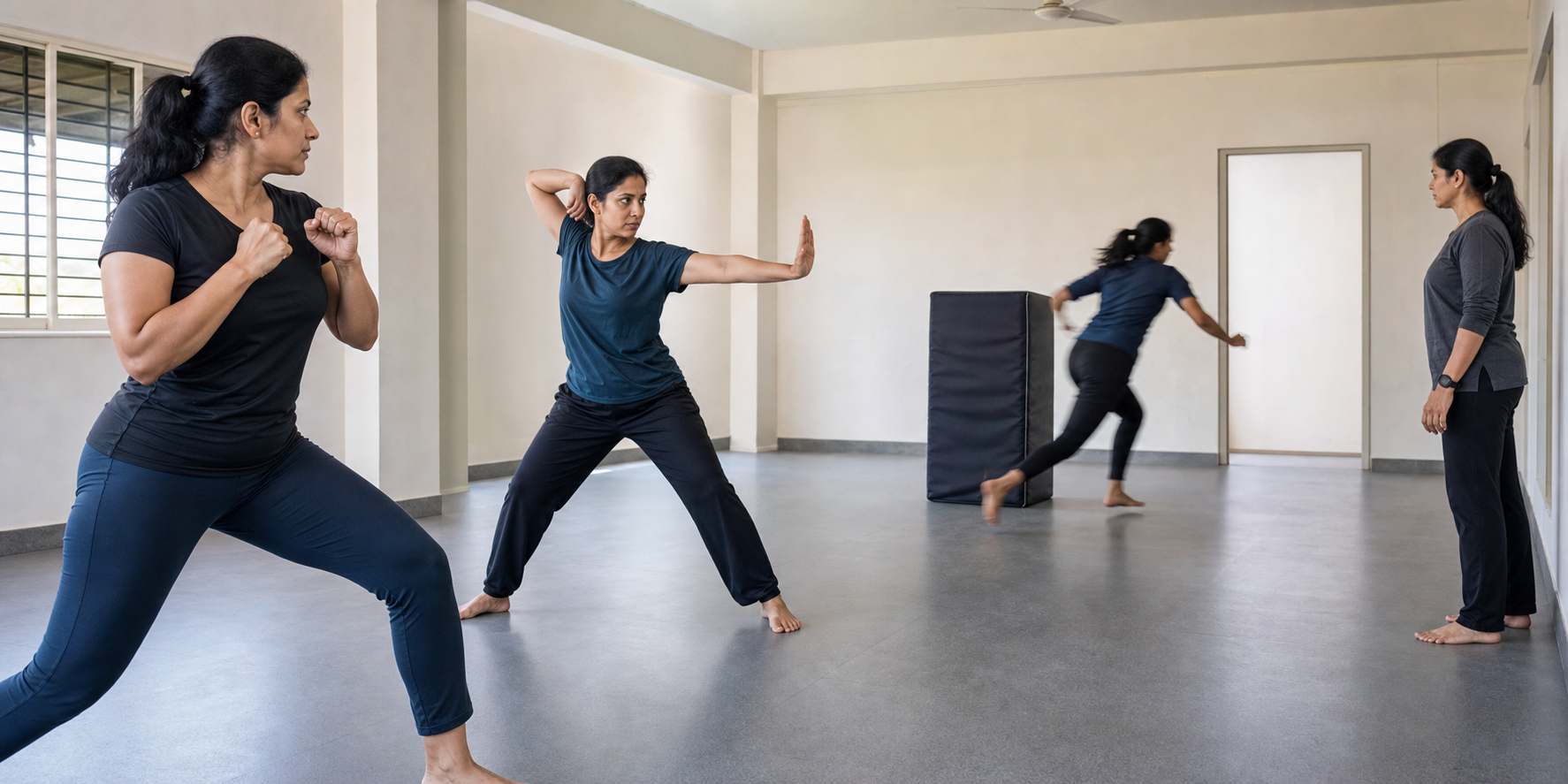
Stress makes complicated movements harder to execute. Training should therefore favour stable posture, gross-motor actions, balance recovery, limb protection, and simple breakaways. These are foundations, not guarantees. Body size, grip, angle, clothing, surface conditions, mobility, and the presence of a weapon can all change what is safe.
A responsible practice sequence should include the whole journey from recognition to safety:
- Establish a stable base. Keep your feet positioned so that you can move without crossing them or being easily pulled off balance. Your hands can remain open and raised between vulnerable areas and the approaching person.
- Join voice to movement. State the boundary while moving toward an exit or safer position. A command delivered from a frozen posture is less useful than one paired with distance.
- Protect and recover. Practise covering vulnerable areas, regaining posture after a stumble, and continuing to move rather than stopping to assess whether a technique looked correct.
- Rehearse common breakaways. Wrist, clothing, and bag grabs should be practised slowly with qualified supervision. No single release works for every grip, so the instructor should adapt the movement instead of promising a universal trick.
- Disengage fully. Once contact is broken, move away, check for another hazard, enter a safer place, call for help, and avoid returning to continue the confrontation.
Good instruction begins cooperatively. Partners agree on the type of contact, practise at low speed, and add resistance only when both are ready. Participants need a clear stop signal, an observer role, and the freedom to decline a drill. Surprise grabs, humiliation, shouting close to someone’s face, or pressure to disclose previous trauma do not prove realism. They remove the consent and choice that trauma-informed teaching is meant to restore.
Inclusive training is not a separate, easier curriculum. It is the same safety objective reached through appropriate variations. A facilitator should be ready to change pace, position, contact level, and verbal explanation for participants with different ages, mobility, health needs, sensory needs, or prior experiences. Someone who cannot perform a standing breakaway may still learn route selection, verbal boundaries, seated protection, bystander mobilisation, emergency calling, and incident documentation.
Judge the session by observable decisions rather than by sweat or excitement. Can you locate an exit without prompting? Can you speak while moving? Can you recover balance and continue toward safety? Can you assign a bystander a specific task? Scenario-based checks reveal whether the sequence is becoming usable. Repeated supervised practice is what turns an introduction into a dependable response.
Know the boundary between defence and retaliation
Legal literacy belongs inside self-defence training because physical ability alone cannot tell you when force is justified. Private defence in India is framed by necessity, an immediate threat, and proportionality. The practical operating rule is straightforward: act to end the danger, use no more force than is needed to disengage, and stop when the immediate threat has ended.
Retaliation is different. Chasing a person after you can safely leave, continuing to strike after the threat has stopped, or using force to punish an insult can create further danger and legal exposure. Escape should remain the priority whenever it is safely available. That is restraint, not weakness.
This is a safety framework, not individual legal advice or a complete statement of the law currently in force. The legality of an action depends on the exact circumstances and applicable law. After a serious incident, obtain advice from a qualified Indian lawyer rather than relying on a remembered section number, a social-media explanation, or a workshop summary.
Once you have reached safety, the next actions matter:
- Call emergency services. Use 112 when urgent police, medical, or other emergency assistance is needed. Give the location, the immediate danger, and a concise description of what happened.
- Attend to injury. Request appropriate medical help. Do not minimise an injury merely because you were able to leave the scene.
- Record facts while they are available. Note the time, place, sequence of events, descriptions, witnesses, injuries, damaged property, messages, and possible camera locations. Distinguish what you directly remember from what someone else told you.
- Preserve material. Keep relevant messages, photographs, call records, and original files. Do not edit material in a way that obscures when or how it was created.
- Contact trusted support. A family member, peer, women’s help desk, healthcare facility, or lawyer can help you navigate the next step without facing it alone.
Do not remain in danger in order to collect evidence. Safety comes first. Documentation begins only when doing it will not expose you to further harm.
Use dharmic heritage as an ethic, not an ornament
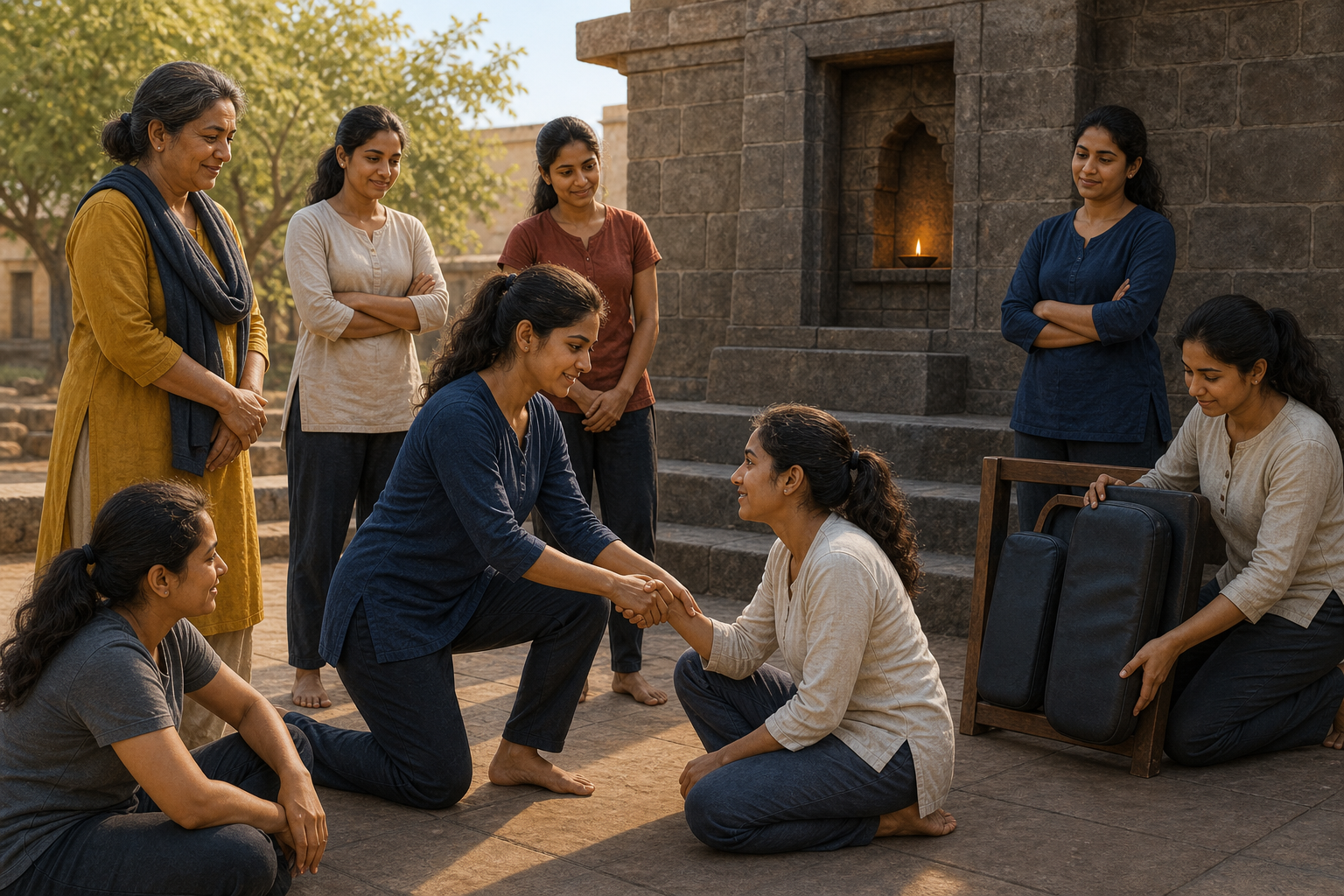
Dharmic heritage strengthens self-defence when it tells you how courage should be used. It should not be reduced to a motivational speech before the physical drills. Nor should every exemplary woman be flattened into the same warrior image. Courage can appear as intellectual independence, disciplined practice, compassion, leadership, service, strategic judgment, or physical resistance.
The dharmic family offers distinct models of agency:
- Gargi and Maitreyi place women’s intellect and voice within Vedic discourse. They are reminders that asking a clear question and refusing an inadequate answer are forms of agency.
- Mahapajapati Gotami represents women’s presence and leadership in the Buddhist lineage, joining spiritual discipline with perseverance.
- Chandanbala provides a Jain model through which courage, restraint, and moral commitment can be considered together.
- Mai Bhago embodies resolve and service in Sikh historical memory, showing that courage is accountable to a community and a cause beyond the self.
- Jijabai and Tarabai bring the discussion home to Maharashtra. Their memory foregrounds stewardship, fortitude, and strategic foresight in public life.
These women should be encountered within their own traditions rather than treated as interchangeable symbols. Their differences are useful. They widen the meaning of strength and make room for Hindu, Buddhist, Jain, and Sikh women to recognise both a shared ethical inheritance and the integrity of their respective paths.
Values can then be connected directly to conduct. In self-defence, ahimsa can guide restraint without demanding passivity in the face of immediate harm. Satya calls for truthful boundaries and an accurate account after an incident. Shraddha supports disciplined practice instead of wishful confidence. Seva turns safety from a private burden into a shared duty.
A facilitator can make that connection practical. After a boundary drill, participants can consider what makes a truthful refusal difficult to voice. After an escape drill, they can ask how restraint distinguishes protection from revenge. During route mapping, they can identify what seva requires from a bystander, family member, neighbour, or community organiser. Heritage becomes relevant when it improves the next decision.
Key takeaways: turn a session into a safety system
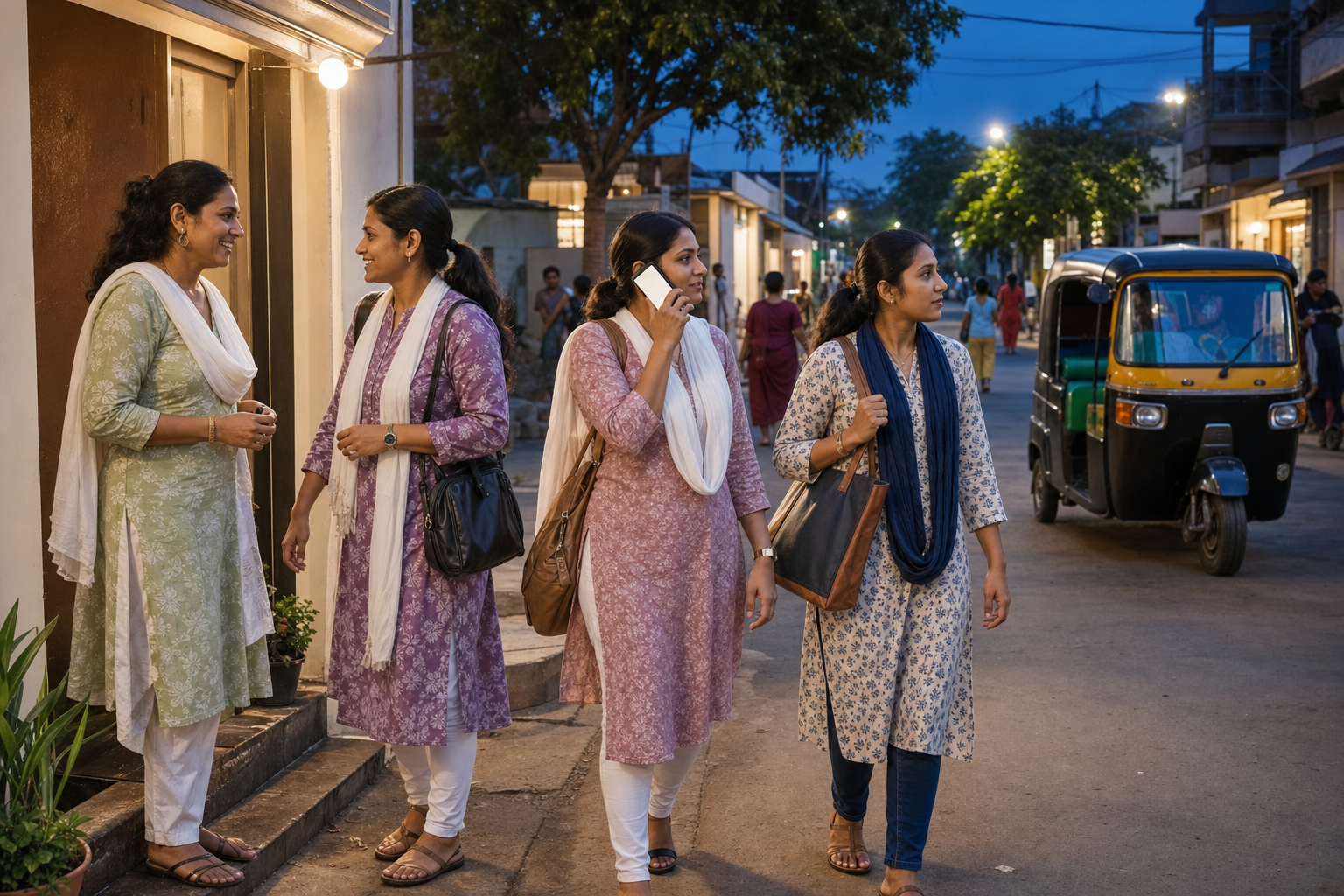
- Arrive ready to move. Wear comfortable clothing and secure footwear, carry water, and bring any necessary medical aid. Tell the facilitator privately about movement or contact limitations that affect safe participation.
- Bring support when permitted. Attending with a trusted peer or family member gives you someone with whom to repeat the drills and build shared safety habits afterward.
- Evaluate the teaching. Look for supervised practice, consent before contact, low-speed instruction, adaptable movements, clear stopping rules, and an emphasis on escape. Be cautious of promises that a technique always works.
- Practise the whole sequence. Awareness, boundary, movement, breakaway, escape, emergency contact, and reassessment belong together. A physical release without a safe destination is incomplete.
- Keep your right to opt out. You may decline contact, observe a drill, request a variation, or stop. An opt-out is not failure; it is part of learning to exercise choice under pressure.
- Map local support. Save 112, identify trusted contacts, and note relevant police outposts, women’s help desks, and healthcare facilities before an emergency occurs.
- Create a peer safety circle. Agree on check-ins for higher-risk routes or timings, who responds to a missed check-in, and when emergency help should be contacted. Keep personal routes and schedules within the trusted circle rather than an open group.
- Make chaperoning voluntary. A trusted companion system should expand women’s mobility and confidence, not become surveillance or a reason to restrict them.
- Measure usable change. Compare confidence before and after training, test awareness through scenarios, and follow up on whether participants remember emergency and reporting pathways. Satisfaction alone does not show that a safety skill can be used.
Do not leave with inspiration alone. Before you go home, rehearse the awareness-to-escape sequence again, exchange details with a trusted peer, and decide where safe supervised practice will continue. That is the standard worth carrying forward in Jalgaon: not the absence of fear, but the ability to act clearly, lawfully, and in solidarity when it matters.
References
