
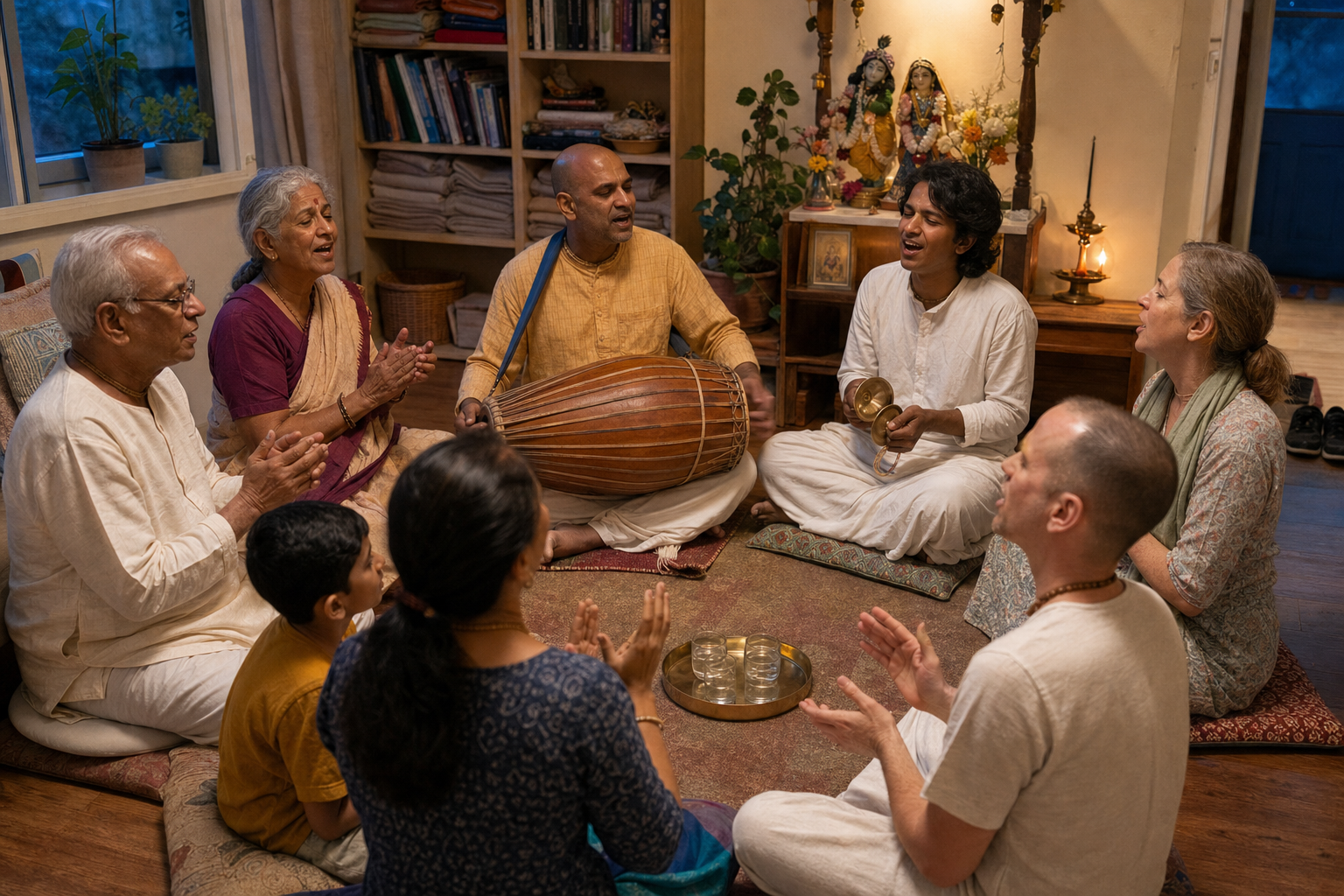
Your japa may be steady, yet the people around you still practise alone. Perhaps the nearest temple is far away, family schedules rarely align, or interested friends have nowhere informal to begin. You want to open your home, but you do not want to create another busy group chat or a gathering that disappears after its first burst of enthusiasm.
Your first goal is not to reproduce a temple in your living room. It is to establish a dependable circle in which the Divine Name, dharmic learning, mutual care, and seva recur often enough to shape relationships. A home becomes a spiritual centre when its sacred rhythm survives the novelty of starting.
Make a promise your household can actually keep
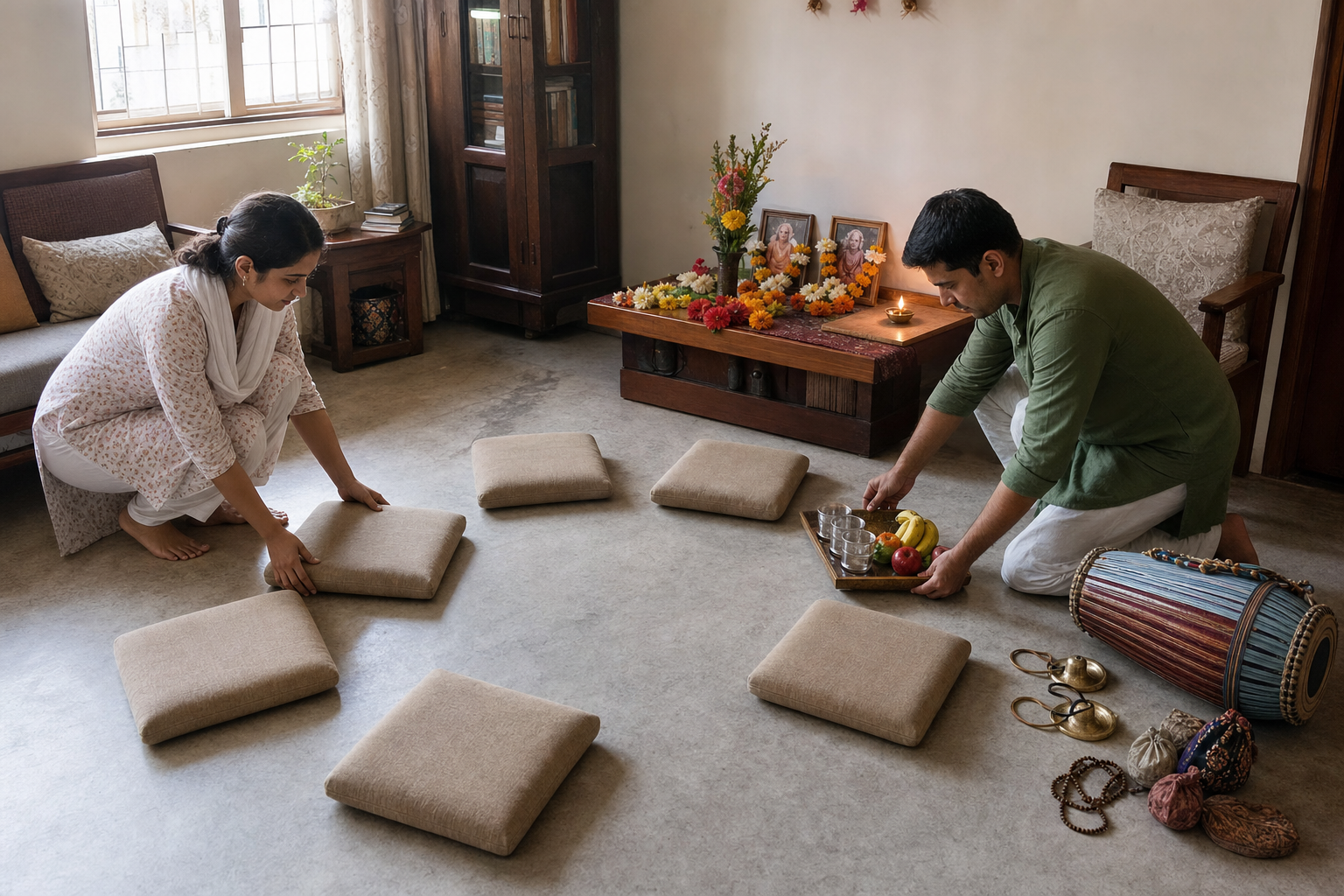
Begin with the people who already live in the home. Agree on which room will be used, what must be moved, how sound will be managed, who will clean, and when the gathering will end. If the household experiences every satsang as an invasion, the programme will eventually compete with grihastha-dharma instead of expressing it.
Choose a weekly or fortnightly cadence that you can maintain during ordinary weeks, not merely during festival season. A modest gathering that happens reliably forms stronger habits than an ambitious event whose date keeps changing. Set the next date before the current gathering closes.
The physical centre can be simple: a clean, designated place with a lamp, a murti or sacred text, and suitable seating. Grandeur is unnecessary. Cleanliness, predictability, and attention tell guests that the space has been set apart for sādhana. Keep shoes, coats, food service, and children’s belongings from gradually taking over that sacred area.
Give the gathering an honest identity. If it is a Gaudiya Vaishnava Harinama satsang, say that plainly. If it centres on Rama-nāma, name that commitment. If it is an inter-Dharmic neighbourhood gathering, explain which tradition will lead each practice. Clarity is more welcoming than vagueness because a newcomer knows what participation means and can listen respectfully without pretending prior belief.
Your invitation should answer the practical questions people hesitate to ask: which nāma will be chanted, whether beginners may simply listen, whether children are welcome, what kind of food will be served, when the programme ends, and whether seating can be adapted. Do not promise a universal spiritual experience. Promise a well-hosted opportunity to chant, learn, serve, and meet others.
Let the Divine Name organise the whole gathering
Harinama is not background music for a social evening. Nāma-tattva holds that the Name and the Named are non-different: sacred sound does not merely point toward Bhagavān but participates in divine presence. That is why clarity, attention, sincerity, and ethical conduct belong to the practice. When chanting becomes a decorative opening before the supposedly important discussion, the centre loses its organising principle.
A stable programme does not need many elements. It needs a coherent movement from arrival to remembrance, reflection, service, and hospitality.
- Receive people personally. Greet newcomers at the door, show them where to sit, and introduce them to someone who can quietly explain the programme.
- State the purpose. Name the mantra or Divine Name, offer its meaning within the relevant lineage, and make it clear that a guest may chant, follow silently, or listen.
- Begin with accessible saṅkīrtana. Use a melody the group can follow. Call-and-response works because nobody needs a songbook or musical training before joining.
- Make room for attentive japa. Audible, soft, and mental recitation are recognised modes of practice. Encourage a relaxed posture and clear enunciation; offer beads where appropriate without turning another person’s count into a public test.
- Read a short, relevant passage. Choose scripture that illuminates the Name, the conduct expected from a practitioner, or the seva being planned. Facilitate reflection instead of delivering an unrelated lecture.
- Move from remembrance to responsibility. Name one concrete community need and let participants volunteer without pressure.
- Share prasāda and close when promised. Informal conversation can continue, but parents, elders, and working people should be able to trust the published end time.
Resist the urge to change mantras, melodies, readings, and formats at every meeting. Repetition is not a failure of creativity. It allows the words to move from novelty into memory and from memory into daily conduct. A person who was unsure during the first gathering should be able to return and recognise the path through the programme.
Dharmic hospitality does not require syncretic dilution. Sikh Naam Simran, the Jain Namokar Mantra, Buddhist recollection and mantric practice, and Hindu Harinama all demonstrate a civilisational confidence in disciplined sacred remembrance. They are not interchangeable techniques stripped of theology. In a multi-tradition gathering, introduce each practice by its own name, preserve its context, and invite someone grounded in that tradition to lead it. In a specifically Vaishnava gathering, welcome Sikh, Jain, Buddhist, and other Hindu guests as honoured participants without disguising the centre’s Vaishnava character.
The test of Harinama appears after the sound ends. Does speech become less careless? Does the host become more patient? Do participants notice an absent elder, share food, reduce harm, and keep commitments? Across Dharmic paths, remembrance is joined to conduct: seva and self-discipline in Hindu practice, honest work and sharing in Sikh life, ahiṃsā and vows in Jain discipline, and moral training in Buddhism. If the gathering produces enthusiasm but no corresponding responsibility, deepen the practice before expanding the audience.
Turn repeat attendance into belonging, not recruitment
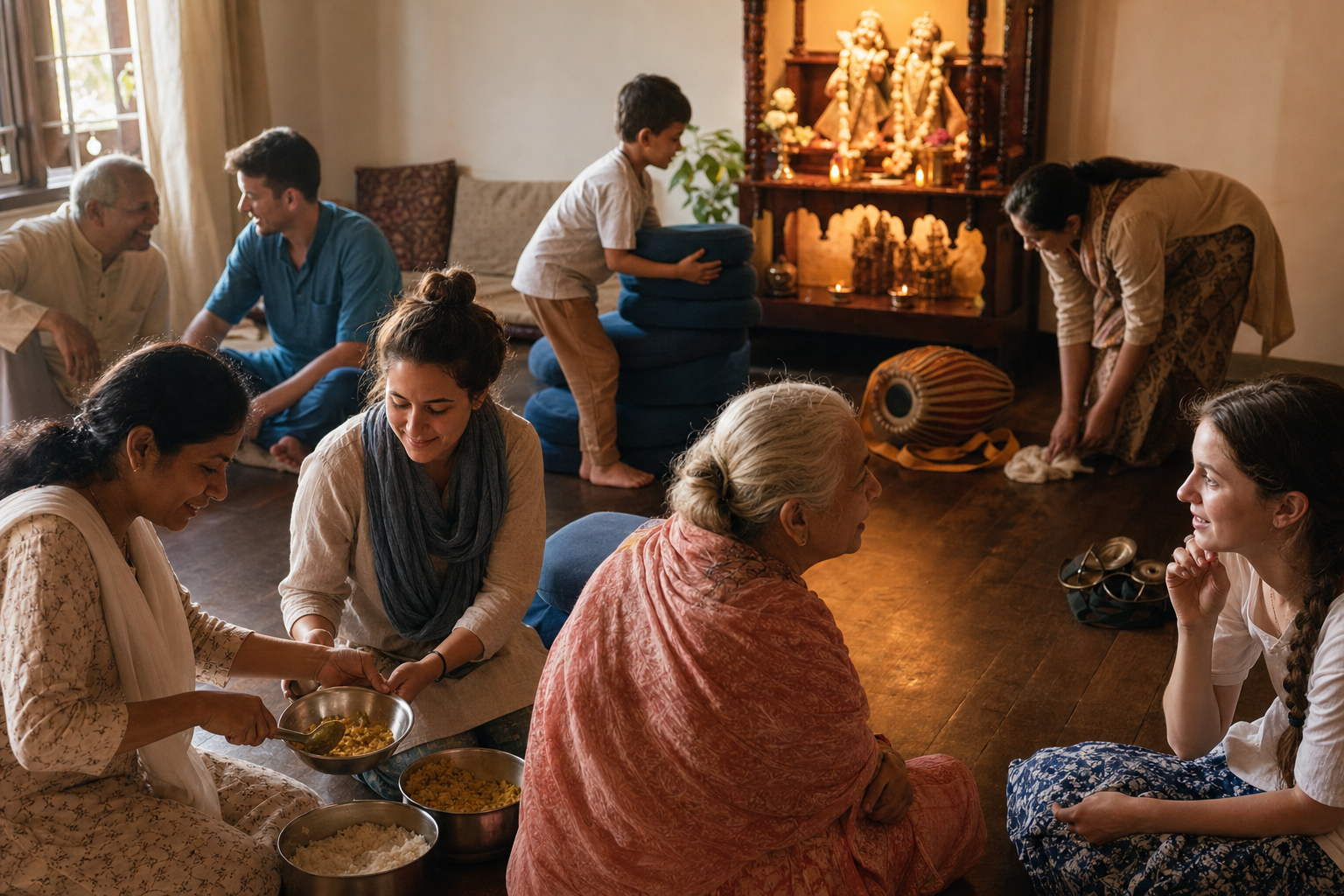
Shared melody, call-and-response, and coordinated breathing can create an immediate sense of togetherness. That feeling matters, but it is not yet a sangha. Belonging develops when people are remembered, trusted with useful work, and cared for between meetings.
Distribute the work from the beginning. One person may host, another lead Harinama, another guide the reading, another organise prasāda, another coordinate seva, and another check on people who need care. These roles need not become titles. Their purpose is to make responsibility visible and prevent the most charismatic or conscientious person from becoming indispensable. Rotate roles gradually so that developing leaders can first observe, then assist, and finally lead with support.
Offer micro-seva before asking for major commitments. A newcomer can welcome arrivals, bring an ingredient, prepare the reading, help an elder find a seat, manage the footwear area, or send the next reminder. Small service reveals reliability and aptitude without forcing anyone into a position they do not understand. Someone who is hesitant to speak may be excellent at care; a young participant may be ready to manage music or prepare a short reflection; an elder may quietly anchor scriptural accuracy.
Follow-up should feel like hospitality, not pursuit. A practical rhythm is a courtesy message within 72 hours, a check-in after two weeks, and later 30-, 60-, and 90-day touchpoints where continued contact is welcome. The first message can thank the person, provide the next date, and invite questions. Later contact should ask what was useful, whether anything made participation difficult, and which form of learning or seva interests them. Silence is not permission to intensify the reminders.
Protect personal information with the same seriousness you bring to the sacred space. Ask before adding anyone to a messaging group. Keep only the contact details needed for announced purposes, offer an easy way to leave, and never circulate someone’s illness, family difficulty, or care request without consent. A home group often feels intimate very quickly; that makes boundaries more important, not less.
Write down a brief code of conduct before a problem forces you to improvise one. It should cover respect for different Dharmic paths, sober gatherings, food and allergen clarity, confidentiality, non-coercive invitations, and zero tolerance for harassment. Children’s participation needs clear adult responsibility and applicable safeguarding practices. A devotional atmosphere cannot be built on ambiguity about safety.
Scale only after the practice is stable

Attendance is the easiest thing to count and one of the least reliable measures of spiritual health. A crowded festival gathering may produce no ongoing practice. A smaller circle may sustain daily japa, scripture engagement, care for families, and repeatable seva. Measure what you actually hope to cultivate.
- Practice: Are regular participants chanting or remembering the Divine Name beyond the hosted event?
- Understanding: Can they explain what is being chanted and why, without reducing Harinama to relaxation or entertainment?
- Character: Are disagreements handled truthfully, patiently, and without gossip?
- Care: Does somebody notice when a regular participant disappears or needs practical help?
- Seva: Is the group completing modest, repeatable acts of service rather than continually announcing grand plans?
- Leadership: Can the gathering continue well when the original host is unavailable?
- Household health: Do the people who live in the home still support the cadence and use of the space?
A monthly service day can give collective devotion a visible public expression. Annadānam, food sharing, assistance for elders, environmental work, and skill-based help are practical possibilities already natural to Dharmic community life. Choose work the group can repeat and complete. An unfinished grand project teaches less than a modest promise faithfully kept.
When the room, parking, noise, or host’s energy reaches its limit, do not automatically seek a larger house. A cluster of lightly coordinated home centres can preserve intimacy while creating more places to participate. Let an emerging facilitator host a nearby circle, share training and readings, and bring the centres together periodically for larger kirtan or seva. Expansion should multiply capable service, not merely multiply invitations.
Keep the home centre connected to established Dharmic institutions where possible. Temples, āśramas, gurdwaras, derasars, monasteries, teachers, and mature practitioners provide festival life, deeper study, lineage guidance, and forms of worship a household cannot responsibly reproduce. The home centre is a bridge into sustained community life, not a private substitute for every institution.
The Ram Setu offers an apt discipline for this work. The Valmiki Ramayana describes a causeway engineered with trees and stones, while later devotional retellings emphasise the power of Rama’s Name and remember contributions ranging from Hanuman’s strength to the squirrel’s grains of sand. The practical lesson is not that every participant must contribute equally. It is that every sincere contribution can be aligned toward the same dharmic crossing. A durable community gives the singer, cook, reader, child, elder, organiser, and quiet newcomer a real place in the setu.
Key takeaways
- Choose a weekly or fortnightly rhythm your household can maintain during ordinary life.
- State the gathering’s lineage and central nāma clearly; welcome other Dharmic paths without blending away their integrity.
- Build the programme around Harinama, reflection, seva, and prasāda, with a predictable beginning and end.
- Judge the practice by its effect on conduct, care, and responsibility, not by musical excitement alone.
- Give newcomers small, useful forms of seva and follow up with consent rather than recruitment pressure.
- Distribute leadership before the founding host becomes overburdened.
- When one home reaches capacity, train another host and form a connected local cluster.
Choose the cadence, obtain your household’s agreement, and set the first date. Invite people to one clear practice rather than an elaborate vision. Then keep the promise. The community will be built through the Name returning to the same room, and through the people in that room learning to carry one another.
References
- Dandavats — The Charismatic Harinama: ‘Jai Shri Rama’, Ram Setu, and the Dharmic Science of Naam
- Dandavats — Ignite Sacred Community at Home: A Strategic Blueprint for Dharmic Congregational Growth
