
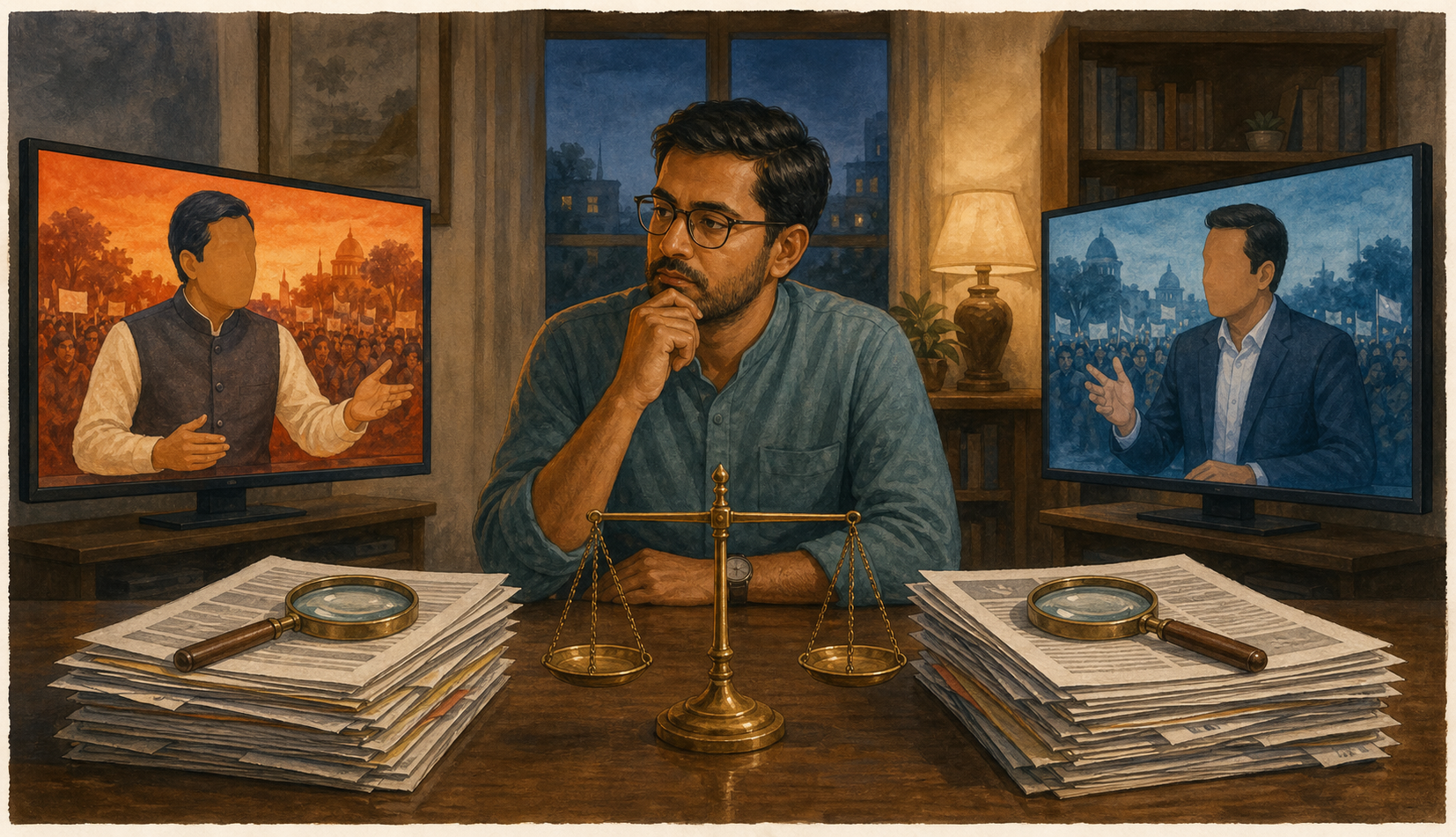
You see a journalist attack the BJP and wonder whether power is being questioned or Congress is being served. Then a nationalist channel defends the BJP, and the same doubt runs in the opposite direction. You need a better test than deciding which side sounds more loyal to Bharat.
The useful question is not whether a journalist has a worldview. Everyone selects, frames and interprets. The question is whether the journalist applies one evidentiary standard to friends and another to opponents. That is something you can examine before you trust, reject or forward the next political claim.
Start with symmetry, not the journalist’s declared camp
A pro-Dharma editorial position is not automatically dishonest. Nor does criticism of the BJP automatically make a reporter anti-Hindu. Honest advocacy tells you what it values, distinguishes facts from judgement and remains willing to expose misconduct by its preferred political camp.
Political servility begins when the standard changes with the party. An allegation that requires documents when made against Congress cannot suddenly become credible on the strength of a viral clip when aimed at the BJP. A friendly interview cannot be defended as human-interest journalism if the same interviewer treats every rival encounter as a prosecution.
The public row over Priyanka Vadra’s “Paaltu Media” jibe and the nationalist counterattack illustrates the trap. Critics answered an insult with photographs, videos, award lists and examples that they believed demonstrated Congress-friendly journalism. Those materials raise questions worth examining. The insult itself answers none of them.
Look for asymmetry in five places: which events receive attention, which facts receive verification, how headlines describe equivalent conduct, how interviewers question political allies and opponents, and whether errors are corrected regardless of whom the correction helps. A consistent pattern across those decisions is more revealing than a journalist’s slogan, reputation or social circle.
Apply a reverse test whenever a story pleases you: if the parties were swapped, would you accept the same evidence and language? If your answer changes because the accused person changed, you are no longer auditing the media. You are joining its factional contest.
Run a coverage audit that another reader can reproduce

You do not need access to a newsroom to examine political allegiance. You need comparable cases and a record of what the outlet actually did. Use the following worksheet for a reporter, programme or publication rather than judging an entire profession from one segment.
| Test | What to record | What would support a finding of partisanship |
|---|---|---|
| Story selection | Comparable incidents covered, ignored or buried under governments of different parties | A recurring change in visibility that follows party control rather than public significance |
| Verification | Evidence demanded before similar allegations are published | Weak claims against opponents are amplified while claims against allies require much stronger proof |
| Framing | Headline verbs, labels, photographs and adjectives used for equivalent conduct | The same action becomes principled, opportunistic, secular or communal according to who performs it |
| Interview scrutiny | Policy questions, interruptions, follow-ups and opportunities to evade | Allies receive prompts and soft detours while opponents face sustained factual challenges |
| Follow-through | Corrections, updates and later reporting after the initial claim | An outlet preserves a damaging narrative after its factual basis weakens, but repairs errors that hurt its preferred side |
| Political proximity | Private access, public appearances, honours and any evidence of coordination | Proximity coincides with favourable editorial decisions or demonstrable cooperation, not merely acquaintance |
Matched cases matter. Critics, for example, contrasted approving treatment of Uddhav Thackeray after his break with the BJP and hostile treatment of Eknath Shinde after his return to the BJP alliance. That is a legitimate lead for a framing audit. To make the case persuasive, inspect the full reports and ask whether the conduct, evidence and political circumstances were genuinely comparable.
A similar contrast placed Ravish Kumar’s dismissive question about time saved on the Meerut-Prayagraj route beside his praise for Rahul Gandhi’s appearance while riding a Bullet motorcycle. The contrast can reveal tone and political warmth. It cannot, by itself, establish the treatment of infrastructure across an entire body of work. Use it to decide what to inspect next, not to declare the inspection complete.
Omission claims require even more care. A charge that media ignored an incident in Congress-JMM-governed Jharkhand is testable only against the outlet’s actual output. Search its archive around the event, include broadcasts as well as written reports, note placement and follow-up, and then compare the treatment with a similar event under a BJP government. One missing search result does not prove a blackout; a recurring party-dependent pattern may.
Photographs of journalists with politicians and lists of Padma recipients belong in the political-proximity row. They may justify questions about access or conflicts. They do not prove that an honour purchased obedience. To support that stronger conclusion, you would need evidence connecting the relationship to editorial conduct. Keeping those claims separate makes your criticism harder to dismiss.
Treat viral material as a lead, not a verdict

Social media compresses a complicated allegation into the most emotionally satisfying frame. A photograph becomes proof of conspiracy. A few seconds from an interview become proof of lifelong allegiance. Repetition then makes the interpretation feel like part of the recording, even when it was added by the account sharing it.
- Locate the earliest available upload or the full programme rather than relying on a compilation.
- Watch what happens before and after the circulated moment. A cut can hide a correction, joke, instruction or change of speaker.
- Write down the exact observable conduct before naming its motive. “The reporter supplied these words” is an observation; “the reporter serves this party” is an inference.
- Check whether the journalist explains the exchange and whether the complete recording supports that explanation.
- Look for comparable behaviour involving another party before turning one incident into a general conclusion.
A clip presented as showing a reporter coaching Congress workers and encouraging provocative slogans would be more probative than a photograph at a social gathering if the complete sequence confirms the described conduct. Even then, the defensible conclusion concerns that conduct. A claim about the reporter’s entire career requires a broader record.
The same discipline applies to footage promoted as a “fixed match” between a politician and interviewer. Identify the apparent coordination, preserve the complete exchange and consider ordinary production explanations before alleging collusion. Direct coordination, if verified, is serious. A friendly tone or an anticipated question is not the same evidence.
Ask one further question before accepting any viral accusation: what evidence would change your mind? If no possible context, correction or contrary example could alter the verdict, the verdict is an allegiance of your own rather than an evidence-based finding.
Keep Dharma larger than any political party

A Dharmic media ethic should be more demanding than party loyalty. Satya requires care with what is asserted. Viveka requires separating appearance from proof. Neither duty disappears because an allegation benefits Hindu interests or harms a political formation regarded as hostile to them.
You may conclude that Congress and its allies repeatedly disregard Hindu concerns. You may also regard the BJP as the more receptive political vehicle. Neither judgement makes Dharma the property of a party. Even a nationalist argument can acknowledge that the BJP is not identical to complete Hindutva. That distinction preserves your ability to question the BJP when its conduct falls short and to recognise a sound action by an opponent.
Use the same distinction when evaluating claims of anti-Hindu media bias. Criticism of a BJP policy is not sufficient evidence. Look instead for a recurring difference in how Hindu beliefs, institutions, victims and public concerns are described, verified and humanised compared with equivalent subjects involving other communities. The case becomes stronger when the pattern survives comparison; it becomes weaker when the label merely replaces an answer to criticism.
Nationalist media must pass this test too. A journalist does not become reliable merely by defending Bharat or using the language of civilisational renewal. If friendly governments escape scrutiny, uncertain claims become facts, or opponents are dehumanised instead of answered, the work has adopted the same vice it condemns.
Harsh labels may energise supporters, but they blur distinctions that serious criticism needs. A compromised interview, an uneven editorial record, an undeclared conflict and an objectionable opinion are different accusations. Name the one you can establish. Precision protects both the target from an exaggerated charge and the reader from being manipulated by it.
Key takeaways
- A declared worldview is not the decisive problem. A concealed double standard is.
- Judge selection, verification, framing, interviews, follow-through and political proximity separately.
- Photographs and honours show association, not obedience; verified coordination carries more evidentiary weight.
- An alleged omission must be checked against the outlet’s archive and a genuinely comparable case.
- Use the reverse test: accept no claim about an opponent that you would reject if it targeted an ally.
- Keep pro-Dharma judgement independent enough to scrutinise every party, including the one you usually support.
Before you share the next accusation
Pause long enough to write four short statements for yourself: what you directly observed, what another person alleged, what you inferred, and what remains unknown. If those statements collapse into one another, you are not ready to forward the claim as fact.
Then narrow your language to the evidence. Say that a clip appears to show a particular act, that an interview deserves contextual review, or that a coverage pattern warrants comparison. Do not turn one disputed example into “all media,” “every nationalist” or “every critic of the BJP.” Sweeping language gives the weakest part of your argument to anyone who wants to ignore the strongest part.
Your next media decision can be simple: preserve the original material, compare like with like, disclose uncertainty and apply the same test across party lines. That is how you resist partisan media without becoming its mirror.
References
