
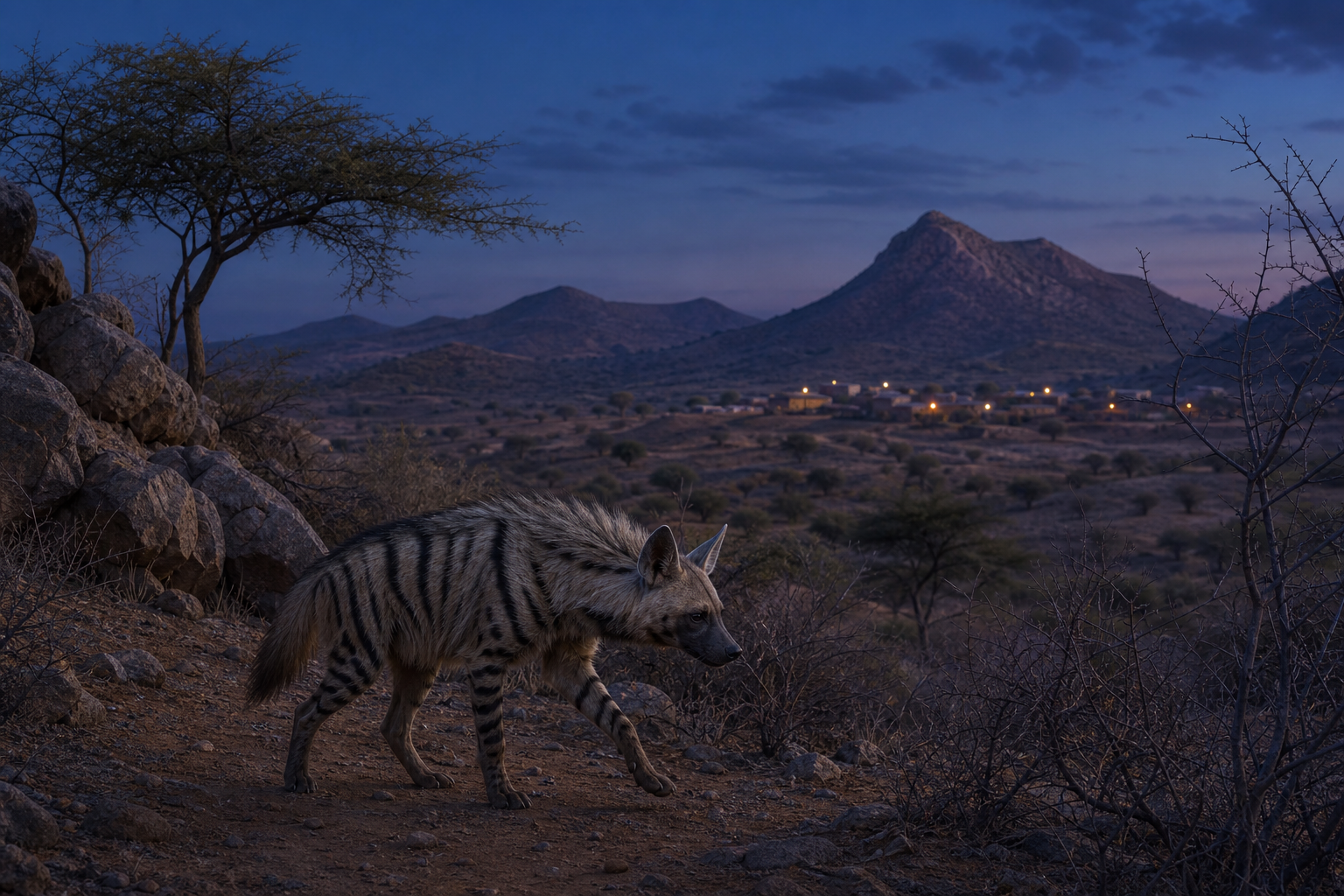
You may have encountered the striking claim that the hyena is a dayan's beast in Rajasthan and wondered whether the idea comes from Hindu scripture. The useful answer is narrower: the hyena-dayan connection belongs to a strand of Rajasthani folk belief, not to the classical scriptural symbolism of Hindu Dharma.
Keeping that boundary clear lets you take regional tradition seriously without turning one local motif into pan-Hindu theology. It also gives you a reliable way to assess similar claims when they appear in family stories, museum labels, videos or social-media posts.
Where the hyena belongs: regional lore, not shastra
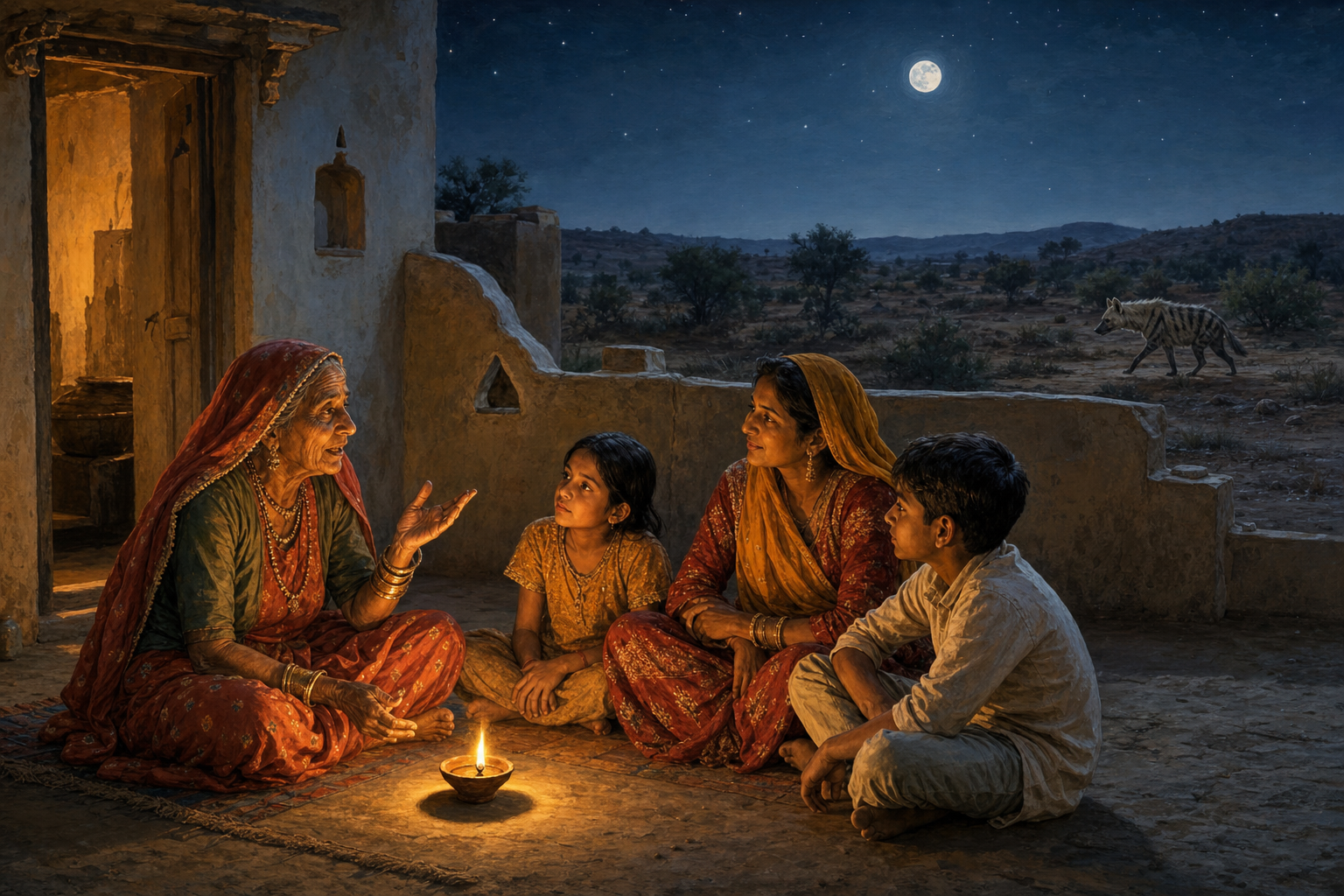
The hyena has no established place in the Ramayana, Mahabharata or Puranas. It is not presented there as a deity's vahana, a sacred emblem or a standard bearer of a theological idea. That distinguishes it from animals such as the cow, elephant, serpent, peacock and owl, all of which possess recognisable scriptural or symbolic associations.
In the Rajasthani belief at issue, the relevant supernatural figure is the dayan, a vernacular witch-like figure associated with feared and harmful magic. The hyena appears within that regional world of supernatural imagination. Its meaning therefore comes from the local tale in which it occurs, not from a universal rule about Hindu belief.
If you need one accurate sentence for teaching, publishing or conversation, use this formulation: In a strand of Rajasthani folk belief, the hyena is associated with the dayan, but that association is not an established role in classical Hindu scripture.
Why the difference between folklore and scripture matters
Not every inherited belief occupies the same level of authority. A useful reading begins by separating four kinds of material:
- Scriptural teaching: a claim grounded in an identifiable text and passage.
- Regional folklore: a story, image or motif transmitted within a particular cultural setting.
- Local practice: something a family or community actually does, whether or not a story explains it.
- Modern retelling: a recent interpretation that may combine older elements, dramatic embellishment and personal opinion.
The hyena-dayan motif belongs in the second category unless a particular telling supplies evidence for something more. This classification does not make the belief worthless. Folklore can preserve a community's fears, boundaries and imaginative vocabulary. It simply does not establish a religious duty, philosophical principle, ritual requirement or pan-Hindu doctrine.
Two opposite mistakes follow when these levels are blurred. Promoting the motif to scripture misrepresents Hindu Dharma. Dismissing it merely because it is not scriptural erases part of Rajasthan's cultural memory. Respect does not require canonisation, and textual absence does not make regional lore culturally meaningless.
Do not invent what the hyena does in the story
The association itself does not tell you its exact narrative mechanics. A hyena that accompanies a dayan, carries her, represents her, receives her commands or appears as her transformed shape would play five different roles. You should not claim that the dayan rides the hyena, changes into it or sends it to harm someone unless the particular telling actually contains that detail.
This is where dramatic retellings often outrun what is known. Before repeating one, identify the smallest secure claim: the hyena and the dayan are associated in a Rajasthani folk-belief context. Treat every additional action, power or prediction as a separate claim requiring its own support.
You should also separate the animal from the character assigned to it. A threatening function in folklore is not a theological declaration that every real hyena is spiritually evil. Nor does an association with a supernatural figure establish worship, sacred status or ritual use. A story can make an animal carry human fear without turning zoology into moral doctrine.
Finally, do not convert Rajasthan into a single undifferentiated voice. The regional label tells you where to begin looking; it does not prove that every community, household or storyteller knows the same motif. The more local the claim, the more carefully its location and context should be recorded.
How to assess and describe a hyena-dayan claim
When you find this belief in a caption, conversation or cultural display, work through five checks before deciding what it means:
- Identify the claimed level of authority. If someone calls the belief scriptural, ask for the text and passage. Naming Hinduism in general is not the same as identifying a textual basis.
- Fix the geography. Record Rajasthan, then narrow the location further if the information is available. A district, village or community is more informative than a state-wide generalisation.
- Preserve the original category. Keep the word dayan when that is the word being discussed. Do not silently replace it with goddess, rakshasi, tantric practitioner or another category carrying a different religious meaning.
- Ask what the hyena actually does. Is it merely mentioned beside the dayan, or does the narrative assign it a specific action? Write only the relationship the telling supports.
- Separate description from interpretation. The statement that a hyena is associated with a dayan describes a motif. Claims that the animal is worshipped, universally feared by Hindus or recognised by shastra are additional interpretations and are not established by that association.
If you are preserving an oral account, record who told it, where they learned it, the language and exact term they used, the occasion on which the story was told, and the hyena's precise role. Also note whether the teller presents it as belief, warning, entertainment or memory. Those details prevent a living local account from becoming a vague claim about all Hindus.
If you are editing a public caption, include both geography and genre. Rajasthani folk belief is accurate in a way that Hindu scripture or Hindu animal symbolism is not. Those few words give the reader the cultural setting and the proper limit of the claim.
Key takeaways
- The hyena-dayan association belongs to a strand of Rajasthani folk belief rather than to an established role in classical Hindu scripture.
- The Ramayana, Mahabharata and Puranas do not provide the hyena with the familiar symbolic standing held by several other animals.
- A folk motif can be culturally meaningful without becoming doctrine, ritual instruction or a universal Hindu belief.
- The association alone does not prove that a dayan rides, becomes or commands a hyena; each narrative detail must be established separately.
- The safest description names both the region and the genre instead of making a claim about Hinduism as a whole.
The next time you encounter the motif, apply a simple two-label rule: name its geography and name its genre. If you can also preserve the teller's words and the hyena's exact role, you will have something more valuable than a dramatic generalisation: a cultural account that can be understood without distorting either Rajasthan's folklore or Hindu scripture.
References
