
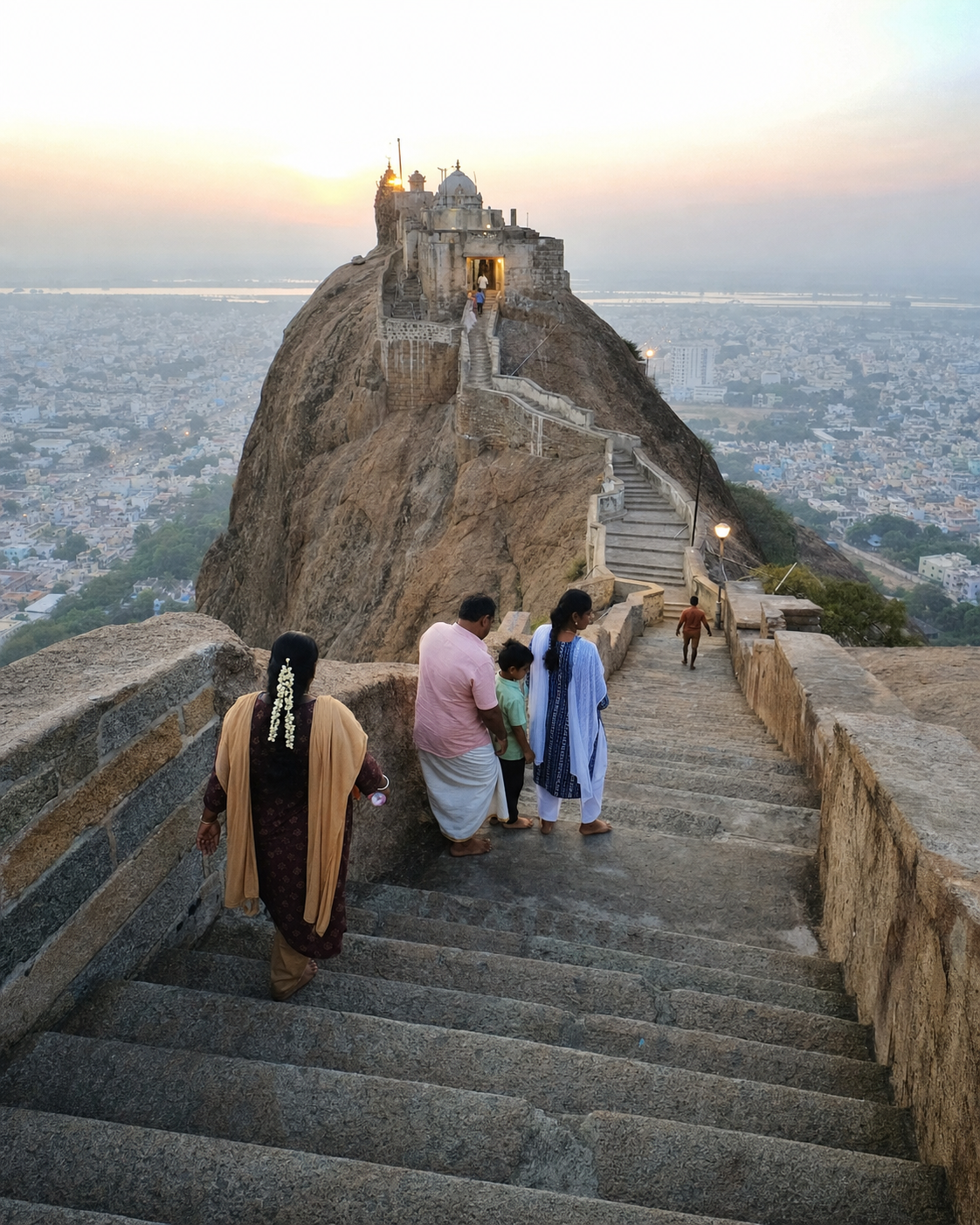
If you want Trichy Rockfort to feel like a pilgrimage rather than a hurried climb to a viewpoint, organize the visit around its three shrines. Manikka Vinayakar receives you at the foot of the hill, Thayumanaswami interrupts the ascent with Shiva darshan, and Ucchi Pillayar completes it at the summit. The sequence and the climb of more than 400 stone steps belong together.
Your practical plan is straightforward: begin before the stone becomes hot, confirm that day’s puja timings at the base, carry little, and refuse to treat the middle shrine as a rest stop. When the body, ritual, architecture, and sthala-purana are given their proper places, the summit becomes the culmination of the yatra rather than its only objective.
Key takeaways
- Start in the morning. Earlier steps are generally cooler, queues can be calmer, and you have a better chance of attending a morning puja without rushing the climb.
- Follow the sacred order: Manikka Vinayakar at the base, Thayumanaswami midway, and Ucchi Pillayar at the summit.
- Prepare for more than 400 steps. Wear simple cotton clothing, leave footwear at the designated point, keep at least one hand free, and pause at landings before fatigue disturbs your attention.
- Do not rely on a generic online timetable for Abhishekam. Festival calendars and temple arrangements can alter the daily rhythm, so ask staff at the base which rite is occurring, at which shrine, and when the queue will form.
- Approach honey, milk, curd, and Panchamirtham as ritual substances with ethical meanings, not as a spectacle or a list of items to collect.
- Carry the Vibhishana and Ganesha tradition with you as you climb. It connects Rockfort to Srirangam and turns the urban landscape into sacred geography.
Make the three shrines your actual itinerary
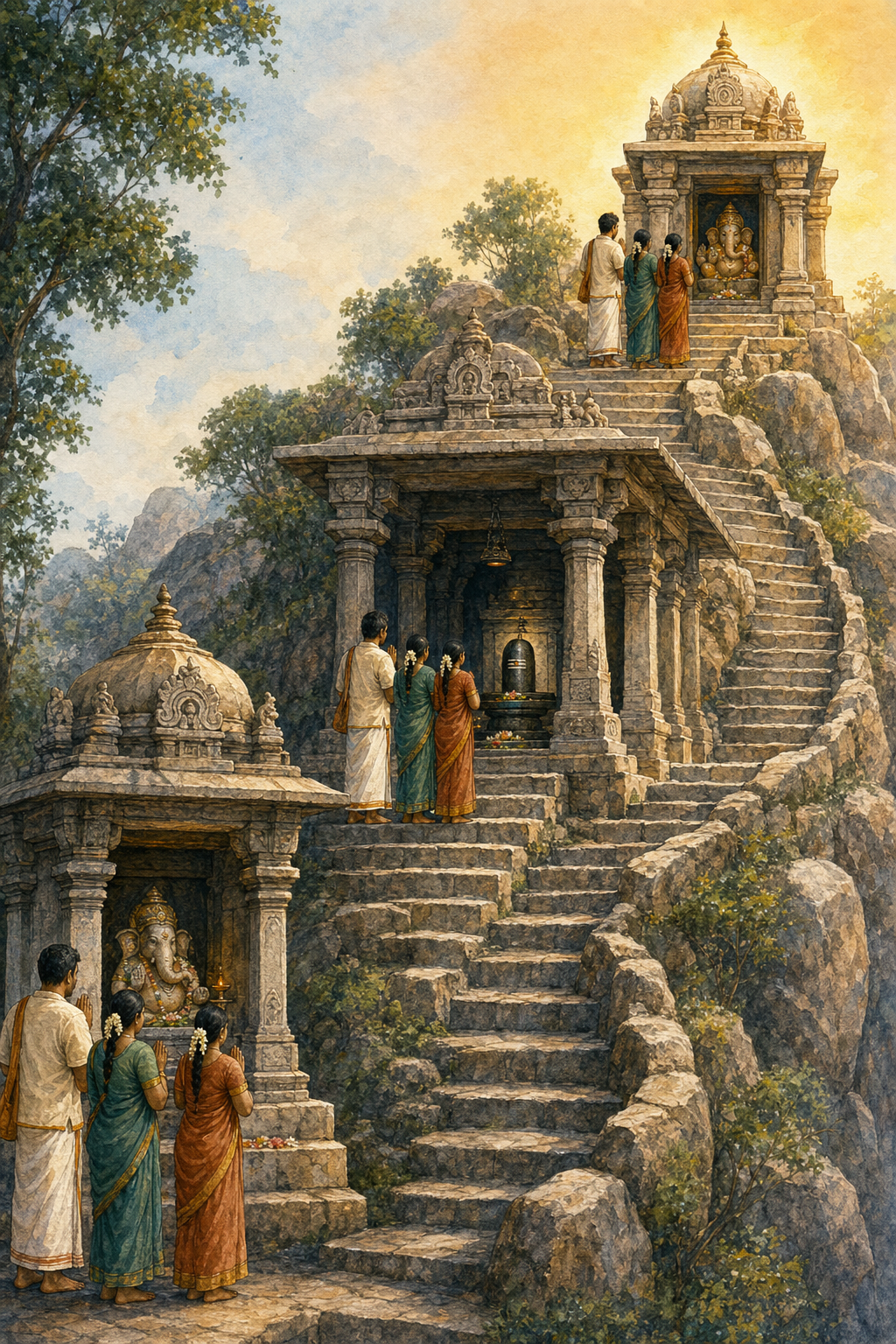
The most common planning mistake is to think only about reaching Ucchi Pillayar. That turns everything below the summit into transit. Rockfort asks for a different rhythm: invocation at the foot, inwardness midway, and completion above the city.
- Before entering, settle your sankalpa. It need not be elaborate. Name the person, duty, obstacle, or inner tendency for which you are undertaking the climb.
- Begin with Manikka Vinayakar. Let this be the threshold rather than a box to tick. Offer your intention, learn the day’s queue arrangement, and allow your breathing to settle before starting the stairs.
- Climb at a pace that leaves room for awareness. If you cannot notice the shrine entrances, carved surfaces, other pilgrims, and changes in the rock, your pace is too aggressive for a pilgrimage.
- Stop properly at Thayumanaswami. The mid-level Shiva temple is one of the complex’s three principal sacred destinations, not merely a shaded interruption on the way to Ganesha.
- Continue to Ucchi Pillayar only after completing the middle darshan without haste. At the summit, give the deity your attention before turning toward the panorama.
- Descend with the same discipline. Fatigue and the desire to finish can make the return less attentive than the ascent, so use the railings and avoid overtaking on narrow portions.
This order is also a useful way to manage exertion. The base shrine gathers the mind before the first steps. The Shiva temple gives the journey a genuine midpoint. The summit then arrives as the third movement of worship, not as a reward for bypassing everything below it.
If you are approaching from Kalyanapuram or elsewhere around Kumbakonam, think of the outward journey as two separate legs: local road travel to Kumbakonam, followed by bus or rail toward Tiruchirappalli. Do not make a tight connection the hidden center of your yatra. The purpose of leaving early is to arrive with enough time to verify the temple’s arrangements and enter without agitation.
The route through the Kaveri delta can also serve as preparation. Instead of filling the entire journey with calls and messages, use part of it to repeat a simple mantra, sit quietly, or return to your sankalpa. The pilgrimage can begin before the first temple step.
Prepare your body for the steps without turning them into a contest
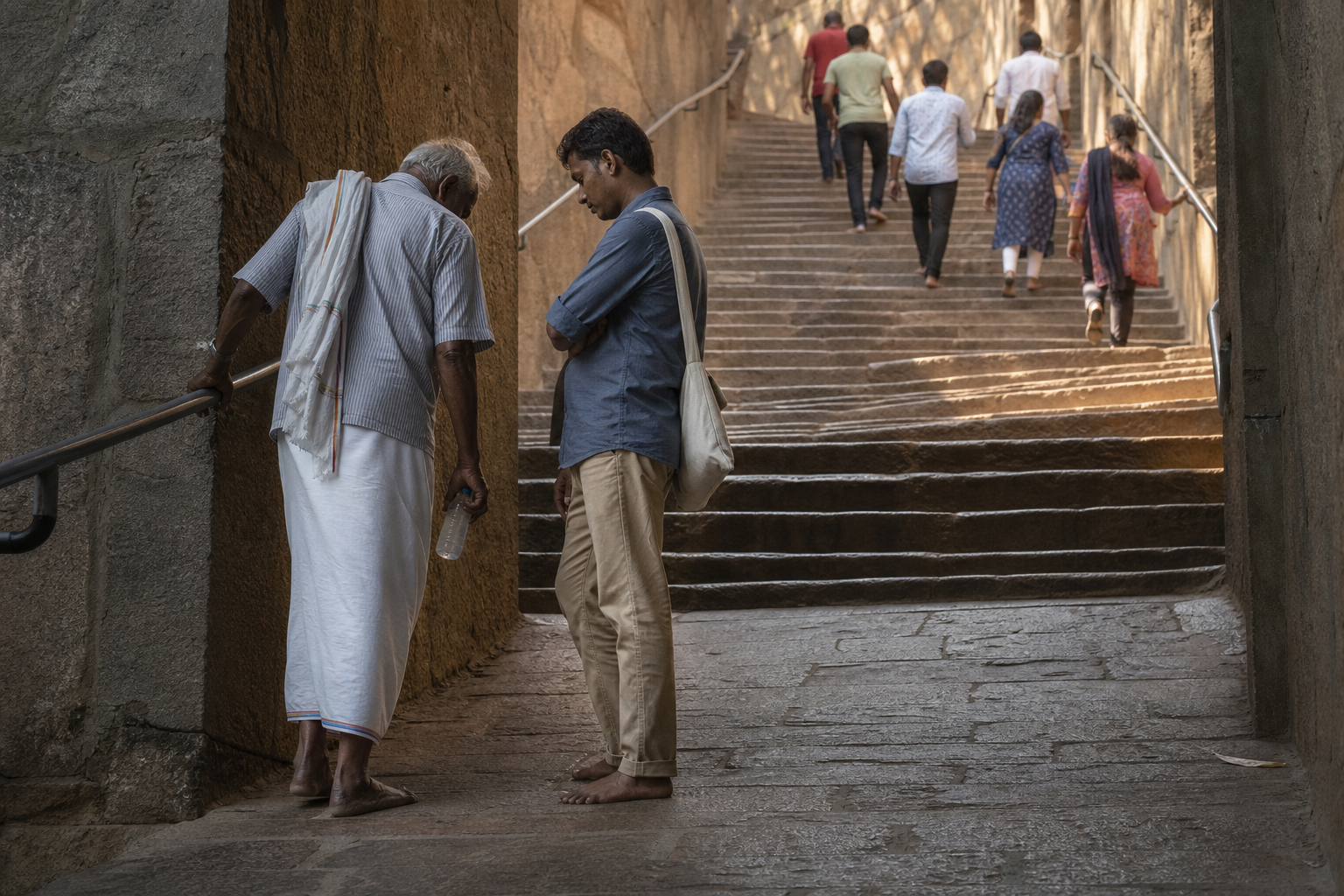
Rockfort rises from an ancient charnockite outcrop, and parts of the stairway are exposed to accumulating heat. An early start is therefore more than a devotional preference. It reduces unnecessary strain and gives you room to pause without feeling that the day is already closing around you.
Use a small, deliberate kit:
- Wear light, modest cotton clothing that permits an unrestricted step.
- Carry a small cloth for perspiration rather than repeatedly using your hands or clothing.
- Leave footwear only at the designated deposit point and remember where it was placed.
- Keep bags small and secure. At least one hand should remain available for the railing.
- Hydrate before the climb and again afterward. If you need water during the ascent, check what is permitted and carry only what you can manage without losing a safe grip.
- Avoid unnecessary offerings and packaging. Simple, temple-approved offerings are easier to carry and create less waste.
Do not measure your climb against a younger pilgrim, a faster relative, or someone who knows the stairs well. The useful measure is whether your breathing remains controlled enough for recollection. Short, planned pauses preserve more dignity than a long, exhausted stop forced by pride.
At a landing, relax the shoulders and try an equal, unforced inhalation and exhalation. This is enough to reunite breath and attention. There is no need for breath retention, complicated counting, or a performance of pranayama on a crowded stairway. Resume only when you can do so steadily. If you become dizzy, unusually breathless, or unsteady, stop in a safe place and seek assistance rather than pressing upward for the sake of completing the climb.
The rock itself can support contemplation. The formation is often dated to billions of years and described as older than the Himalayas. You do not need an exact geological figure to grasp the contrast: human regimes, fortifications, and cities have changed around a mass of stone whose time is radically deeper than ours. Pause where it is safe, look at the exposed rock, and let that scale correct the urgency you carried up the hill.
Within a Dharmic reading, this is not geology replacing devotion. The stone becomes a reminder of stability, witness-consciousness, and dharma held through change. The body moves, the breath changes, the city spreads below, and the rock remains. That is a concrete contemplation you can practice during the ascent.
Meet Abhishekam as a discipline of inner refinement
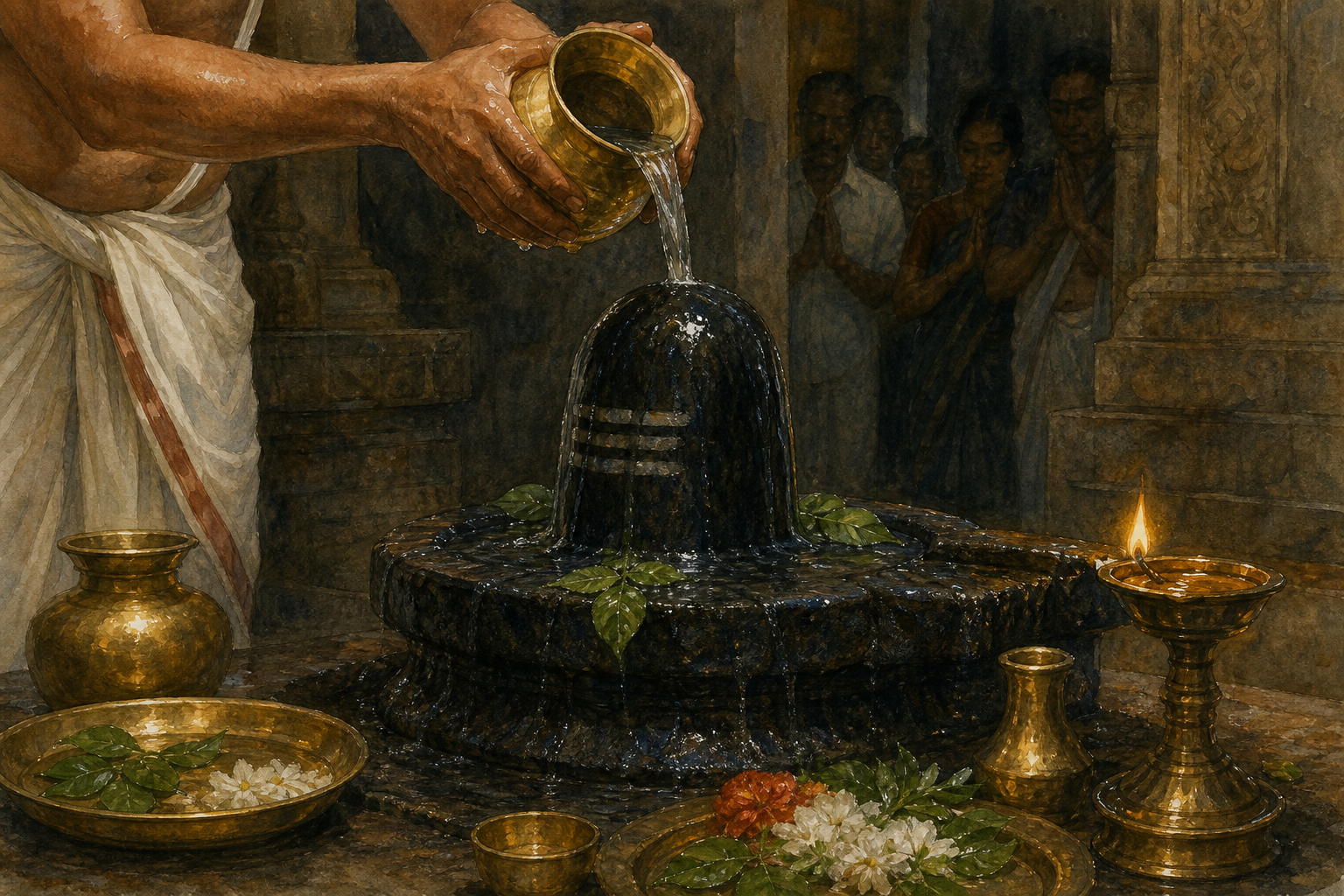
Honey, milk, curd, and Panchamirtham are among the Abhishekam substances encountered in Rockfort worship. In an Agamic frame, the rite is both an anointing of the murti and an education of the worshipper. The external offering is precise and visible; the corresponding change in conduct must continue after the vessel is empty.
- Milk signifies sattva, luminosity, and clarity. Give it a practical counterpart by identifying one source of confusion or needless agitation you will reduce.
- Curd signifies nourishment and strength. Ask what steady discipline supports your dharma but has been neglected through inconsistency.
- Honey points toward sweetness in speech and conduct. Choose one relationship in which truth can be spoken without harshness.
- Panchamirtham expresses abundance, harmony, and the integration of the senses. Let it prompt moderation: abundance becomes auspicious when its parts support one another rather than compete for attention.
Panchamirtham is not necessarily identical at every Tamil temple. A local preparation may include banana, jaggery, honey, ghee, and aromatics, while ingredients and handling follow the practice of the sacred place. Palani’s well-known formulation should not be treated as a recipe that every other shrine must reproduce. At Rockfort, receive what is consecrated there instead of approaching the offering with expectations imported from another temple.
Daily temple worship is often organized around Kala-sandhi in the morning, Uchikala around midday, Sayaraksha in the evening, and Ardha-jama at night. These names describe a broad liturgical rhythm, not a guaranteed Rockfort timetable. The actual schedule can vary by shrine and festival calendar. On arrival, ask a concrete question: which shrine has Abhishekam today, at what time, and where should you wait?
Participation may mean reverently witnessing the rite rather than personally pouring a substance. Follow the directions of priests, staff, and the temple administration. Do not push toward the front, request an exception during worship, or raise a phone over another pilgrim’s head. Photography rules can differ between spaces and occasions; absence of a warning sign is not permission. Ask once, accept the answer, and return your attention to the deity.
When prasad is distributed, receive it without turning the queue into a second contest. Panchamirtham is not merely a sweet acquired after darshan. It is the returned form of an offering, a sharing of grace that should make you more considerate of the next person in line.
To prevent the rite from ending at the temple door, attach one small vrata to it. After honey Abhishekam, for example, you might resolve to remove one habitual cruelty from your speech for the rest of the day. After milk, protect one period of mental clarity from unnecessary distraction. Such a resolution is modest enough to keep and specific enough to expose whether worship has entered conduct.
Read the hill as sacred geography and living history
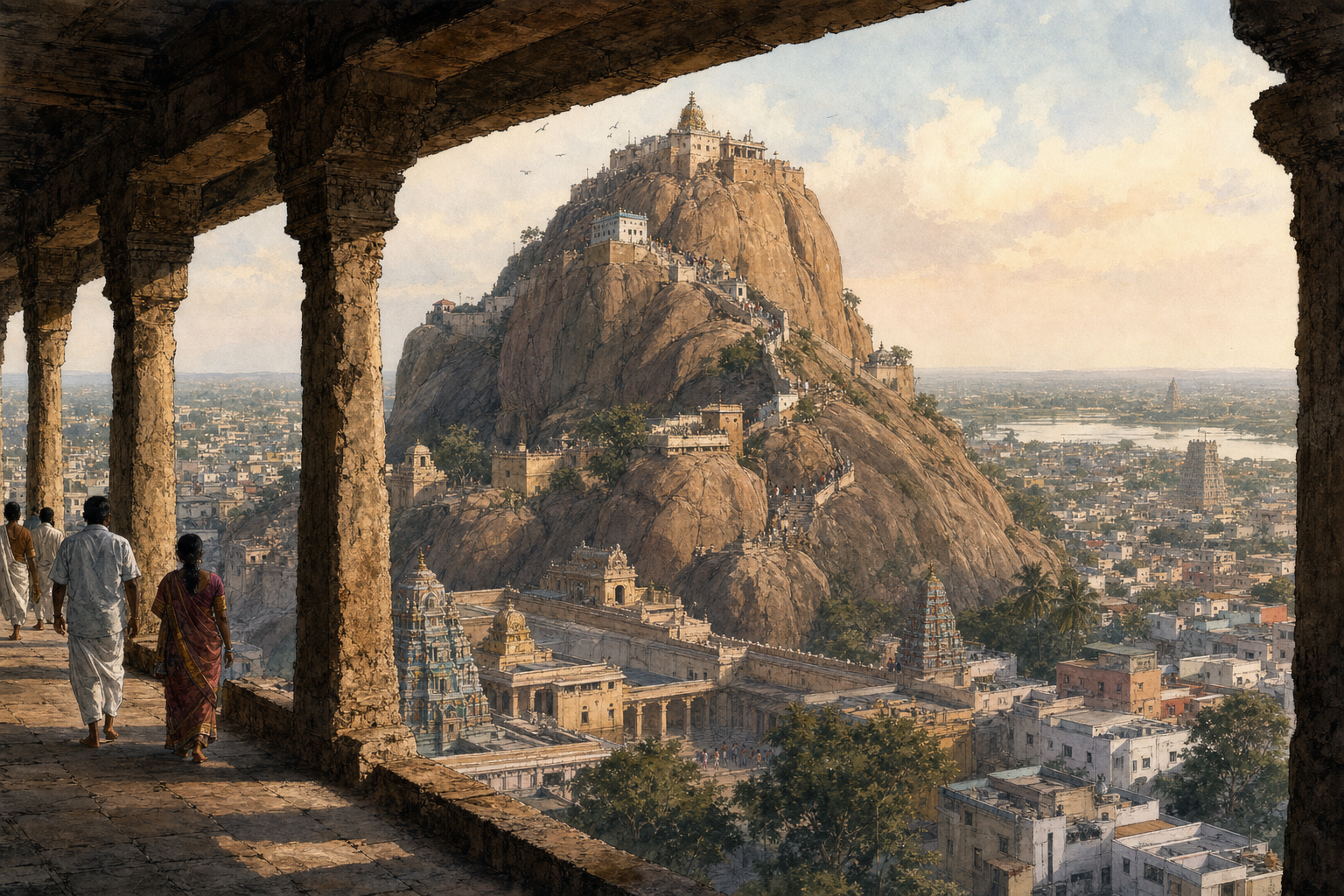
Let the Vibhishana tradition connect Rockfort and Srirangam
The sthala-purana of Ucchi Pillayar is inseparable from the sacred geography of the Kaveri. Vibhishana receives a holy image of Ranganatha and carries it on his journey. Ganesha appears as a boy, agrees to hold the image, and then sets it down at Srirangam, where it becomes fixed. Vibhishana pursues the boy to the Trichy rock before recognizing the divine play and submitting to an order larger than his own intention.
The Vibhishana narrative binds Ucchi Pillayar, Srirangam, and the Kaveri landscape into one devotional map. Carry that map while climbing. Ganesha is encountered here not only as the remover of obstacles but as the deity whose apparent obstruction reveals the proper placement of the sacred.
This distinction matters when your own sankalpa concerns an outcome you strongly desire. The story does not teach that devotion guarantees control. It teaches that an interrupted plan can belong to a larger sacred order. At the summit, ask not only for an obstacle to disappear, but also for the discernment to recognize when resistance is redirecting you toward dharma.
Notice where temple, rock, and fort meet
The complex preserves several historical layers without ceasing to be a place of worship. Its rock-cut traditions carry architectural evidence associated with the Pallava period, around the sixth and seventh centuries CE. The Nayaks of Madurai later embellished and fortified the hill in the sixteenth and seventeenth centuries. Its strategic position also drew the fort into the Carnatic Wars and later colonial contestation.
You can read these layers in the rock-cut sanctums, pillared mandapas, Dravidian superstructures, hewn stairs, narrow landings, and fortified elevation. Look for three relationships rather than trying to memorize a catalogue of dynasties:
- Notice what has been carved from the living rock and what has been constructed upon it. The distinction reveals how sacred architecture can emerge from a landscape without erasing that landscape.
- Notice how gopurams and thresholds direct a pilgrim’s movement while the fort’s height commands the surrounding plain. Devotional and strategic uses occupy the same hill but organize attention differently.
- Notice that the temples remain active. Approach inscriptions and masonry with historical curiosity, but do not behave as though worshippers and rituals are exhibits in a museum.
The panoramic view of Tiruchirappalli and the Kaveri plain is worth receiving, but receive it after darshan. Looking outward then becomes part of the pilgrimage: the city is no longer visual entertainment below a successful climb, but the field of duties to which you will return.
Rock-cut sanctity also belongs to a wider civilizational vocabulary. Buddhist and Jain cave-temple landscapes, including Ajanta and Ellora, likewise use stone, silence, elevation, and disciplined movement to reshape attention. This resonance does not make their theologies or rites interchangeable. It shows how several Dharmic traditions learned to make the enduring rock a partner in contemplation.
That is the right basis for inter-Dharmic regard: recognize kinship without flattening difference. At this Hindu temple, unity is expressed by honoring its own deities, queues, ritual authorities, and restrictions. Quiet, cleanliness, modesty, service, and consideration for fellow pilgrims are practices that people from Hindu, Buddhist, Jain, and Sikh backgrounds can recognize, even while each path preserves its particular discipline.
Before you begin the first step, make two decisions: which scheduled worship you hope to attend, and which habit you intend to refine. Confirm the first with temple staff. Carry the second through Manikka Vinayakar, Thayumanaswami, and Ucchi Pillayar. Then leave the hill slowly enough for the pilgrimage to follow you back into the city.
References
