
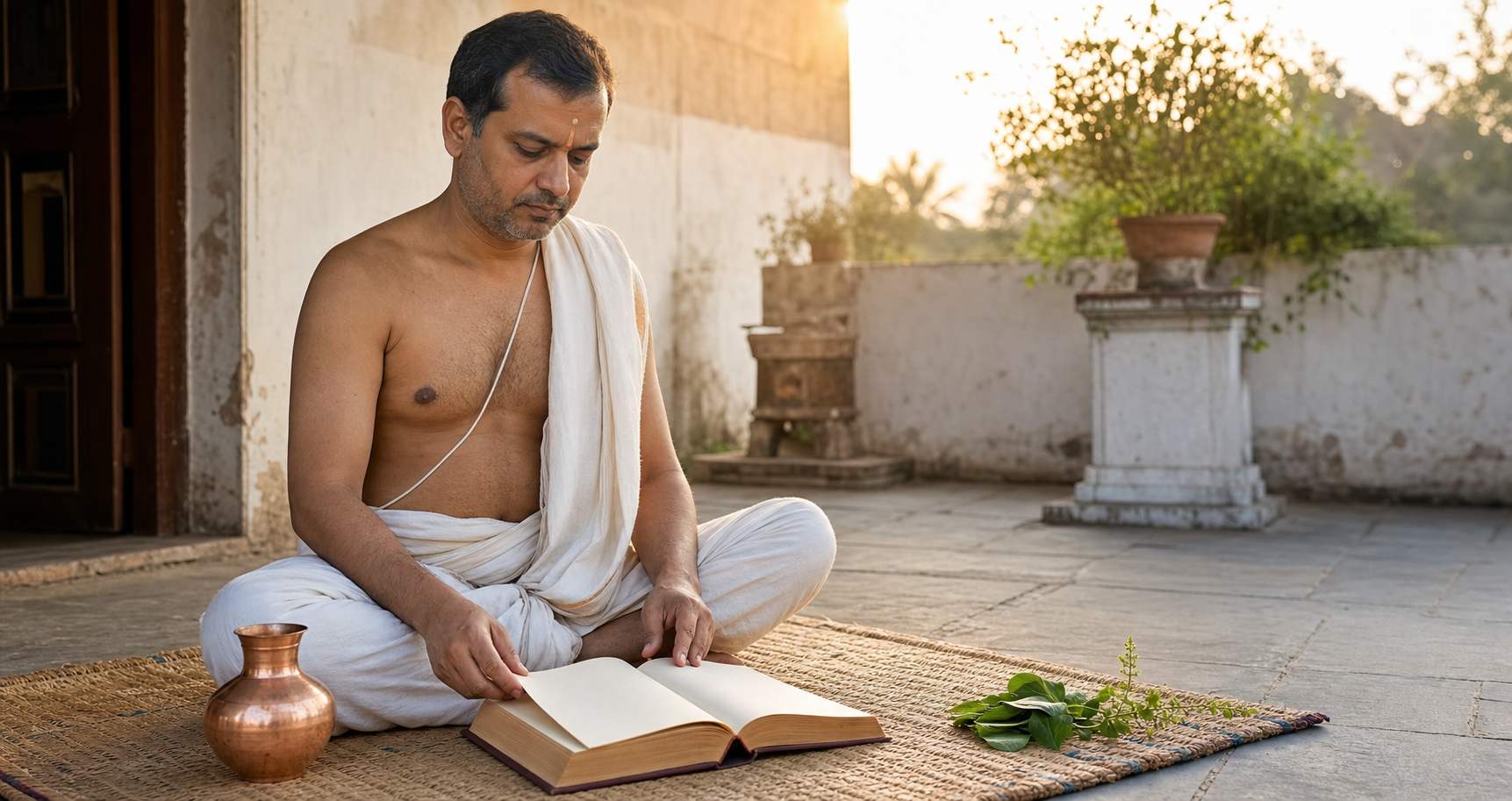
If you wear a janeyu but are unsure what should happen after the upanayana ceremony, the missing piece is not another theory about the cord. It is a workable bridge between initiation and an ordinary day. The thread is meant to keep a demanding but practical vow within reach of your attention: learn with discipline, remember the Divine, govern your conduct, and make knowledge useful through service.
You do not need to display it, treat it as a magical charm, or force every strand into one rigid interpretation. You need to understand its ritual grammar, follow the paddhati taught in your lineage, and make the commitments behind it visible in the way you pray, study, speak, and serve.
Begin with the vow, not the cord
Upanayana is a beginning, not a graduation. The initiate receives the yajñopavīta as part of entering disciplined learning. Sankalpa, purification, investiture, the beginning of study known as vedārambha, and Gayatrī-japa belong to that larger movement. Some regional forms also include bhikṣā-caraṇa, ritual alms-seeking that teaches the learner humility and dependence upon the community.
This is why janeyu is also called yajñasūtra or vratabandha: it binds the wearer to a discipline. The word upavīta points to a cord worn upon the body, while yajñopavīta places that cord in relation to yajña. The physical object matters because it gives memory a physical location. It touches the body repeatedly, interrupting forgetfulness before the vow disappears into ceremony photographs and family nostalgia.
The ritual framework is distributed across Gṛhya Sūtra traditions such as Āpastamba, Baudhāyana, Gobhila, and Pāraskara. Dharmaśāstra passages, including Manusmṛti 2.36–2.41, connect upanayana with Vedic learning and daily observance. The practical point is more important than treating any isolated line as a slogan: receiving the thread opens a course of practice. It does not certify that the course has already been completed.
The usual construction reinforces that lesson. Three primary strands meet at the brahma-granthi, the prescribed central knot. Several interpretations of the three strands live within the tradition: the Ṛg, Yajus, and Sāman Vedas; sattva, rajas, and tamas; and the debts owed to ṛṣis, devas, and pitṛs. These are layered contemplative readings, not competing engineering specifications. Resist any claim that the thread can have only one possible symbolic meaning.
The three debts offer an especially useful daily examination. Ask yourself: What did I learn or preserve today? What did I offer in worship or grateful remembrance? Whom did I serve? Study, worship, and service turn the symbolism into conduct. If all three repeatedly disappear from your week, the janeyu has become an identifier rather than a vrata.
The aspiration for brahmavarcas, radiance born of sacred knowledge, should likewise be read as responsibility rather than social rank. Its outward signs are clarity, truthful speech, restraint, reverence for teachers, and courage in doing what dharma requires. A thread cannot manufacture those qualities. It can remind you to cultivate them.
One vocabulary trap is worth removing. Some communities colloquially call the thread a brahmasūtra. That usage does not refer to Bādarāyaṇa’s Brahma-sūtra, the foundational Vedānta text. Keep the ritual cord and the philosophical work distinct when searching, teaching, or discussing them.
Read the three wearing positions as ritual grammar
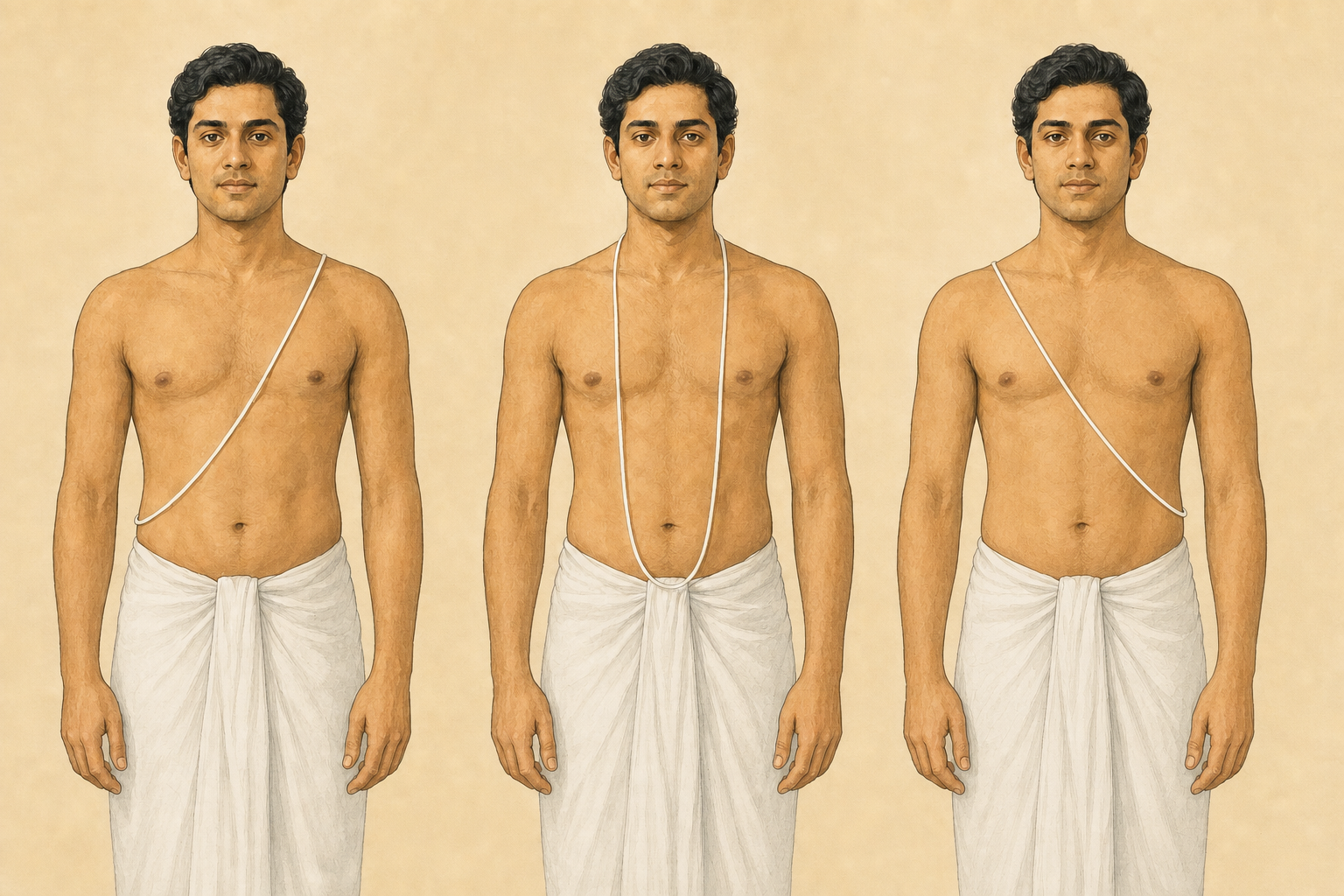
The thread’s orientation is not a matter of appearance. It indicates the kind of action being performed. For an initiated wearer, learning these positions prevents two common errors: wearing the thread casually in whichever arrangement feels convenient, and copying a position from a ceremony without understanding why it changed.
| Position | Placement | Ritual use | Practical rule |
|---|---|---|---|
| Upavīti | Over the left shoulder and under the right arm | Daily sandhyāvandanam and auspicious or deva-oriented rites | Use this as the standard prayer orientation unless your paddhati directs otherwise. |
| Prācīnāvīti | Over the right shoulder and under the left arm | Pitṛ-kārya, or rites directed toward the ancestors | Change to it for the prescribed ancestral action, not as an everyday alternative. |
| Nivīti | Looped around the neck | Select tasks identified in certain Gṛhya Sūtra traditions | Use it only where your lineage teaches it; its occasions are not uniform. |
This simple distinction makes the cord a form of ritual syntax. Upavīti, prācīnāvīti, and nivīti do not express three levels of holiness. They tell you whether an action is deva-oriented, pitṛ-oriented, or one of the lineage-specific occasions for nivīti.
Regional names do not erase that shared grammar. Janeu or janoi is common in parts of North and West India; poonal or poonool is familiar in Tamil regions; other languages preserve their own forms. Ritual details can also follow different Vedic recensions and household traditions. When two elders give different instructions, first ask whether they are discussing the same śākhā, Gṛhya tradition, and ceremony. A genuine lineage difference should not be mistaken for carelessness.
If you are arranging an upanayana rather than maintaining a practice already received, do not assume that one internet checklist settles age, eligibility, or procedure. Historical Dharmaśāstra formulations, regional customs, community vocations, and modern educational interpretations have not produced one uniform social practice. Many contemporary communities emphasize upanayana as character formation and disciplined learning. Make that decision openly with your family and a competent ācārya, while keeping the rite’s duties more central than the prestige of holding it.
Build a daily practice that the thread can actually recall
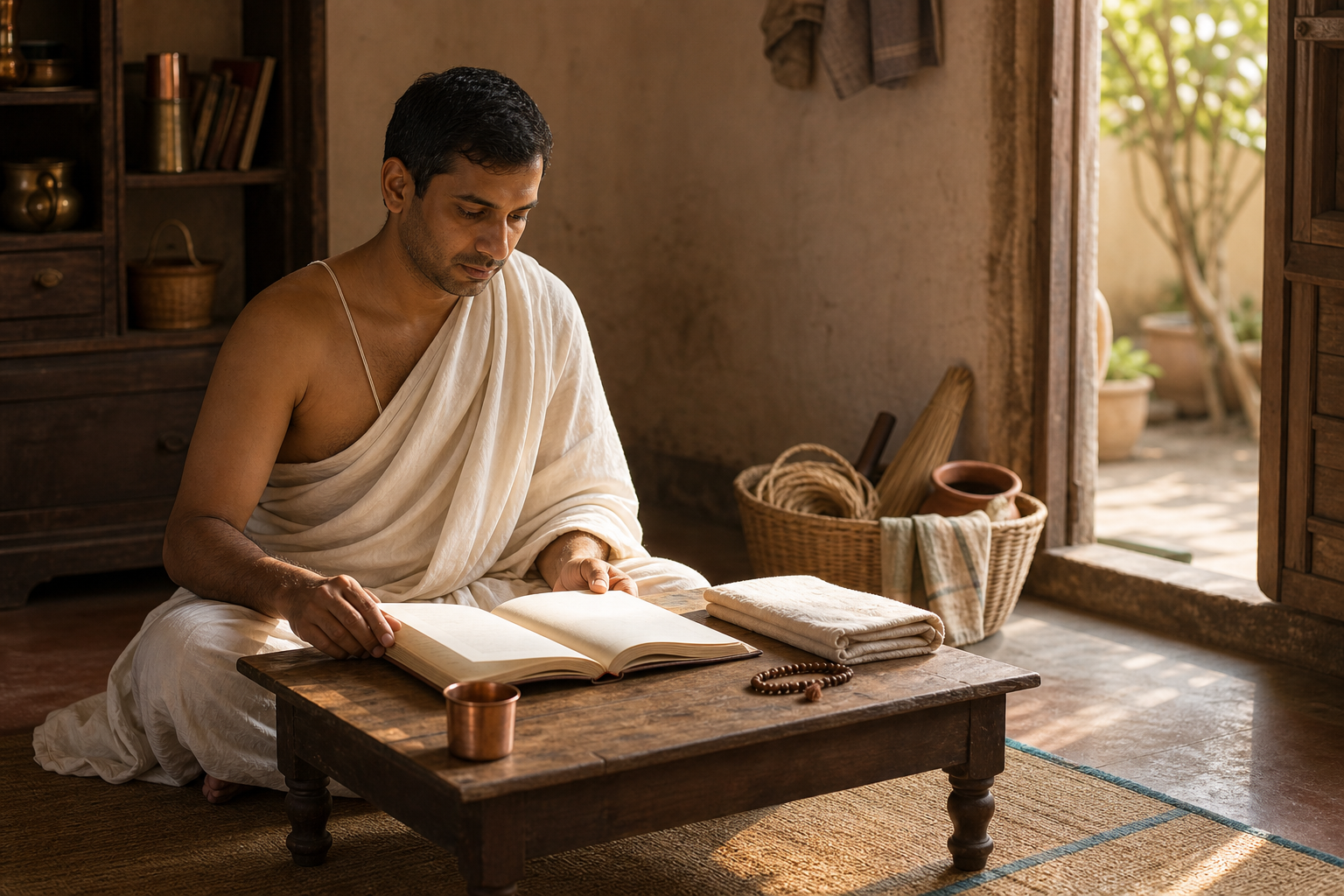
A universal sandhyāvandanam script would be misleading because recitation, sequence, and ritual detail can vary by Vedic recension and lineage. The procedure taught during your initiation takes precedence over a generic checklist. What can be made universal is the structure of follow-through: prepare attentively, perform the received practice, study, govern conduct, and serve.
- Begin in the correct orientation. Before the sandhyā time prescribed to you, make sure the thread is clean, intact, and resting in the upavīti position. Settle your attention and perform ācāmana or other preparatory actions exactly as taught. This physical check prevents the ritual from starting on autopilot.
- Perform sandhyā and Gayatrī-japa with attention. Preserve the pronunciation, sequence, breath discipline, and repetition count given by your teacher. If you no longer remember a detail, ask for correction rather than building a hybrid procedure from unrelated online demonstrations. The objective is steady remembrance, not merely rapid completion.
- Give svādhyāya a definite unit. Decide before the day begins what you will study: a teacher-assigned lesson, a passage of scripture, a recitation that needs correction, or the next section of an established course. A vague intention to study later usually produces no study. Mark where you stopped so the next session has an obvious starting point.
- Carry the vow into one predictable test of speech. Choose a setting in which you tend to become careless: a hurried work message, a family disagreement, an excuse, or an exaggerated claim. When the thread touches your body, use that sensation as a cue to pause. Truthfulness and restraint are not optional extras added after ritual; they are part of what the ritual is training.
- Complete one concrete act of sevā. Teaching someone, caring for a dependent person, helping an elder, sharing useful knowledge, or protecting someone vulnerable turns learning outward. The scale may be small. The important distinction is between an action that benefits another person and a private feeling that you value service.
This pattern works under office clothes, during fieldwork, at university, and in diaspora households. The thread does not need to become public display. Put the sandhyā times prescribed in your tradition into the same calendar that governs classes and meetings. If a school or work schedule repeatedly collides with the practice, take the actual timetable to your teacher and ask how your lineage handles the constraint. Quietly rewriting the rite each week eventually leaves you with no stable rite at all.
A one-week reset when janeyu has faded into the background
This reset is a habit check, not a replacement for your paddhati. For seven days, make three columns labelled sandhyā, svādhyāya, and sevā. Give each a simple yes or no at the end of the day. Do not score pronunciation, spiritual feeling, or the size of the service. You are looking for the point at which remembrance repeatedly fails.
- If sandhyā is usually missed, put the prescribed time and preparation cue into your calendar.
- If svādhyāya is usually missed, choose the next passage before closing the current study session.
- If sevā is usually missed, name the person or responsibility you will help before the day begins.
- If all three are marked yes but your speech remains dishonest or harsh, add a fourth column for the specific conduct you are trying to restrain.
At the end of the week, change the weakest cue rather than making a grand new vow. A janeyu is suited to small, repeated recollection. Let the system around it be equally concrete.
Care for the thread without reducing renewal to maintenance
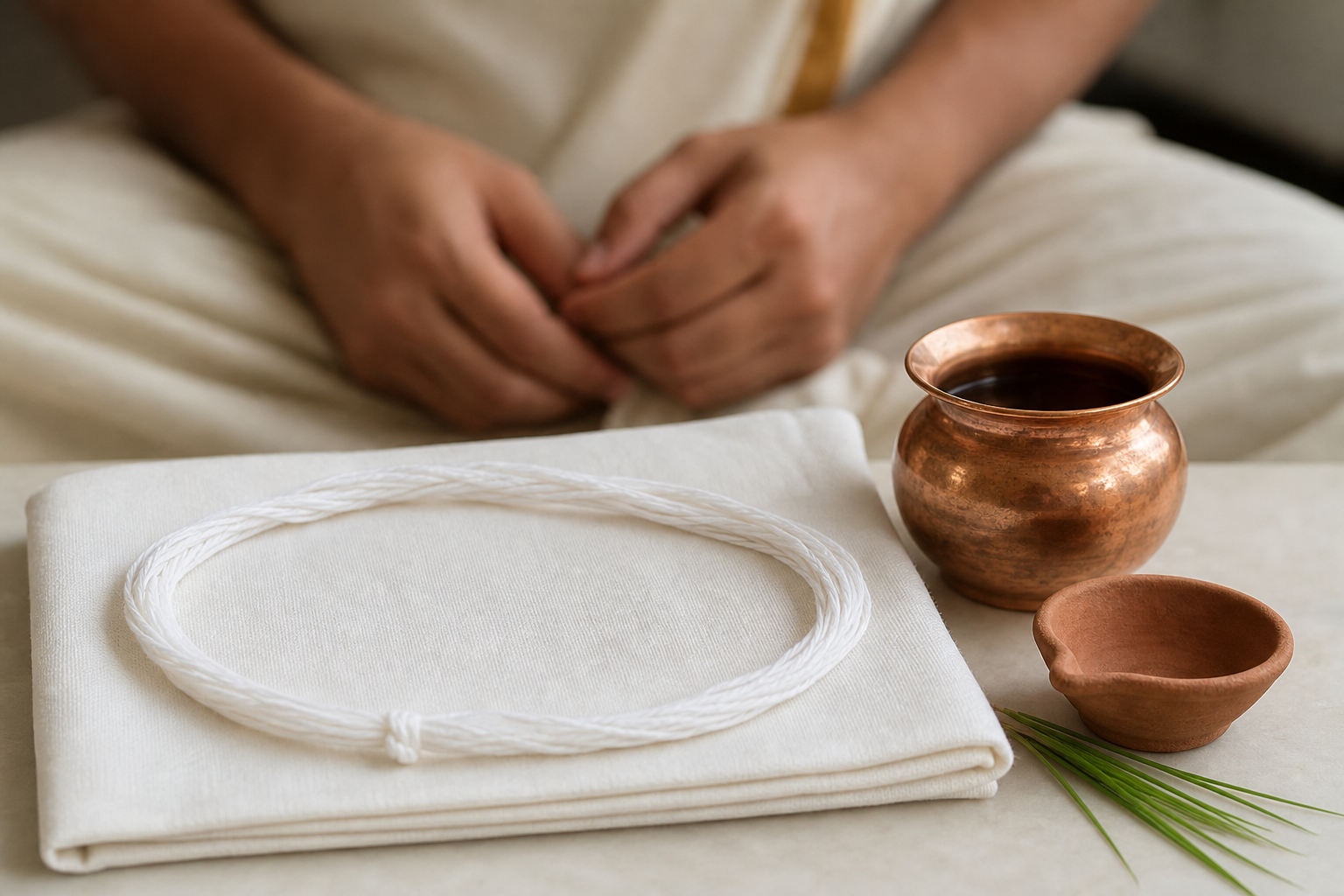
Traditional janeyu is commonly made from cotton, valued for purity and simplicity. Silk appears in some ritual contexts, and early prescriptions also recognize mūrvā fibre. This variety is not an invitation to choose a thread by fashion or personal symbolism. Receive or obtain the form prescribed by your community and rite.
- Keep it clean. The physical condition should match a discipline concerned with śauca, or cleanliness.
- Do not add casual knots. The brahma-granthi is the prescribed knot. A fraying thread should not accumulate improvised repairs that obscure its ritual form.
- Replace it when it is soiled or frayed. Follow the replacement mantra and procedure taught in your household or lineage. Do not wait for an annual observance if the thread already requires replacement.
- Treat uncertainty as a question for instruction. Rules concerning bathing, sleep, bodily functions, temporary removal, and disposal can be handled differently across households. Get your own procedure from the person responsible for teaching your rite, preferably before an awkward situation arises.
Annual renewal belongs to upākarma, when Vedic students ritually pause and recommence study while expressing gratitude to the ṛṣis and teachers who preserved the learning. Avani Avittam is a familiar name for the observance among Yajurveda adherents, while other traditions follow their applicable calendar and procedure. The renewal of the thread and the renewal of study belong together. Exchanging old cotton for new cotton while leaving svādhyāya untouched misses the event’s educational purpose.
Have four questions answered clearly by your family teacher or officiating ācārya: Which sandhyāvandanam paddhati and Vedic recension do we follow? On which occasions does our tradition use nivīti? What is our replacement procedure? Which upākarma observance applies to us? Those answers are more useful than collecting dozens of disconnected rules from different communities.
Key takeaways
- Janeyu marks the continuing vow of upanayana: disciplined learning, Divine remembrance, ethical restraint, and service.
- Upavīti, over the left shoulder and under the right arm, is the standard position for sandhyā and deva-oriented rites.
- Prācīnāvīti is used for ancestral rites; nivīti belongs only to select occasions identified by particular traditions.
- The three strands carry several legitimate symbolic readings. The debts to ṛṣis, devas, and pitṛs become practical through study, worship, and service.
- A sacred thread is not a magical charm or proof of excellence. Without sandhyā, Gayatrī-japa, svādhyāya, and ethical conduct, its central purpose remains unfulfilled.
- Replace a soiled or frayed thread according to your lineage, and use upākarma to renew study as well as the physical thread.
Before your next sandhyā, do two things: place the thread correctly and write down one unresolved question about your own paddhati. Take ritual uncertainty to your teacher, and take recurring habit failure to your calendar. The janeyu becomes meaningful when its touch changes what you remember before you pray, study, speak, or serve.
References
