
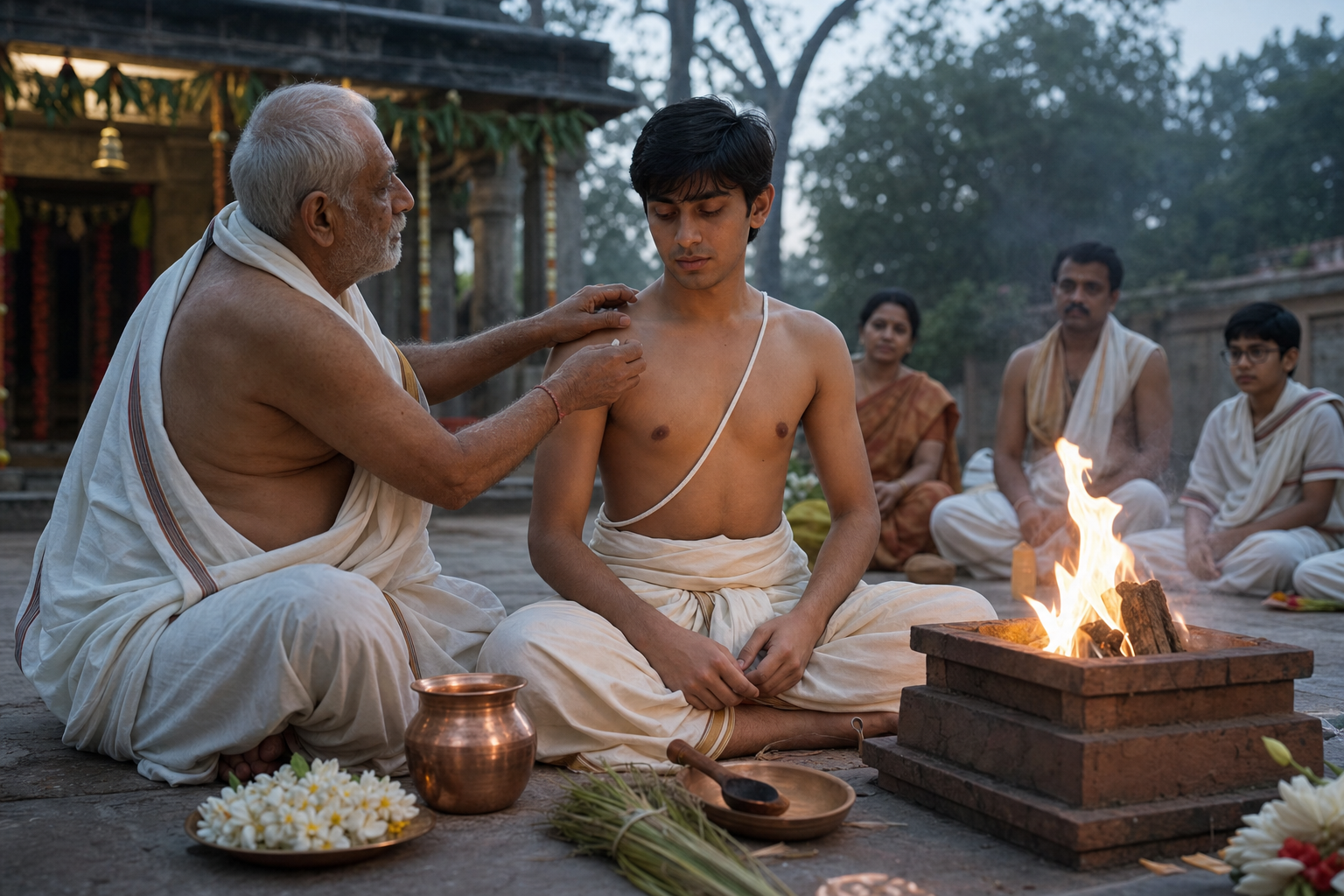
If you are arranging an Upanayana, or deciding whether you or your child is ready for one, the hardest question is not what to buy. It is what will begin after the guests leave and the ceremonial thread becomes part of ordinary life.
A meaningful Janeyu initiation gives the initiate a teacher, a daily discipline and a clear understanding of duty. Treat the ceremony as the first day of that discipline, not as the finished achievement.
Begin with the commitment that follows Upanayana
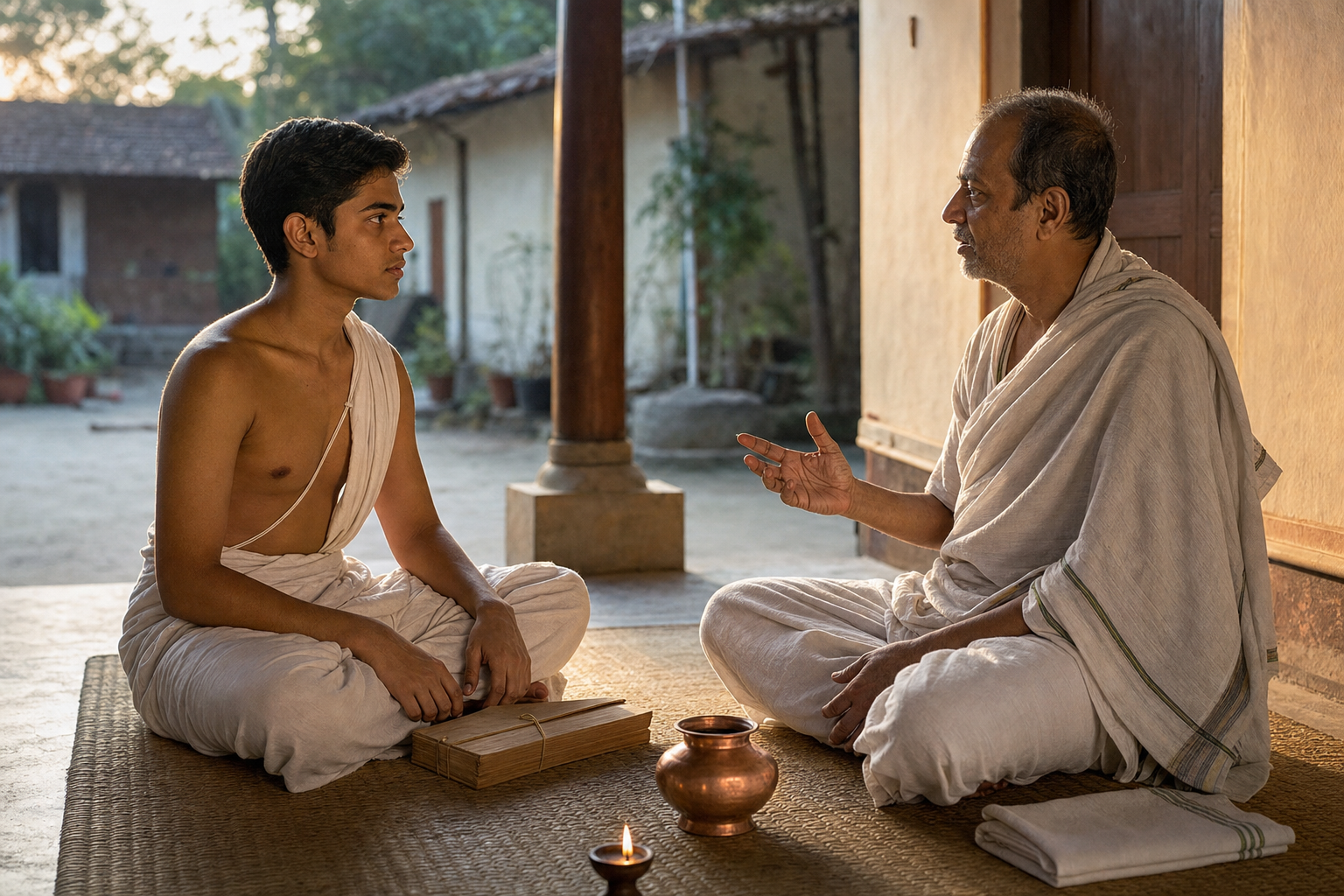
Upanayana joins initiation to brahmacharya: study, self-restraint and service. Its decisive moment is brahmopadesha, the conferral of the Gayatri mantra and the responsibility to undertake the practice associated with it. The sacred thread makes that responsibility visible, but wearing it is not a substitute for fulfilling it.
Before fixing the ceremony date, ask the officiating acharya four practical questions:
- Which Vedic, family or regional procedure will be followed?
- Who will teach the initiate the Sandhyavandanam sequence and correct mantra pronunciation?
- What daily observance is expected after brahmopadesha?
- Whom should the initiate contact about travel, missed observances, a damaged thread or annual renewal?
If nobody can answer those questions, the family has planned an event but not yet prepared an initiation. Secure continuing instruction before spending energy on clothing, invitations and photography.
Classical traditions preserve recommended ages associated with earlier social arrangements, but many contemporary communities also consider intention and preparedness. Readiness is not simply the ability to sit through a homa. The initiate should be able to understand that a promise is being made, accept a recurring practice, receive correction without resentment and identify the teacher who will help when questions arise.
This matters especially when a child is being initiated. Adults can organize the rite, but they cannot perform the child’s future discipline on the child’s behalf. Explain the commitment in plain language before the ceremony: you will learn, pray, practise restraint, speak truthfully and serve. A child who understands those verbs is better prepared than one who has memorized only the schedule for the day.
Read the thread without turning one symbolism into dogma
A standard yajnopavita consists of three joined strands and a central brahma-granthi, or sacred knot. The physical form is stable enough to be recognizable, but its three strands carry several inherited interpretations:
- The three debts: responsibility to the divine, to the rishis and teachers, and to the ancestors.
- The three gunas: sattva, rajas and tamas, whose movements must be understood and disciplined.
- The sacred rivers Ganga, Yamuna and Sarasvati.
- Dharma, artha and kama, ordered toward the culminating aim of moksha.
These are interpretive traditions, not competing claims about how the thread was manufactured. Ask which meaning your lineage teaches, learn that explanation carefully and use it as a prompt for conduct. If the strands signify the three debts, for example, the useful question is not whether you can recite their names. It is whether you are studying, showing gratitude to teachers, honoring ancestors and contributing rather than merely consuming.
Janeyu is also called yajnopavita, yajnasutra, brahmasutra and vratabandha in different contexts. Cotton is now common, while ritual traditions also discuss linen or flax and wool. Do not order a thread solely because a seller uses a familiar name. Confirm the material, strand arrangement, knot and customary number with the officiating tradition.
Some lineages add another yajnopavita after marriage to represent enlarged household responsibilities. That practice is not a universal instruction to add a thread independently. If marriage changes the number worn in your tradition, the family acharya should explain when, why and how.
Learn the three orientations before the ceremony ends
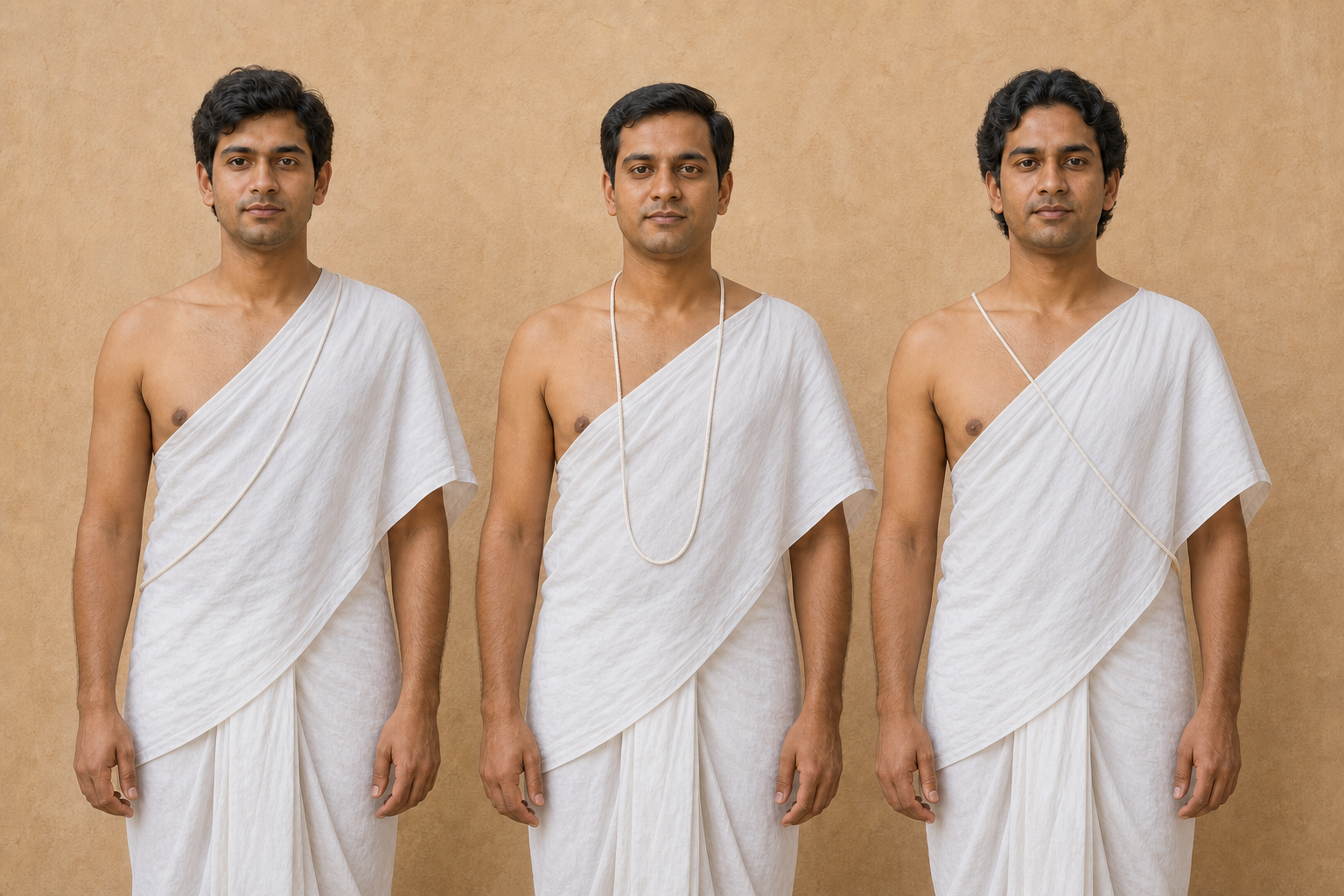
The sacred thread changes orientation with ritual context. This is an embodied part of the practice, not a decorative preference. Learn the movement physically from the acharya rather than relying on a photograph later.
| Orientation | How it is worn | Usual context | What to remember |
|---|---|---|---|
| Upavita | From the left shoulder, across the torso and under the right arm | Daily worship and most auspicious rites | This is the ordinary ritual orientation and leaves the right hand free for offerings. |
| Pracinavita | From the right shoulder across toward the left side | Rites directed toward the ancestors | The reversal marks a change in ritual purpose; it is not merely an alternative way to wear the thread. |
| Nivita | Looped around the neck | Certain preparations and other prescribed situations | Some traditions use it during bathing or when the cross-body line must not obstruct an action; follow the procedure you were taught. |
Upavita, pracinavita and nivita encode different ritual intentions. Practise identifying them before you need them. The most reliable test is whether you can move the thread correctly while naming the context: ordinary worship, pitri-karya or a specifically prescribed nivita use.
Do not turn this table into a substitute for lineage instruction. Grihya traditions preserve procedural detail, and regional customs can differ. When a family manual or competent acharya gives a more specific rule for a particular rite, that rule governs the practitioner performing it.
Build the daily practice and renewal plan
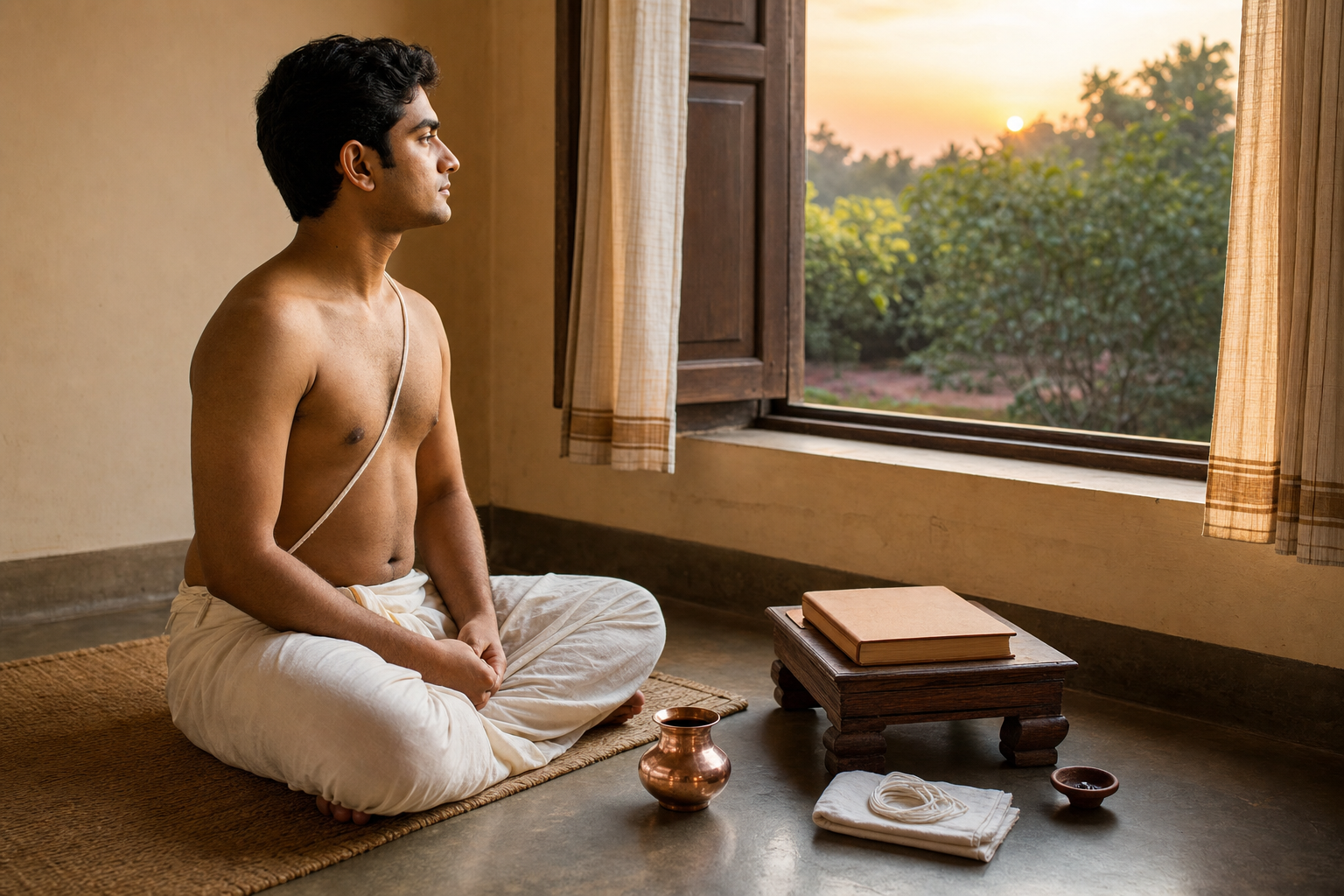
The thread becomes a living vow through Sandhyavandanam. Its disciplines include Gayatri recitation, regulated breathing, mindful ritual actions and the offering of water toward the light of the Sun. Dawn, noon and dusk provide the traditional daily junctions. Exact sequences, mantras and physical details depend on the inherited procedure.
A workable plan has five parts:
- Receive the complete sequence from a qualified teacher. A printed transliteration can support memory, but it cannot hear and correct pronunciation.
- Perform the first observances under supervision. Correct posture, orientation and sequence before errors become automatic.
- Reserve the three daily junctions in the initiate’s actual routine. If school, work or travel creates a recurring conflict, ask the teacher how that lineage handles the constraint instead of quietly abandoning the practice.
- Connect recitation to conduct. Satya, ahimsa, dama and svadhyaya mean truthfulness, non-harm, self-restraint and study. Choose concrete expressions of them: truthful speech when a lie would be convenient, restraint before an impulsive action, and protected time for learning.
- Put the annual Upakarma observance on the family calendar once its date is known for the relevant Vedic tradition.
Upakarma is more than routine thread replacement. It joins renewal with recitation, correction, atonement and recommitment to study. Its observance may fall in Shravana or Bhadrapada depending on the Vedic recension and community. Do not assume that a date used by another family automatically applies to yours.
Ask about damaged or worn threads before the problem occurs. The old thread is to be handled respectfully, and the replacement should be donned with the prescribed orientation and mantra. Knowing that procedure in advance prevents a broken thread from turning into either panic or casual disposal.
The best measure of continuity is not whether the Janeyu remains hidden neatly beneath clothing. Notice whether it still interrupts forgetfulness. When the thread touches the body, it can prompt a small audit: Have you studied? Have you acted truthfully? Have you controlled an avoidable harm? Have you remembered those to whom you owe gratitude?
Choose a living lineage, not a generic script
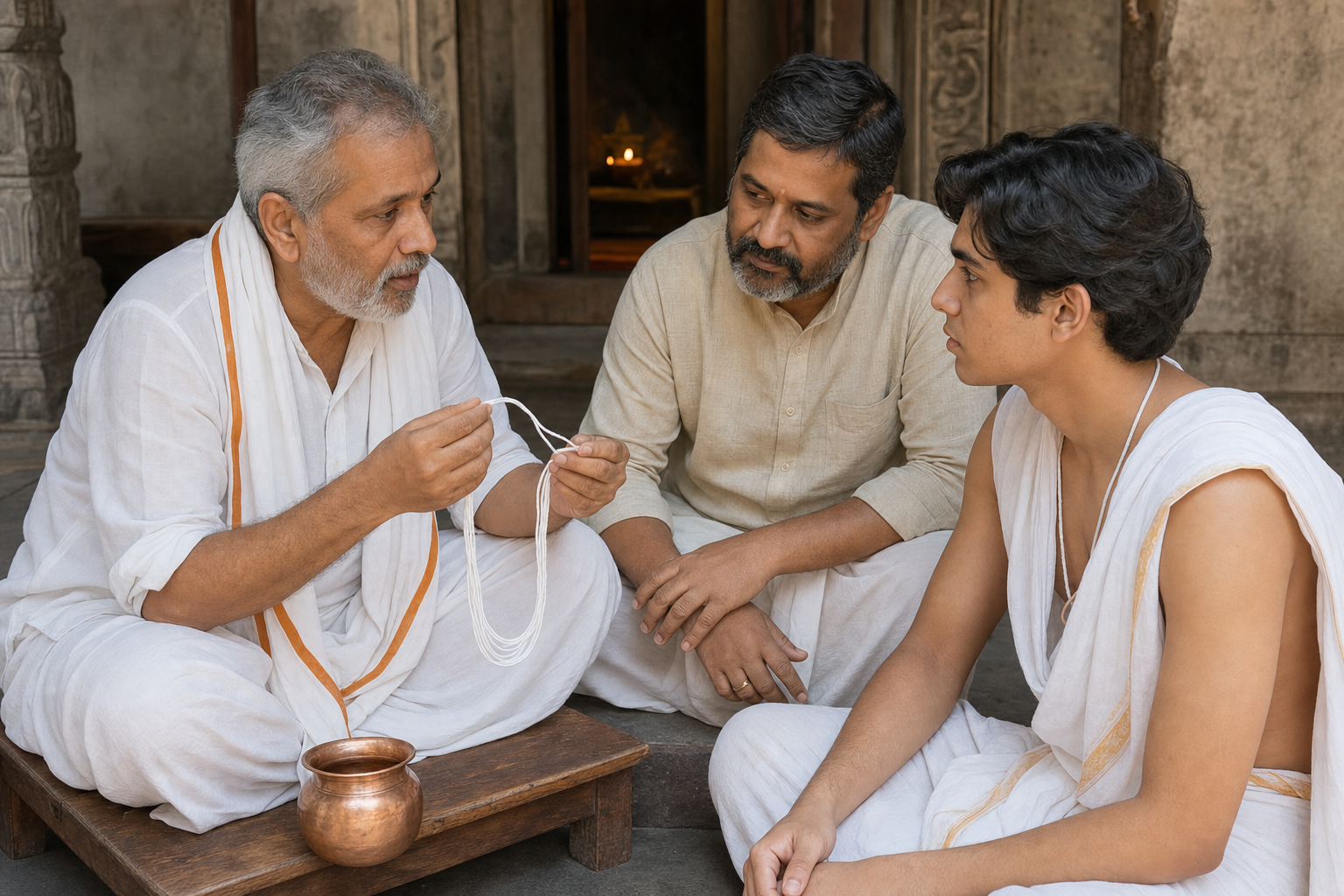
The rite appears under several regional names: Poonool or Upanayanam in Tamil Nadu, Poonal in Andhra-Telangana, Munja or Vratabandha in Maharashtra, Janeyu or Janoi across parts of North India, and Bratabandha among several communities in Nepal. Preparation of the yajnopavita, homa, brahmopadesha and the assumption of discipline form a recognizable continuity, but the shared outline does not make every regional script interchangeable.
If your family is maintaining an unbroken custom, begin with its acharya and inherited procedure. If the custom has lapsed, find a teacher who can explain what preparation is needed rather than trying to reconstruct the rite from disconnected instructions. If you are approaching Upanayana outside a hereditary family practice, seek a lineage that explicitly accepts and trains sincere aspirants.
Eligibility deserves an honest answer because Hindu communities do not all apply one contemporary rule. Dharmashastra discussions reflect historical forms of social organization. Many living communities now foreground study, ethics, discipline and reverence for knowledge, and some welcome sincere aspirants under appropriate guidance. That development should neither be denied nor inflated into permission to self-initiate. The ethical aspiration can be wide while authority to conduct a particular samskara remains lineage-specific.
Other Dharmic initiations can clarify the larger principle without being treated as versions of Janeyu. Buddhist upasampada and forms of diksha, Jain diksha, and Sikh Amrit Sanchar establish their own commitments, disciplines and visible signs. A robe, sacred thread, kara or Khalsa discipline is not interchangeable with another tradition’s form. What they share is the insistence that an initiation must alter how a person learns, acts, remembers and serves.
Key takeaways
- Plan the post-ceremony discipline before planning the ceremonial display.
- Choose an acharya who will teach and correct the initiate, not only officiate at the homa.
- Learn what your lineage means by the three strands instead of presenting one interpretation as universal.
- Practise upavita, pracinavita and nivita physically, with the ritual context attached to each orientation.
- Arrange daily Sandhyavandanam support and annual Upakarma renewal from the beginning.
- Handle questions of eligibility through a living, accountable lineage rather than assumption or online self-initiation.
Your next step is a conversation, not a purchase. Sit down with the prospective initiate and the acharya before selecting the date. Write down the daily practice, the teaching plan, the applicable renewal observance and the person who will answer future questions. Once those are clear, the ceremony can do its proper work: begin a vow that remains active when nobody is watching.
References
