
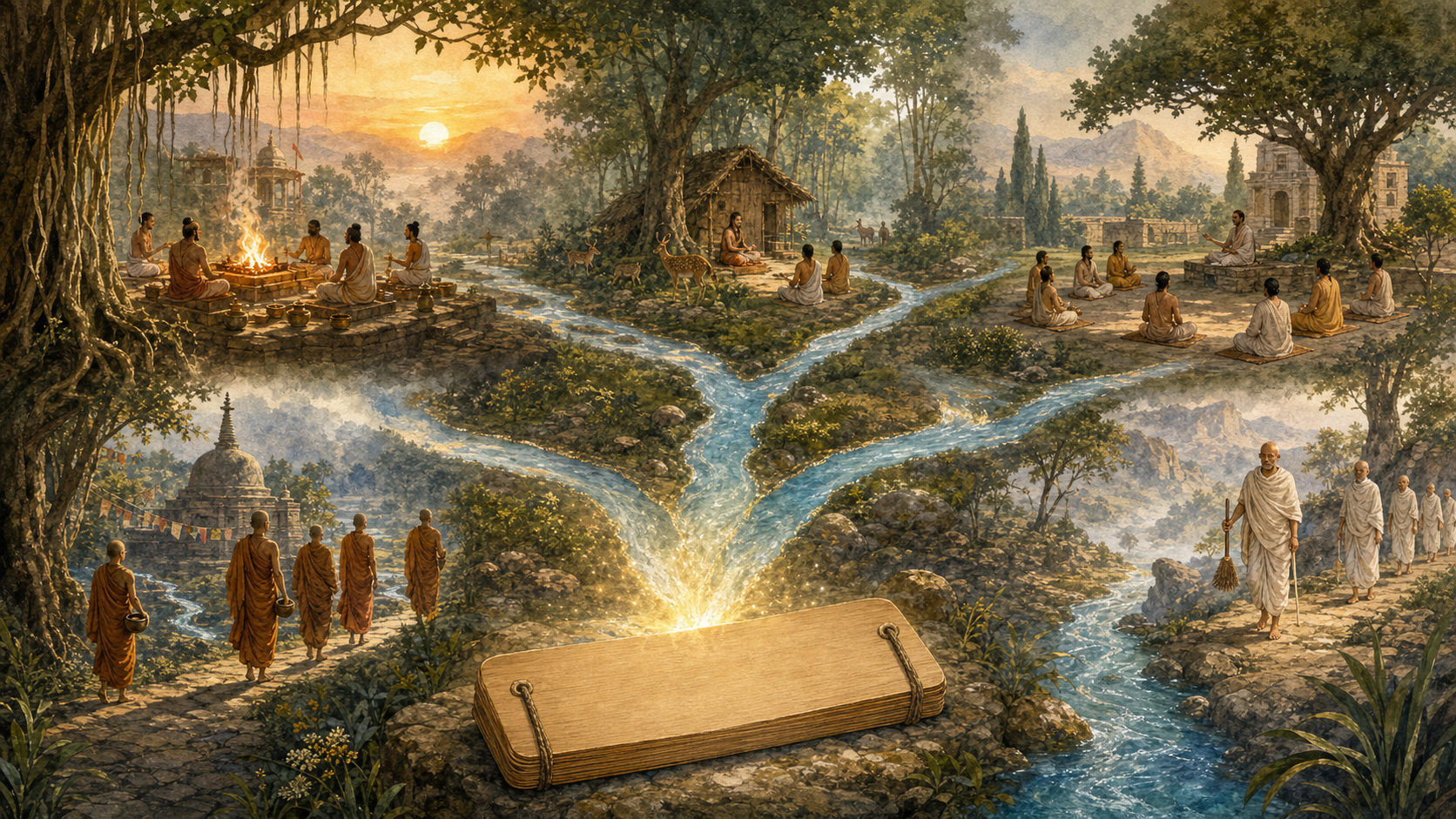
You have met Gautama in the Rig Veda, the Ramayana, Nyaya philosophy, Buddhism, or Jainism. Now you want to know whether these references point to one extraordinary sage, a single inherited lineage, or several unrelated teachers.
The short answer is that they do not all name the same person. “Gautama” can identify an individual, a Vedic lineage, a clan affiliation, or an authorial tradition. Once you separate those functions, you can appreciate the connections without collapsing distinct identities into a convenient but inaccurate story.
Begin by asking what the name is doing
Modern readers usually treat a name as a unique label. Ancient Dharmic naming does not always work that way. A name may locate a person within a family of transmission, associate a teacher with a gotra or clan, preserve the authority of a school, or distinguish a thinker through an epithet.
This is why resemblance is not identity. Siddhartha Gautama, Akshapada Gautama, and Gautama Swami do not become one historical person merely because they share “Gautama.” Nor should every Hindu use of the name be assigned automatically to one Vedic rishi. The useful question is not simply, “Who is Gautama?” Ask, “Which Gautama, in which textual community, and in what role?”
| Name or usage | Primary setting | What the name identifies | Clue that prevents confusion |
|---|---|---|---|
| Gotama Rahugana and the Gautama lineage | Vedic tradition | A seer and a lineage of hymn transmitters | Look for Rahugana, Vamadeva, Nodhas, Rig Vedic mandalas, deities, metres, or yajna |
| Gautama of the Dharmasutra | Early dharma literature | The authorial authority attached to a sutra manual | Look for ashrama duties, social norms, shraddha, expiation, or royal duty |
| Akshapada Gautama | Nyaya philosophy | The traditional systematizer of logical and epistemological inquiry | Look for valid knowledge, perception, inference, comparison, or testimony |
| Gautama Maharshi with Ahalya | Ramayana and later retellings | A rishi within a moral and sacred narrative | Look for Ahalya, penance, Rama, restoration, or grace |
| Gautama in the Godavari tradition | Puranic sacred geography | The ascetic sage associated with Gautami Ganga | Look for tapas, Tryambakeshwar, Nashik, pilgrimage, or the Godavari |
| Siddhartha Gautama | Buddhism | The Buddha, with Gautama functioning as a clan name | Look for suffering, ethical conduct, meditation, awakening, or Buddhist teaching |
| Gautama Swami, also called Indrabhuti | Jainism | The chief disciple of Bhagavan Mahavira | Look for Mahavira, Jain discipleship, ahimsa, austerity, or liberation |
Use this table as a first filter, not as a claim that each row has no relationship to any other. Traditions can inherit names, vocabulary, and memories without preserving one continuous biography.
The Hindu Gautama traditions form a cluster, not one biography
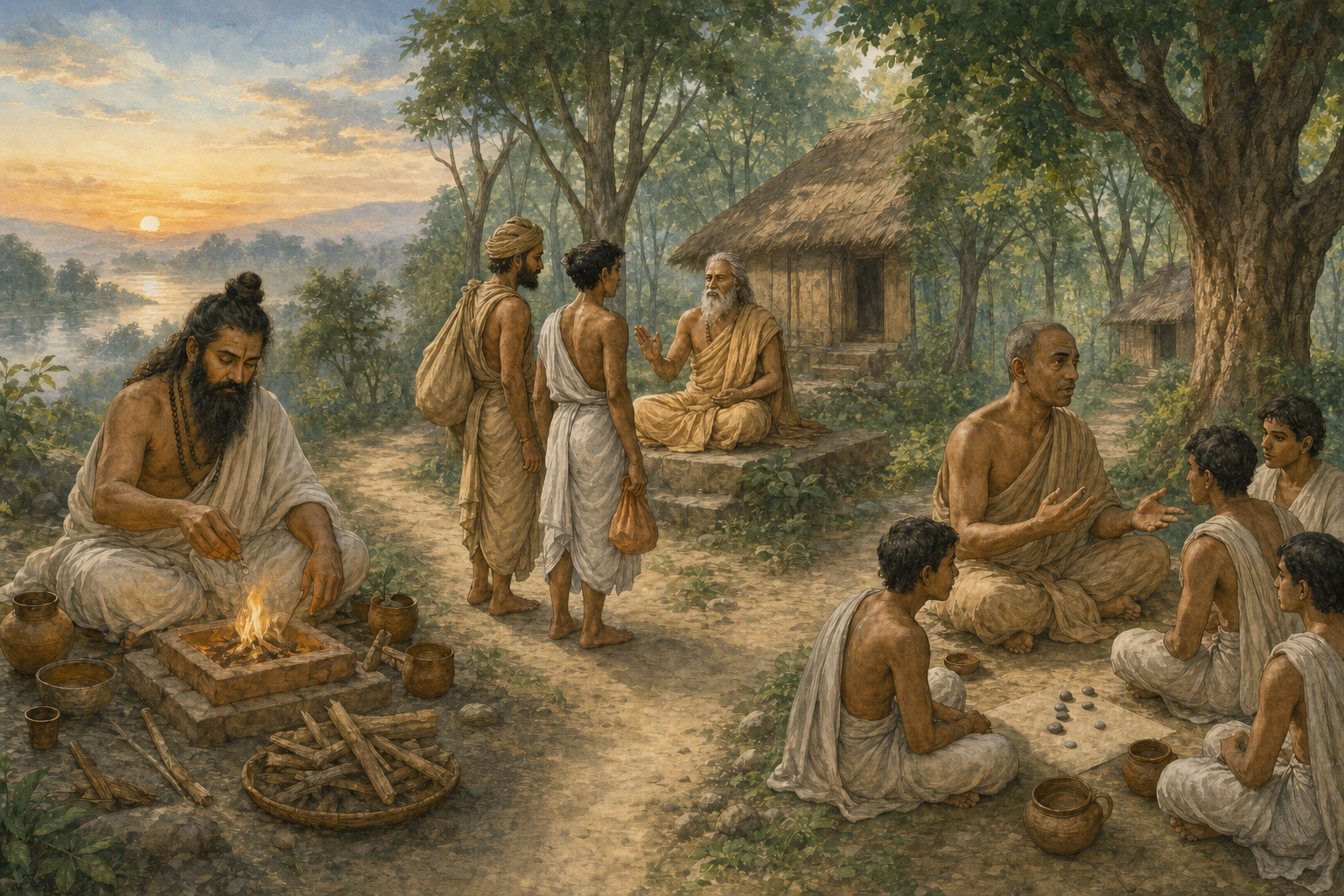
The Vedic lineage preserves revelation through transmission
Gotama Rahugana is traditionally remembered as the son of Rahugana. The wider Gautama lineage includes hymn attributions connected with figures such as Vamadeva Gautama and Nodhas Gautama, although their precise genealogical relationships vary across traditional accounts. That qualification matters: belonging to a lineage or teaching circle is not always the same as being a direct biological descendant.
Vamadeva Gautama is credited with Mandala 4 of the Rig Veda, while hymns attributed to Nodhas Gautama appear in Mandala 1. Their compositions address deities including Agni, Indra, and the Ashvins and employ metres such as Gayatri, Anushtubh, and Trishtubh. Here “Gautama” points you toward a culture of disciplined transmission: poetic insight, ritual knowledge, cosmic order, and mastery of sacred speech were carried through a parampara rather than detached from it.
When you encounter “Gautama” beside a Rig Vedic hymn, therefore, check the full rishi attribution. Do not silently replace Vamadeva or Nodhas with a generic Gautama Maharshi. The individual name tells you who is credited; the lineage name tells you the inherited world of learning in which that seer stands.
Dharma and Nyaya require separate identifications
The Gautama Dharmasutra belongs to another register. Its compressed sutras address duties associated with stages of life, social norms, ancestral rites, expiation, and royal responsibility. Its textual affiliation and date remain matters of scholarly discussion, though it is often connected with the Samaveda tradition and placed in the late first millennium BCE.
You should read that attribution conservatively. “Gautama” signals the authority under which this body of dharma teaching was transmitted; it does not, by itself, prove that the compiler was the same individual as Gotama Rahugana, Vamadeva Gautama, or the rishi of every later narrative. Ancient authorial attributions can preserve schools and lineages as well as individual authorship.
Akshapada Gautama is more clearly distinguished by his epithet and subject. The Nyaya-sutra is traditionally attributed to him, and Nyaya examines how a person acquires valid knowledge. Its four familiar means of knowledge are perception, inference, comparison, and verbal testimony. If the discussion turns on evidence, reasoning, debate, or the conditions of knowledge, you are dealing with the Nyaya teacher rather than merely another episode in the life of the Vedic sage.
This distinction also changes how you study. Approach the Dharmasutra by asking how dharma was formulated and applied. Approach Nyaya by testing arguments, identifying the means of knowledge being used, and asking whether a conclusion actually follows. A shared name should not make two different intellectual disciplines appear interchangeable.
Ahalya and Gautami Ganga belong to sacred memory and place
The Valmiki Ramayana associates Gautama with Ahalya and her eventual restoration through the presence of Sri Rama. Later retellings sometimes employ the familiar image of Ahalya becoming stone and being restored by Rama’s touch. The versions should not be flattened into one supposedly uniform account. The recurring moral field includes error, penance, expiation, compassion, and grace, but the narrative details depend on the telling before you.
If you are interpreting the episode, name the version first. Then distinguish its actual wording from later devotional imagery. This small discipline prevents a popular retelling from being projected backward into every recension, while still allowing that retelling to carry genuine theological meaning for the community that receives it.
Gautama’s memory also enters geography through the Godavari, revered as Gautami Ganga. Puranic sacred tradition connects the sage’s tapas with the river’s manifestation near Tryambakeshwar by Nashik. Pilgrimage, ancestral observance, oral memory, and the river’s identity preserve this Gautama through place rather than through philosophical authorship.
At Tryambakeshwar, do not treat the local Gautama tradition as decorative folklore added to a river. Ask how the river, the sage’s austerity, purification, and present ritual life interpret one another. Sacred geography is one of the ways Bharatiya civilization remembers: a teaching can remain embodied in water, pilgrimage routes, recitation, and repeated rites long after a single historical chronology becomes difficult to reconstruct.
Buddhist and Jain Gautamas are distinct, but not culturally isolated
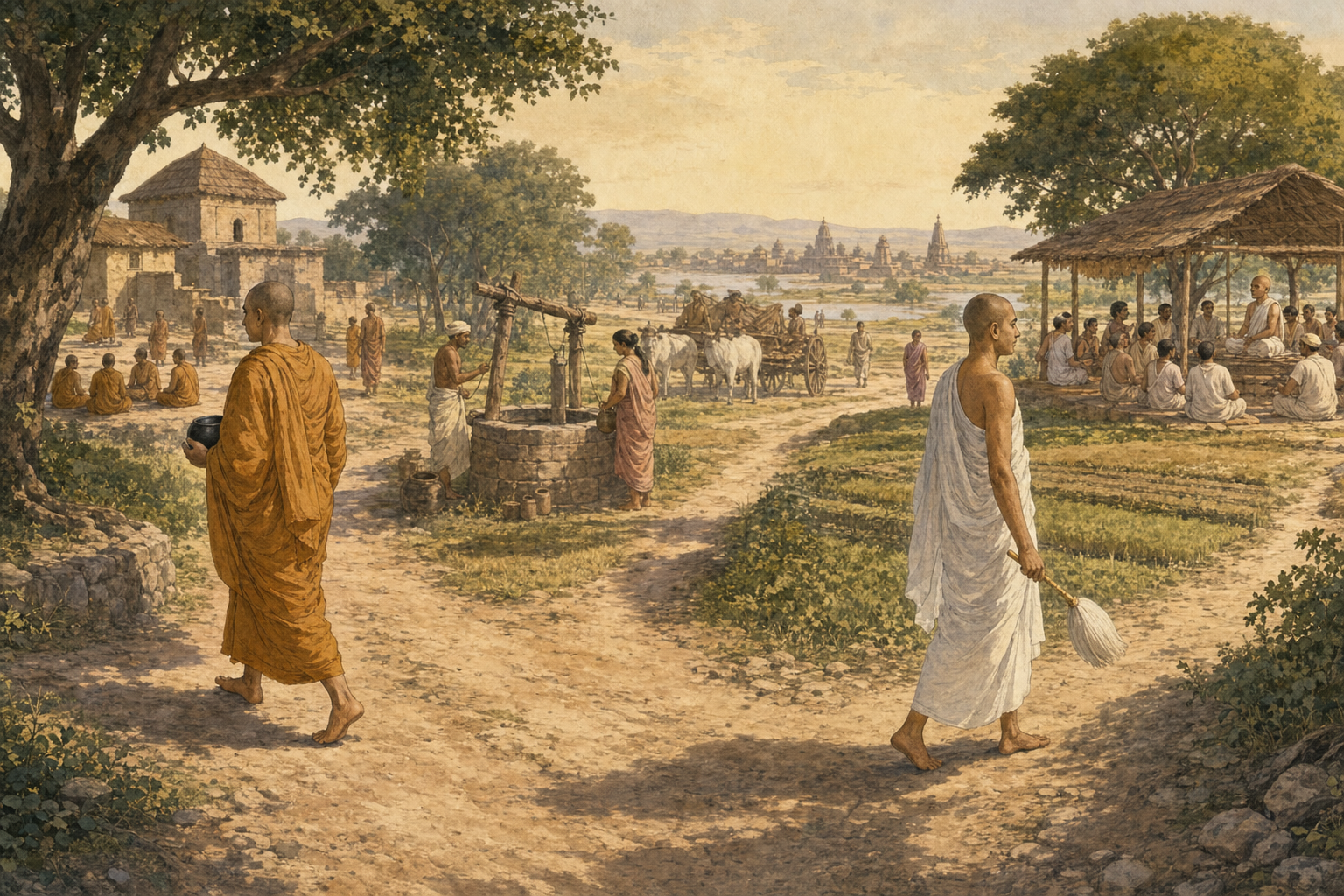
In Buddhism, Gautama is the clan name associated with Siddhartha Gautama, the Buddha. That fact does not turn the Buddha into the Vedic rishi or the Nyaya philosopher. His identity belongs within the Buddhist setting of suffering, ethical discipline, meditation, awakening, and liberation.
In Jainism, Gautama Swami is also known as Indrabhuti and is revered as the chief disciple of Bhagavan Mahavira. He is neither Siddhartha Gautama nor the Vedic Gautama. His proper interpretive setting is Jain discipleship and the pursuit of liberation under principles that include ahimsa and disciplined austerity.
Historical distinction does not require civilizational isolation. These traditions arose within a broad Bharatiya environment in which renunciation, tapas, moral causation, disciplined knowledge, non-violence, and liberation could be intelligible across community boundaries even when their definitions and doctrines differed. A shared name can be evidence of that connected cultural world without becoming evidence for a shared personal identity.
The same restraint is necessary when bringing Sikhism into an inter-Dharmic conversation. Sikh commitments to truth, service, and unity can illuminate shared ethical concerns, but there is no need to invent a Sikh Gautama counterpart to create a neat four-tradition symmetry. Real kinship survives honest difference. In fact, it becomes more credible when we refuse to manufacture equivalences.
Use this five-step test whenever a Gautama appears

You can resolve most cases without constructing a universal family tree. Work from the immediate context outward:
- Record the complete name. Keep Rahugana, Vamadeva, Nodhas, Akshapada, Siddhartha, Swami, or Indrabhuti attached. Epithets and companion names are identification tools, not optional ornament.
- Locate the textual or ritual setting. A Rig Vedic hymn, Dharmasutra rule, Nyaya argument, Ramayana episode, Buddhist teaching, Jain lineage, and Godavari pilgrimage begin with different presumptions.
- Classify the use of “Gautama.” Decide whether it is functioning as a personal name, lineage or gotra marker, clan name, school attribution, or sacred-memory designation. Do not decide that it means “the same man” before this step.
- Match the subject matter. Hymn and yajna indicate the Vedic sphere; duties and expiation indicate the Dharmasutra; valid knowledge indicates Nyaya; Ahalya or Gautami Ganga indicates epic or Puranic memory; Mahavira indicates Jainism; the Buddha’s path indicates Buddhism.
- State only the relationship you can support. Say “shares a name,” “belongs to the Gautama lineage,” “is traditionally attributed to,” or “is associated with” when those are the warranted claims. Reserve “is the same person as” for cases where the identity is actually established.
This method is especially useful when you write, teach, caption a social-media image, or explain a tradition to children. A single missing qualifier can turn a meaningful connection into a false historical assertion. Adding one precise phrase often solves the problem: “the Nyaya sage Akshapada Gautama,” “the Jain teacher Gautama Swami,” or “the Gautama lineage of Vedic seers.”
It also helps you evaluate sweeping claims. If someone says that one Gautama authored Vedic hymns, composed the Dharmasutra, founded Nyaya, married Ahalya, became the Buddha, and served Mahavira, ask for the identity evidence at each transition. Repetition of a respected name is not enough. Traditional reverence and historical care are allies here: both ask us to receive each figure in the form in which that tradition actually remembers him.
Key takeaways for responsible Dharmic reading
- “Gautama” is not one universal personal name across every Hindu, Buddhist, and Jain setting.
- The Vedic Gautama material includes both individual seers and a lineage of transmission; precise genealogical relations are not uniform in every account.
- The Gautama Dharmasutra and Akshapada Gautama’s Nyaya-sutra represent different fields of inquiry and should not be assigned automatically to the Vedic rishi.
- Ahalya and Gautami Ganga preserve Gautama through epic, Puranic, ritual, and geographical memory.
- Siddhartha Gautama and Gautama Swami are distinct Buddhist and Jain figures; their shared name indicates cultural proximity, not personal identity.
- Unity among Dharmic traditions becomes stronger when similarities are explored without erasing doctrinal, textual, or historical differences.
The next time you encounter Gautama, pause before merging identities. Write down the full name, identify the tradition and genre, and ask whether “Gautama” marks a person, lineage, clan, or school. That habit will give you something better than a tidy legend: a clearer view of how Bharat preserved wisdom through revelation, reasoning, discipline, story, discipleship, and sacred place.
References
