

You may revere a sacred story and still wonder what, exactly, you are being asked to believe. Must every Purāṇic detail function as literal history before the story can disclose truth? If you question one chronology, have you rejected dharma? Or does reading symbolically reduce scripture to fiction? You do not have to accept that cramped choice.
Dharmic traditions offer a more demanding path. Philosophy clarifies what can be known, sacred narrative trains you to perceive meaning, and sādhanā tests whether that meaning changes how you see and act. The word divine will not mean exactly the same thing in Hindu, Buddhist, Jain, and Sikh settings. What these traditions can share is a disciplined refusal to confuse belief with mere assertion.
Key takeaways
- A sacred narrative can preserve civilizational memory, teach dharma, support ritual, and map inner life at the same time.
- Śraddhā is best treated as disciplined trust that sustains inquiry, not as permission to stop asking questions.
- Śabda, anumāna, and pratyakṣa give you three different ways to approach a spiritual claim: trustworthy testimony, inference from effects, and direct perception refined through practice.
- A sound interpretation should make responsibility clearer and loosen possessiveness. Emotional intensity alone is not evidence of realization.
- Hindu, Buddhist, Jain, and Sikh paths have genuine affinities, but their accounts of self, liberation, and ultimate reality should not be collapsed into one doctrine.
Clarify what kind of knowing you are seeking
A common mistake appears before interpretation even begins: you look for God as though looking for an object that has gone missing. That approach may be unsuitable if Brahman is the ground of awareness, if Īśvara is known through relationship and devotion, or if the sacred is recognized when habitual grasping becomes quiet. You first need to identify the claim in front of you.
Ask whether the passage is making a claim about ultimate reality, offering a rule for conduct, describing a contemplative state, or giving you a practice. Those claims require different tests. A meditation instruction is not verified by proving a genealogy. A moral teaching is not established merely because an event is ancient. A claim about consciousness cannot be settled only by examining material objects.
Indian epistemology gives you a practical framework through the idea of pramāṇa, a reliable means of knowing. Different darśanas do not recognize precisely the same set, but three are especially useful for spiritual inquiry:
- Śabda, trustworthy testimony: A śāstra, realized teacher, or established lineage gives you an orientation that ordinary sense perception may not supply. Treat this testimony respectfully but precisely. Record what is actually being claimed instead of replacing it with what you hope it means.
- Anumāna, inference: Examine the effects of the teaching and its practice. Does it steadily reduce reactivity, deepen compassion, improve clarity, and support equanimity? These changes do not prove every metaphysical claim, but they are meaningful evidence that a practice is doing what it says it is meant to do.
- Pratyakṣa, direct perception: Dharmic disciplines do not restrict perception to an untrained glance. Dhyāna, mantra-japa, ethical restraint, breath awareness, and sustained attention refine the instrument of knowing. The aim is not to manufacture a dramatic feeling but to see more clearly when agitation and clinging subside.
The Bhagavad Gita 4.39 connects śraddhā with knowledge through the expression śraddhāvān labhate jñānam. Śraddhā here need not mean blind assent. It is the confidence required to practice long enough for knowledge to mature. You do not demand the final result before taking the first step, but neither do you declare the result before doing the work.
Use a simple notebook with three headings: teaching, practice, and fruit. Under teaching, write one claim in plain language. Under practice, note what you actually did. Under fruit, record changes in attention and conduct, including failures. This prevents a comforting idea, an inherited affiliation, and an experienced transformation from being treated as though they were the same thing.
Read sacred narrative without forcing it into modern boxes
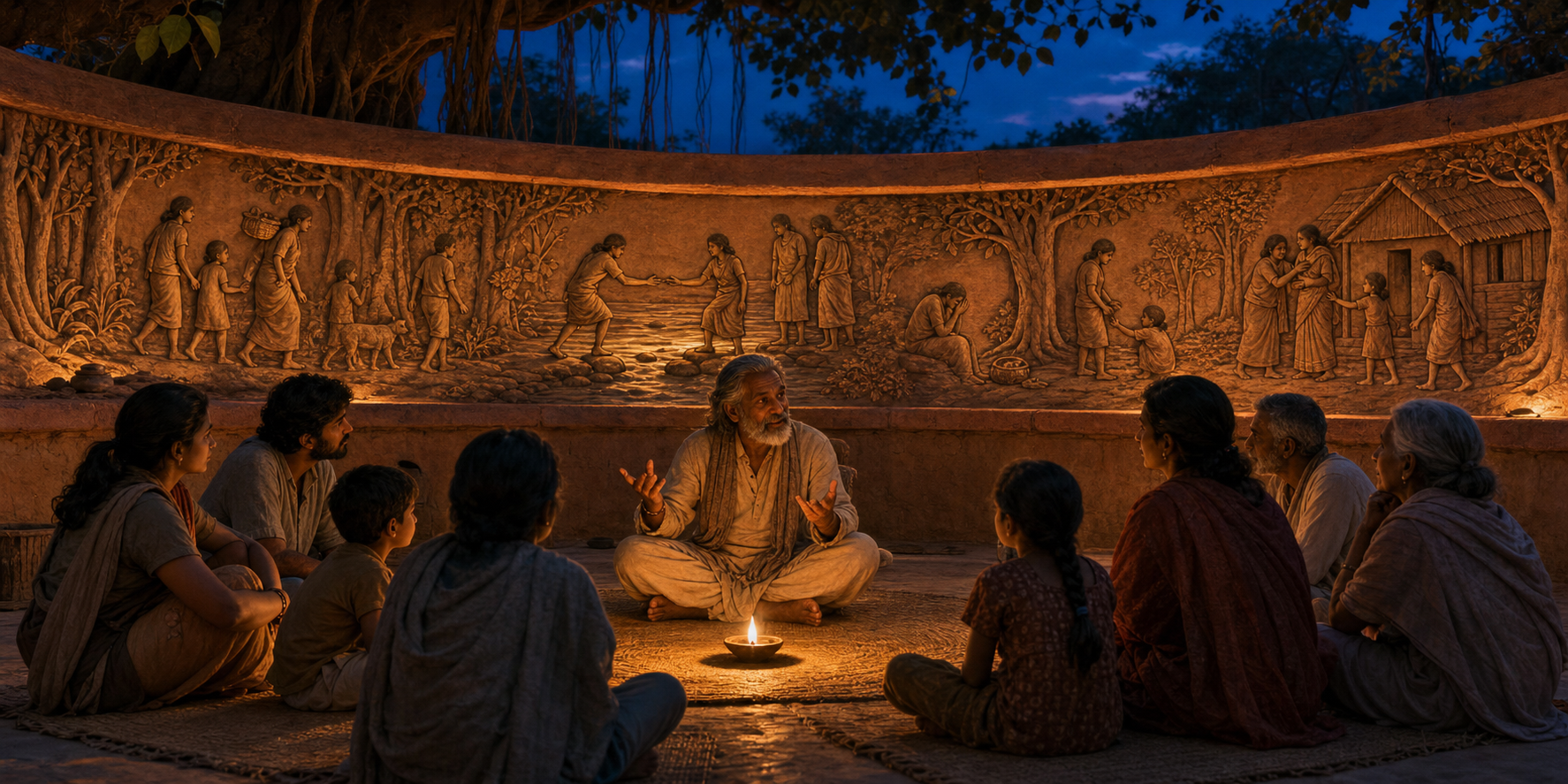
The label fiction is often too narrow for the Purāṇas. These works combine cosmology, genealogies, ritual memory, moral instruction, devotion, and teachings directed toward liberation. Traditional descriptions identify five recurring concerns: creation, dissolution and renewed creation, lineages, cosmic epochs, and accounts of royal or sage succession. A modern novel and a modern court chronicle are therefore both poor containers for the whole genre.
This does not mean that historicity is irrelevant. Purāṇic genealogies can preserve civilizational memory and may intersect with inscriptions, regional traditions, or archaeological indications. They can also telescope time, sacralize memory, and arrange events for a teaching purpose. You can investigate an external claim without assuming that the spiritual worth of the entire narrative rises or falls with that single inquiry.
Use a three-pass reading
Classical distinctions among abhidhā, lakṣaṇā, and vyañjanā help you read direct meaning, extended meaning, and suggested resonance without making them compete unnecessarily. Put that principle to work in three passes:
- Follow the event: Who acts, what conflict appears, what changes, and what consequence follows? Do not jump to symbolism so quickly that you stop hearing the actual narrative.
- Identify the pattern: Ask what structure the event reveals in cosmic order, community, ritual, or the mind. Name the pattern in one sentence rather than attaching a symbolic meaning to every decorative detail.
- Accept the demand: Decide what the story asks you to notice or do. A reading that never reaches conduct, contemplation, or discernment has probably remained incomplete.
Consider Samudra Manthana, the churning of the ocean. On its narrative level, opposing powers cooperate in a cosmic undertaking. On a psychological level, disciplined faculties and unruly impulses pull against one another while practice churns a turbulent inner life. On a contemplative level, clarity does not appear by denying the turbulence; it is refined through sustained effort under divine guidance. These meanings can coexist. The inner reading need not cancel the cosmic one, and the cosmic reading need not exempt you from the inner work.
When two versions differ, resist the impulse either to hide the difference or to announce that nothing can be trusted. Place the versions side by side and ask three questions: Which motif remains stable? Which ritual, regional, or pedagogical emphasis changes? What dharmic result does each version seek? Variation may reveal adaptation to distinct audiences rather than simple carelessness.
Then apply an ethical check. If your interpretation consistently hardens the heart, feeds vanity, excuses cruelty, or turns every opponent into an asura, examine it again. Kāma, krodha, lobha, moha, mada, and matsarya can be read as forces within your own conduct before they become labels for somebody else. At the same time, do not confuse moral usefulness with historical proof. A teaching can transform you without establishing a chronology, and uncertainty about chronology does not automatically erase contemplative meaning.
Let philosophy correct how you imagine the Divine

Sacred stories give divine reality names, forms, relationships, battles, births, and acts of grace. Philosophy prevents you from reducing those forms to ordinary objects. The image of the sun is especially effective because it joins metaphysics with practice: light reveals everything in its field without taking on the condition of each thing revealed.
The analogy has limits. The physical sun changes and participates in material processes. Divine Light is not a claim that God is a star. The comparison is useful at selected points: illumination, impartiality, sustenance, and freedom from the qualities of the objects illumined.
Bhagavad Gita 13.33 compares the one sun illuminating the world with the knower illuminating the field. The point becomes practical when you notice that a thought, a fear, and a desire are all known. Each mental event changes, while the capacity by which it is known is not simply another event of the same kind. This is the doorway to sākṣī-bhāva, the witness perspective.
Do not make one Vedānta school speak for all
The sun image does not eliminate disagreement about the relationship among the Divine, the world, and the individual self. It helps you locate that disagreement more accurately.
- Advaita Vedānta understands Brahman as the unchanging, nondual ground whose light reveals nāma-rūpa, names and forms, without itself becoming modified by them. Inquiry examines mistaken identification with transient states.
- Viśiṣṭādvaita affirms an inseparable relation in which the world is understood as the body of Brahman, while the Lord remains untainted. Difference is not dismissed as mere practical inconvenience.
- Dvaita preserves a real qualitative distinction between the Lord and dependent beings. Divine purity follows from the Lord’s supreme independence, not from an eventual discovery that every distinction was unreal.
If you are studying across these schools, mark their disagreements instead of smoothing them into the vague claim that everything is one. Ask who or what knows, whether difference is ultimately real, and how liberation relates the individual to the Supreme. Those questions will show you where the schools genuinely diverge.
You can also turn the sun analogy into a short exercise. After your usual meditation, notice one sensation, one thought, and one emotion as they arise. For each, silently recognize that it is known. Do not chase a verbal answer to the question of what knows it. Let the event pass, then bring to mind one unfinished duty. Separate the action that dharma requires from the outcome you want to possess.
This last step matters. Non-attachment is not indifference. Bhagavad Gita 5.10 joins offered action with relinquishment of attachment and uses the lotus leaf, untouched by water, as its image. If the witness perspective makes you less responsible to family, work, community, or a person you have harmed, you are using it as avoidance. Genuine asanga loosens possessiveness so that care can become steadier.
Preserve shared discipline without inventing sameness
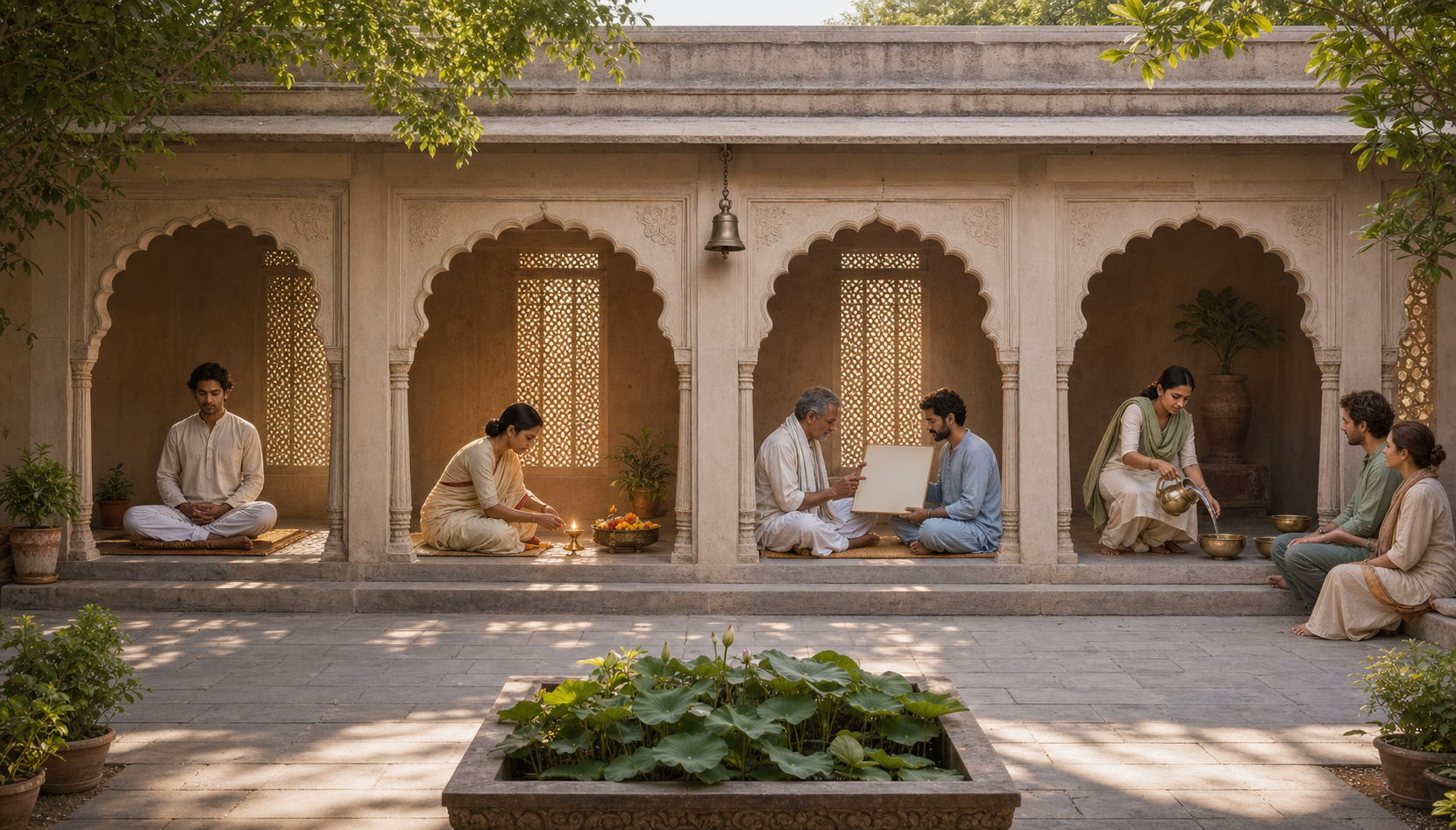
Hinduism, Buddhism, Jainism, and Sikhism share a civilizational vocabulary of disciplined attention, ethical restraint, freedom from clinging, and compassion. That kinship is real. So are their doctrinal boundaries. You understand the Dharmic family better when you can see resemblance without turning every tradition into a disguised version of your preferred school.
| Tradition | Illumination or liberation frame | Practice to notice | Distinction to preserve |
|---|---|---|---|
| Hindu traditions | Brahman, Īśvara, an Iṣṭa, or the Guru-tattva may orient knowledge and devotion, with major disagreements among darśanas. | Upāsanā, mantra-japa, dhyāna, inquiry, Karma Yoga, and bhakti. | Do not confuse Advaita, Viśiṣṭādvaita, and Dvaita accounts of self, world, and God. |
| Buddhism | The pabhassara citta image presents mind as luminous while adventitious defilements obscure it. | Śamatha and vipaśyanā expose conditioned mental events and weaken upādāna, or clinging. | Anattā prevents luminous mind from being casually renamed an eternal individual self or a creator God. |
| Jainism | The jīva’s inherent knowledge becomes unobstructed as karmic accretions are shed. | Dhyāna, vrata, aparigraha, and nirjarā direct life toward clarity and release. | Liberated luminosity should not be collapsed into union with a creator deity. |
| Sikhism | Ik Onkar is remembered as Nirlep, unstained, and as Jot, the Light present in beings. | Simran, kirtan, and seva join remembrance with impartial service. | Jot is not merely a generic metaphor detached from devotion, the Guru, and lived service. |
The most useful common test is ethical rather than terminological. Does your path make ahiṁsā more exact, aparigraha more visible, satya more demanding, and seva less dependent on praise? Luminous awareness that leaves grasping and partiality untouched has not yet become a transformed life.
For daily practice, stay grounded in one coherent lineage or discipline long enough to understand its internal logic. Comparative study becomes more fruitful after you know which distinctions matter within each path. Collecting interchangeable techniques may feel inclusive, but it can prevent any one method from becoming deep enough to test.
Put the teaching to a 40-day test
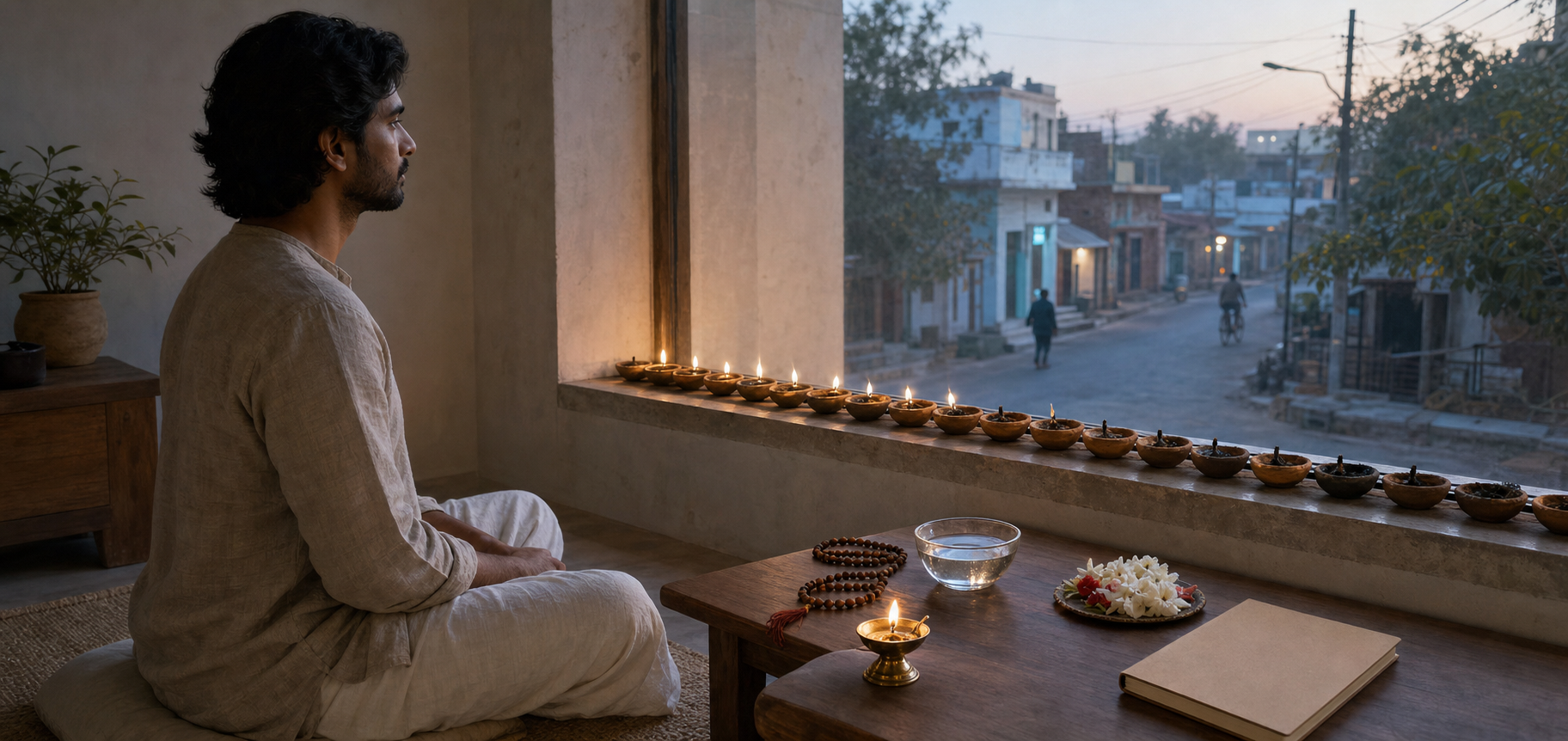
You do not need to settle every metaphysical question before beginning. Choose one teaching that matters in your actual life, such as acting without ownership of the result, seeing anger before it becomes speech, or serving without demanding recognition. Then give one disciplined routine enough continuity to show you something about your habits.
The following 40-day structure joins satsang, sādhanā, seva, and svādhyāya:
- Settle the body and attention: Begin the morning with 10 to 15 minutes of gentle prāṇāyāma. If you have not learned a specific method from a qualified teacher, keep the breathing natural and unforced rather than improvising an intense technique.
- Steady the mind: Continue with 20 minutes of mantra-japa connected to your Iṣṭa or lineage. Use one mantra consistently instead of changing it whenever the mind becomes restless.
- Enter silence: Sit for 20 minutes of dhyāna. Notice thoughts and emotions as known events. The task is not to suppress them or turn the witness into a new mental picture.
- Read a bounded passage: Study one chapter or episode from the Bhagavad Gita, Śrīmad Bhāgavatam, or another text recognized within your path. Use a reputable commentary and remain with the same text throughout the period.
- Review the day: In the evening, record affect, attention, and conduct. Name the trigger, your first reaction, whether you recovered before acting, and what responsibility remains.
- Make insight social: Keep a weekly seva commitment. Choose work that is genuinely useful and that does not depend on public recognition. Light dietary discipline and reduced digital input in the early hours can help protect the continuity of the morning practice.
If your home tradition uses a different form, preserve the structure rather than forcing Hindu terminology onto it. Sikh practice can center simran and seva. Buddhist practice can center śamatha and vipaśyanā. Jain practice can connect dhyāna with vrata and aparigraha. The important point is to combine disciplined attention, ethical restraint, trustworthy instruction, and service instead of relying on private feeling alone.
Judge the period by four markers: reactivity, compassion, clarity, and equanimity. Look for ordinary evidence. Did you notice anger earlier? Could you act firmly without carrying the quarrel for the rest of the day? Did service become less transactional? Could you release an outcome while still completing the duty?
Do not use visions, unusual sensations, or emotional intensity as your only measure. A memorable state may be meaningful, but it does not interpret itself. If the practice produces spiritual pride, withdrawal from responsibility, or contempt for other paths, return to the teaching, the commentary, and a competent mentor. If nothing changes, check consistency and method before declaring either that the Divine has been disproved or that hidden progress must be occurring.
At the end of the 40 days, do not ask only whether you have proved God. Ask a more exact question: What can you now see that grasping previously concealed, and what act of dharma has that clearer seeing made possible? Keep the practice that helps you answer honestly, and take that answer into your next duty.
References
- DharmaRenaissance Blog — Unattached Like the Sun: Dharmic Wisdom on the Divine Light That Impartially Illumines All
- DharmaRenaissance Blog — Are the Puranas Just Fiction? A Rigorous, Heart-Centered Guide to Finding God and Trusting Truth