
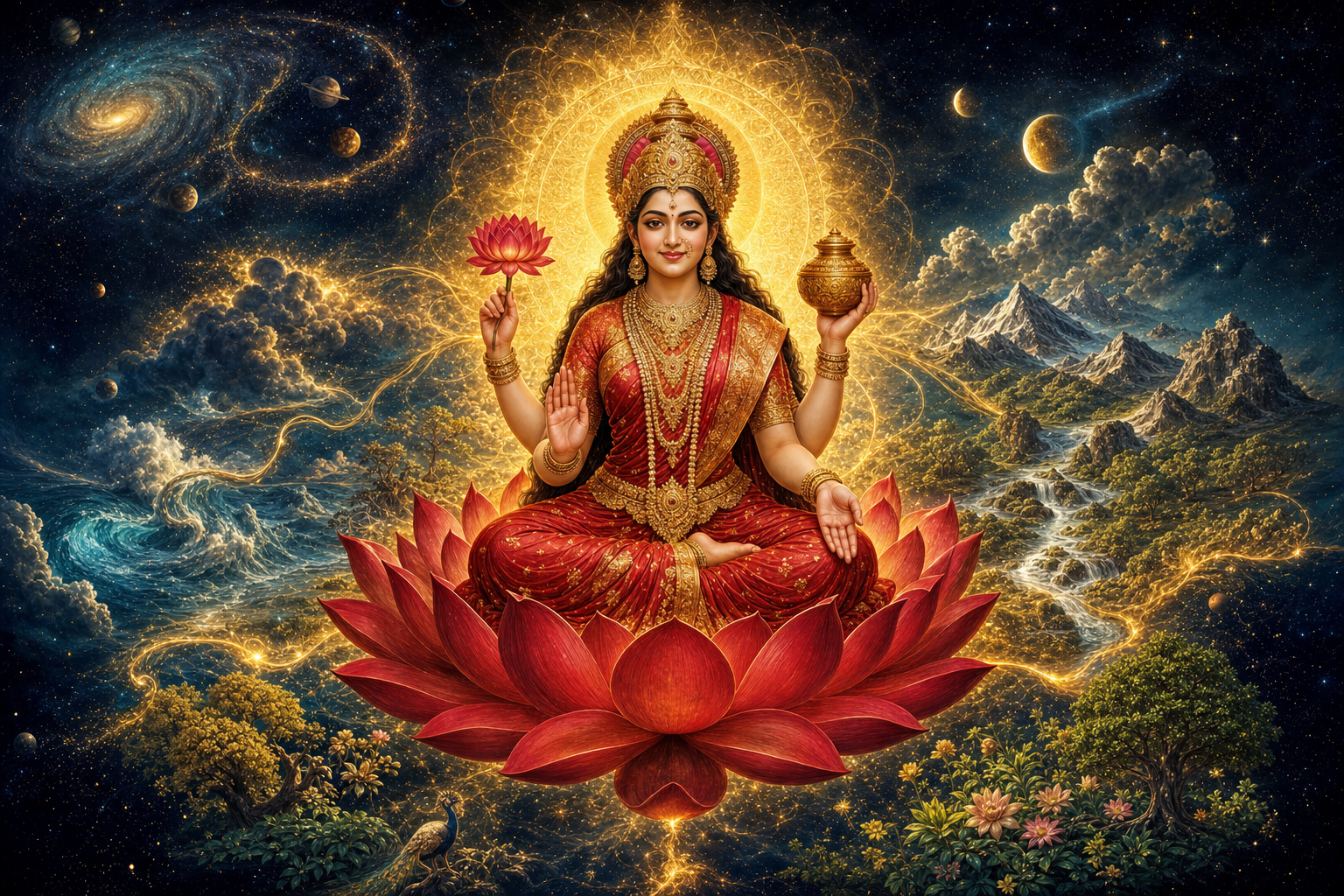
If you know Lakshmi chiefly as the giver of prosperity, the Pradhanikarahasya can be disorienting. Here Mahalakshmi does not simply bless a universe created elsewhere. She is the primordial Shakti from whom the universe, its governing powers, and its possibilities arise.
That distinction changes how you read the Devimahatmya, how you understand the three gunas, and even what you mean when you pray for Sri. The practical question is no longer only, “How do I receive abundance?” It becomes, “How should I live when abundance, intelligence, action, and liberation are expressions of one sacred power?”
Read Mahalakshmi at the scale of the primordial cause
The familiar devotional image of Lakshmi is not being rejected. It is being placed inside a much larger theology. The lotus-bearing Goddess of auspiciousness and prosperity remains real, gracious, and worthy of worship, but she is not confined to one department of cosmic life.
Within the Pradhanikarahasya, Mahalakshmi exists before differentiated creation. Brahma, Vishnu, and Shiva arise through her power and perform their functions within it. She is therefore not merely one divine being among several. She is the ground that makes divine agency, material manifestation, knowledge, time, and causation possible.
The title helps establish the scale. Pradhana points to the primordial, unmanifest ground associated with mulaprakriti, while rahasya signals an inward or esoteric disclosure. The teaching identifies that ground not as lifeless material waiting to be activated from outside, but as the sovereign power of the Devi. Consciousness and creative power belong to one reality.
This gives you a reliable test when reading. If an interpretation reduces Mahalakshmi to money, luxury, or good fortune, it is too small for this setting. If it treats her as a rival who must defeat Vishnu, Shiva, or Brahma for supremacy, it is also too small. Her supremacy is ontological: their powers are intelligible as expressions within her all-encompassing Shakti.
The word Sri should therefore be heard as plenitude, harmony, beauty, dignity, and auspicious order. Money can participate in Sri, but money severed from dharma can also destroy harmony. Prosperity becomes Lakshmic when it sustains rightful relationships, responsible household life, generosity, ecological restraint, and the conditions in which knowledge and liberation can be pursued.
- When you encounter “Mahalakshmi,” ask whether the name denotes the supreme totality or a particular manifest function.
- When you encounter “prosperity,” ask what kind of order that prosperity creates around it.
- When you encounter “supremacy,” read it as metaphysical dependence, not as a sectarian contest among deities.
One supreme Goddess appears through three powers
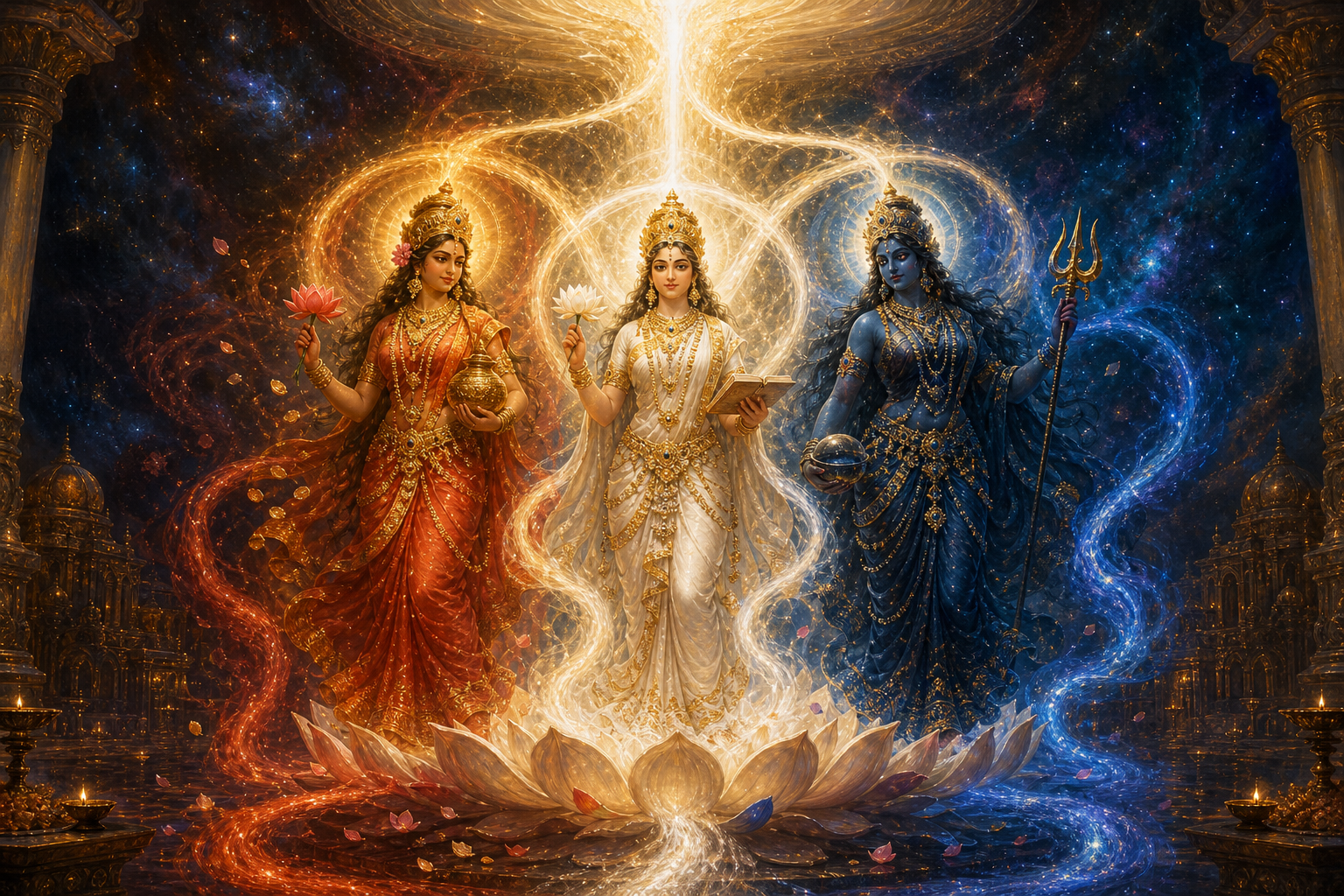
A common difficulty arises because Mahalakshmi appears both as the supreme source and as one member of the triad Mahakali, Mahalakshmi, and Mahasaraswati. The two uses are not contradictory. One names the undivided whole; the other names a distinctive mode through which that whole operates.
The three great narrative cycles of the Devimahatmya can be read through the three gunas. The Madhu-Kaitabha cycle is associated with Mahakali and tamas, the Mahishasura cycle with Mahalakshmi and rajas, and the Shumbha-Nishumbha cycle with Mahasaraswati and sattva. This is not a division of the cosmos among three independent goddesses. It is a way of seeing one Shakti govern the fundamental conditions of manifestation.
| Narrative cycle | Manifest form | Guna | What to notice in yourself |
|---|---|---|---|
| Madhu-Kaitabha | Mahakali | Tamas | Inertia, obscuration, or the inability to awaken and discern |
| Mahishasura | Mahalakshmi | Rajas | Powerful activity that changes direction, resists discipline, or becomes domination |
| Shumbha-Nishumbha | Mahasaraswati | Sattva | Clarity and refinement, along with the subtler danger of claiming purity, beauty, or knowledge as possessions of the ego |
Do not turn this map into the crude formula “tamas bad, rajas mixed, sattva good.” Every embodied life involves all three gunas. Rest and stability would be impossible without tamas; purposeful work would be impossible without rajas; discernment would be impossible without sattva. Bondage arises when their movement is unconscious, disordered, and appropriated by the ego.
Nor should Mahakali be reduced to inertia, Mahalakshmi to restless desire, or Mahasaraswati to intellectual calm. The Goddess is the ruler of the gunas, not their prisoner. She exposes their distorted forms, restores their proper relation, and opens a path beyond identification with them.
This makes the battles with the asuras useful for self-examination without reducing them to psychology. Cosmic conflict and inner conflict can be read together. When an impulse repeatedly changes form to evade discernment, notice the Mahishasura pattern. When pride wants to possess every excellence it sees, notice the Shumbha-Nishumbha pattern. When dullness keeps awareness submerged, notice the Madhu-Kaitabha pattern. Then ask which quality of Shakti must become conscious rather than merely condemning the impulse.
Mahamaya both manifests the world and reveals its ground
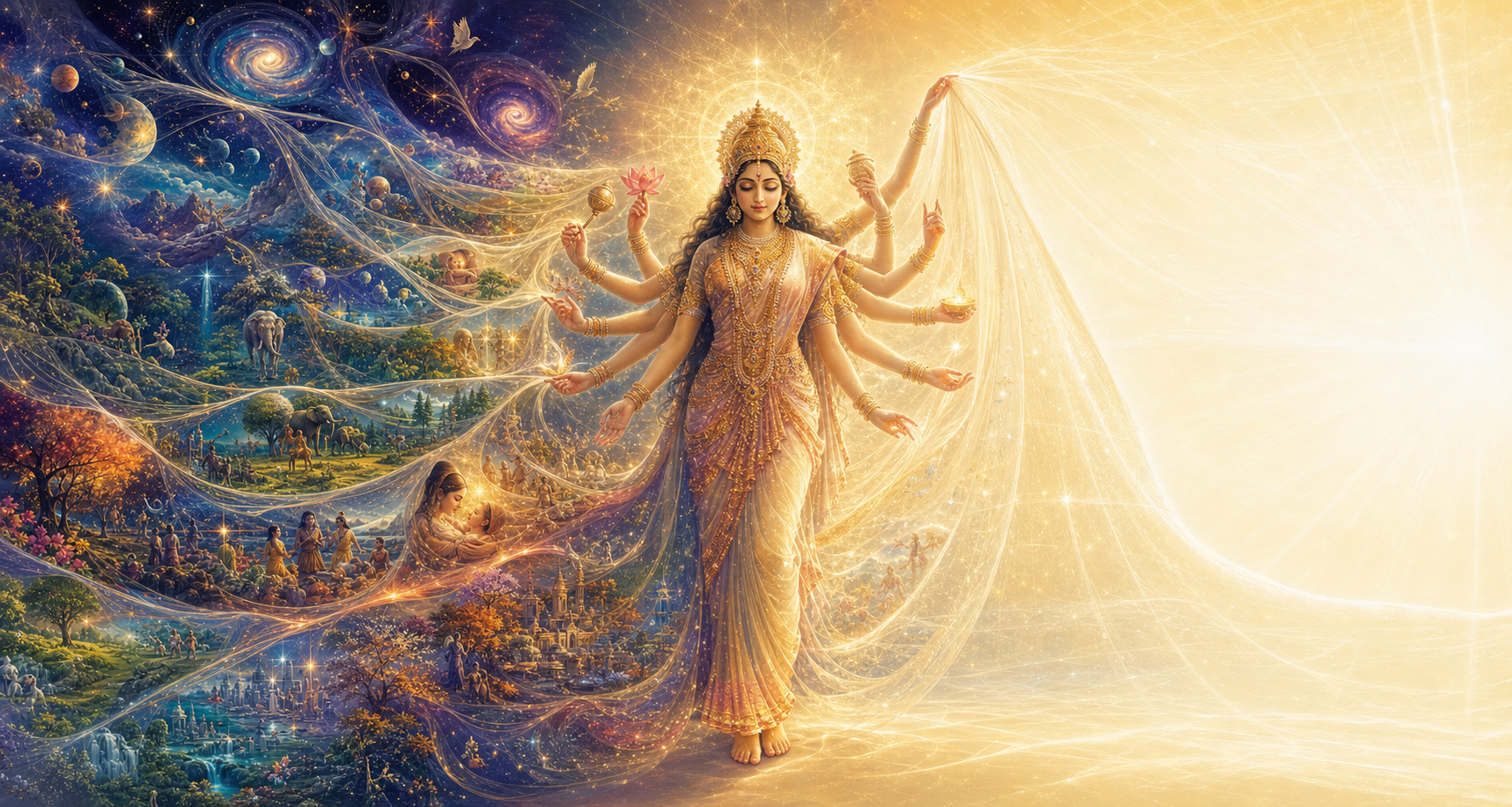
Calling Mahalakshmi Mahamaya does not mean that the world is a worthless trick. Maya is the power through which the unmanifest becomes name, form, relation, and experience. It can veil the ground of reality when you grasp its forms as separate and self-sufficient. The same power can unveil that ground when a form is approached as a doorway to the whole.
This is why devotional worship and non-dual insight need not cancel each other. As saguna, the Goddess can be loved, visualized, invoked, and served through a particular form. As nirguna, she exceeds every quality, image, function, and name. These are not two competing goddesses. They are two ways of approaching one reality: through gracious manifestation and through the ground that no finite description can contain.
The philosophical move is precise. Classical Sankhya language treats pradhana or root-nature as distinct from consciousness. Vedantic language points toward Brahman as the absolute ground. Shakta non-dualism brings consciousness and power together as Chit-Shakti. Consciousness is never a powerless spectator, and Shakti is never unconscious material. The Absolute is inherently capable of manifestation without being exhausted by what it manifests.
You can apply that insight during worship. Do not stop at the image, but do not hurry past it either. Attend to the form carefully, receive its meaning, and let that concentrated attention disclose what the form cannot delimit. A lotus can remind you that participation in the world need not become bondage. The boon-bestowing and fear-dispelling hands join generosity to courage. Conch and discus, where present, express the inseparability of Sri and Vishnu rather than a competition between Vaishnava and Shakta devotion.
The same test works outside the shrine. When beauty, skill, wealth, or social power makes you more possessive, Mahamaya is functioning as concealment. When the same gifts deepen gratitude, responsibility, and recognition of interdependence, her power is functioning as disclosure. The object may not have changed; the quality of your relationship to it has.
Use a four-part method for study, recitation, and conduct
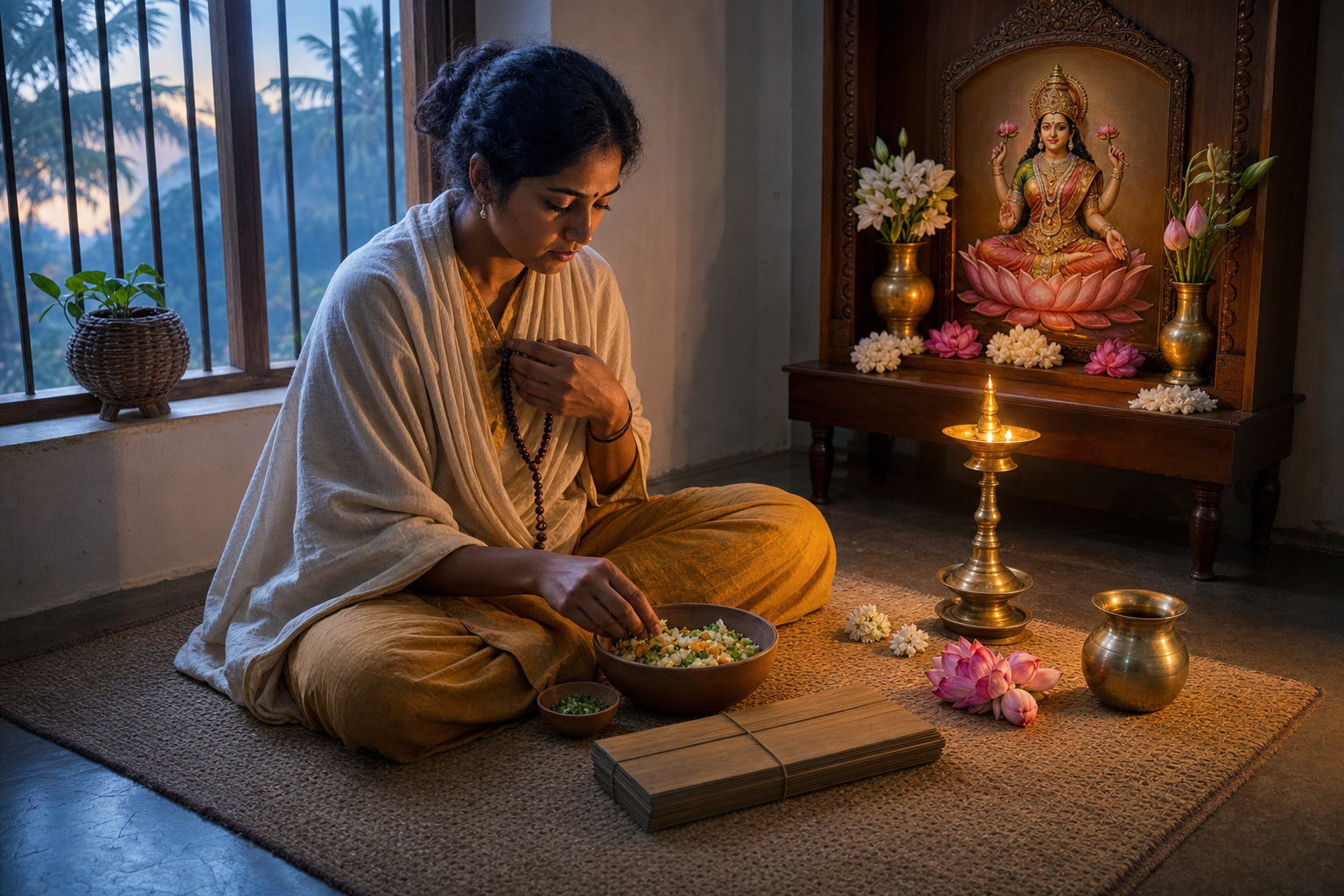
The Pradhanikarahasya belongs to the living recitational world of the Durgasaptashati. It is used alongside auxiliary texts such as the Argala and Keelaka stotras and, in several recensions, the Vaikritika Rahasya and Murtirahasya. Regional manuscripts and paddhatis can differ in arrangement, so the printed order in one edition should not automatically be imposed on every family or temple tradition.
If you are performing a formal Navaratri, Durga Puja, japa, or homa sequence, follow the placement, pronunciation, and ritual instructions of the lineage or temple whose paddhati you have received. If you are studying privately, you can still use the following method without pretending to have ritual initiation you do not possess.
- Establish the scale before reading. Begin with the question, “Is Mahalakshmi being described as a particular beneficent form, a cosmic function, or the supreme ground?” Keep those levels distinct.
- Classify each claim. Mark whether a passage is speaking about ontology, cosmology, psychology, devotion, or ethics. A statement about primordial causality should not be flattened into a promise of personal financial gain.
- Return to one Devimahatmya cycle. Read the corresponding conflict and observe how tamas, rajas, or sattva appears cosmically and inwardly. Look for the form of disorder, the Devi’s response, and the restored relation rather than treating the episode as spectacle alone.
- Translate Sri into one decision. End the session by choosing a concrete act that restores harmony: discharge a neglected obligation, reduce a wasteful purchase, support someone who depends on you, give without display, or bring order to work that has become careless.
The final step matters because Lakshmi worship becomes distorted when prayer for artha is separated from dharma. The four purusharthas are not four unrelated shopping lists. Dharma gives rightful form to artha and kama, while moksha prevents worldly attainment from becoming the final measure of life.
Before calling a gain “Lakshmi,” ask three questions. How was it acquired? What relationships or duties will it sustain? What attachment will it intensify or release? A larger bank balance may be useful, but it is not by itself proof of Sri. Wealth that depends on deception, exploitation, vanity, or the abandonment of duty carries disorder inside the gain.
This approach also prevents a second error: turning the Goddess into a moral slogan. Mahalakshmi is not merely a poetic name for responsible finance. Ethical prosperity matters because all action occurs within a sacred, conscious order. Seva, gratitude, restraint, and generosity become modes of recognition, not techniques for bargaining with the deity.
Key takeaways
- Mahalakshmi is the primordial Shakti in this theology, not merely a distributor of material wealth.
- Brahma, Vishnu, and Shiva operate through her power; supremacy therefore concerns the ground of divine agency, not rivalry among deities.
- Supreme Mahalakshmi encompasses all three gunas, while the manifest triad of Mahakali, Mahalakshmi, and Mahasaraswati expresses tamas, rajas, and sattva.
- Mahamaya is the power that manifests relational existence and can either conceal or disclose its non-dual ground.
- Nirguna and saguna language offers two approaches to the same Goddess: beyond every attribute and graciously present through attributes.
- Prosperity bears the character of Sri only when artha remains ordered by dharma and directed toward responsible, liberating life.
At your next recitation or study session, resist beginning with a request. First identify which level of Mahalakshmi is before you, then carry one consequence of that vision into how you earn, spend, serve, or keep a promise. That is where cosmic theology starts becoming sadhana.
References
