
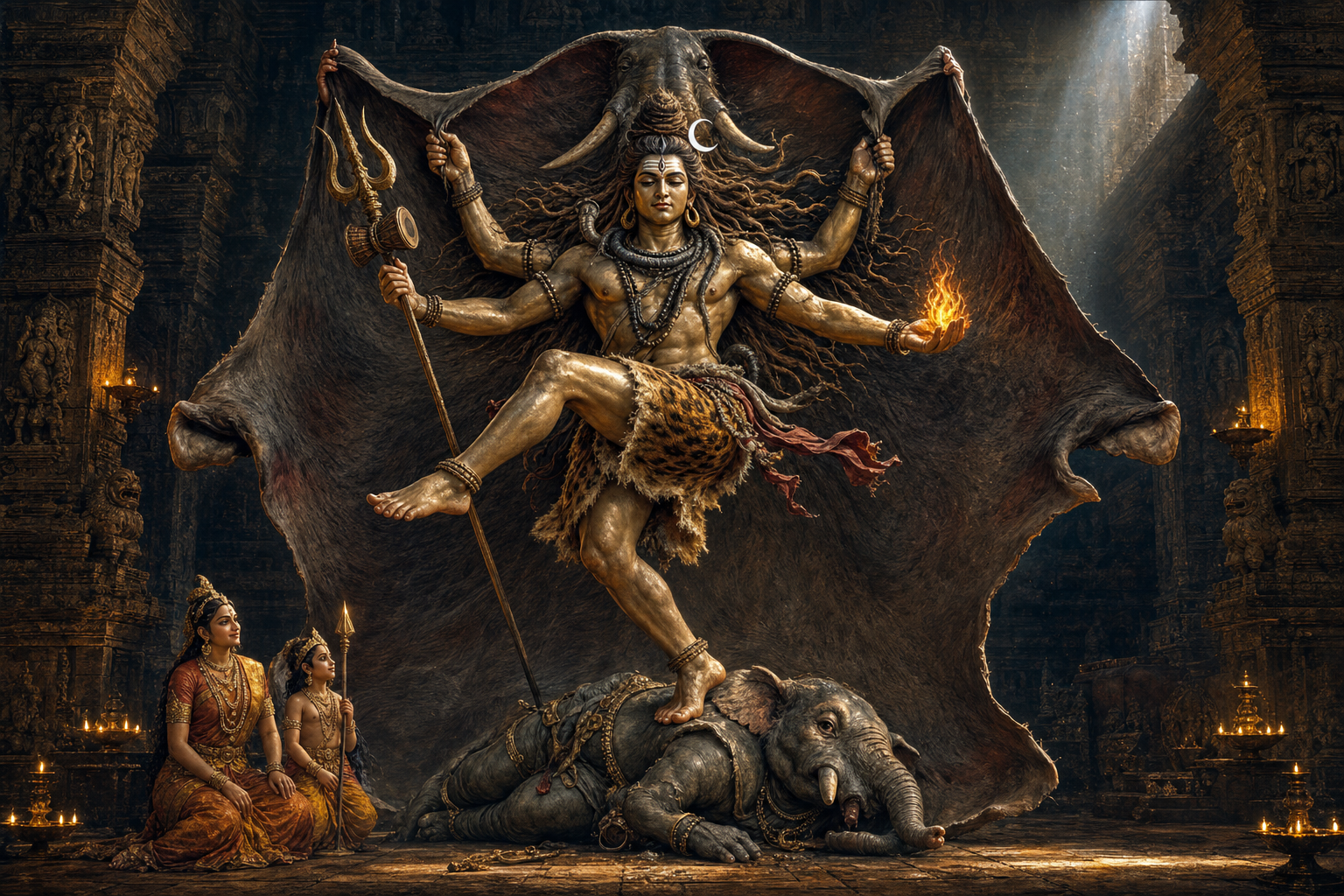
If you stand before a many-armed Shiva holding an elephant hide wide behind his body, the image can feel so violent that its teaching disappears from view. Is this a trophy of destruction, a warning against pride, or another form of Shiva’s dance?
The answer is carried by the composition. Shiva has not merely defeated Gajasura; he has turned the demon’s hide into the frame of a fierce dance. Once you know how to read the silhouette, feet, hands, expression and witnesses, the scene becomes a precise theology of power brought back under dharma.
The conquest is only the beginning of the teaching
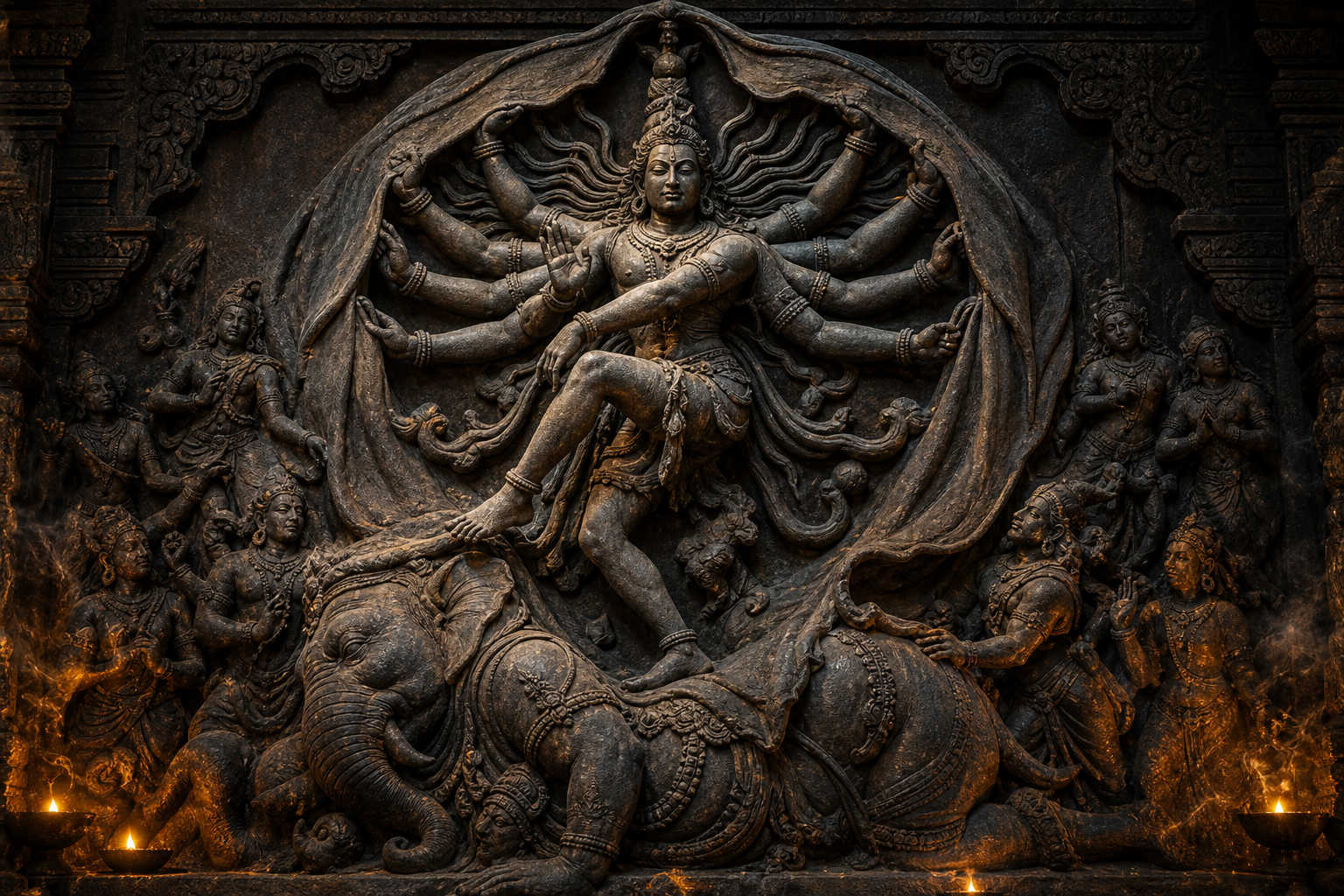
Gajasura’s story begins with capacity, not weakness. Austerity and boons give the demon formidable power. The crisis begins when that power becomes hubris and tyranny, disturbing sages, devas and the wider order sustained by dharma. Shiva therefore appears as more than a slayer. He intervenes because one being’s ungoverned self-importance has become a public danger.
This matters when you interpret the image. Ahaṅkāra should not be reduced to confidence, dignity or a healthy sense of identity. Here it is the self-claim that converts ability into entitlement: power is treated as personal possession, and other beings are forced to absorb its consequences. Gajasura’s fault is not that he became strong. It is that his strength ceased to answer to dharma.
The icon unfolds through four theological actions. Shiva stops the destructive momentum, strips away its dominating form, transforms what has been conquered, and displays that transformation as instruction. The elephant hide is stretched above and behind the dancing Shiva rather than discarded. What had projected Gajasura’s mass and menace now frames the Lord who has mastered it.
That is why the hide is more than a victory trophy. Flaying becomes a visual metaphor for removing the coverings of avidyā, or ignorance. Wearing the hide makes a further claim: subdued force need not simply vanish. Once its arrogance is broken, its energy can be placed within a higher order. The image is therefore about transformation as much as destruction.
Shiva’s raudra, or wrathful, character must also be read carefully. His intensity is not an uncontrolled tantrum that happens to overpower a worse aggressor. The dance is disciplined, iconographically ordered and directed toward the restoration of balance. Every controlled limb and prescribed attribute tells you that divine fierceness is serving a moral purpose.
Do not turn the elephant itself into a universal emblem of evil. Symbols in Hindu art take their meaning from narrative and context. In Gajasurasamhara, the demon’s elephant form gives pride a particular visual character: immense weight, forward momentum and stubborn resistance. The warning concerns Gajasura’s misuse of power, not the animal in every sacred setting.
Identify Gajasurasamhara from the outside inward
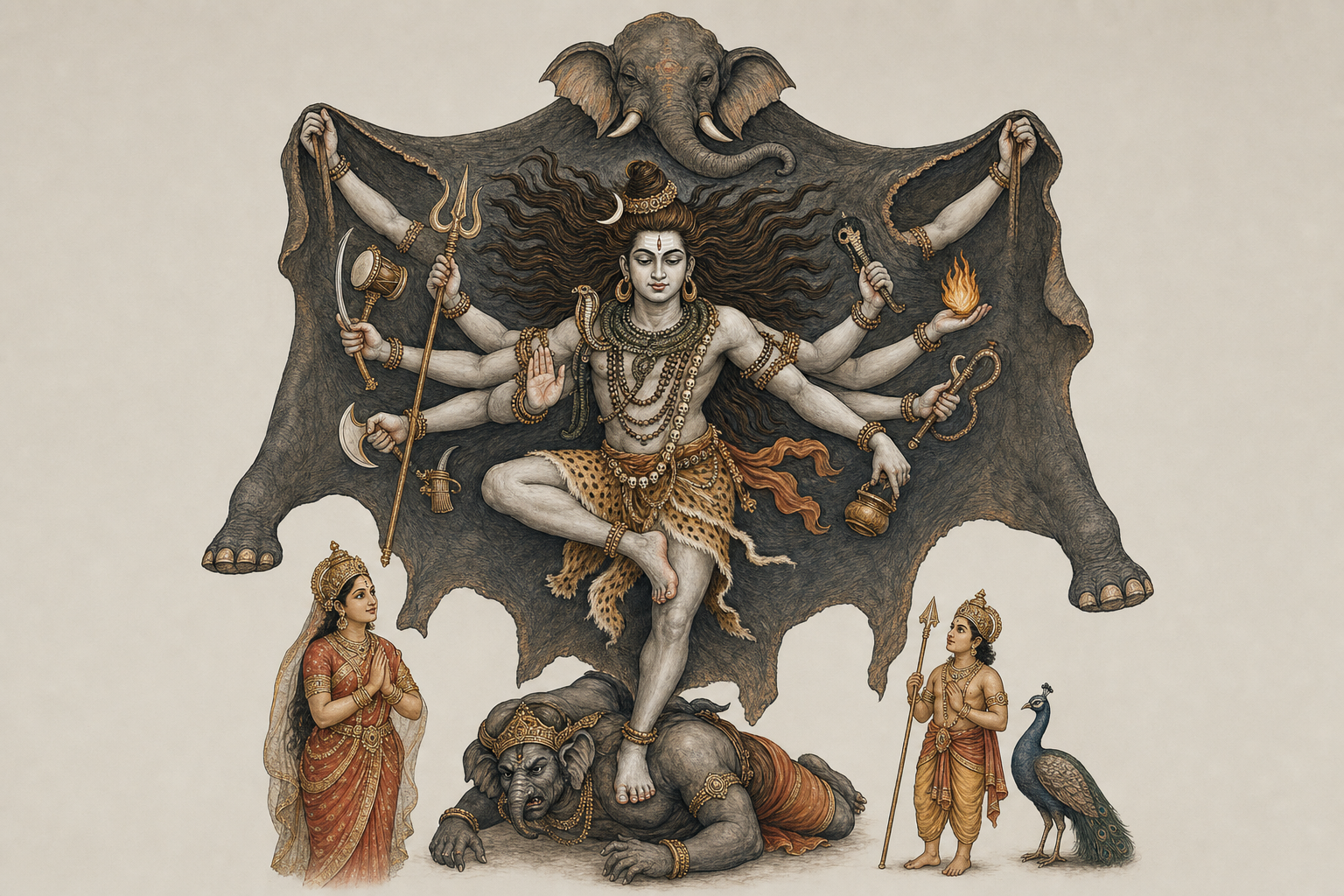
Begin with the largest shape rather than a small weapon. Hands, faces and attributes may be damaged, hidden or crowded together, but the overall composition usually preserves the identity of the form. Read it in this order:
- Find the tensile arc of the hide. The upper hands commonly pull the elephant skin wide behind Shiva, producing a canopy or arch around the body. This is the strongest identifying feature. In visual terms, the hide occupies the framing role that a halo or flame-ring performs in other images, but it remains part of the conquered being and therefore part of the narrative.
- Follow the dance down to the base. An active leg commonly pins the elephant’s head or body, while the other leg sweeps outward or rises into an emphatic curve. The contrast between pressure below and expansion above makes the conquest legible: disruptive force is arrested at the base while Shiva’s movement remains free.
- Count the arms, but do not identify the form by arithmetic alone. Six or eight arms are typical. The upper pair often holds the hide, while other hands may carry the ḍamaru, triśūla, pāśa or mṛga: the drum, trident, noose or antelope. Individual examples vary, and a missing or broken hand can erase an attribute. Arm count is supporting evidence, not the decisive clue.
- Read the face and hair together. The face is commonly ugra, with focused, widened eyes and a slightly open mouth that suggests the breath and force of the tāṇḍava. Above it, the jaṭāmukuṭa may carry the crescent moon and Gaṅgā. Those signs of cosmic sovereignty prevent you from mistaking ferocity for loss of divine identity.
- Notice how the ornaments extend the theology. A tiger-skin garment presents ascetic power already mastered. A serpent may take the place of the yajñopavīta, showing fearlessness before what ordinarily alarms human beings. Rudrākṣa, a skull garland and the triśūla connect the dancer’s fierce activity with renunciation, mortality and guardianship of dharma.
- Look last at the witnesses. Pārvatī may appear startled or composed. A frightened child Skanda can cling near her, while gaṇas animate the lower field and Nandi observes from the side. These figures are not decorative leftovers. Their reactions give emotional scale to the dance and place Shiva’s cosmic authority within a field of relationship, devotion and family.
The diagnostic combination is therefore simple: a dancing Shiva, a spread elephant hide and the subdued elephant form below. A trident by itself proves little, and multiple arms are common throughout Hindu iconography. Start with the distinctive relationship among body, hide and base; use the smaller details to confirm it.
The Kāmikāgama, Suprabhedāgama and Karaṇāgama, together with works on architecture and image-making such as the Mayamata and Śilparatna, establish the form’s recognizable grammar. Yet schools and regions do not reproduce a single mechanical template. The number of arms, selection of attributes, posture and emotional emphasis can vary while the hide-held-aloft composition remains legible. Treat the prescriptions as a family resemblance governed by sacred conventions, not as a modern manufacturing diagram.
Do not collapse this fierce dance into Nataraja
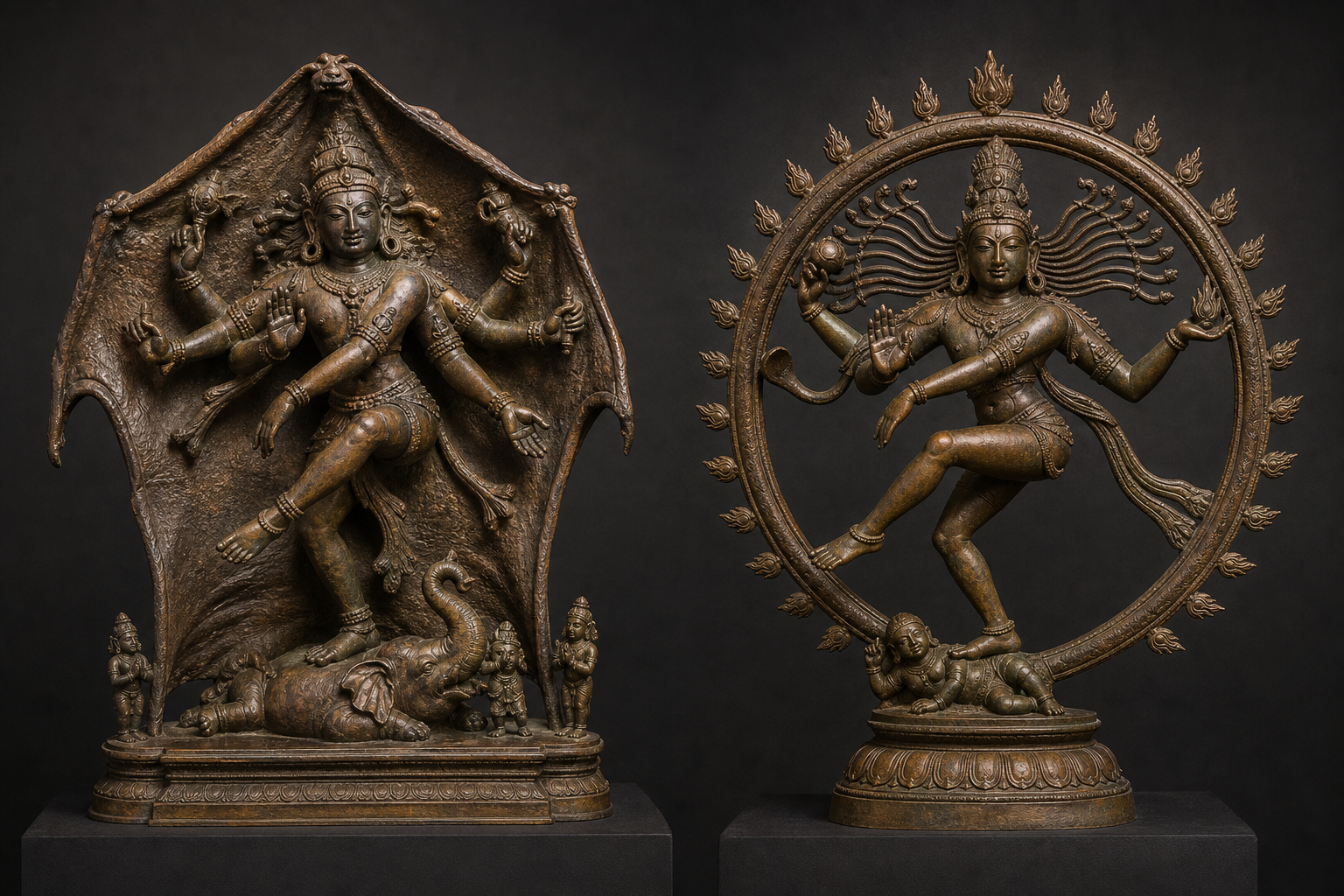
A common shortcut is to call every dancing Shiva “Nataraja.” The two forms belong to the same Lord and share the language of tāṇḍava, but they direct your attention toward different problems. The surrounding frame and the figure beneath the foot provide the quickest distinction.
| Visual question | Nataraja | Gajasurasamhara |
|---|---|---|
| What frames Shiva? | A prabhāmaṇḍala, or ring of flame | The elephant hide stretched wide by Shiva’s hands |
| Who or what is subdued? | Apasmara, the dwarf associated with ignorance | Gajasura in his massive elephant form |
| What is the dance’s dominant register? | Ānanda tāṇḍava, the dance of bliss | Raudra tāṇḍava, the dance of fierce corrective force |
| What does the composition foreground? | The cyclical balance of creation, preservation and dissolution | An ethical crisis in which pride has become destructive and must be transformed |
The difference is one of focus, not a contest between a peaceful Shiva and an angry one. Nataraja places ignorance within the ceaseless rhythm of cosmic activity. Gajasurasamhara gives egoic obstruction enormous weight and momentum, then shows the decisive action required when that obstruction harms an entire community. One image teaches through cosmic continuity; the other through a crisis brought to its necessary end.
This distinction also changes how you read the frame. Nataraja’s fire-ring belongs to an encompassing cosmic cycle. In Gajasurasamhara, the surrounding arc is the transformed remainder of the adversary. If the arc looks like stretched skin rather than separate flames, and an elephant form occupies the base, you are looking at Gajasurasamhara even when a museum label uses only a broad phrase such as “dancing Shiva.”
Let region, material and performance refine the reading
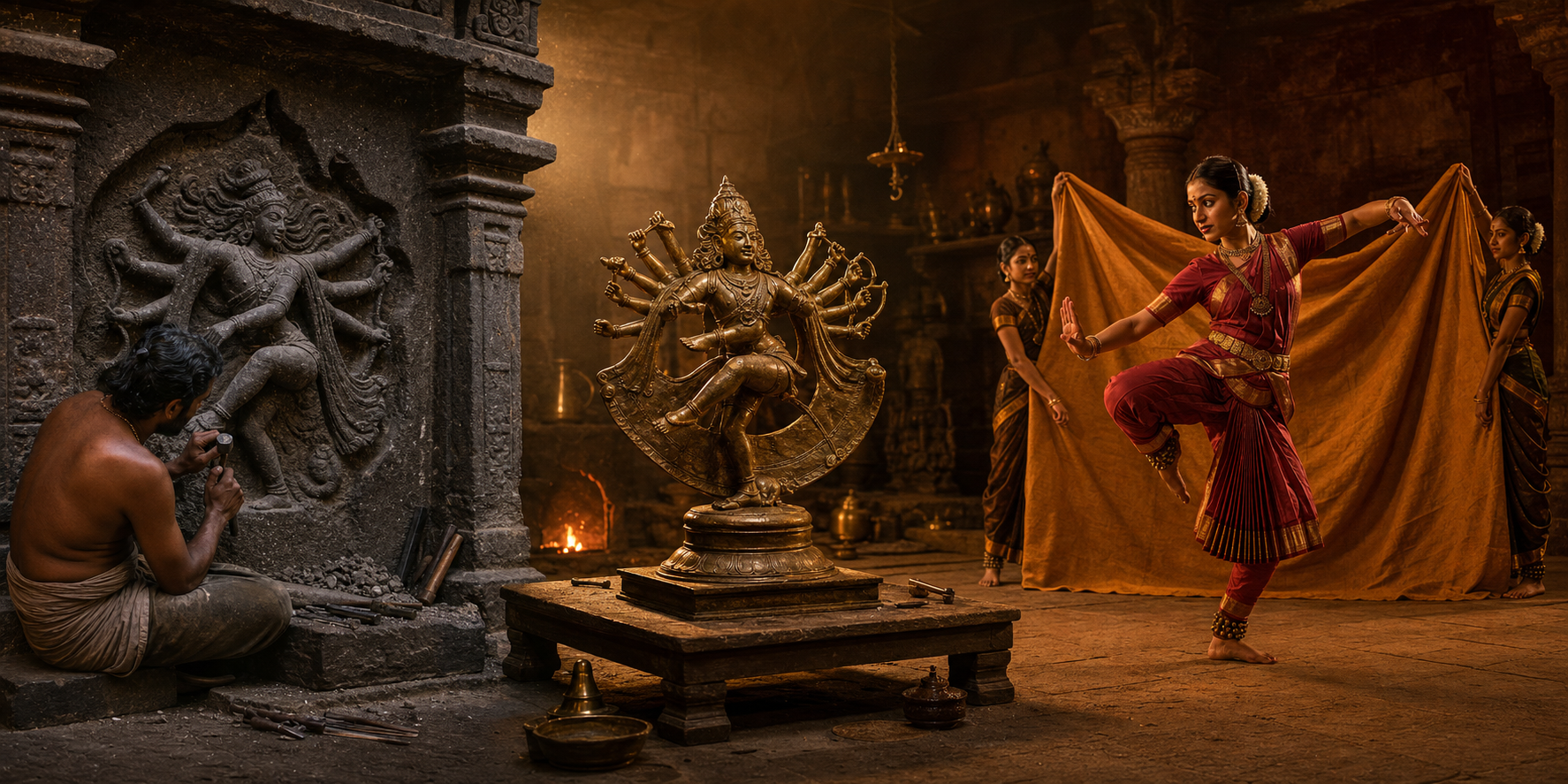
Identify the form before trying to date it. Regional style changes the accent of Gajasurasamhara without changing its central grammar. The following tendencies can orient you, but no single stylistic feature securely dates an image on its own:
- Pallava works of the seventh and eighth centuries, including carvings associated with the Kailāsanātha Temple at Kanchipuram, tend toward economy, slim bodies, clear silhouettes and taut linear movement.
- Chola works of the ninth through thirteenth centuries intensify bodily torsion and sweeping movement. Examples associated with Thanjavur, Chidambaram and the Airavatesvara Temple at Darasuram show how the form matured into a technically daring sculptural event.
- Later Pandya and Nayaka treatments preserve the recognizable hide and dance while often increasing jewelry, facial emphasis and the density of attendants.
- Hoysala workshops in Karnataka use the theme more selectively, sometimes placing the event within richly worked narrative friezes rather than isolating it as a single commanding figure.
Material alters what the artist can make you feel. Stone gives the hide architectural weight and binds Shiva’s movement to the temple wall. Chola processional bronzes made through the lost-wax method achieve deeper undercutting, wider negative spaces and an extraordinary impression of suspension. In accomplished pañcaloha examples, symbolism and engineering solve the same problem: the spread hide helps balance the forward thrust of the limbs, while the demon’s form contributes structural support.
Use three viewing distances when the setting permits. From farther away, read the complete silhouette of hide, limbs and base. From an angle, examine the undercuts and see how the sculpture transfers visual and physical weight. Up close, confirm the attributes, hair, ornaments and attendants. This order keeps decorative richness from distracting you before you have understood the composition.
Location can add another layer. Temples may place Gajasurasamhara on an exterior wall or within a subsidiary shrine in keeping with Āgamic directional and ritual arrangements. A peripheral position does not make the form peripheral to theology. Fierce images often perform a specific protective or instructive role within the larger sacred plan.
Some temples bring processional forms into public view during festivals. Arudra Darsanam in the Tamil month of Mārgaḻi principally foregrounds Nataraja, although allied dance forms may also be emphasized in particular Shaiva settings. Do not assume that every temple follows the same festival program; local ritual practice determines when and how an image is encountered.
Bharatanatyam offers another way to see the sculpture’s movement. Lifted knees, sharp turns of the torso and forceful tāṇḍava passages convert its apparent stillness back into bodily action. The karaṇas supply a vocabulary for those choices, while abhinaya can make Pārvatī’s composure or alarm and Skanda’s fear dramatically present. In traditions such as the Vazhuvoor bāṇi, Shaiva narrative imagery can become a sustained dramatic arc rather than a sequence of isolated poses.
Key takeaways for your next encounter
- Identify Gajasurasamhara by the combined presence of a dancing Shiva, an elephant hide held as a wide canopy and Gajasura subdued below.
- Read the hide as transformed power, not merely as a trophy. The dangerous form is stripped away, but its energy is placed under divine order.
- Expect six or eight arms, though variation and damage make arm count less reliable than the overall silhouette.
- Use the frame and the figure underfoot to distinguish Gajasurasamhara’s raudra tāṇḍava from Nataraja’s ānanda tāṇḍava.
- Establish the iconographic identity first; only then use body type, ornament, material and composition to consider region and period.
The image also gives you a practical way to examine ahaṅkāra without confusing humility with passivity. Ask where a genuine capacity, achievement, office or grievance has become a claim that others must submit to. Then ask who is carrying the cost. The icon does not demand the disappearance of strength; it demands that strength cease serving self-inflation and return to dharma.
Comparable diagnoses appear elsewhere in the Dharmic family: Buddhist traditions speak of kleśas, Jain traditions of kaṣāyas, and Sikh teaching warns against haumai. These are not interchangeable doctrines, but each refuses to treat unmastered ego and passion as private matters without consequences. Inner disorder eventually enters relationships and institutions.
When you next meet this form, look at the label only after you have traced the hide, found the restraining foot and noticed the witnesses. Then carry its question into a concrete decision: what force in your life needs to be stopped, stripped of self-claim and redirected toward protection, service or disciplined action? That movement from recognition to transformation is where Gajasurasamhara’s fierce beauty completes its work.
References
