
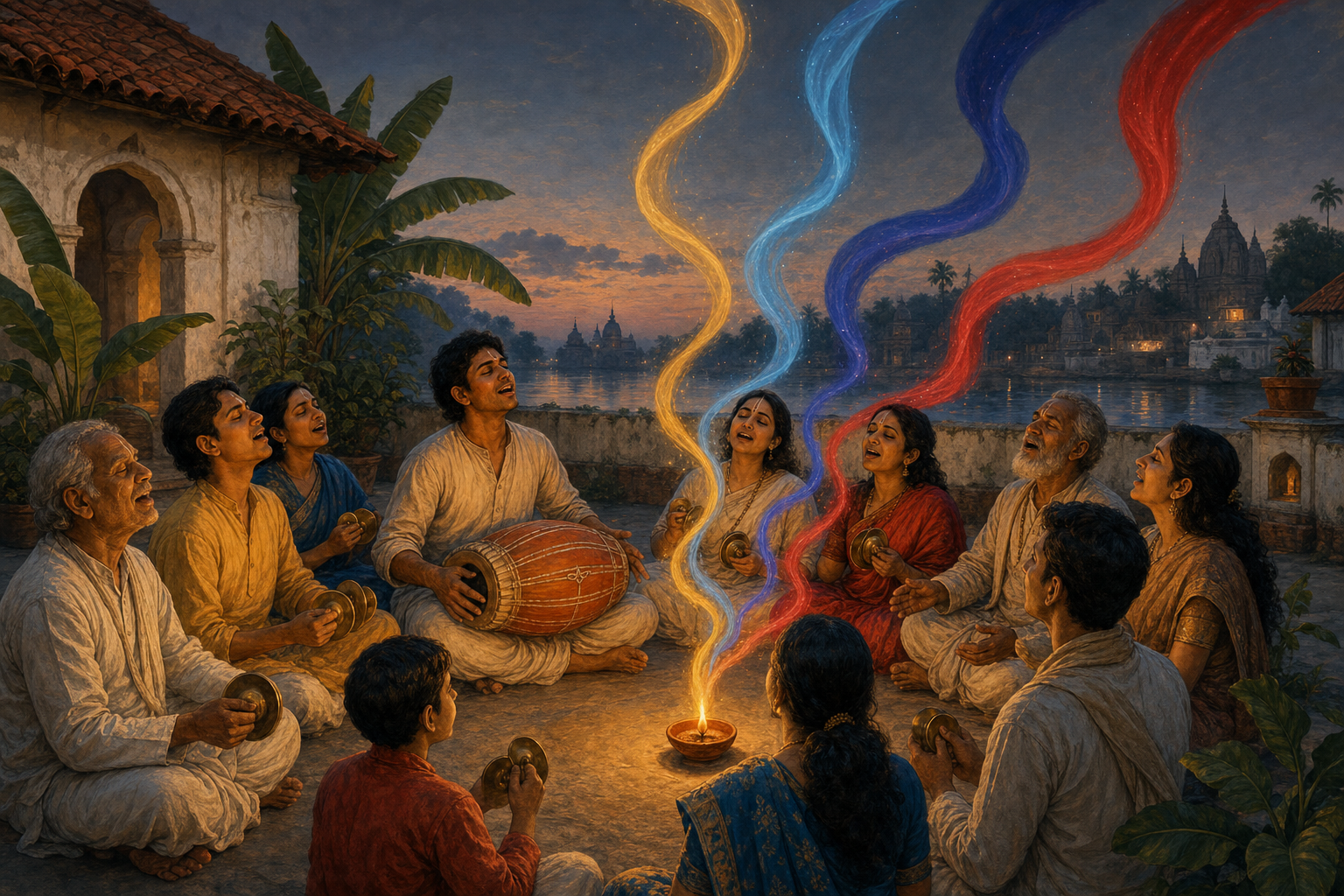
If you have heard a Bengali kirtana move from Nimai to Gauranga, or a Baul song place Shyam and Shyama almost on the same breath, you may wonder whether the singer is changing deities or revealing one Divine through several forms. The honest answer is that Bengali devotion can do both: preserve distinct forms while refusing to turn their differences into rivalry.
These names are not interchangeable labels for a vague higher power. Each one selects a form, a relationship, a devotional mood and a way of responding. Once you learn to hear those layers, you can recognize divine unity without making Krishna, Kali or Chaitanya indistinct.
Four names open four relationships with the Divine
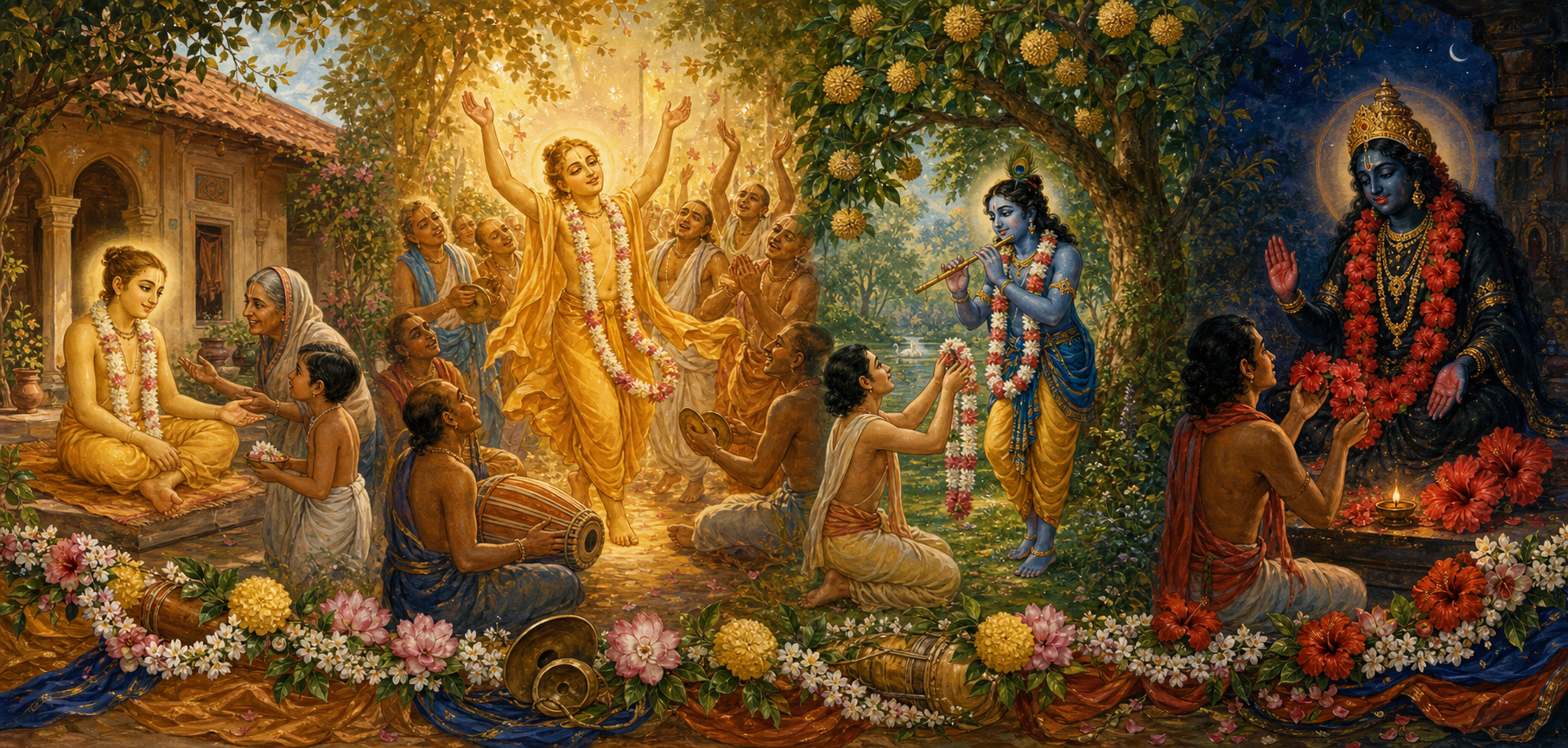
When you encounter a devotional name, ask four questions before translating it: What image does it evoke? Who would use it? In what setting is it being sung? What response does it invite from the devotee? Those questions reveal why a change of name can change the entire emotional scale of worship.
| Name | Primary cue | Relationship | What to notice |
|---|---|---|---|
| Nimai | Chaitanya’s childhood name, associated with his birth beneath a neem tree | Child, son and neighbor | Household protection, tenderness, belonging and purification |
| Gauranga | The golden or radiant-limbed Chaitanya | Public teacher and compassionate divine manifestation | Love moving outward through congregational chanting |
| Shyam | Krishna’s deep, raincloud-dark beauty | The enchanting Beloved | Attraction, sweetness, play and devotional longing |
| Shyama | Kali as the dark Mother, linked with blackness and time | Mother, guardian and dissolver of limitation | Fierce compassion, fearlessness and release from ego |
Nimai brings a figure of immense theological importance into the courtyard of a Bengali home. Gaudiya devotional memory associates the name with Chaitanya’s birth beneath a neem tree and with a cultural world in which neem signified protection and cleansing. The name carries a family’s wish that a vulnerable child be guarded. Its intimacy is not a lesser form of religion. It teaches that sacred transformation begins in the relationships where care, speech and pride are tested every day.
Gauranga widens the frame. The Sanskrit elements gaura and anga indicate golden, radiant limbs. Gaudiya Vaishnava theology understands that radiance as more than appearance: Chaitanya is honored as Krishna bearing Radha’s devotional disposition and luminosity, offering prema-bhakti through nama sankirtana, the congregational chanting of divine names. In this setting, golden color signifies spiritual radiance and compassionate purpose. Reading it through modern racial categories misses the theological point.
Shyam and Shyama create a different pair. Their similar sound and shared dark imagery give Bengali singers a bridge between Krishna and Kali. Yet the names remain precise. Shyam still evokes Krishna’s flute, beauty and playful attraction. Shyama still evokes the Mother whose relation to time, mortality and dissolution makes her compassion fierce. The difference is what gives their conjunction meaning. If your explanation turns them into featureless synonyms, it has discarded the relationships that make devotion possible.
Divine unity here means communion, not sameness
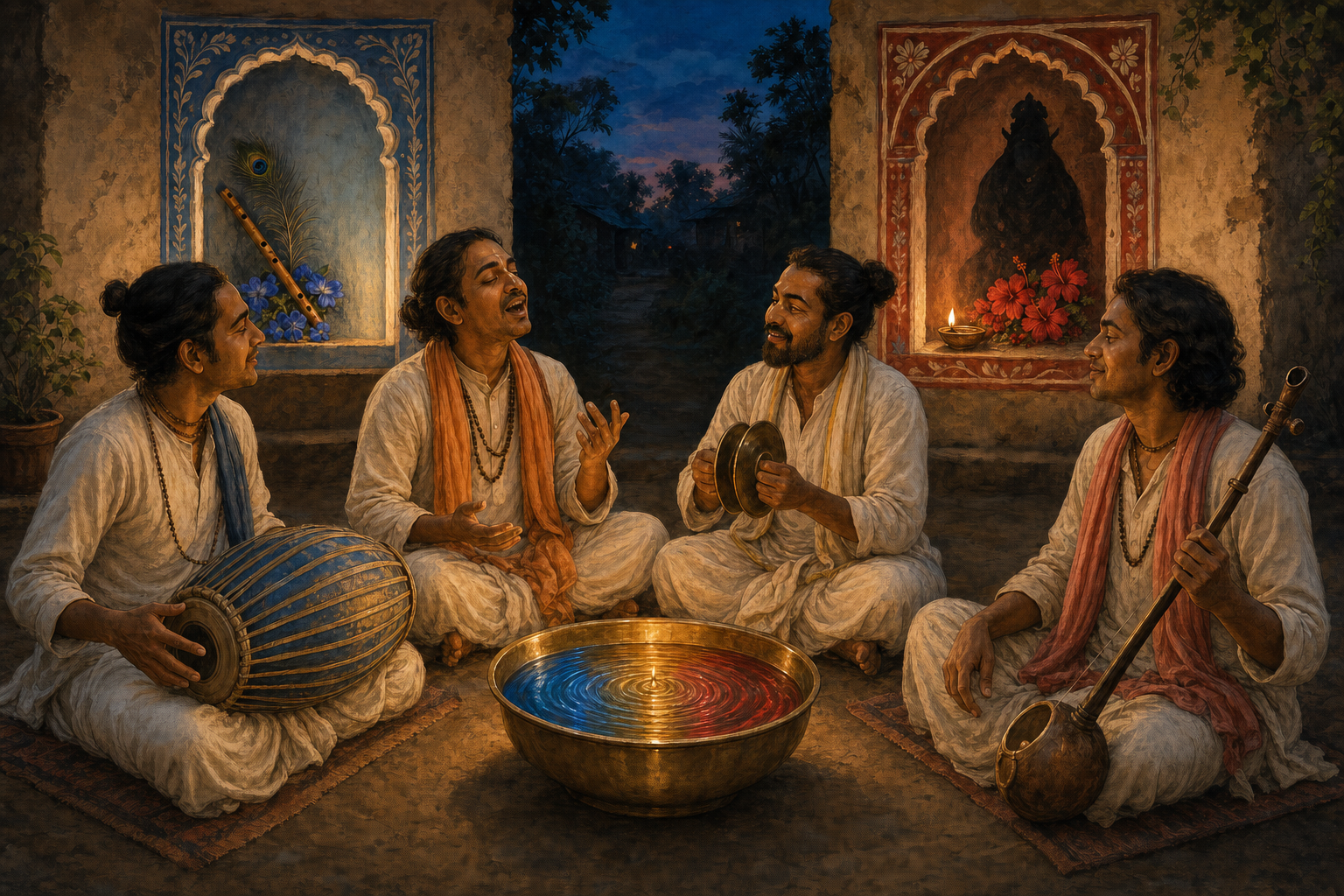
The slogan that all names are simply the same can sound generous, but it is too coarse to explain Bengali devotion. A devotee does not love an abstraction. Love moves through form, memory, gesture and address: child, teacher, Beloved or Mother. Unity becomes spiritually serious when it can include those differences instead of erasing them.
Acintya-bhedabheda, the Gaudiya principle of inconceivable simultaneous difference and non-difference, offers a useful grammar for this balance. It allows unity to be affirmed without treating plurality as an error. Applied carefully, it explains how the Divine can be one while relationships with the Divine remain genuinely different. It is not a license to claim that every Bengali lineage holds an identical doctrine.
Baul spirituality approaches the balance through lived interiority. Its musical and contemplative world draws on Vaishnava, Shakta, Nath yogic and Sufi currents, yet it gives priority to what is realized through the body, breath, voice and transformed conduct. The moner manush, the person of the heart, is the inward Beloved around whom these names can meet. Singing Shyam and Shyama together therefore makes an experiential claim: Krishna’s sweetness and Kali’s fearless shelter can disclose a shared sacred depth without ceasing to be distinct devotional approaches.
This gives you a practical test for claims of unity. Ask whether the interpretation preserves the integrity of each form, deepens humility and reduces hostility. A theory that uses oneness to mock a devotee’s chosen form fails the first test. A sectarian claim that treats another sacred form as an enemy fails the last two. Unity should make attention more exact and conduct more compassionate.
Compare Dharmic paths through resonance, not forced equivalence
The same discipline helps when you place Bengali devotion beside other Dharmic paths. Gaudiya nama sankirtana and Sikh naam-simran both give sacred remembrance through sound a central place, but their histories, liturgies and theological vocabularies remain their own. Jain anekantavada can reinforce humility about one-sided claims without becoming another name for Bengali bhakti. The Baul image of fertile, luminous darkness may resonate with Buddhist reflection on emptiness and interior transformation, but that resonance does not make Buddhist and theistic categories interchangeable.
When you discuss such connections, use a three-part sentence: name the exact practice, state the point of resonance and preserve the doctrinal boundary. That method produces a stronger account of Dharmic kinship than either sectarian isolation or a hurried claim that everything means the same thing.
The setting tells you which layer of a name is active
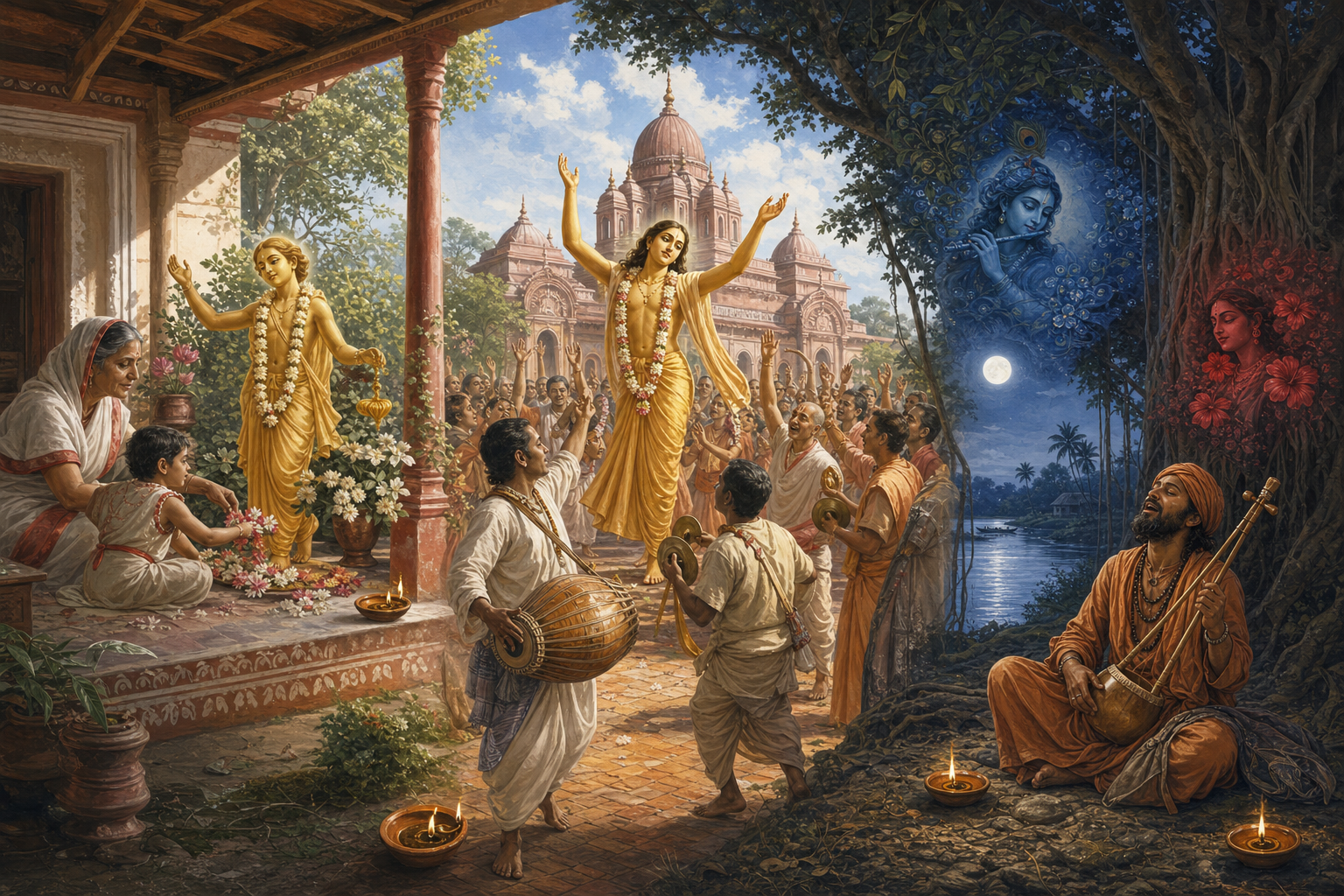
A dictionary can give you an etymology, but it cannot tell you the whole devotional meaning. For that, listen to the setting. A birth narrative, a Gaudiya kirtana and a Baul performance can use sacred names for different relational purposes.
In the household, Nimai keeps the Divine near
Nimai belongs first to family and neighborhood memory in Navadvipa. When the name appears in a retelling of Chaitanya’s childhood or the observance of Gaurapurnima, hear its tenderness before searching for an abstract doctrine. Mother Saci’s world of protection, kinship and concern is part of the theology. The Divine who will gather crowds in song is first addressed as a child for whom a household cares.
This domestic register also corrects a common mistake: public spiritual influence does not make ordinary care irrelevant. If Nimai is the name that moves you, let it turn your attention toward the quality of your home life. Protection, patient speech and the cleansing of intellectual pride are more faithful responses than merely admiring an exceptional religious personality.
In congregational chanting, Gauranga gathers a public
The movement from Nimai to Gauranga parallels Chaitanya’s movement from Navadvipa scholar and teacher to renunciate, public devotional leader and mystic associated with Jagannath Puri. Gauranga belongs naturally to the raised arms, answered refrain and shared rhythm of kirtana. Here compassion becomes participatory: people do not merely observe a holy figure; they lend their own voices to the remembrance he taught.
Many Gaudiya gatherings begin by invoking Sri-Krsna-Caitanya Prabhu Nityananda, Sri-Advaita Gadadhara Srivasadi Gaura-bhakta-vrnda. The sequence honors Chaitanya and his devotional circle before the central chanting proceeds. The compact call Nitai-Gaur likewise joins Nityananda and Gauranga in sound. If you are attending such a gathering, listen for the call-and-response structure. The names are teaching belonging through the act of being voiced together.
In Baul song, Shyam and Shyama meet within the heart
In a Baul setting, the ektara, dotara, khol, breath and moving body are not incidental decoration around a doctrine. They are part of how the teaching is explored. A melody may pass from Shyam to Shyama because the singer is following a shared darkness into complementary moods: attraction and refuge, play and dissolution, longing and fearlessness.
Do not assume that the singer has forgotten which deity is being named. Follow the change of mood. Krishna’s darkness draws the heart toward beauty beyond possession; Kali’s darkness places that heart before time, mortality and the Mother’s shelter. Their meeting in the moner manush is an inward reconciliation, not careless iconographic mixing.
- Write down the name as it is sung instead of replacing it immediately with a generic word such as God or divinity.
- Identify the setting: household narrative, Gaudiya temple or kirtana, festival observance, or Baul performance.
- Notice the action and mood around the name: protection, yearning, communal joy, surrender, fearlessness or purification.
Those three observations will usually tell you more than an isolated translation. They show what the name is doing in the devotional life of the singer.
A four-pass practice for your next kirtana or sacred song
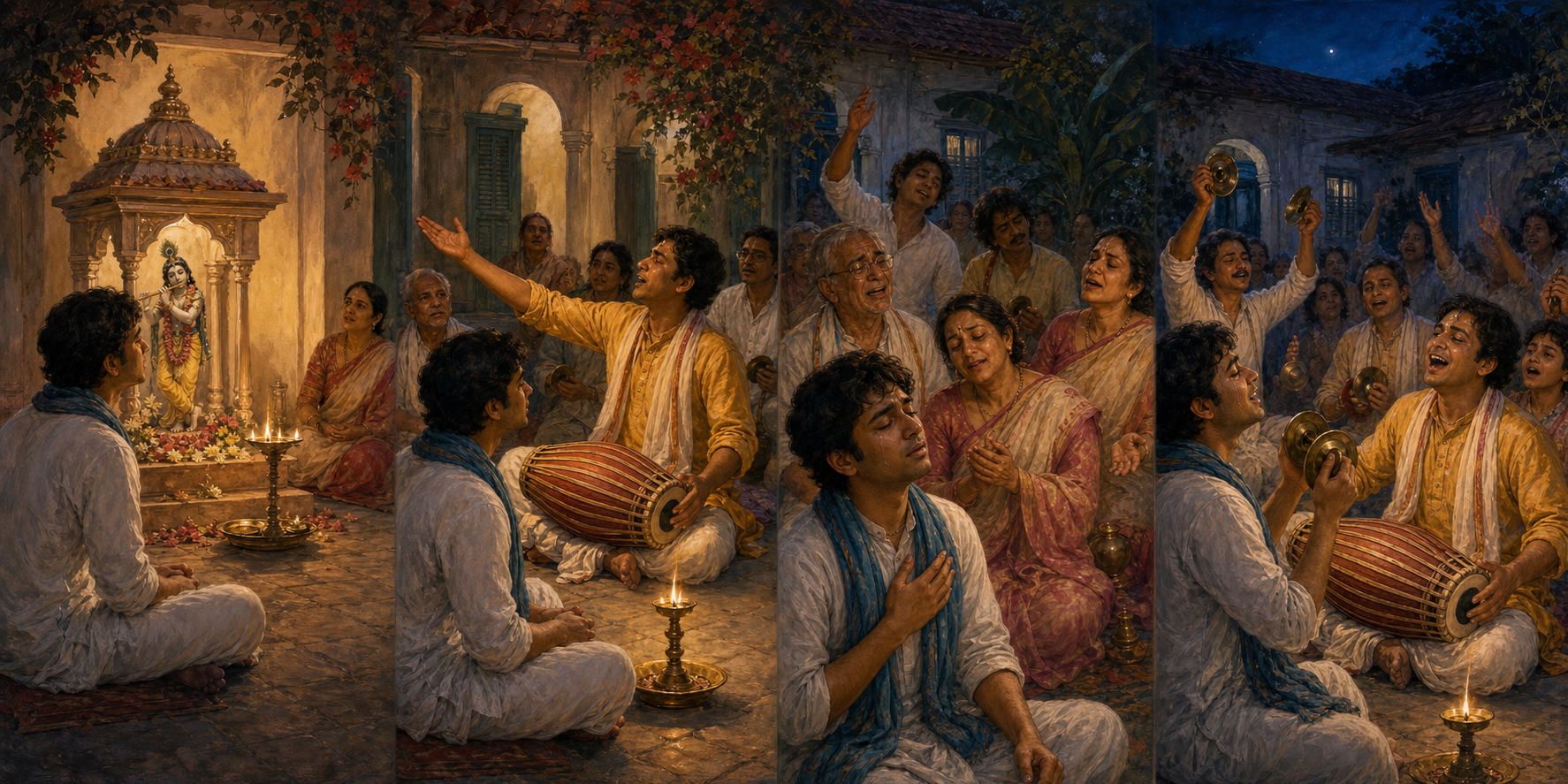
You do not need to settle every metaphysical question before listening well. Use this four-pass method the next time you hear one of these names in a recording, temple, festival or village-song setting.
- Preserve the form. Name Krishna, Kali or Chaitanya before speaking about an underlying unity. Record the symbols that remain active: neem, golden limbs, flute, Mother, darkness, time or raised arms in kirtana.
- Locate the relationship. Ask whether the singer approaches a child, teacher, divine manifestation, Beloved or Mother. This prevents an etymology from replacing the emotional truth of worship.
- Find the bridge actually being used. Nimai and Gauranga are linked through one life expressed at domestic and public scales. Shyam and Shyama are linked in Baul contemplation through sound, darkness, interior realization and complementary modes of compassion. Do not invent a different bridge merely to make the names fit a preferred theory.
- State unity with a boundary. A careful sentence would say that Shyam and Shyama remain Krishna and Kali while a Baul song brings them together through shared dark imagery and the inward Beloved. For Nimai and Gauranga, say that one Chaitanya is approached through the intimacy of home and the radiance of a public devotional mission.
If you want to participate rather than analyze, begin by listening through one complete refrain. Notice where the group answers and how the name is pronounced. Join at the established pace instead of inserting a private combination of names into the community’s chant. In a lineage setting, honoring the form of the practice is itself part of honoring divine plurality.
Afterward, translate one name into one visible act. Let Nimai prompt protective care or gentler speech at home. Let Gauranga prompt you to make communal devotion more welcoming. Let Shyam sharpen loving attention without possessiveness. Let Shyama help you face fear or impermanence without turning that fear into cruelty. This keeps sacred naming from ending as vocabulary alone.
Key takeaways
- Nimai and Gauranga name the same Chaitanya through different relational scales: household intimacy and public, radiant compassion.
- Shyam and Shyama remain Krishna and Kali; Baul spirituality brings them into communion through shared darkness, sound and the inward Beloved.
- Divine unity does not require devotional sameness. Difference gives bhakti its relationships, moods and forms of address.
- Context is decisive. A home narrative, Gaudiya kirtana and Baul song activate different meanings even when they point toward unity.
- Cross-Dharmic comparison works best when you identify a precise resonance and preserve each tradition’s doctrinal boundary.
At the next kirtana or sacred song you encounter, resist the urge to translate too quickly. Note the name, setting, relationship and response first. Then ask how unity is being expressed. That order lets you meet Bengal’s devotional language as its practitioners do: through distinctions that become doors to communion rather than walls of separation.
References
- DharmaRenaissance Blog – Golden Grace and Neem-born Humility: Decoding ‘Gauranga’ and ‘Nimai’ of Chaitanya Mahaprabhu
- DharmaRenaissance Blog – Decode Shyam-Shyama: Baul Mysticism’s Bold Union of Krishna and Kali as One
