
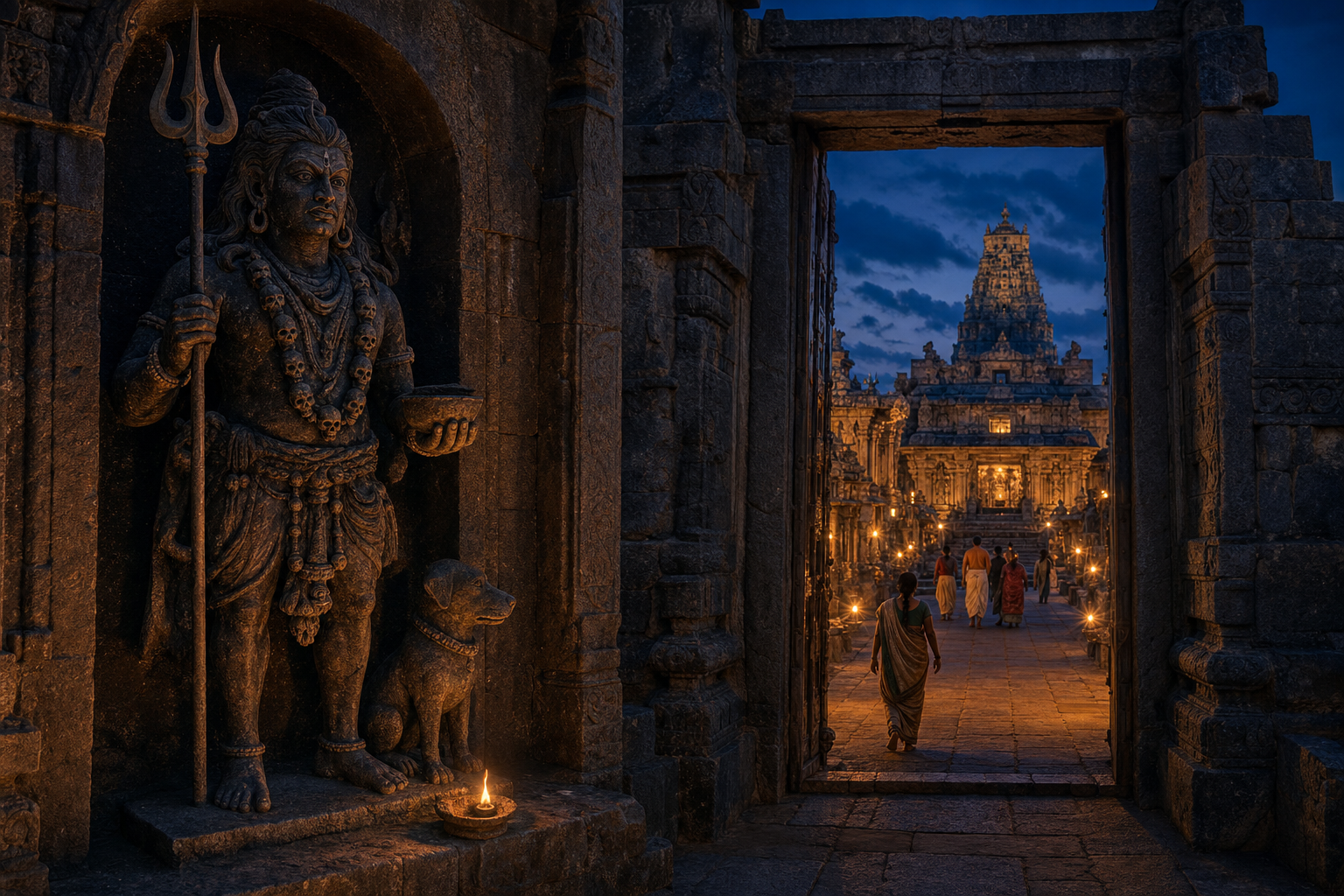
You see a fierce figure near a temple gate or along the outer circumambulatory path. He carries weapons, perhaps a skull-bowl, and a dog accompanies him. Is this an ominous deity kept away from the sanctum, or does his position tell you something essential about how a Hindu temple works?
Bhairava’s place at the edge is not a sign of exclusion. It is his office. As Kshetrapala, the guardian of the sacred field, he protects the conditions under which worship can occur. Once you understand that role, gates, enclosure walls, bali-pithas, processional routes, and even the timing of worship stop looking like incidental details. They become parts of a living system of sacred order.
A temple begins at its boundary, not at its sanctum
Most visitors naturally direct their attention toward the garbhagriha. That is where the principal deity resides, so everything outside it can seem like an approach to the place that really matters. Agamic and Tantric temple traditions ask you to see a larger whole. The temple is a mandala given architectural and ritual form, extending from the sanctum through successive enclosures to the outer perimeter.
Each layer regulates movement. A gateway marks a transition. A prakara defines an enclosure. A pradakshina path directs the body around a sacred centre. Directional shrines establish orientation. The devotee’s movement, the priest’s movement, mantra, offerings, and attention all pass through this ordered field.
This is why kshetra means more than a plot of land. It is a field with a religious identity, a centre, a perimeter, and appropriate forms of conduct. Pala means protector. A Kshetrapala therefore guards not just walls or property but the integrity of a consecrated domain.
A boundary, in this setting, is not a declaration that the sacred must hide from the world. It makes meaningful encounter possible. The threshold distinguishes ordinary movement from deliberate entry. It asks you to set aside distraction, disorder, and careless behaviour before approaching the deity. Bhairava gives that demand a visible form.
Try one small change on your next visit: pause before crossing the principal gateway. Notice what you are carrying inward, including your pace, conversation, agitation, and intention. That pause is not a substitute for any prescribed temple rite. It simply allows the architecture to do what it was designed to do: turn entry into transition.
Learn to read the temple’s layered guardian system

Bhairava is not the only protective presence in a temple. Sacred architecture commonly distributes guardianship among several forms, each associated with a different layer or function. Treating every fierce face as Bhairava erases this carefully articulated system.
| Marker | Where you may find it | What it helps you notice |
|---|---|---|
| Bhairava or Kshetrapala shrine | Near a gateway, at a corner of an outer enclosure, or along the pradakshina path | Guardianship of the consecrated field and its ritual order |
| Dvarapalas | Flanking a doorway | The immediate threshold into a more restricted or concentrated sacred zone |
| Dikpalas | Placed according to directional relationships | The temple’s orientation within a larger cosmic order |
| Kirttimukha | Often above a doorway or on a lintel | A devouring protective face that marks the seriousness of crossing the threshold |
| Bali-pitha | At ritual stations, including nodes on a perimeter circuit | A place in the temple’s prescribed offering system, not merely a decorative pedestal |
Exact placement varies. You may find Bhairava near a gopura in one temple, at a corner of the outer prakara in another, or in a dedicated sannidhi along the circumambulatory route. Do not turn one regional arrangement into a universal rule. The stable principle is liminality: Bhairava stands where passage, direction, time, and conduct must be regulated.
His iconography reinforces the same work. The trishula conveys decisive power; the damaru recalls Shiva’s creative and ordering resonance; the kapala confronts the limits of embodied identity; and a sword or khatvanga can express the force that cuts through disorder. The dog, a recurring vahana of Bhairava, evokes alertness at the boundary. Its presence is especially apt for a deity whose guardianship depends upon detecting what inattentive eyes miss.
The face may be fierce, but fierce does not mean demonic. Raudra is a divine mode capable of arresting confusion and removing what makes a sacred space uninhabitable for disciplined worship. Bhairava’s appearance warns, but it also wakes. If serene iconography gathers your attention through beauty and repose, Bhairava may gather it by refusing to let you remain casual.
When you walk the outer prakara, look for relationships rather than isolated sculptures. Where is the nearest gateway? Is the shrine aligned with a corner or direction? Are bali-pithas positioned along the route? Does a kirttimukha appear above the door you just crossed? These elements form a layered grammar of protection; reading them together tells you far more than identifying one image by name.
Perimeter rites maintain the sacred field
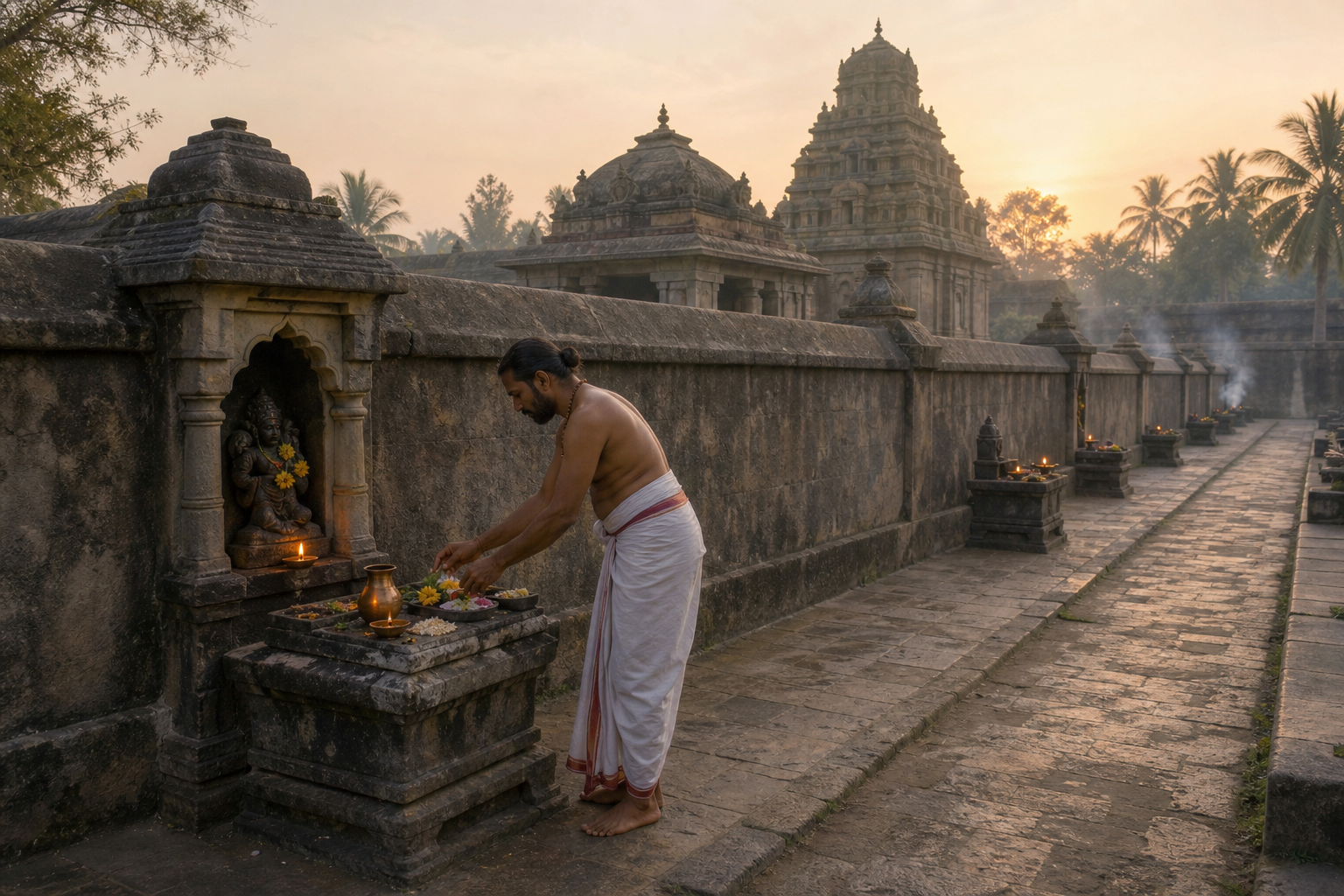
A consecrated temple is not thought to remain ritually ordered through architecture alone. It is maintained through recurring acts. Among these are kshetra-bali and bali-pradakshina, in which priests move through a prescribed circuit and place offerings at designated stations. Such rites may occur at dusk or night, during festivals, or at other times set by the temple’s own paddhati and calendar.
It is easy to misread these offerings as fearful attempts to buy off something malevolent. That interpretation misses their governing function. A bali circuit acknowledges the entire sacred field, including its directions, junctions, custodial powers, and outer limits. The rite renews relationships that ordinary sanctum-centred worship may not make visible.
The Shaiva Agamas, including the Kamikagama and Suprabhedagama, situate shrine placement and ritual movement within this ordered whole. Bhairava Tantras such as the Svacchanda Tantra develop protective dimensions through mantra, yantra, and nyasa. The Somasambhupaddhati gives practical form to temple ritual in the eleventh to twelfth centuries. These traditions do not reduce guardianship to a statue near a wall; they embed it in repeated liturgical work.
As Kala Bhairava, the guardian also governs a boundary that architecture cannot contain: time. Rituals have beginnings and endings. Transitional hours such as sandhya require attention. Festivals intensify the temple’s activity. Vows have durations and obligations. Timekeeping therefore becomes ethical as well as calendrical. To arrive, observe, speak, and depart with discipline is part of respecting the kshetra.
If you encounter an evening bali circuit or a festival procession, do not step into its route to obtain a better view. Stand where temple attendants direct you. Observe which stations the priest visits, how the path relates to the enclosures, and when the movement returns toward the centre. You will be watching the temple’s sacred geography become visible through action.
Do not copy an offering you saw elsewhere. Kshetrapala observances can be vegetarian or otherwise shaped by region and sampradaya, and practices appropriate in one setting may be prohibited in another. Ask the archaka or an authorised temple attendant what is customary. Unsolicited offerings at a shrine, bali-pitha, tree, corner, or gateway can disrupt rather than honour the local order.
Local tradition decides how guardianship is expressed
The principle of guardianship is widespread, but its expression is not uniform. In many Tamil Shaiva temples, a dedicated Bhairava sannidhi appears on the circumambulatory path, and ashtami may receive particular devotional attention. In Kashi, the role expands from temple perimeter to sacred city: the Kashi Khanda presents Kala Bhairava as the kotwal, or chief guardian, of the Avimukta Kshetra. Pilgrims commonly include his darshan when acknowledging the city’s ritual jurisdiction.
That Kashi custom should not be imposed mechanically upon every Shaiva temple. Its importance lies in what it reveals: a kshetra can scale from a sanctum and its enclosures to an entire sacred geography. Roads, ghats, shrines, pilgrims, ritual time, and civic conduct can all participate in the same theological field.
Nepal offers another scale. Bhairava images can occupy public squares as well as temple precincts, joining urban guardianship to sacred presence. In eastern India, Bhairava may appear within Shakta ritual worlds alongside fierce goddesses such as Chamunda or Bhadrakali. Across parts of Southeast Asia, kirttimukha forms and the Kala heads above Javanese portals continue the visual logic of an alert, protected threshold even where names and local interpretations differ.
Before interpreting a guardian shrine, ask three concrete questions:
- What name does this temple use for the guardian? Do not assume every fierce Shaiva form is Kala Bhairava.
- What territory does the shrine guard: a doorway, an enclosure, the temple complex, a pilgrimage route, or the wider settlement?
- Which local observances govern approach, offerings, circumambulation, photography, and festival days?
These questions keep you attentive to sampradaya instead of assembling a private ritual from disconnected practices. They also prevent a common error: treating regional variation as contradiction. A guardian can fulfil the same underlying office through different images, placements, calendars, and offerings.
The pattern is not confined to Shaiva and Shakta traditions. Vaishnava temple order gives Vishvaksena an important custodial role. Vajrayana Buddhism knows fierce Dharmapalas such as Mahakala and Yamantaka, whose terrifying forms serve the protection of Dharma. Jain sacred sites may venerate Kshetrapal as a protective yaksha. Sikh tradition preserves the sanctity of the gurdwara through maryada, seva, remembrance, and collective discipline.
These are functional resonances, not claims that distinct deities or theologies are interchangeable. The shared civilizational insight is more precise: a place of refuge does not remain a refuge by sentiment alone. It needs boundaries, custodianship, disciplined conduct, and a community willing to maintain them. Guardianship across Dharmic traditions joins protection to responsibility, not to sectarian hostility.
Let the threshold change how you carry yourself
Bhairava’s guardianship can also illuminate your inner life, but only if you avoid shrinking the deity into a psychological metaphor. Begin with the religious reality: Bhairava is worshipped as a divine guardian within living Shaiva and Shakta traditions. The inward application follows from that encounter; it does not replace the deity, temple worship, or lineage-specific practice.
The temple boundary then becomes a demanding contemplative model. Attention also has gateways. Speech allows some intentions to enter the shared world and restrains others. A vow gives time a moral shape. Yama and niyama protect yogic life by defining what must not be admitted and what must be deliberately cultivated. A boundary is therefore not merely refusal. It is clarity about what a worthy centre requires.
You can carry that insight through a temple visit without inventing a new ritual:
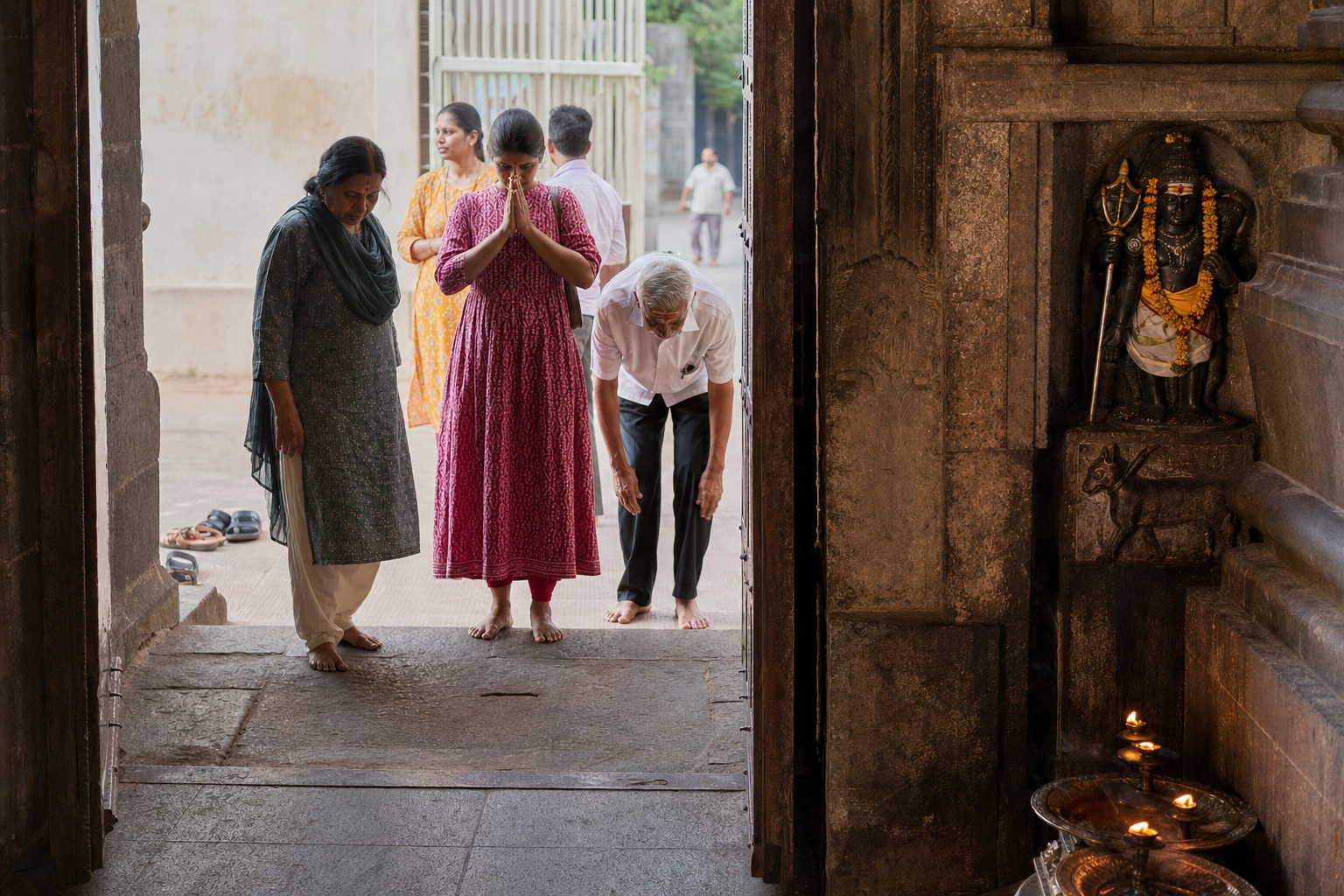
- At the gateway, stop long enough to identify your purpose for entering. Let conversation and phone use yield to that purpose.
- During pradakshina, locate the guardians, directional markers, and offering stations before hurrying to the sanctum.
- At Bhairava’s shrine, offer the form of respect permitted locally. If you do not know the custom, a quiet namaskara and a question to temple authorities are better than imitation.
- Before leaving, identify one boundary that your darshan asks you to keep: a promise, a restraint in speech, a protected period for sadhana, or a duty you have been postponing.
- Cross the outer threshold deliberately. Carry the discipline of the kshetra into conduct rather than treating departure as the end of sacred responsibility.
This is where Bhairava’s ferocity becomes practical. Compassion without discernment can become indulgence. Openness without a boundary can allow disorder to consume the space meant for worship. Discipline without hospitality can become mere control. The Kshetrapala holds these tensions together: protect the centre, regulate the threshold, and preserve the field so that sincere seekers can enter.
Key takeaways
- Bhairava’s peripheral placement expresses his authority over thresholds; it does not indicate that he is religiously marginal.
- A temple’s guardianship is distributed among Bhairava or Kshetrapala, dvarapalas, dikpalas, kirttimukha forms, bali-pithas, enclosure walls, and ritual circuits.
- Kshetra-bali maintains the ordered sacred field. It should not be reduced to the appeasement of a supposedly malevolent power.
- Placement, offerings, calendars, and forms of approach vary by temple and sampradaya. Follow local instruction rather than transferring a custom from somewhere else.
- The inward lesson is disciplined attention: decide what may cross a threshold, what must remain outside, and what sacred purpose the boundary protects.
On your next temple visit, do not begin your reading of sacred space only when the sanctum comes into view. Begin at the gate. Look up at the lintel, notice who stands beside the doorway, follow the enclosure, and find the guardian. Bhairava teaches that reverence starts with knowing how to cross a boundary.
References
