
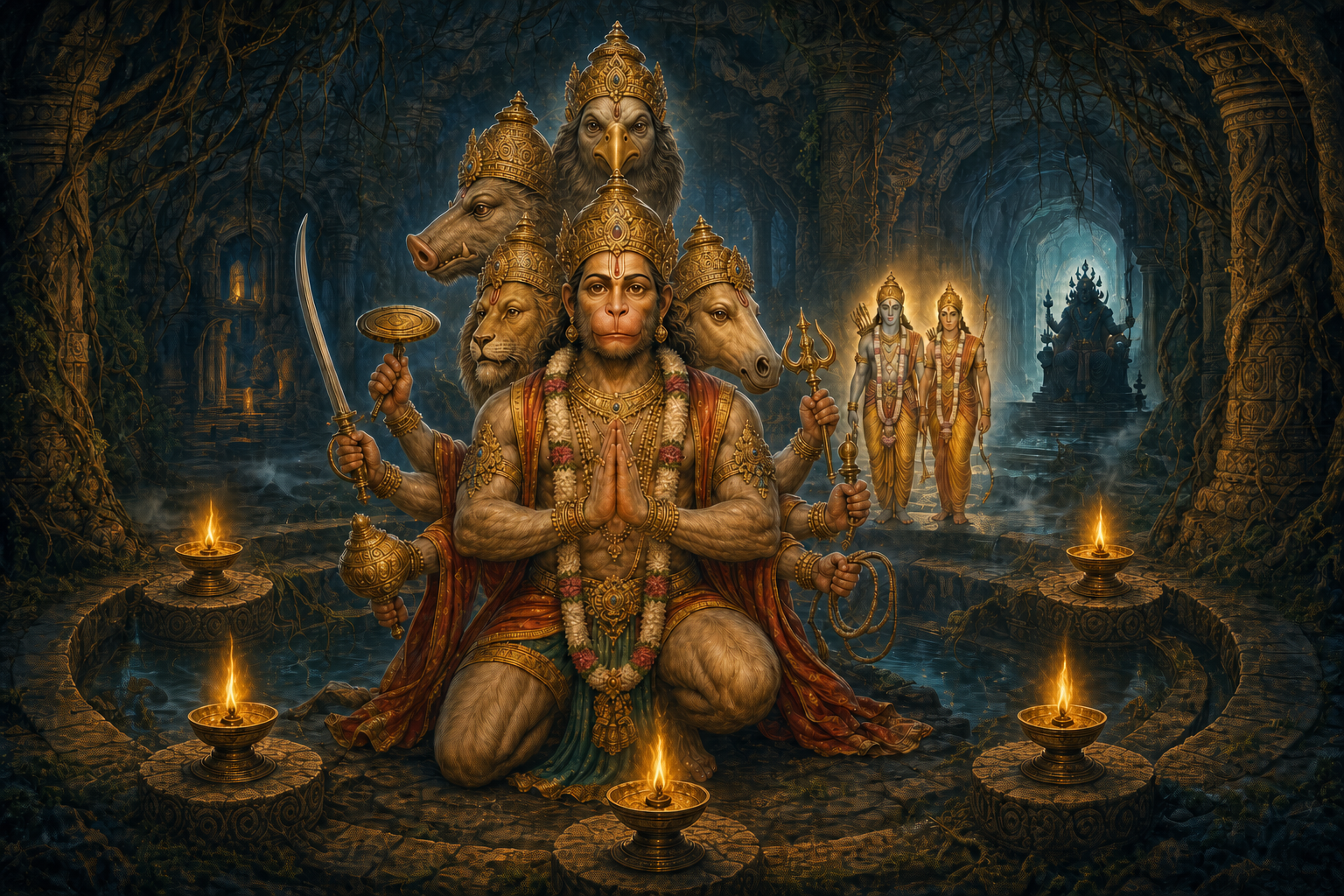
You may have encountered Panchamukhi Hanuman in a temple, calendar image, family narration, or Ramleela and then heard a troubling objection: Mahiravana’s abduction of Rama and Lakshmana is not in Valmiki’s Ramayana. Does that make the five-faced form inauthentic, or does it belong to a different layer of the Ramayana tradition?
The precise answer is more useful than either dismissal or exaggeration. The episode is absent from the critical edition of Valmiki’s text but richly present in later and regional Ramayana traditions. Once you keep those two facts together, you can appreciate Panchamukhi Hanuman devotionally, explain it honestly, and understand why the story continues to matter.
Where the Mahiravana episode belongs in the Ramayana tradition
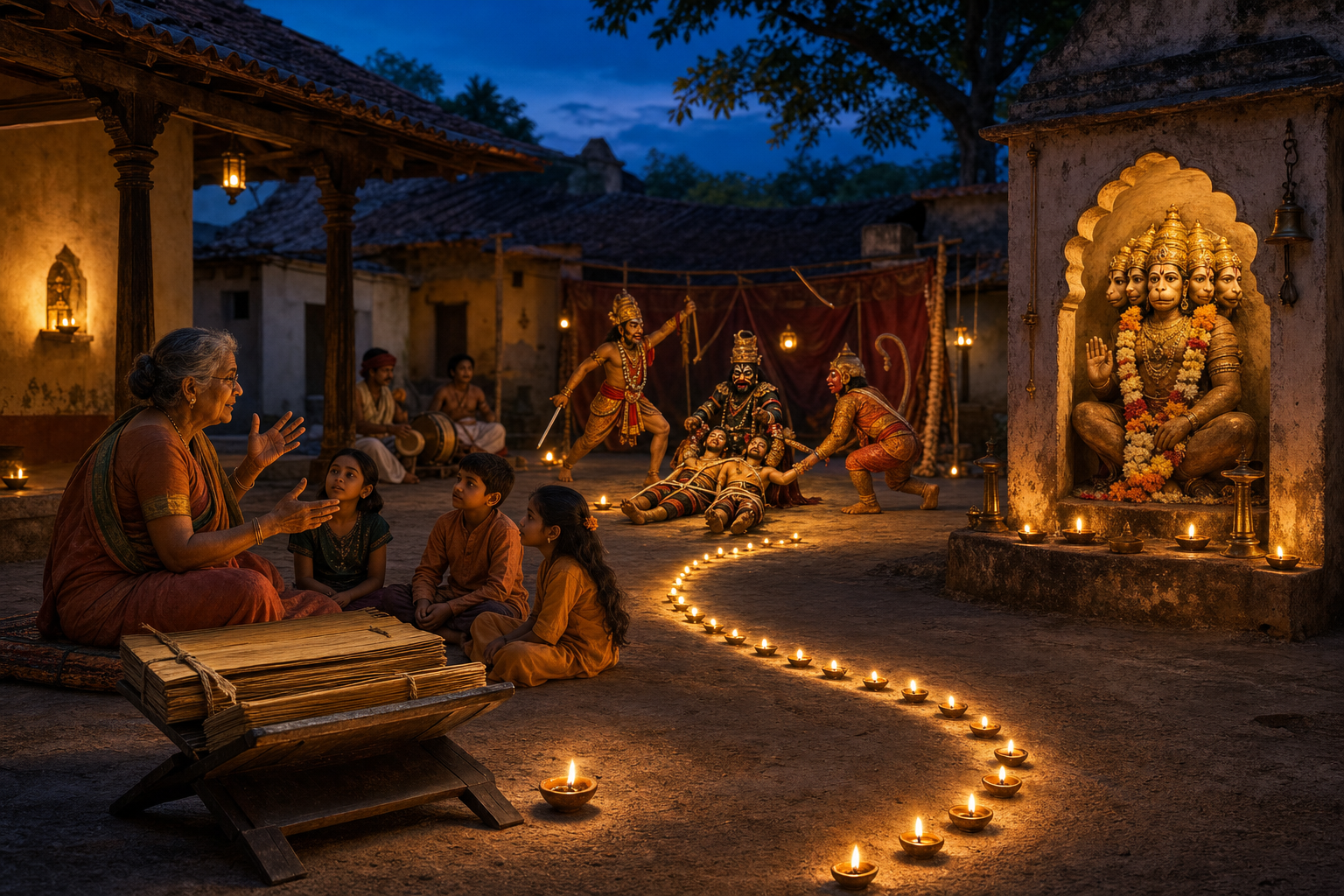
The Ramayana lives in more than one literary and performative stream. Valmiki’s text remains foundational, but regional poetry, oral narration, theatre, temple iconography, and devotional practice have carried the Rama-katha into different languages and communities. The Mahiravana rescue belongs to this expanding field of reception rather than to the critical edition of Valmiki’s Ramayana.
You can therefore use one clear sentence whenever textual status matters: In later and regional Ramayana traditions, Mahiravana abducts Rama and Lakshmana and Hanuman rescues them from Patala. This wording neither passes a later episode off as a passage from Valmiki nor treats a living sacred tradition as worthless because it developed outside that textual boundary.
The tale is especially associated with the Krittivasi Ramayana, the Adbhuta Ramayana, and South Indian oral traditions. Those streams do not always preserve every detail in the same way. Mahiravana may also be called Ahiravana. The fierce Goddess connected with his sacrificial rite may be identified as Chandika or Bhadrakali. Such variation is not a problem to be repaired by forcing every telling into one standardized script. It is evidence that communities have received and retold the episode through their own devotional languages.
Precision matters here because the word canonical can hide several different questions. If you mean present in the critical edition of Valmiki’s Ramayana, the answer is no. If you mean established within Hindu narration, performance, iconography, and worship, the answer is plainly different. Textual location and devotional legitimacy are related questions, but they are not the same question.
There is another common misreading worth correcting. Patala should not be reduced to the Western idea of hell. Within the cosmological setting of the tale, it is a complex and luminous underworld inhabited by different beings and energies. Hanuman’s descent is therefore a passage across a hidden threshold into the adversary’s domain, not a simple journey to a place where every inhabitant is morally condemned.
Why the rescue requires five faces rather than greater force
The Panchamukhi form becomes intelligible when you pay attention to the problem Hanuman must solve. Ravana, pressed by the war in Lanka, turns to Mahiravana, a subterranean ruler skilled in sorcery and illusion. Hanuman guards Rama and Lakshmana and, in some tellings, coils his tail around them to create a living defensive enclosure. Mahiravana does not defeat that enclosure by striking it harder. He assumes the appearance of Vibhishana, presents himself as someone entitled to enter, and is admitted through the boundary.
Rama and Lakshmana are then carried into Patala, where Mahiravana prepares to sacrifice them to a fierce form of the Goddess. The ritual setting makes an important dharmic distinction: sacred vocabulary, formidable technique, and ceremonial appearance do not make an act righteous. Adharma can borrow the outward form of religion while violating its moral center.
The decisive constraint is simultaneity
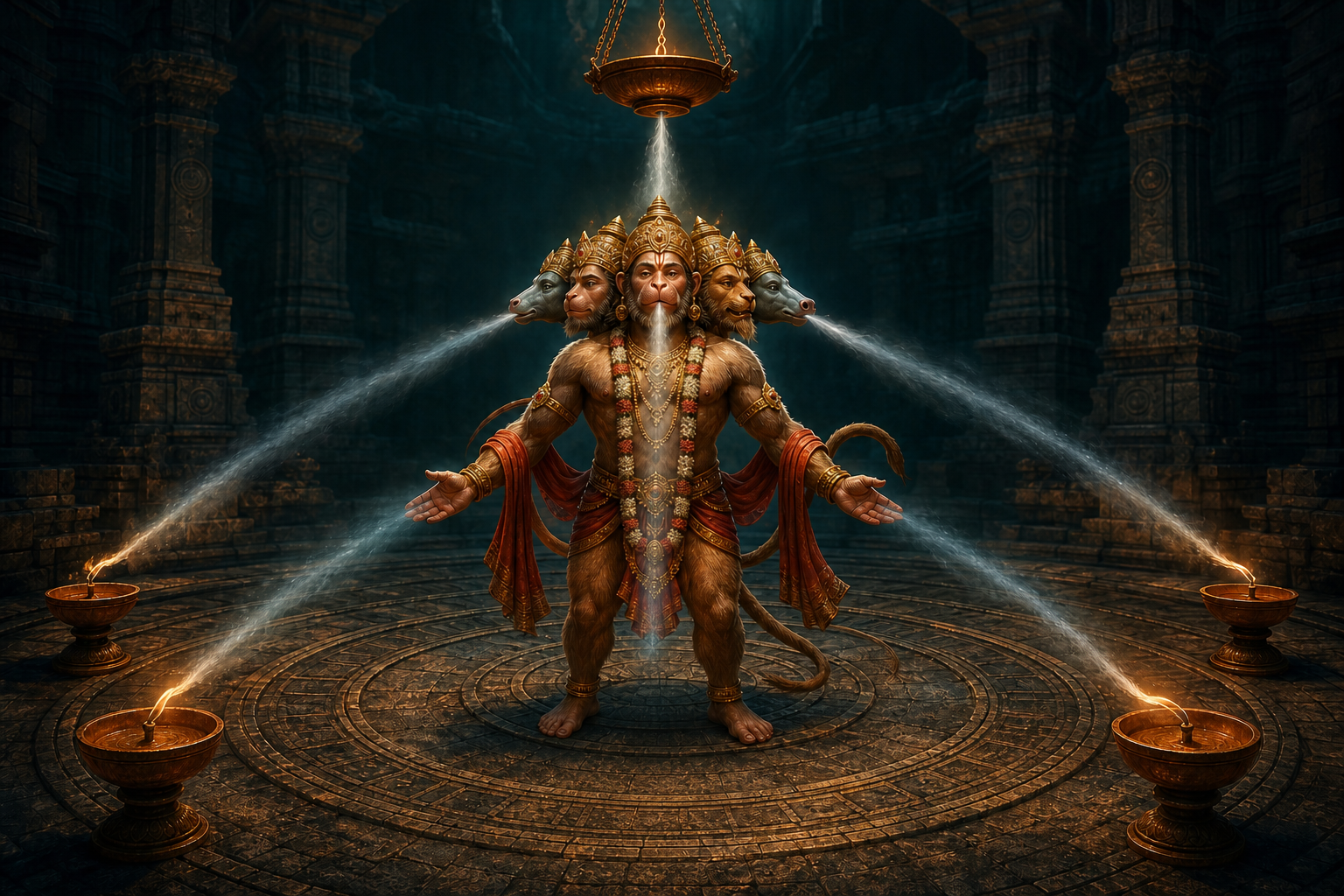
After the real Vibhishana exposes the deception, Hanuman learns the structure protecting Mahiravana’s life. Five lamps sustain the asura and must be extinguished at the same instant. Four stand toward the cardinal directions – east, west, north, and south – while the fifth is at the zenith.
This detail changes the nature of the contest. Ordinary strength applied in one direction cannot meet a five-directional condition. Speed alone also leaves open the possibility that the lamps will not be extinguished simultaneously. Hanuman must become capable of attention and action in several directions at once. Panchamukhi Hanuman is the exact answer to that requirement.
With the five faces aligned, Hanuman extinguishes the lamps in one coordinated act, breaks the matrix sustaining Mahiravana, defeats him, and releases Rama and Lakshmana. The transformation is therefore not an ornamental interruption in the plot. It expresses a practical principle: when a danger is maintained by several interdependent supports, dharmic action must identify and address the whole structure.
What the five faces contribute to the icon
The faces are commonly identified as Hanuman, Narasimha, Garuda, Varaha, and Hayagriva. Together they place Hanuman’s service within a broad field of protective and liberating power. The form can be contemplated as coordinated devotion, courage, release from obstruction, recovery from the depths, and discerning knowledge.
That sequence is a devotional interpretation, not a claim that every recension, temple, or lineage assigns an identical definition to each face. The shared narrative gives you the five lamps, their directional arrangement, the requirement of simultaneous action, and the commonly named faces. It does not require every local tradition to use one universal face-to-direction chart.
If you encounter a diagram that assigns a direction, mantra, color, weapon, or specialized benefit to every face, first ask which temple, sampradaya, ritual manual, or regional custom it represents. Do not reject a lineage-specific arrangement merely because it is not universal, but do not present it as the only arrangement on the strength of the Mahiravana story alone. This small habit protects both devotional seriousness and textual honesty.
The tail-dome reveals the story’s sharper lesson
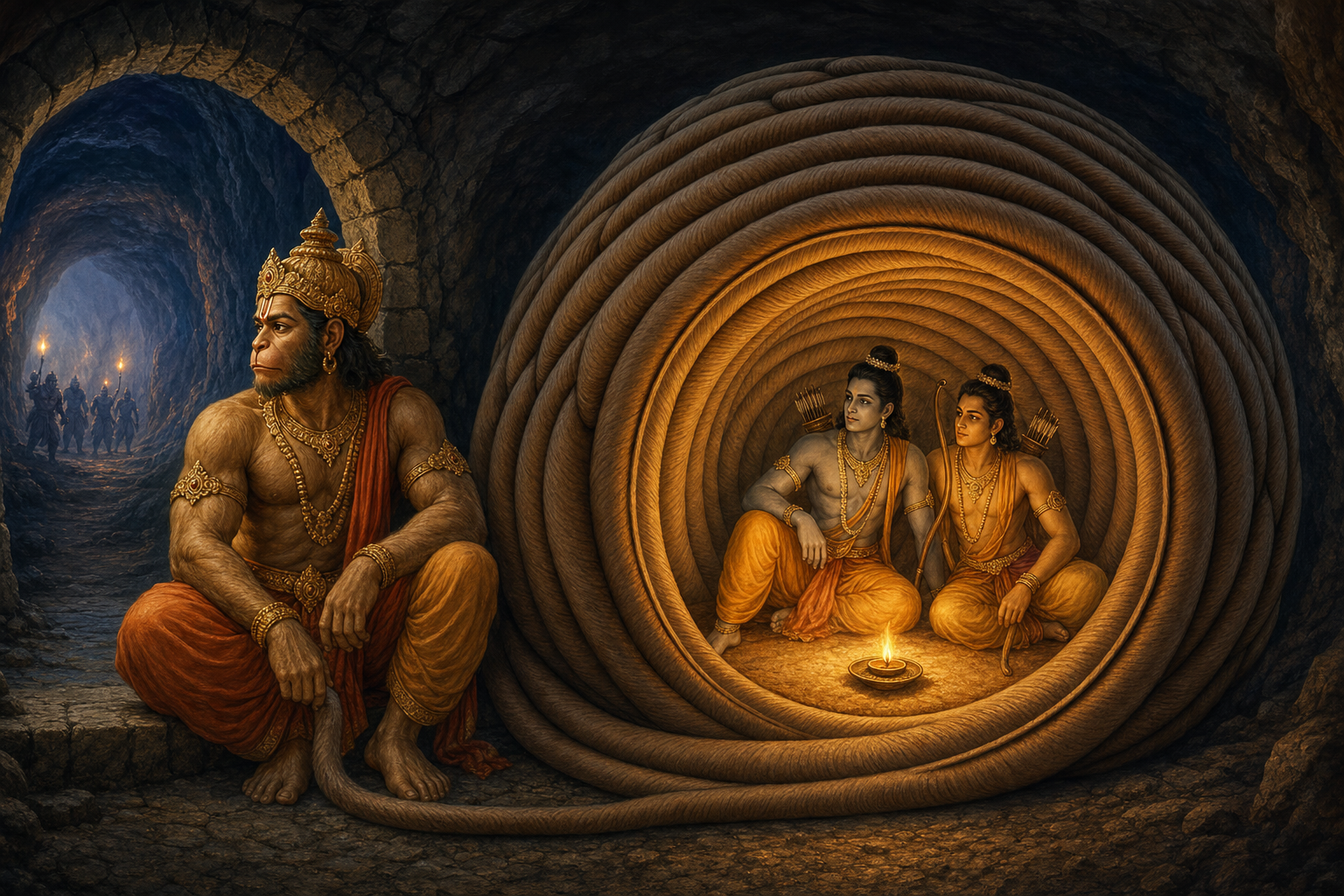
Hanuman’s tail-dome is an imaginative piece of sacred architecture. His disciplined energy becomes a protective enclosure around those entrusted to him. It can be read as a kavaca, a consecrated sheath, or as a mandala-like boundary concentrating attention and prana. Yet its breach shows why even an excellent boundary cannot substitute for alert judgment.
Mahiravana succeeds by impersonating Vibhishana, the trusted ally. He copies the signs by which the guardian normally recognizes a friend. The danger is not open hostility announcing itself at the gate; it is adharma using the appearance, voice, and moral credit of someone trustworthy. The episode therefore asks a harder question than whether you are strong enough to defend a boundary: can you recognize an abnormal request when it arrives in a familiar form?
The practical lesson is not to distrust everyone close to you. Suspicion without discrimination corrodes community. The better rule is to verify independently when a familiar person appears to ask for an unusual exception to an important boundary. In ordinary life, that can mean contacting the person through a known channel before releasing sensitive information, changing an established safeguard, or granting access that cannot easily be withdrawn.
The same pattern applies to the inner life. A destructive impulse rarely introduces itself by saying that it intends to weaken your discipline. It often borrows the language of duty, affection, urgency, or spiritual certainty. The tail-dome invites you to build good disciplines; Mahiravana’s disguise reminds you to remain consciously present at their gates.
Hanuman’s response after the breach is equally instructive. He does not remain trapped in shame over having been deceived. He consults the real Vibhishana, learns the terrain and the condition sustaining the enemy, descends into Patala, and changes form to meet that condition. For you, the sequence is concrete: acknowledge the breach, obtain reliable knowledge, locate the supporting mechanism, and choose an action fitted to the actual problem. Strength becomes effective only after discernment gives it direction.
The five lamps deepen this lesson. Mahiravana’s apparent power depends on a concealed system. Fighting only what is visible would leave that system intact. When a recurring problem survives repeated effort, ask what keeps relighting it. There may be several supports that must be addressed together rather than one symptom that can be defeated in isolation.
How to tell, teach, and approach the tradition responsibly
When telling the story at home
Begin with its textual location instead of waiting for someone else to turn that location into an accusation. Tell children and new readers that the Rama-katha has a foundational Valmiki stream as well as later regional tellings, and that this adventure comes from the latter. Then let the story do its work: Hanuman first guards, is deceived by a false appearance, learns from the error, understands the five-lamp secret, assumes five faces, and rescues Rama and Lakshmana.
Keep the distinction between stable structure and variable detail visible. The abduction into Patala, the deception, Hanuman’s descent, the multi-directional challenge, and the rescue form the recognizable spine. Names, ritual details, the identity of the Goddess, and the route through the underworld can vary. If a relative remembers a different version, ask which region or performance tradition carried it rather than immediately declaring one memory false.
When approaching Panchamukhi Hanuman devotionally
A later place in literary history does not by itself determine whether an image can bear devotional meaning. Communities encounter Panchamukhi Hanuman through worship, temple iconography, festival remembrance, theatre, and inherited narration. The form gathers the qualities most needed in the Patala crisis: bhakti that does not abandon its object, buddhi that investigates the hidden condition, courage that enters hostile terrain, and disciplined power that acts without fragmentation.
Use the icon as a prompt for integrated practice rather than as a catalogue of supernatural guarantees. Ask where your own attention has become one-directional. Ask whether service is being supported by discernment, whether courage is being guided by knowledge, and whether the several causes of a problem are being faced together. These questions follow the dramatic logic of the five-faced form without pretending that one symbolic reading exhausts it.
If you want to adopt a specific mantra, kavaca, directional visualization, or ritual procedure, learn it from the sampradaya, temple, teacher, or practice tradition to which it belongs. A narrative can explain why a sacred form matters without supplying every rule for its formal worship. Making that distinction prevents improvised instructions from being mistaken for inherited practice.
When discussing a wider Dharmic resonance
The protective enclosure has analogues across Dharmic life: protective recitation in Buddhist practice, the disciplined ethical boundaries of Jain vows, and Sikh emphasis on seva, courage, and steadfast remembrance all illuminate the union of compassion with vigilance. The useful claim is ethical kinship, not theological sameness or proof of a single historical origin.
You can therefore speak of a shared Dharmic concern for protecting truth without erasing the distinctive teachings of Hindu, Buddhist, Jain, or Sikh paths. Comparison becomes responsible when it clarifies a common moral problem while allowing each tradition to retain its own vocabulary, discipline, and understanding of liberation.
Key takeaways
- Describe the Mahiravana rescue as a later and regional Ramayana tradition, not as an episode from the critical edition of Valmiki’s Ramayana.
- Expect variation. Mahiravana and Ahiravana are alternate names, and details such as the Goddess associated with the sacrifice differ across tellings.
- Read Panchamukhi Hanuman as a precise response to five lamps that must be extinguished simultaneously in four cardinal directions and at the zenith.
- Treat face-to-direction charts and specialized ritual correspondences as lineage- or context-specific unless the tradition presenting them establishes otherwise.
- Carry the central discipline into life: verify unusual requests, examine the system sustaining a problem, and join devotion to discriminating intelligence.
The next time you see Panchamukhi Hanuman, do not stop at asking whether the image occurs in Valmiki’s critical text. Ask which Ramayana stream brought it to you, which details that community preserves, and what kind of many-sided attention the form demands. That approach lets you receive a living tradition with devotion, accuracy, and discernment together.
References
