

Someone tells you that Hindutva is simply Hindu fundamentalism. Someone else insists that Hindutva and Sanatana Dharma are interchangeable in every context. If you accept either equation without examining what the speaker means, the argument is over before the real question has even been asked.
You need a more reliable test. Protecting Hindu civilizational memory, maintaining temples, teaching inherited traditions, or objecting to cultural erasure is not proof of fundamentalism. But invoking dharma cannot excuse coercion, collective hostility, or the suppression of honest disagreement. The decisive question is not how proudly a person uses the word Hindutva. It is how that person handles authority, truth, dissent, pluralism, and power.
First establish which Hindutva is being discussed
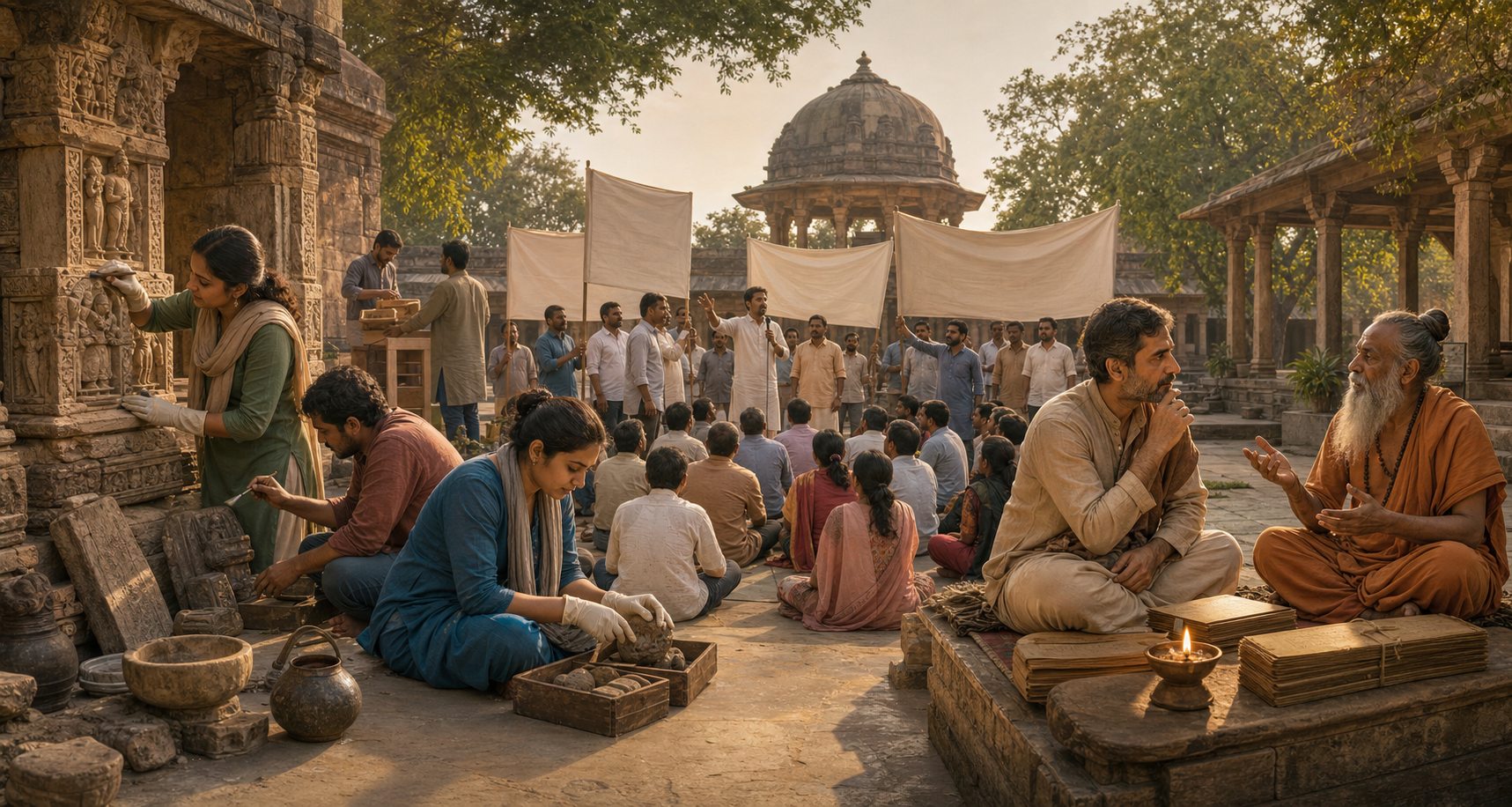
Hindutva does not carry one uncontested meaning in public life. An indigenous civilizational usage associated with Chandranath Basu presents it as Hindu-ness: the cultural and philosophical world shaped by Sanatana Dharma. In that usage, Hindutva is broader than an electoral platform. It includes memory, sacred geography, philosophy, festivals, social practices, inherited institutions, and a sense of civilizational continuity.
Modern political actors may use the same word for particular policies, organizations, or strategies. Critics sometimes use it even more broadly as a label for conduct they regard as majoritarian. These uses overlap, but they are not identical. A criticism of one organization does not automatically disprove the legitimacy of Hindu civilizational self-expression. Conversely, a civilizational definition cannot be used to sanctify everything done under the Hindutva name.
When the term appears in a difficult conversation, ask three questions before defending or condemning it:
- What is being named: a civilization, a spiritual outlook, a social movement, an organization, a policy, or a specific act?
- What exact proposition is being disputed: Hindu continuity, equal religious rights, legal policy, treatment of minorities, or the conduct of particular people?
- What evidence would settle the claim: a stated doctrine, an institutional rule, a proposed law, or documented conduct?
This clarification is not evasion. It prevents equivocation. A speaker should not criticize a concrete political act and then silently transfer that criticism to Sanatana Dharma as a whole. A defender should not begin with Sanatana Dharma’s pluralism and then assume that every contemporary political act must therefore be pluralistic.
Fundamentalism is an operating pattern, not a synonym for conviction

Fundamentalism is most useful as the name of a recurring structure. It is not a generic word for religious seriousness, traditional morality, conservative opinion, or a community maintaining an identity. A person can hold firm theological convictions without trying to silence every rival. A sampradaya can preserve demanding disciplines without claiming the right to impose them on the entire population.
The fundamentalist pattern becomes clearer when several of the following features operate together:
- A single text or doctrine is declared infallible and is used to terminate every dispute.
- One institution, clerical body, party, or leader claims final interpretive authority and treats sustained questioning as disloyalty.
- Insiders and outsiders are divided into rigid moral camps, with little room for mixed identities, honest error, or principled disagreement.
- One path claims an exclusive monopoly on truth or salvation and denies the legitimacy of every alternative.
- Pluralism is treated as corruption rather than as the civic condition under which different communities can live and reason together.
- Activism seeks to place education, law, culture, and the state under an enforced doctrinal program.
No single item automatically settles the diagnosis. Sacred texts matter in many traditions. Communities need boundaries, teachers, and standards. The stronger indication is a cluster of closure, unanswerable authority, hostile boundary-making, and coercive ambition. The transition from conviction to fundamentalism occurs when disagreement is no longer something to answer but something to disable.
This pattern can appear in religious and secular ideologies. Early twentieth-century Protestant fundamentalist movements emphasized biblical inerrancy, creedal boundaries, and campaigns to shape public morality and education. Certain Islamic revivalist or Islamist movements seek a comprehensive political order governed by their understanding of scripture and sharia. Some historical Marxist formations treated dialectical materialism as unquestionable truth, canonical thinkers as final authorities, and the vanguard party as history’s authorized interpreter.
These comparisons do not make Christianity, Islam, and Marxism interchangeable, nor do they define every Christian, Muslim, or Marxist. Christianity contains Orthodox, Catholic, Protestant, ecumenical, and historically critical approaches. Islam contains Sunni, Shia, Sufi, jurisprudential, and regional traditions. Democratic socialist currents differ sharply from coercive party-states. The comparison concerns the machinery of dogmatism, not the moral worth of entire populations.
In an actual conversation, listen to the verbs being used. Persuade, teach, debate, practice, protect, and serve leave room for the agency of others. Silence, purge, compel, subordinate, and punish point toward a different relationship with power. Calling an opposing view mistaken is not in itself fundamentalism. Seeking civil disabilities for the person who holds it is a qualitatively different act.
Sanatana Dharma is plural without being empty
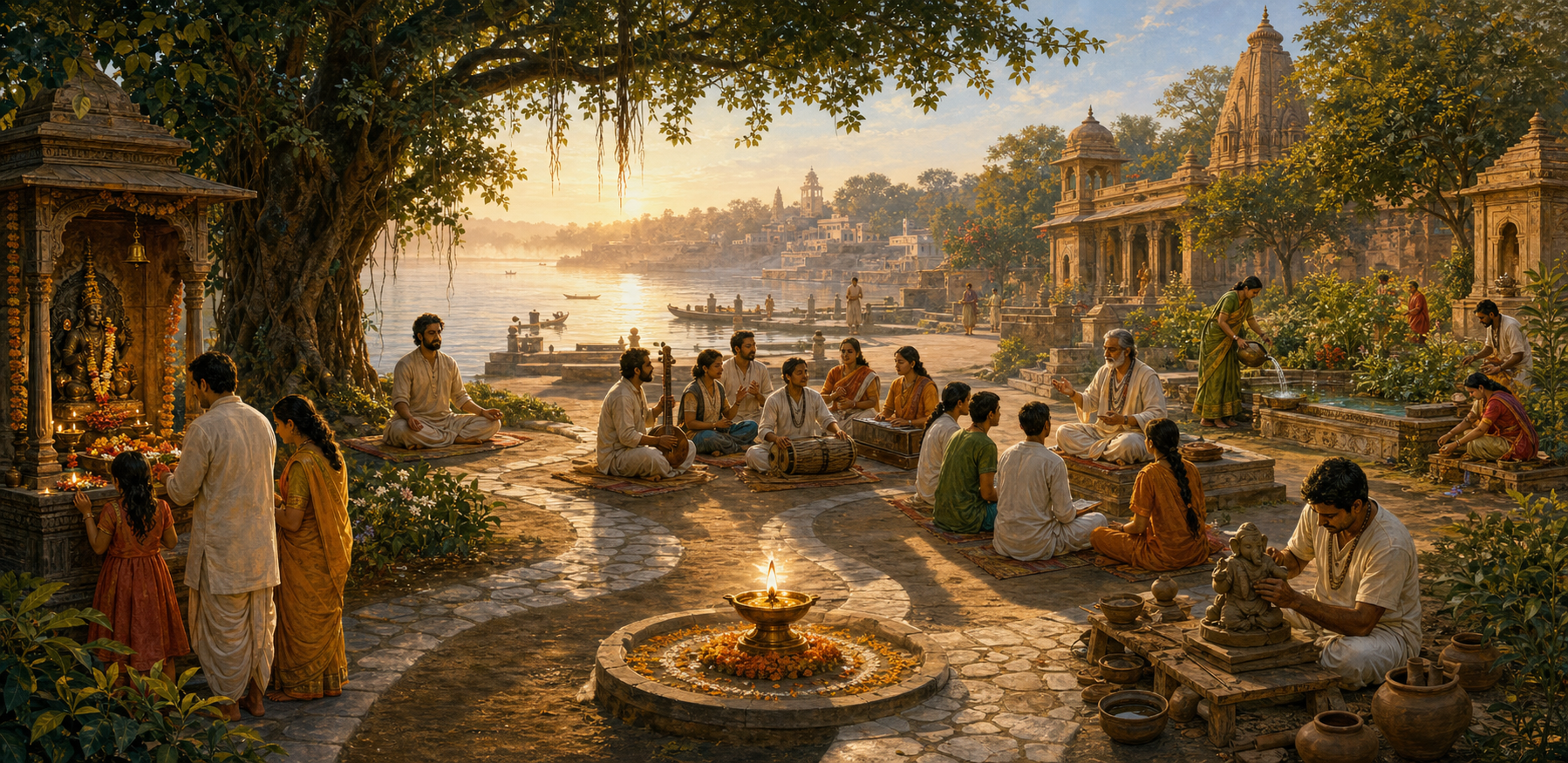
Sanatana Dharma has structural defenses against the concentration of spiritual authority. It has no single earthly ecclesia governing every Hindu. Its textual world includes shruti, smriti, itihasa, and purana rather than one isolated canon interpreted through one mandatory institution. Its philosophical life includes schools such as Advaita, Dvaita, Vishishtadvaita, Nyaya, and Mimamsa, which disagree on serious questions without ceasing to inhabit a shared civilizational world.
Different schools accept different combinations of pramanas, or means of knowledge. Perception, inference, and scriptural testimony can all enter disciplined inquiry. The guru-shishya parampara transmits knowledge through lineages, but those lineages remain distributed. Shastrartha gives disagreement a method: understand a position, state its reasoning fairly, present the purva-paksha, and then offer an uttara-paksha. That is more demanding than merely declaring that every opinion is equally correct.
Plurality within Sanatana Dharma therefore does not mean intellectual indifference. Advaita and Dvaita cannot be collapsed into the same metaphysical proposition. A Vaishnava, Shaiva, Shakta, or Smarta lineage may prescribe distinctive forms of worship and discipline. The plural principle is that disagreement need not produce a single centralized apparatus that expels every rival path from legitimate spiritual life.
Ishta, the freedom to orient oneself toward a chosen form or spiritual focus, helps make this possible. Bhakti, jnana, karma, and raja yoga offer different margas suited to different dispositions and aims. Diversity is held within practice rather than tolerated only as an abstract slogan. You can be deeply committed to one path while recognizing that another person’s sadhana need not reproduce your own.
The wider dharmic conversation strengthens this habit without erasing the independence of its traditions. Jain Anekantavada trains attention on the many-sided and context-bound character of human judgments. Buddhist traditions contribute disciplined inquiry into suffering, conduct, mindfulness, and karuna. Sikh traditions place powerful emphasis on sangat and seva. Hinduism, Buddhism, Jainism, and Sikhism are not interchangeable, but they can cooperate without requiring a common pope, creed, or salvific monopoly.
None of this makes Hindus automatically immune to dogmatism. A decentralized tradition can still produce domineering leaders, hostile factions, or political simplifications. A person can quote pluralistic philosophy while behaving coercively. The dharmic inheritance supplies correctives; it does not apply them on our behalf. Those correctives have to be practiced through debate, self-restraint, contextual reading, and a willingness to distinguish a cherished conviction from a demand for total control.
The line between civilizational confidence and coercive identity
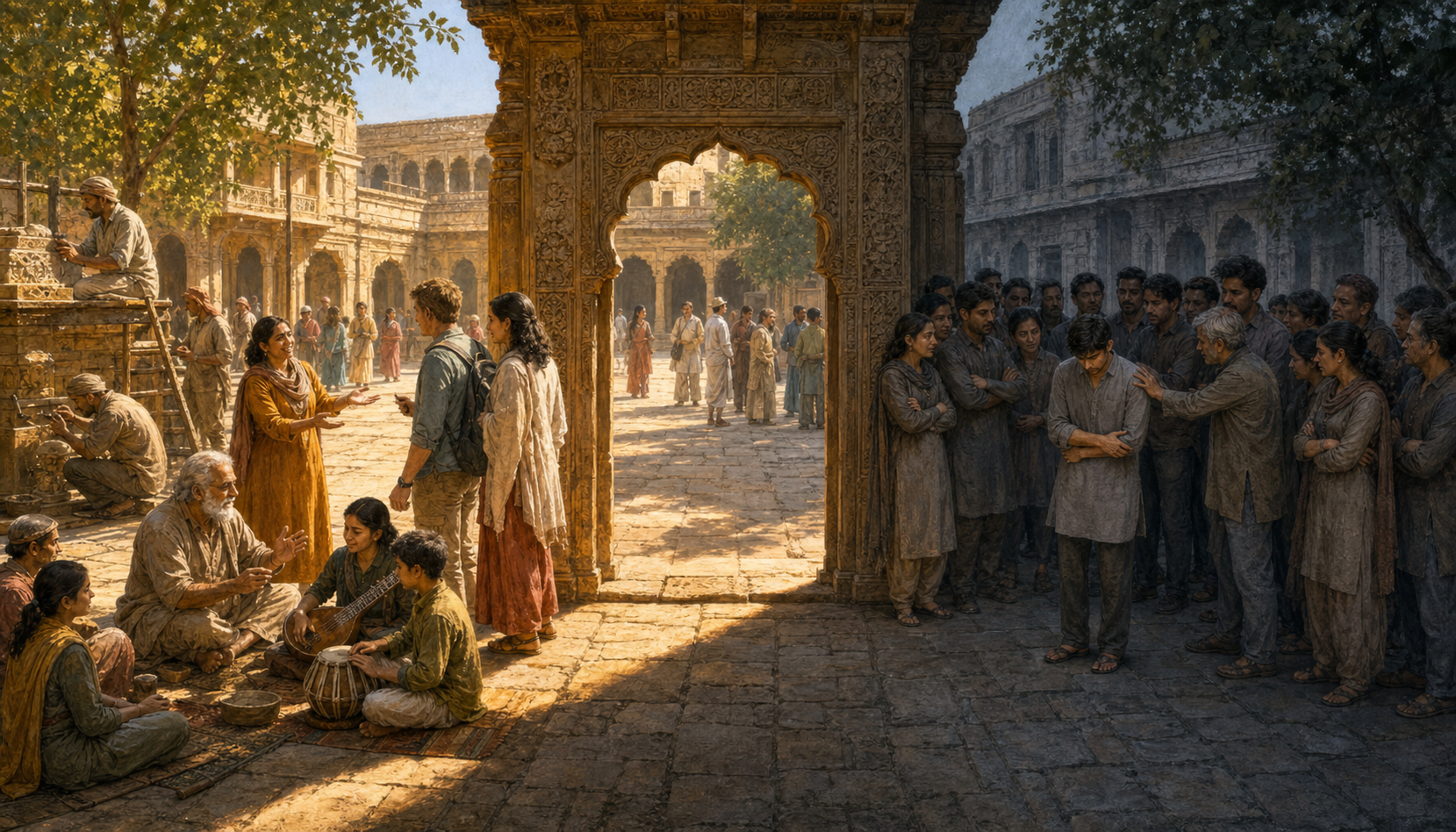
A civilizational Hindutva remains consistent with Sanatana Dharma when it protects continuity without demanding uniformity. It can teach history, preserve sacred places, support Hindu institutions, challenge cultural misrepresentation, and seek equal treatment under law. The drift toward fundamentalism begins when belonging is converted into a monopoly on truth, authority is made unanswerable, or state power is recruited to impose one faction’s doctrine on everyone else.
| Question | Dharmic civilizational posture | Fundamentalist drift |
|---|---|---|
| How is truth approached? | A tradition argues for its conclusions while recognizing multiple schools, pramanas, and forms of sadhana. | One formulation is declared beyond examination, and every rival is treated as illegitimate. |
| Who may interpret? | Authority is distributed among texts, teachers, lineages, institutions, reason, and lived practice. | One leader, party, institution, or doctrinal gatekeeper demands the final word. |
| What happens to dissent? | Disagreement is met through purva-paksha, uttara-paksha, correction, and continued argument. | Questions become evidence of betrayal, impurity, or enemy allegiance. |
| What is the civic aim? | Communities retain their traditions under equal freedom of conscience and a shared public order. | Law and education are redesigned to compel conformity with a sectarian program. |
| Which means are acceptable? | Ahimsa, anrishamsya, restraint, and loka-sangraha limit the pursuit of political goals. | Intimidation or cruelty is excused because the movement regards its desired end as absolute. |
| How are outsiders seen? | Differences can be serious without turning every outsider into a permanent moral enemy. | Collective suspicion replaces judgment of particular beliefs and acts. |
Community discipline and universal coercion must also be kept separate. A voluntary sampradaya may set standards for its own initiation, worship, or teaching. That does not automatically amount to governing everyone. Yet the word voluntary cannot be used to conceal intimidation, and inherited custom cannot make cruelty dharmic. Ask who can refuse, what refusal costs, and whether the same rule is being forced on people outside the community.
A useful civic test is reciprocity. If you want the state to possess a power because your preferred group currently holds influence, would you accept the same power in the hands of a rival sect or religion? If the answer is no, the proposal probably protects dominance rather than dharma. Equal public rules are more durable than privileges whose justice depends on who controls the machinery.
Historical pressure can explain why identities harden. Colonial encounters, missionary competition, cultural denigration, and modern nation-building intensified the need for Hindu civilizational self-definition. Explanation, however, is not absolution. Past injury can justify recovery, preservation, education, and lawful advocacy. It does not convert present-day collective blame or coercion into a dharmic duty.
Digital media makes the distinction harder because certainty travels faster than interpretation. Before sharing a clipped speech or a one-verse declaration, locate the full passage, identify the speaker’s lineage or institutional role, look for competing interpretations within the relevant tradition, and determine what action is actually being demanded. If those checks cannot be completed, treat the claim as rhetoric from a participant, not as the settled voice of Sanatana Dharma.
Key takeaways: use five questions before choosing a side
- Define the object. Determine whether Hindutva refers to civilizational belonging, a spiritual philosophy, a movement, a party, a policy, or one person’s conduct. Do not let the speaker move between these meanings unnoticed.
- Locate the authority. Ask whether a claim rests on a text, a sampradaya, a guru, reasoned inference, a political manifesto, or personal opinion. A forceful social-media voice is not automatically a representative authority.
- Watch the treatment of dissent. Look for fair restatement, contextual interpretation, and a reasoned reply. When questions are answered mainly with threats, exclusion, or accusations of impurity, a fundamentalist structure is taking shape.
- Inspect the proposed public rule. Defending equal freedom, sacred institutions, and civilizational literacy differs from compelling every citizen to obey one doctrinal interpretation. Apply the reciprocity test before endorsing new state power.
- Test the means as seriously as the end. A policy presented as pro-Hindu should still be measured against ahimsa, non-cruelty, self-restraint, and loka-sangraha. A dharmic name does not purify adharmic conduct.
The next time someone uses Hindutva as either an accusation or an all-purpose defense, slow the conversation at its first ambiguity. Ask for the precise claim, its authority, its treatment of dissent, the public power it demands, and the means it permits. Then defend Hindu civilizational continuity where it deserves defense and reject coercion where it violates dharma. That discipline allows Sanatana Dharma to speak confidently in public without being reduced to either political embarrassment or political absolutism.
References
