
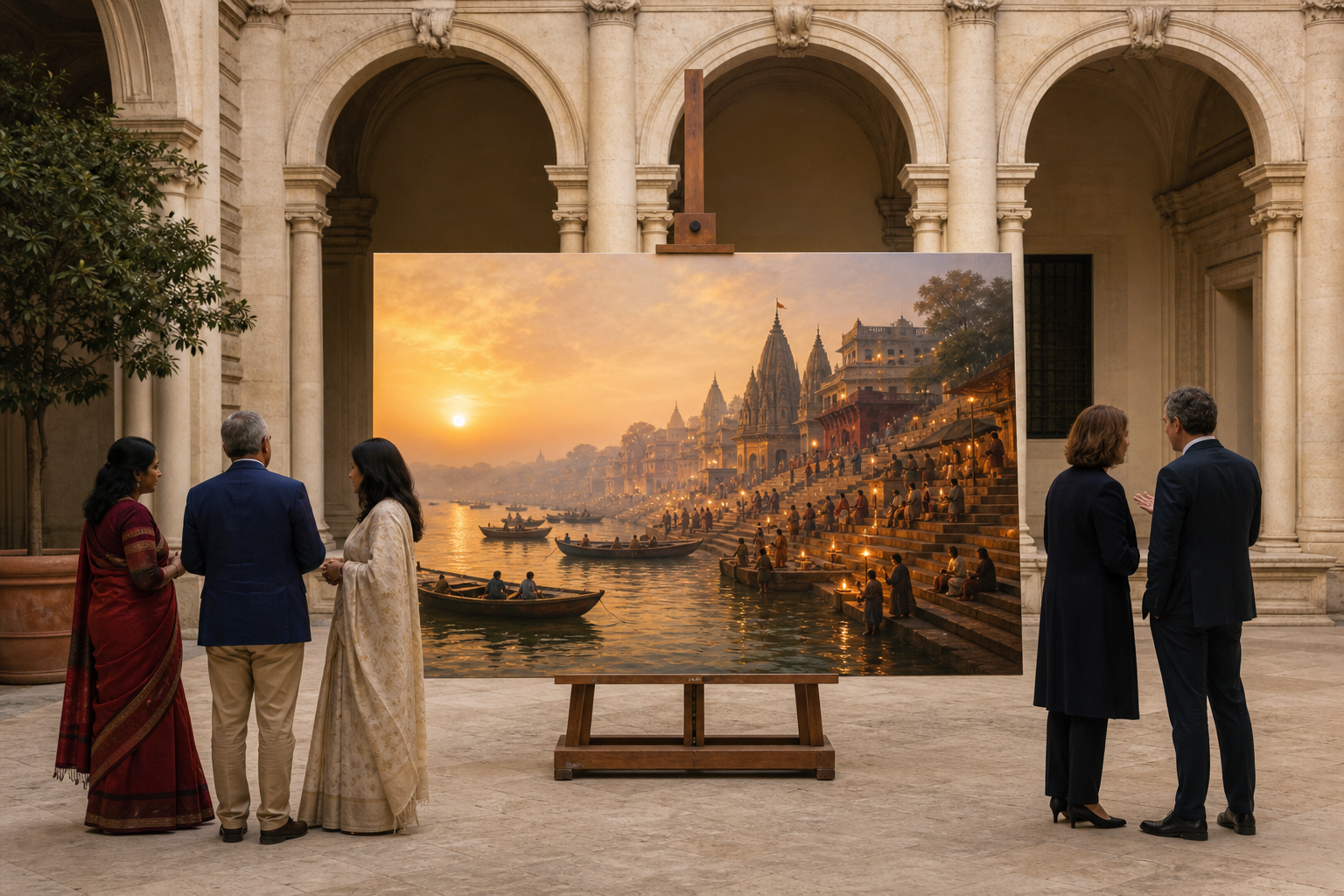
You may have seen the photograph from Rome and wondered whether the Kashi painting was simply a gracious gift beside the serious business of diplomacy. It was ceremonial, but it was not empty. Art cannot replace policy. What it can do is make a civilisation, a relationship, and a set of values visible before formal language takes over.
During an official visit to Italy, Prime Minister Narendra Modi met Italian artist Giampaolo Tomassetti, known in Vaishnava circles as Jnananjana Dasa, in an exchange centred on a painting of Kashi in Rome. Three elements gave the moment its diplomatic weight: Indian sacred geography, an Italian artist formed by bhakti, and an official encounter in the Italian capital. If you want to judge whether this was meaningful cultural diplomacy, examine all three rather than treating the painting as an isolated gift.
Read the Kashi image in three layers
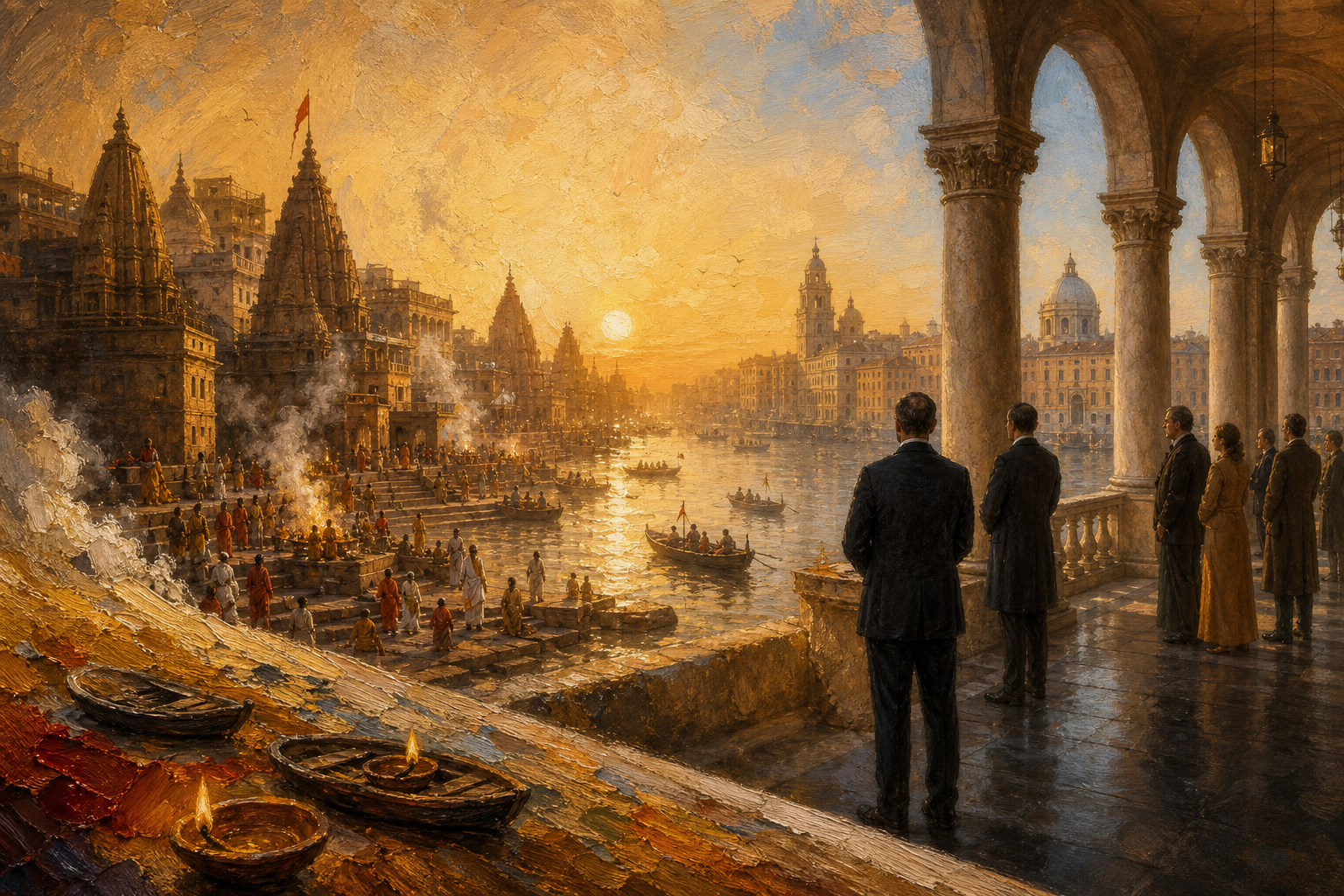
A Kashi cityscape is immediately recognisable, but recognition is only the first level of seeing. The ghats, river, boats, stone steps, temple forms, and early light carry different kinds of meaning at the same time. Reading those layers separately prevents the image from becoming either a tourist postcard or a vague symbol of spirituality.
- Begin with the physical place. The painting presents the ghats of Kashi beside the Ganga, with wooden boats resting near the stepped embankments and morning light moving across water and stone. These concrete features matter. Cultural diplomacy becomes persuasive when it begins with a place people can see and remember.
- Notice the lived rhythm. The ghats are not an architectural backdrop detached from human practice. Dawn mantras, temple bells, pilgrims, boats, worship, movement, and stillness give the riverfront its daily character. The image therefore represents a practised sacred geography, not merely an old urban landscape.
- Then consider the civilisational meaning. Kashi is understood as a tirtha associated with learning, pilgrimage, and liberation. The riverfront holds human life beside ideas of continuity, mortality, renewal, and transcendence. That is why a single view of the ghats can communicate more than a conventional civic monument.
Precision is important here. Kashi should not be diluted into generic multi-faith spirituality. It is a Hindu sacred city with its own theological depth and ritual life. Nearby Sarnath provides a distinct connection to foundational Buddhist history. Jain and Sikh traditions belong in the wider Dharmic conversation through their own histories, teachings, and institutions; they should not be treated as interchangeable meanings projected onto every ghat. An inclusive reading becomes stronger, not weaker, when it preserves these distinctions.
You should also keep observation separate from technical inference. A reproduced ceremonial photograph can establish the painting’s subject, but it may not establish whether the work was executed in oil or acrylic or which process produced a particular effect. Kashi cityscapes often use atmospheric perspective, riverine diagonals, temple silhouettes, layered colour, and controlled edges to hold physical observation and metaphysical suggestion in one composition. Cool river blues set against warm sandstone ochres can create a visual movement from night or distance toward awakening. Use language such as the genre often employs unless an exhibition label or the artist verifies the materials and method of this particular work.
Why an Italian Vaishnava artist changes the meaning
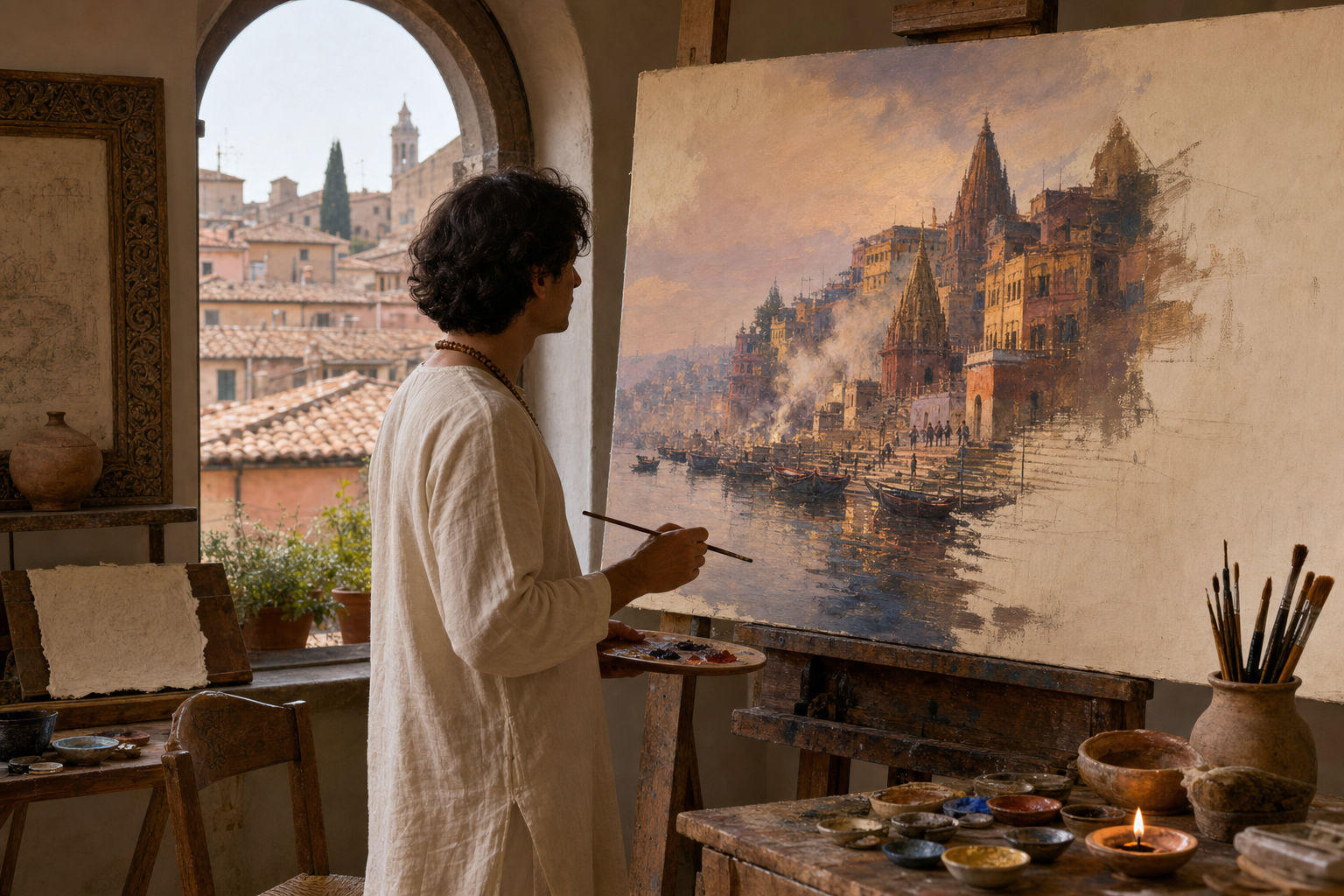
The artist’s identity is not an incidental biographical detail. Tomassetti is an Italian artist whose work engages Indic themes and sacred places. His Vaishnava name, Jnananjana Dasa, publicly locates that engagement within a devotional world connected to bhakti and resonant with international communities such as ISKCON. That does not make him an official representative of every Vaishnava, Hindu, or Indian viewpoint. It does make the exchange more substantial than the presentation of Indian imagery by a culturally distant observer.
The symbolic movement is reciprocal. An Italian artist interprets an Indian sacred city through devotional art, and an Indian prime minister receives that interpretation in Rome. India is not only displaying heritage abroad; an Italian participant has encountered that heritage deeply enough to render it through his own discipline. The bridge is embodied in the artist before it is represented by the diplomatic photograph.
Italy also supplies a meaningful artistic setting. Renaissance altarpieces and Baroque uses of light demonstrate an extensive Italian history of making devotion visible through form, colour, gesture, and illumination. The parallel with bhakti art should not be forced into equivalence. A Kashi riverfront and a Christian altarpiece emerge from different theologies and practices. The productive comparison concerns what sacred art asks of the viewer: sustained attention, moral imagination, and an openness to realities that ordinary description cannot fully contain.
When you encounter a cross-civilisational artwork, ask a more useful question than whether one tradition resembles another. Ask which visual devices each tradition uses to orient the viewer. Light may suggest revelation or awakening. Distance may create longing. Repetition may establish ritual rhythm. A figure, river, threshold, or sacred building may organise the passage from everyday perception to contemplation. This approach allows dialogue without pretending that the traditions say the same thing.
What one cultural moment can and cannot accomplish
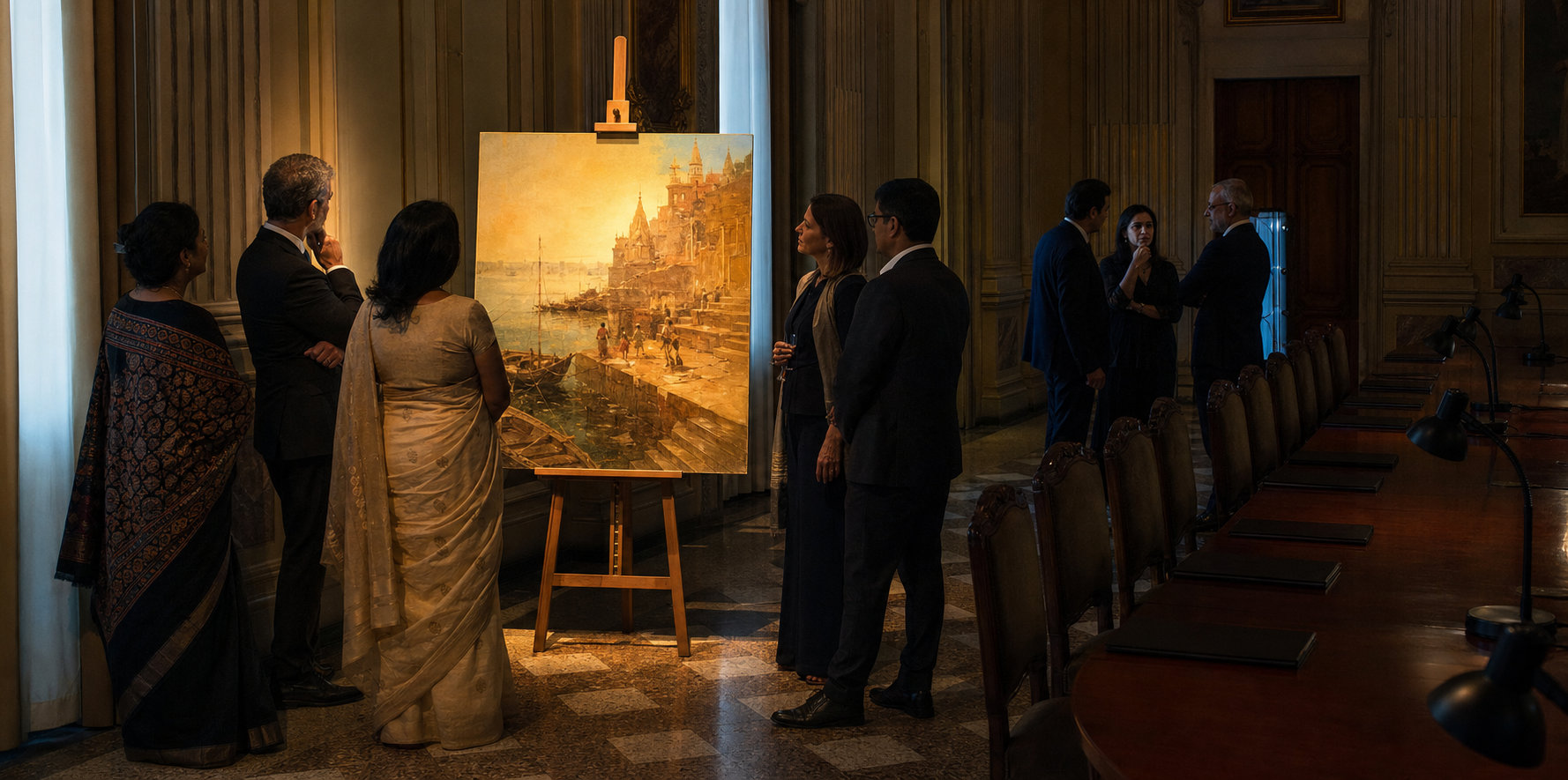
Cultural diplomacy is often described as soft power, but the phrase becomes empty unless you identify the mechanism. An artwork works diplomatically when it gives unfamiliar audiences a memorable point of entry, makes inherited values emotionally intelligible, and creates reasons for institutions and communities to meet again. It prepares relational ground; it does not sign agreements or settle political differences.
What the Kashi exchange can do
- Compress a large civilisational story. The Ganga, ghats, boats, temples, pilgrims, and morning light place geography, ritual, memory, and aspiration within a single frame.
- Create reciprocal recognition. The Indian subject and Italian artist show cultural influence moving through relationship rather than through one-way display.
- Give the diaspora a rooted public symbol. Kashi remains geographically specific even when its image travels. That combination can support cultural confidence without requiring the host society to become a copy of India.
- Open a Dharmic conversation. Kashi’s Hindu meaning can stand clearly while nearby Buddhist history and the wider ethical contributions of Jain and Sikh traditions enter through their own distinct doors.
- Connect reverence to responsibility. Attention to the Ganga and ghats can lead naturally to questions about river ecology, heritage conservation, mindful pilgrimage, and sustainable tourism.
What it cannot prove
- A ceremonial meeting does not by itself demonstrate a change in Italian public opinion or government policy.
- A painting cannot establish progress in trade, technology, climate cooperation, or other areas of statecraft. It can provide a human context in which such cooperation is discussed.
- One artist cannot represent every Italian response to India, just as one sacred image cannot contain every Hindu or Dharmic understanding of Kashi.
- Admiration for a riverfront does not conserve the river or protect the ghats. Symbolic concern acquires substance only when institutions, pilgrims, residents, and cultural organisations carry it into practice.
This distinction protects you from two opposite errors. The cynical error dismisses every ceremony as decoration. The romantic error treats an attractive image as evidence of a diplomatic achievement that has not occurred. A sound reading recognises symbolic capital while looking for the relationships, programmes, and acts of stewardship that follow it.
Key takeaways
- Kashi art carries diplomatic force because it joins a recognisable place to living ritual and civilisational meaning.
- The painting’s Italian authorship makes the Rome exchange reciprocal: Indic culture has been interpreted, not merely exhibited, in Europe.
- Dharmic inclusion should preserve specificity. Kashi’s Hindu identity, Sarnath’s Buddhist importance, and the distinct paths of Jainism and Sikhism should not be blended into a generic spirituality.
- Sacred-art comparisons work best through precise questions about light, space, attention, and devotion, not claims that different theologies are identical.
- The real test begins after the photograph: look for continued education, community participation, artistic exchange, and care for the heritage represented.
Turn the symbol into a durable India-Italy relationship
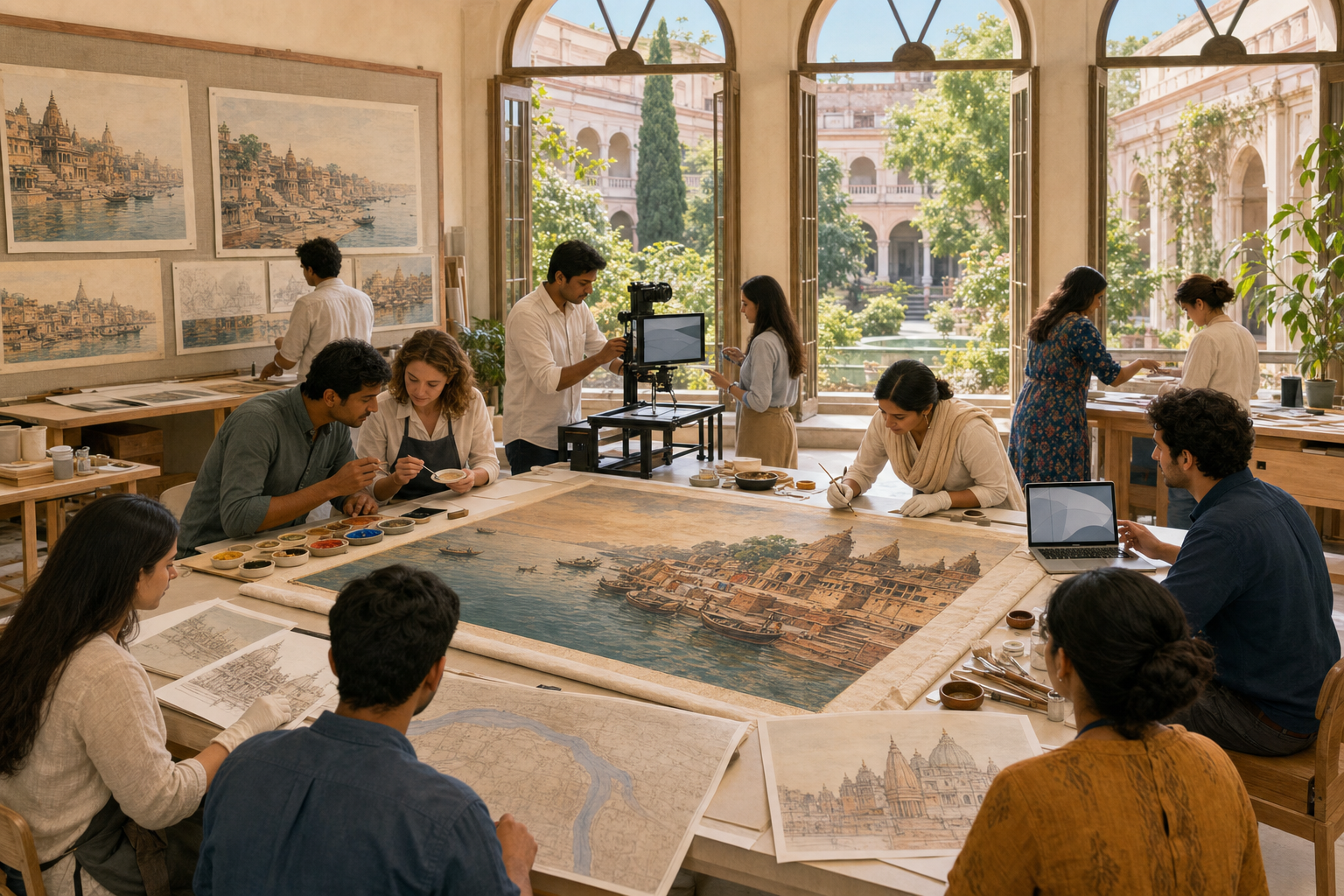
A cultural gesture has a short public life unless someone gives it an institutional afterlife. Museums, universities, temples, community groups, artists, and diaspora organisations do not need to reproduce official diplomacy. They need to create settings in which people can examine the object carefully, understand its religious context, and return for a deeper encounter.
For curators, educators, and cultural institutions
- Verify the object before interpreting it. Confirm the title, artist, date, medium, dimensions, and ownership wherever that information is available. Do not convert assumptions drawn from a photograph into catalogue facts.
- Build interpretation from the visible outward. Start with the ghats, Ganga, boats, steps, architecture, light, and human movement. Then explain how those forms relate to pilgrimage, learning, liberation, memory, and daily worship.
- Compare sacred art through a defined question. An India-Italy programme might examine the use of light in Kashi painting and Italian devotional art, or how sacred architecture directs the viewer’s attention. A narrow formal question produces more understanding than a sweeping exhibition about universal spirituality.
- Create a second encounter. Follow the display with an artist conversation, public lecture, contemplative viewing session, educational programme, or discussion of river and heritage stewardship. The second event is where a diplomatic symbol begins becoming a relationship.
- Measure continuity rather than publicity alone. Record repeat attendance, co-hosted programmes, translated educational material, and whether participants return through another organisation. A widely shared photograph shows reach; continuing participation shows depth.
For Dharmic and diaspora organisations
Living institutions make cultural memory durable. The Italian Hindu Union and local ISKCON centres, for example, provide settings for festivals, lectures, kirtan, and education beyond official meeting rooms. Their value is not merely that they preserve identity. They allow neighbours to encounter Dharmic traditions through people, practices, music, study, service, and hospitality.
- Lead with accurate Hindu context. Explain why Kashi and the Ganga matter within Hindu sacred geography before expanding the conversation.
- Invite distinct Dharmic voices. When Buddhists, Jains, or Sikhs participate, let each community describe its own teachings and history. Shared commitments such as compassion, service, and non-violence become more credible when differences are not erased.
- Pair celebration with stewardship. A programme built around the beauty of the ghats should also ask what reverence requires of pilgrimage, river ecology, and heritage protection.
- Prepare material for the host society. Explain unfamiliar Sanskrit terms, identify places on a map, separate verified information from devotional interpretation, and make room for sincere questions. Cultural confidence does not require obscurity.
For the reader sharing the image
If you share the Rome image online, avoid a caption that says only that Indian spirituality has gone global. Give readers four pieces of information: what the painting depicts, why Kashi matters, who created the work, and what continuing India-Italy relationship the moment could support. That small discipline turns social-media pride into cultural literacy.
The next time a cultural gift crosses your screen, do not stop at calling it beautiful or historic. Name the place accurately. Identify the interpreter. Preserve the distinctions among traditions. Then ask which institution, community, or act of stewardship will carry the encounter forward. That is how a painting in Rome can become more than an official photograph: it can become a durable invitation to know Bharat through attention rather than stereotype.
References
