

You may be trying to answer an uncomfortable question: if a person belongs to a group causing harm, does helping that person betray your own community? Bhai Kanhaiya’s example gives you a precise answer. Relieve the immediate suffering without surrendering your judgment about injustice.
That is the discipline of impartial seva. It directs care by need rather than affiliation. It does not ask you to pretend that every cause is equally just, or to place yourself in avoidable danger. It asks you to keep principled resistance from turning into dehumanization.
Key takeaways
- Impartial seva serves the person in need without making identity, faction, caste, creed, or political loyalty the price of assistance.
- Caring for someone does not mean endorsing that person’s conduct or accepting the justice of that person’s cause.
- Impartiality is not identical distribution. When resources are scarce, greater urgency can properly receive greater assistance.
- Compassion must remain competent. In an emergency, summon trained responders and do not attempt medical procedures or enter active violence beyond your training.
- The most reliable seva follows a rule decided before tempers rise: who will be served, how need will be prioritized, and which safety boundaries will apply to everyone.
What happened at Anandpur, and what the Guru clarified
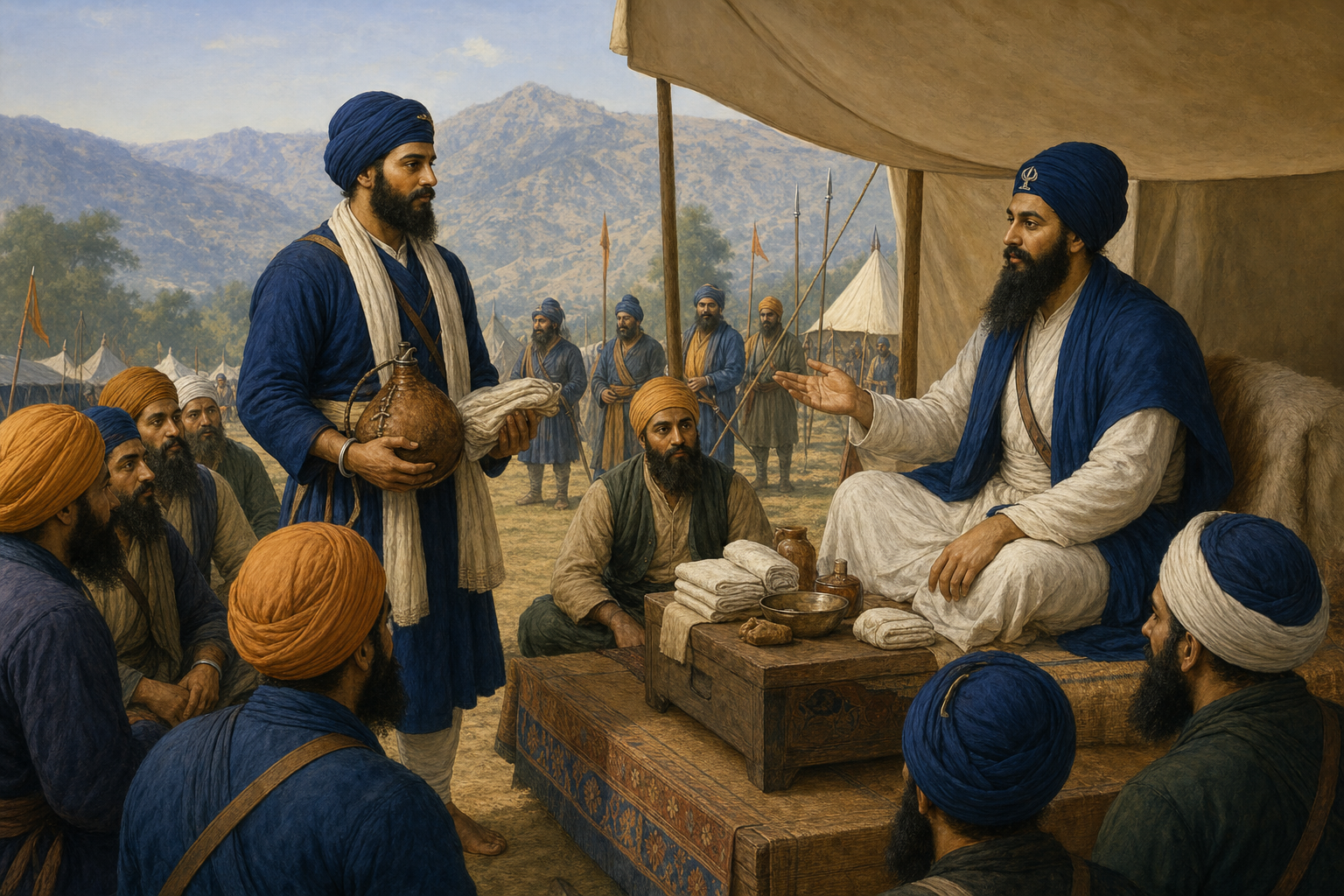
The remembered setting is the prolonged conflict around Anandpur Sahib in the early eighteenth century. Bhai Kanhaiya moved among injured combatants with a mashk, a traditional water-skin, and gave water to wounded Sikhs, Mughals, and Afghans without separating them by allegiance. On a battlefield, water was not a ceremonial offering. It was immediate, life-sustaining relief.
Some Sikhs feared that this aid could revive opponents who might fight again. They brought their concern to Guru Gobind Singh. When questioned, Bhai Kanhaiya explained that he was not seeing partisan labels in the injured faces; he was seeing the same Divine radiance. The Guru did more than approve the sentiment. He equipped Bhai Kanhaiya with balm and the means to dress wounds, extending the seva from relief of thirst to practical healing.
This sequence matters. A complaint was heard, the moral conflict was made explicit, and leadership clarified the community’s standard. Guru Gobind Singh did not treat compassion as a private eccentricity that could be tolerated when convenient. He gave it a mandate and the tools required to continue.
The decision also clarified the sant-sipahi, or saint-soldier, ideal. The Khalsa could resist oppression while refusing cruelty toward a person who was wounded and vulnerable. Martial courage and mercy were not rival obligations. Mercy kept courage anchored to dharma; courage prevented mercy from becoming passive acceptance of injustice.
Traditional accounts differ over some biographical dates, places, and later details. The stable center of the memory is the battlefield seva, the concern raised before the Guru, and the affirmation of care without discrimination. You do not need to force uncertain precision onto the sakhi to receive its demanding ethical lesson.
Impartial care does not mean moral confusion
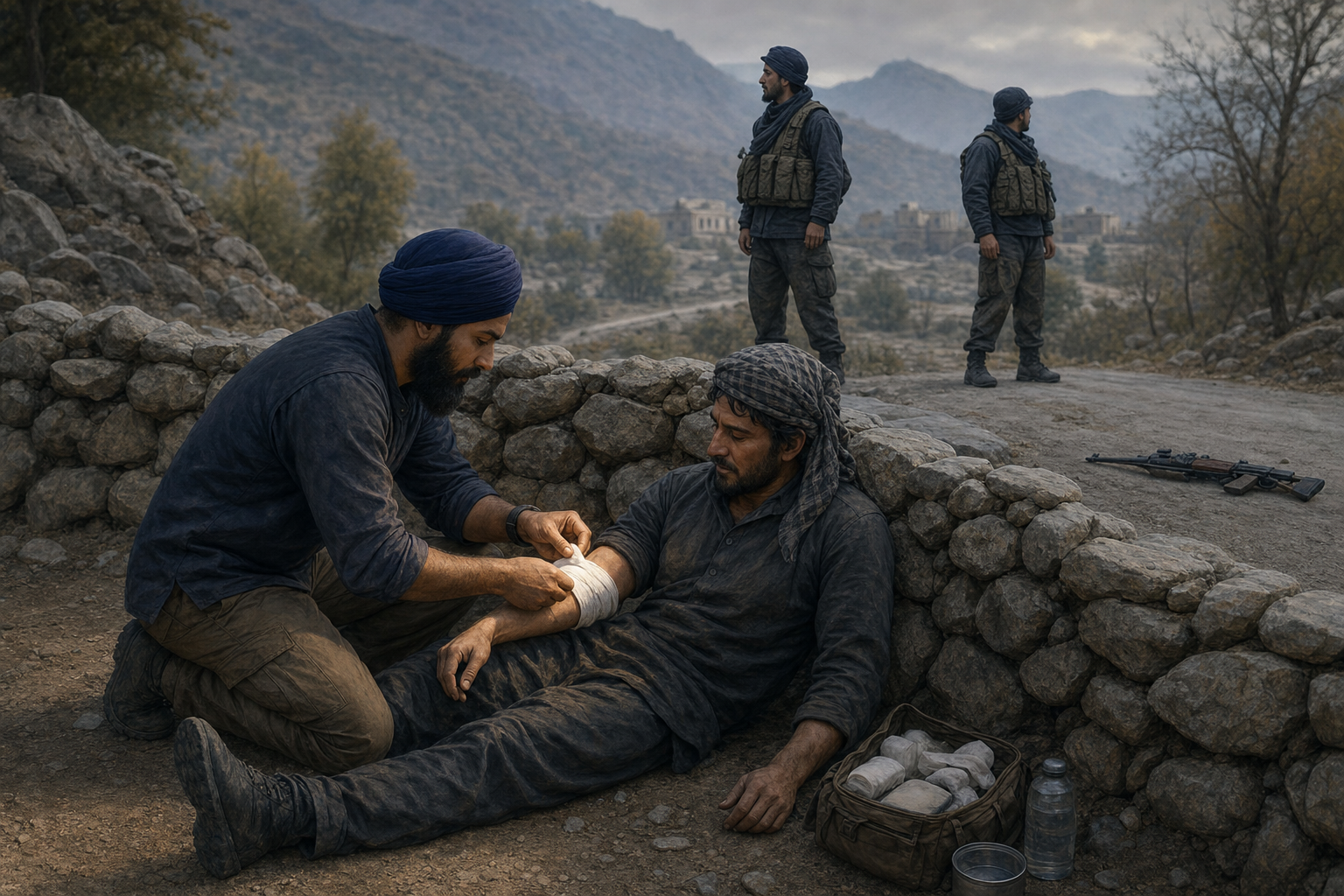
The hardest misunderstanding is that helping an adversary somehow declares the adversary innocent. It does not. Impartial seva and moral judgment answer different questions. Seva asks who is suffering and what can safely relieve that suffering. Justice asks what was done, what must be stopped, and how responsibility should be established.
- Separate the person from the conduct. You can protect a person’s life while firmly condemning that person’s harmful actions.
- Separate relief from allegiance. Food, water, shelter, or access to qualified medical care need not purchase loyalty or signal political agreement.
- Separate urgency from accountability. Immediate danger may need attention now; investigation, restraint, and consequences can proceed through their proper processes.
- Separate equal dignity from identical allotments. Impartiality means using the same need-based rule for everyone. It can require giving scarce help first to the person in greatest danger.
Suppose someone who has used hateful language suffers a medical emergency at a public gathering. Calling emergency responders and making room for qualified care does not erase the hateful conduct. The speech can still be documented, challenged, and addressed. The emergency should not become an opportunity for punishment by neglect.
The same distinction applies during disaster relief. A person threatening volunteers may need to be removed from a distribution area by trained security or the appropriate authorities. If that person later qualifies for relief under the same need-based rules as everyone else, denying food because of identity or opinion would turn assistance into factional reward. Safety boundaries remain firm; human dignity remains intact.
Impartial seva is therefore neither softness nor strategic blindness. It is disciplined control over the point at which legitimate opposition can decay into vengeance. Bhai Kanhaiya did not decide which army was right by inspecting the wounded. He recognized that incapacitated suffering made a different claim upon him.
Several dharmic paths train the same moral reflex
Bhai Kanhaiya’s vision is distinctly rooted in Sikh dharma. Ik Onkar places Oneness before the divisions through which the ego sorts human beings. Sarbat da bhala directs prayer and action toward the welfare of all. The scriptural teaching na ko bairi, naahi begana, commonly understood as recognizing neither enemy nor stranger, trains the Sikh to resist enmity at the level of perception.
Other dharmic traditions approach this discipline through their own vocabularies. Hindu thought invokes Vasudhaiva Kutumbakam and the vision of the One in living beings. Buddhism cultivates karuna and metta, compassion and loving-kindness directed beyond preference. Jain dharma joins ahimsa with anekantavada, teaching restraint from harm alongside humility about the limits of one’s viewpoint. These are related civilizational resources for protecting dignity across boundaries, though they are not interchangeable doctrines.
That distinction is useful when you organize interfaith seva. Unity does not require pretending that Sikh, Hindu, Buddhist, and Jain teachings are identical. Let each community explain service in its own spiritual language, then agree on one operating rule: aid will be based on need, no religious identity test will be imposed, and no distressed person will be pressured to participate in worship as a condition of help.
Shared action is often stronger than abstract declarations of tolerance. A jointly staffed hydration point, langar, shelter desk, or supply station lets people encounter dharmic solidarity as a dependable practice. The public learns who you are from the person you serve when serving that person brings no social advantage.
A practical test for impartial seva
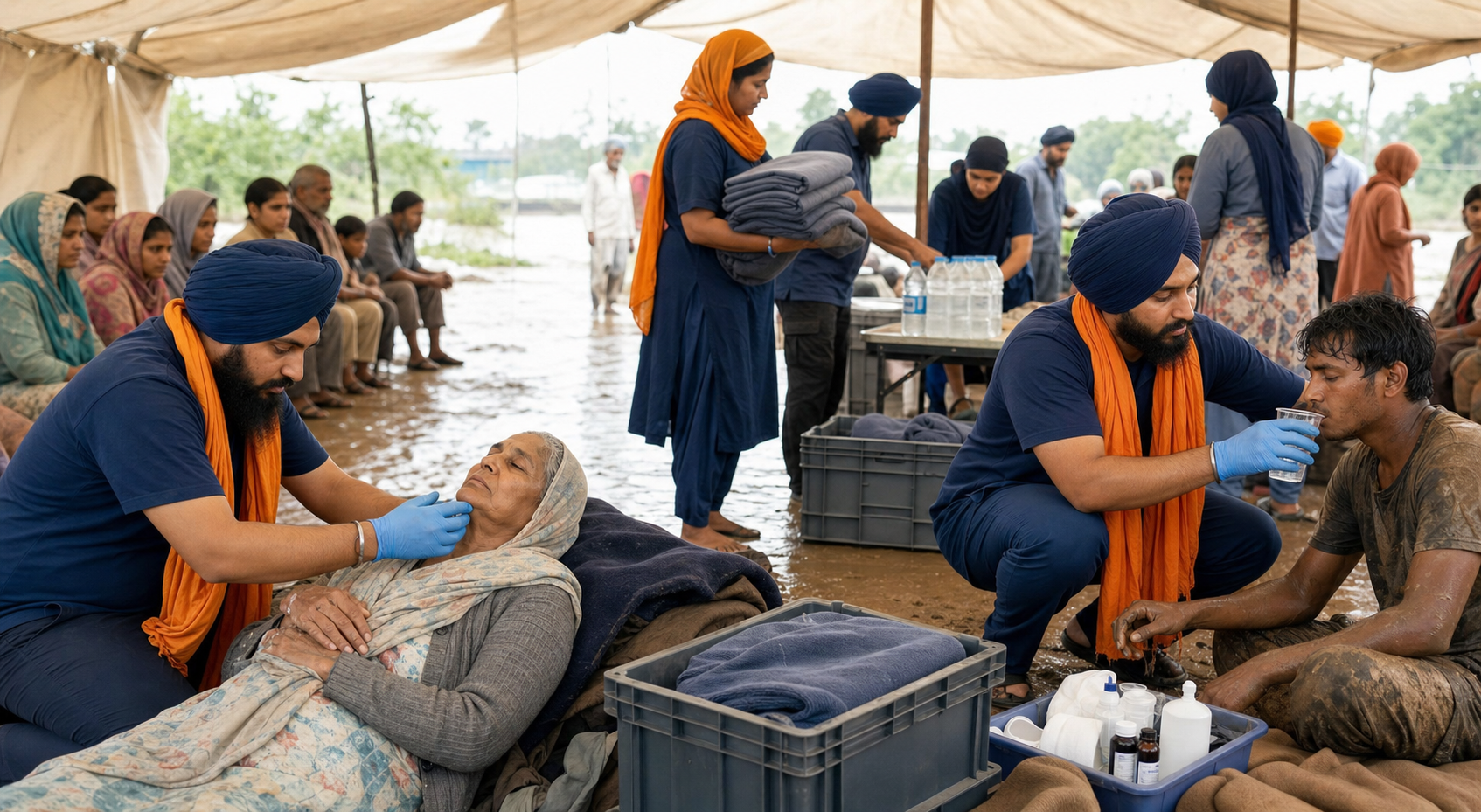
Good intentions are least reliable when fear, anger, and group pressure are highest. Use the following questions before you act. They turn Bhai Kanhaiya’s insight into a rule you can apply at a gurdwara, mandir, relief site, neighborhood dispute, workplace, or public event.
Five questions to use in the moment
- Is there immediate danger? If life or physical safety may be at risk, contact local emergency professionals. Do not delay urgent care for an ideological argument, enter active violence, or perform procedures beyond your training.
- What is the actual need? Name the concrete problem before reacting to the person’s label. The need may be qualified medical attention, safe evacuation, shelter, translation, transport, a phone call, or access to a relief queue.
- Would you apply the same rule to your own side? Reverse the identities. If your decision changes while the need stays the same, in-group bias is probably controlling the response.
- Can you relieve suffering without supplying a means of further harm? Access to care is different from access to weapons, confidential information, vulnerable people, or institutional power. Provide the first without casually granting the second.
- Could you state your rule publicly? A defensible rule sounds like this: we assist according to urgency and vulnerability, and we apply the same safety limits to everyone. If the real rule depends on surnames, clothing, sect, slogans, or party affiliation, it is not impartial seva.
This test also corrects a common mistake about equal treatment. If one person needs routine assistance and another faces an urgent threat, handing both the same quantity of help may look even-handed while ignoring reality. The battlefield logic associated with Bhai Kanhaiya points toward care ordered by the urgency of the wound rather than the identity of the wounded. In an actual medical setting, trained clinicians should make clinical triage decisions.
Build a repeatable service rule
Bhai Kanhaiya’s legacy did not remain a single inspiring moment. The Sevapanthi tradition carried service into water stations, rest houses, care for travelers, and relief networks. That institutional turn contains a practical lesson: people should not have to depend on whether a volunteer happens to feel generous under pressure.
- Choose one defined service. Start with a hydration station, community meal, supply desk, shelter referral team, or first-aid point staffed by appropriately trained people.
- Publish the eligibility rule. State plainly that assistance is open to anyone within the service area and is not conditioned on religion, caste, nationality, faction, or political agreement.
- Set the priority rule before scarcity arrives. Use observable need, urgency, and vulnerability. Do not let donors, influential visitors, or members of the organizing community silently jump the queue.
- Assign roles. Name who handles intake, supplies, qualified care, safety concerns, translation, and referrals. A compassionate crowd without roles can still become chaotic.
- Prepare the material means. Check drinking-water supply, food handling, accessibility, contact numbers, transport options, and the condition of any first-aid materials before opening the service.
- Review exclusions afterward. Record who was turned away, who waited longest, what ran out, and whether the stated rule was applied consistently. Correct the procedure rather than defending every decision.
Contemporary forms can include hydration points during dangerous heat, interfaith langar for displaced families, and properly staffed mobile care during a crisis. The visible activity matters, but the beneficiary rule matters more. A service carrying dharmic symbols while quietly screening recipients by faction would preserve the appearance of seva and abandon its substance.
Before your next community event, choose the boundary at which bias is most likely to enter: the queue, the volunteer team, the distribution list, or the response to a hostile person. Write the rule now, give someone responsibility for enforcing it, and test it by reversing the identities involved. That small act of preparation is how seeing no enemy becomes more than an admired memory.
References
- SikhNet – Bhai Kanhaiya, the Sikh Water Bearer: Radical Compassion That Saw No Enemy
- SikhNet – Bhai Kanhaiya Ji: Sevapanthi Saint Who Healed Friend and Foe, Inspiring Interfaith Unity
