
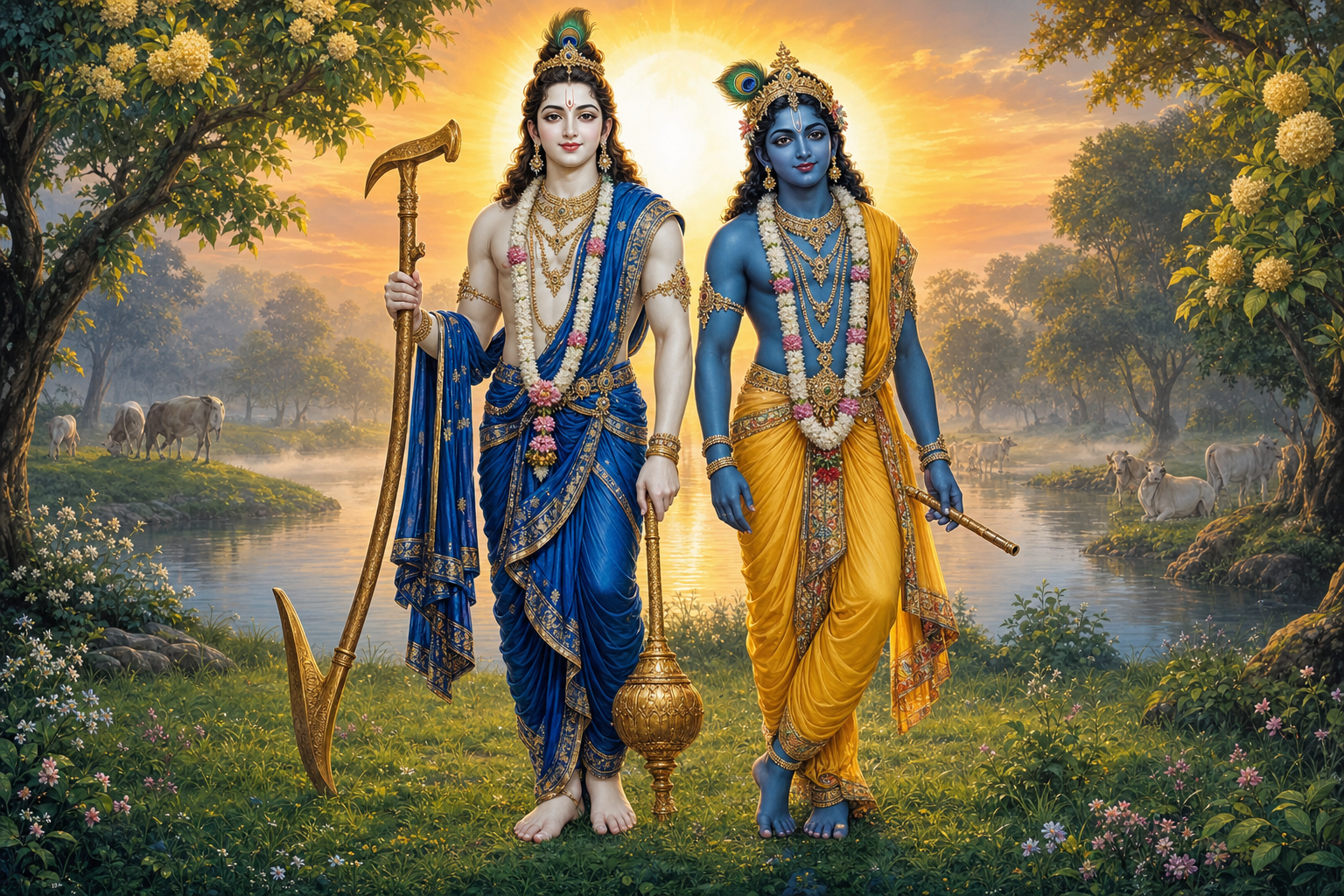
When you meet Balarama in a temple painting or festival alankara, the blue can be easy to misread. Is Balarama himself blue, as Krishna often appears, or is blue the color of his clothing? The distinction matters because the image teaches through contrast.
In the familiar Bhagavata arrangement, Balarama is fair in complexion and dressed in blue, while Krishna is dark and dressed in yellow. Once you see that pairing clearly, Balarama’s blue becomes more than a decorative choice. It shows you how strength can remain calm, how authority can support rather than dominate, and how disciplined power becomes seva.
Key takeaways
- Balarama’s blue usually belongs to his garment, not his complexion; his form is traditionally described as fair or white.
- The color works relationally. Balarama’s fair-and-blue appearance complements Krishna’s dark-and-yellow appearance.
- Blue gives a visual mood of depth, composure and restraint to Balarama’s strength.
- His identities as Ananta Sesha, the adi-guru and Sankarshana add the ideas of support, disciplined knowledge and inner consolidation.
- His plough prevents the symbolism from becoming merely abstract: strength must cultivate, nourish and sustain life.
- You can use the image as a practical test before acting: cool the reaction, clarify the duty and direct your strength toward service.
Read the whole image, not the color in isolation
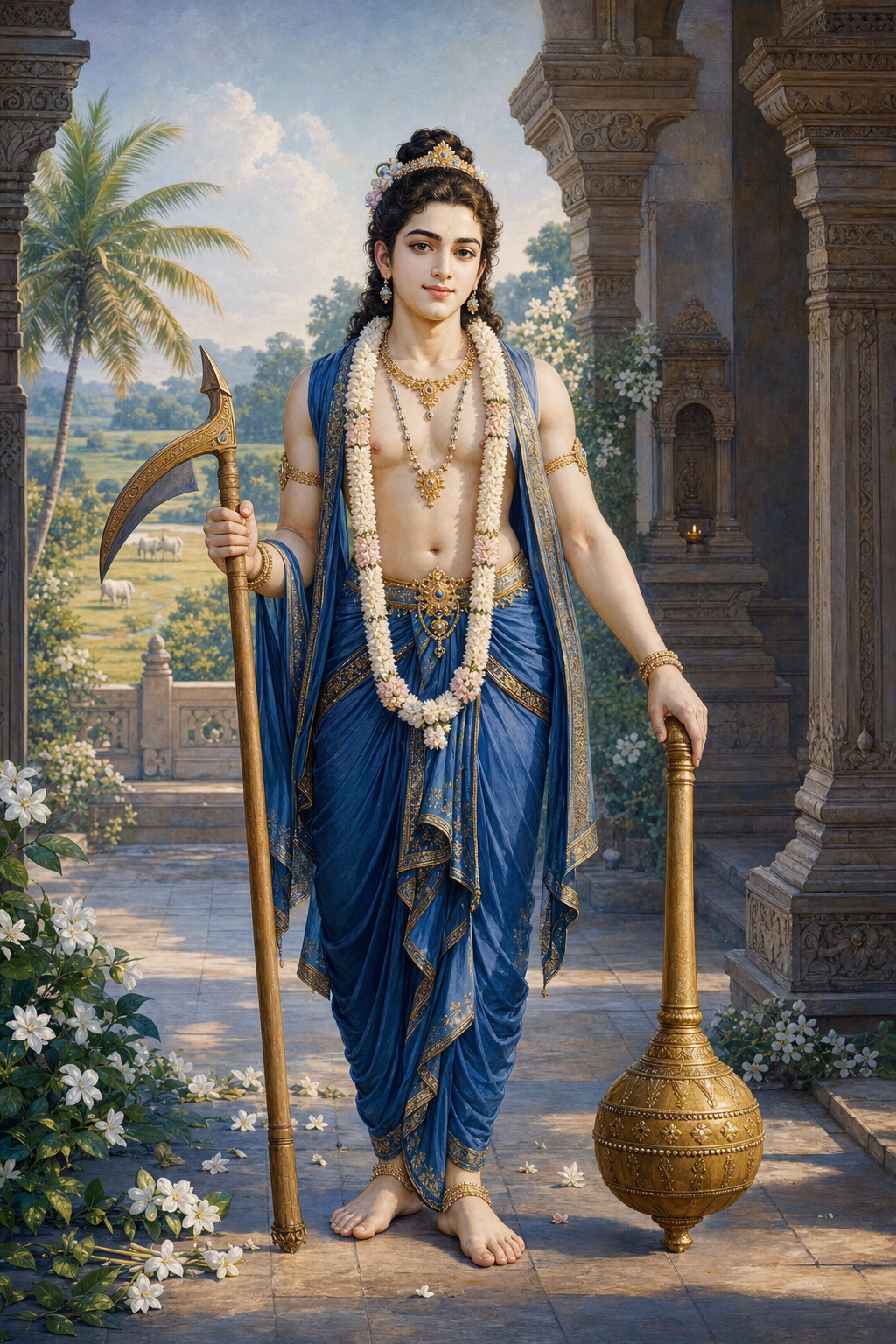
The Sanskrit color terms establish the first distinction. Sveta-varna indicates Balarama’s fair or white complexion, while nila-vastra describes deep-blue or indigo clothing. Krishna is syama, a dark hue often compared to a rain-bearing cloud, and his yellow garment is pita or pitambara. Blue is therefore not simply a label attached to Balarama. It is one part of a deliberately balanced visual relationship.
The Bhagavata Purana, especially the narrative world of Skandha 10, supplies an important foundation for this iconography. The Vishnu Purana and Harivamsa also belong to the textual memory behind Balarama’s recognizable form. Paintings, textiles and temple adornment later made the color contrast immediately visible, even to a devotee who had not studied the Sanskrit descriptions.
This helps explain why color must be read differently in a stone sculpture and a painted image. An early stone figure cannot preserve the color of a garment. You identify Balarama there through form, attributes and context. In a painting or dressed murti, the textile can carry part of that identifying work.
When you encounter an unfamiliar image, use four cues together:
- Complexion: Is the figure fair, white or pale rather than dark?
- Garment: Is blue being used for the cloth rather than the body?
- Emblems: Are the plough, pestle or mace present?
- Relationship: Does the figure stand beside Krishna as the elder brother and balancing presence?
This method is more reliable than deciding that every blue element must mean Krishna or that every fair figure must be Balarama. Hindu sacred art speaks through combinations. Complexion, clothing, implements, posture and placement interpret one another.
Regional and festival practice can vary. Balabhadra’s fair form and martial attributes are prominent in the Jagannath tradition of Puri, where blue textiles can appear in festive adornment. Blue vestments also occur within South Indian cycles of alankara. A different garment on a particular day does not invalidate the underlying association. It usually means that another ritual mood, local custom or festival theme is being emphasized.
Blue joins strength, serenity and seva
Balarama is not a gentle figure because he lacks power. His very name foregrounds bala, strength. He bears formidable weapons, is remembered for mastery of the mace and stands within the martial world of the epics. Yet his strength is not presented as uncontrolled aggression. His refusal to fight for either side at Kurukshetra is especially important: power does not have to become partisanship merely because competing sides demand it.
The blue garment cools the visual impression of that power. Deep blue evokes the breadth of sky, the depth of water and the composure of something that can hold movement without being thrown into disorder by it. Against Balarama’s fair form, it inclines the image toward santa-rasa, the contemplative mood of tranquility. White contributes clarity; blue contributes depth and steadiness.
This does not make serenity passive. Balarama’s blue asks whether your power is governed. A calm person may still set a boundary, correct an injustice, carry a heavy responsibility or refuse an unprincipled demand. The difference is that the action proceeds from dharma rather than wounded pride.
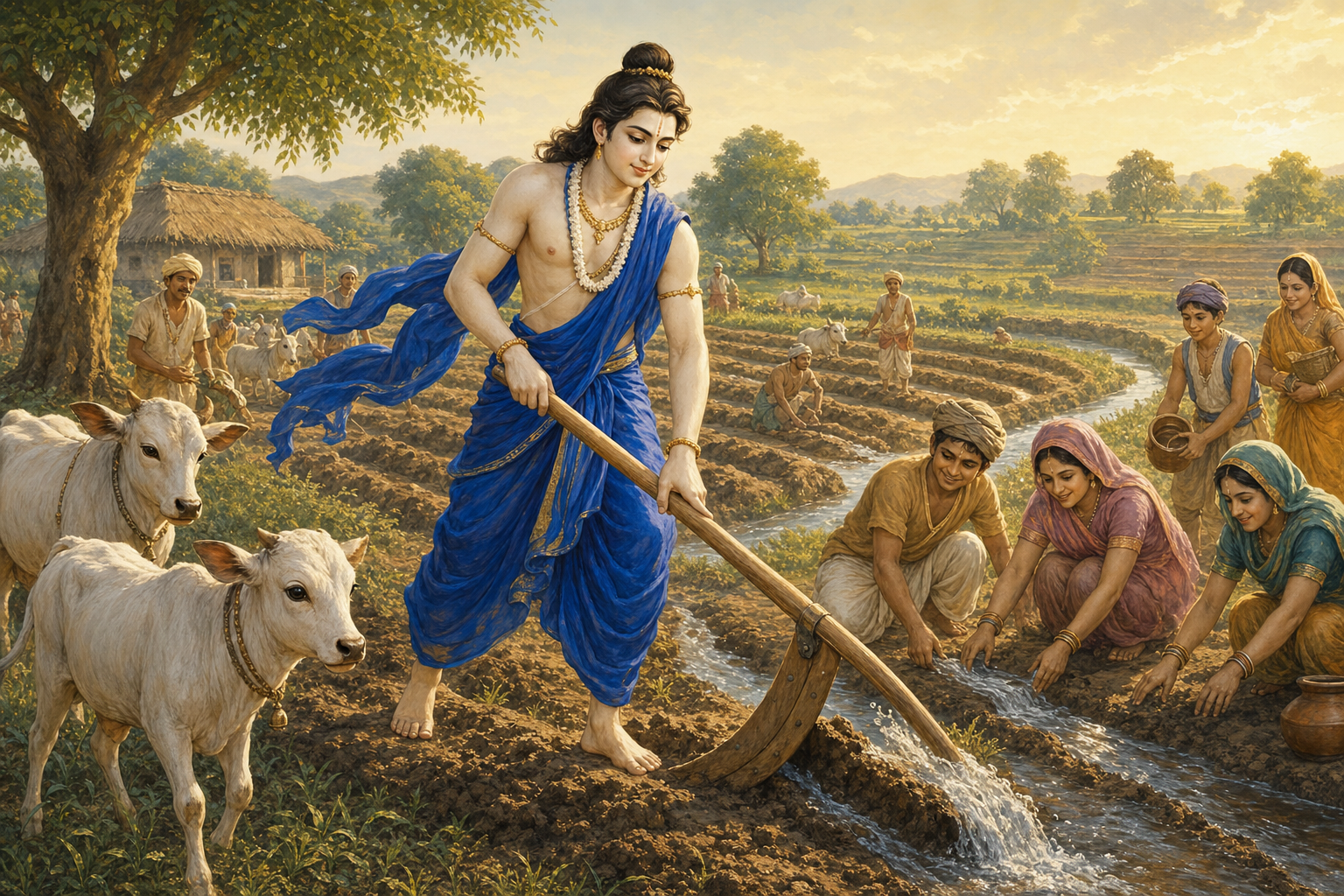
The plough, or hala, brings this lesson down to earth. Agriculture requires strength, patience and the right measure of water. Blue can therefore recall the rain and water that make cultivation possible, while the plough represents the labor that converts that possibility into food. Rain without cultivation does not feed a community; strength without disciplined work does not sustain one.
That agrarian layer gives seva a concrete shape. Service is not only an elevated feeling. It is the work that prepares the ground, bears weight and makes nourishment possible. Balarama’s pestle and plough direct attention toward productive force: power is sacred when it supports life.
Before you correct someone, take a side or exercise authority, let the blue garment put three questions in front of you:
- Is the mind cool? If agitation is choosing the words, pause until you can distinguish duty from reaction.
- Is the principle clear? Ask whether you are defending dharma or merely defending the group, reputation or preference you call yours.
- Who will be supported? Look for the person, responsibility or common good that your strength is supposed to uphold.
These questions turn iconography into an ethical discipline. The point is not to become weak or agreeable. It is to ensure that strength leaves something steadier than it found it.
Related virtues appear elsewhere in the Dharmic family without creating a single universal color code. Deep blues associated with Akshobhya and Bhaisajyaguru in Buddhist iconography can convey imperturbability and healing presence. The blue of the Sikh Nihang tradition carries disciplined valor and protective service. Jain emphasis on restraint and ahimsa likewise insists that ethical power begins with mastery of the self. These are resonances, not interchangeable doctrines. Their shared civilizational insight is that courage becomes trustworthy when calm, discipline and service govern it.
Ananta Sesha, the adi-guru and Sankarshana deepen the color
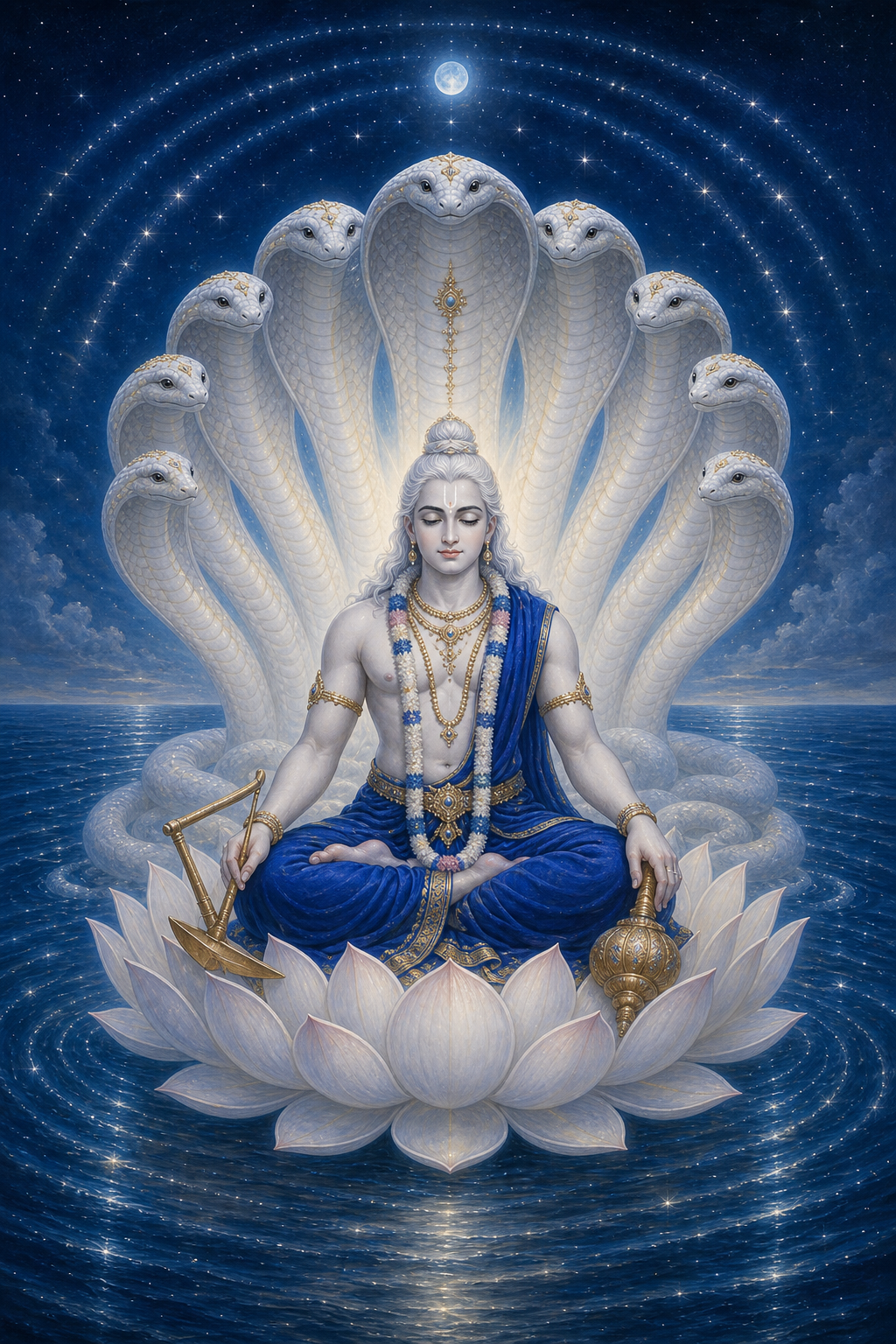
Balarama’s blue carries further meaning when you read it beside his theological identities. He is identified with Ananta Sesha, the unending serpent who supports the cosmic order and upon whom Narayana reposes. The association makes depth and bearing capacity central to Balarama’s character. Like an ocean beneath a vessel or a foundation beneath a structure, support is most successful when everything resting upon it can remain secure.
The marine quality of deep blue fits this identity particularly well. Ananta suggests support without exhaustion; blue suggests depth that cannot be measured at a glance. The cloth does not prove the doctrine by itself, but it makes the doctrine available to the devotional imagination. You see a strong fair form wrapped in the color of depth, and cosmic support becomes visible rather than merely conceptual.
Balarama’s place as the adi-guru adds a second layer. The first teacher is not simply the person who possesses information. The guru steadies the disciple, bears responsibility for transmission and turns knowledge toward transformation. In this reading, blue expresses knowledge held without agitation and authority exercised without spectacle.
This is a useful correction whenever spiritual authority is confused with personal dominance. Guru-tattva is measured not only by how forcefully someone speaks, but by what that guidance enables another person to carry, understand and serve. Balarama’s blue places composure beside strength so that neither can be mistaken for the whole.
Pancharatra theology identifies Balarama with Sankarshana in the catur-vyuha. Different exegetical strands connect this form with functions such as consolidation, discrimination and the quieting of egoic turbulence. The wording varies across traditions, so it would be misleading to turn blue into a rigid doctrinal code. The more careful conclusion is that its cultural mood of depth and restraint harmonizes with the gathering of a scattered mind.
You can keep these layers ordered so that interpretation does not become guesswork:
- Begin with what the image visibly shows: fair form, blue cloth and recognizable emblems.
- Read the relational contrast with Krishna rather than assigning meaning to blue alone.
- Bring in Balarama’s established identities: elder brother, bearer of the plough, Ananta Sesha, adi-guru and Sankarshana.
- Only then ask what discipline the image calls forth in your own conduct.
This sequence respects both tradition and interpretive humility. It keeps personal reflection rooted in the form you are actually contemplating.
Make the blue garment part of your sadhana
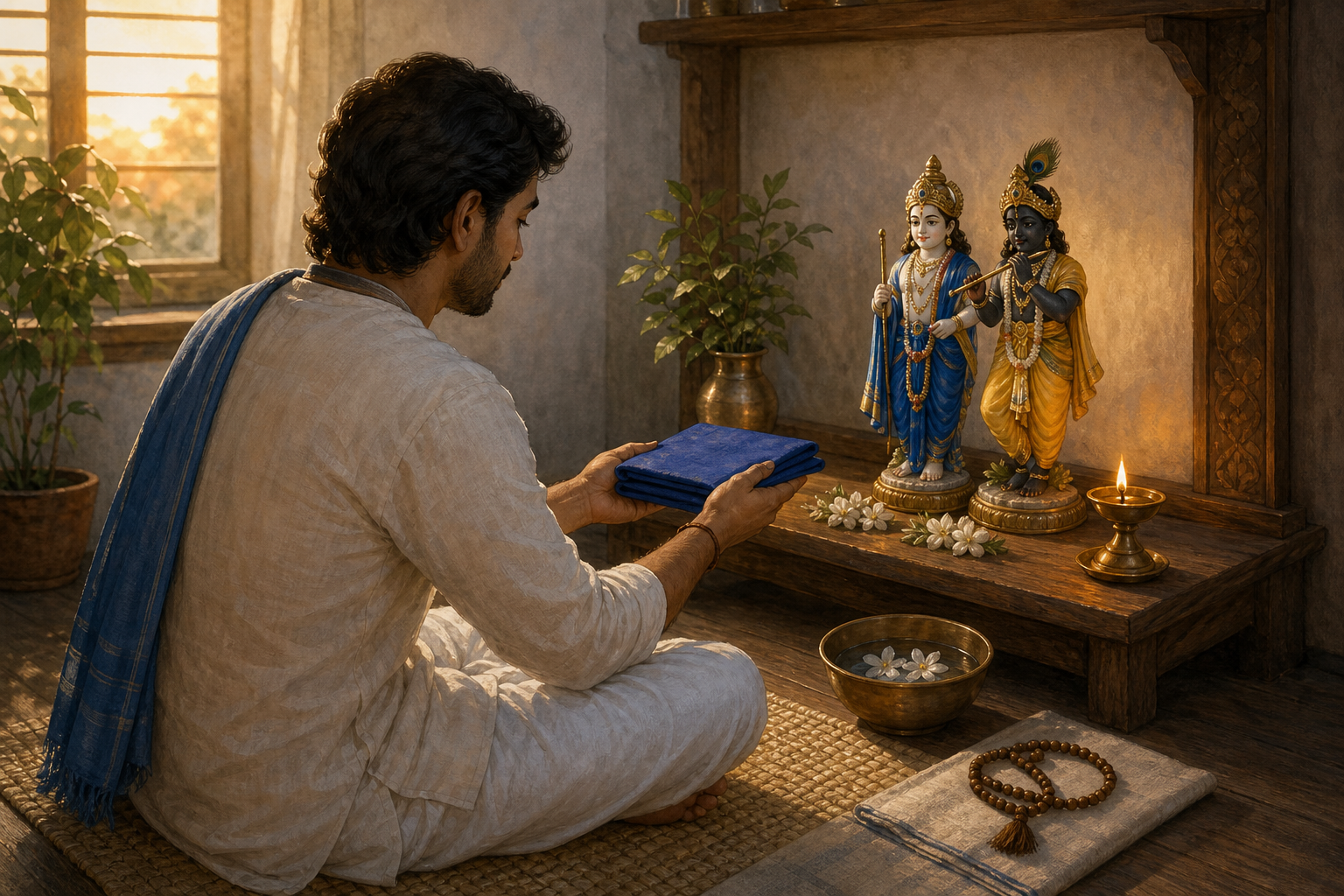
The symbolism becomes useful when it changes what you do after darshana. You do not need an elaborate ritual to begin. You need an image of Balarama, an actual responsibility requiring steadiness and a willingness to convert contemplation into service.
- Look before interpreting. Notice the fair form, blue cloth, posture and implements. Let the complete image settle in attention.
- Rest the gaze on the garment. Breathe naturally. If you already follow a Balarama mantra or a practice given within your sampradaya, keep to that established discipline rather than inventing a new formula.
- Name the turbulence precisely. Is it anger, haste, fear of losing status, resentment about carrying too much, or pressure to choose a side before your duty is clear?
- Recall the supporting form. Let Ananta Sesha remind you that genuine strength bears weight. Let the plough remind you that support requires work.
- Choose one observable act of seva. Complete an overlooked duty, speak a necessary truth without humiliating anyone, uphold a boundary without vengeance, or take responsibility for work that sustains the group.
- Leave contemplation by acting. The blue has done its devotional work when calm attention becomes dependable conduct.
If you help with home or temple adornment, treat blue as a meaningful inheritance rather than a mandatory rule for every occasion. Follow the temple’s ritual calendar and the practice of the relevant sampradaya. When a priest or community uses another palette, ask what festival mood or local tradition is being expressed before declaring the image incorrect.
The same restraint applies when explaining Balarama to a child or visitor. Start with the visible distinction: Balarama is fair and wears blue; Krishna is dark and wears yellow. Then connect Balarama’s blue to calm strength and his plough to sustaining work. Add Ananta Sesha, guru-tattva and Sankarshana only when the listener is ready for those theological layers. A symbol teaches best when each layer has somewhere to rest.
The next time you stand before Balarama, do not stop at the formula that blue means calm. Read the full form, identify the duty in front of you and decide what your strength is meant to support. Let the mind become cooler, the principle clearer and another person’s burden lighter. That is where Balarama’s blue garment passes from symbolism into sadhana.
References
