
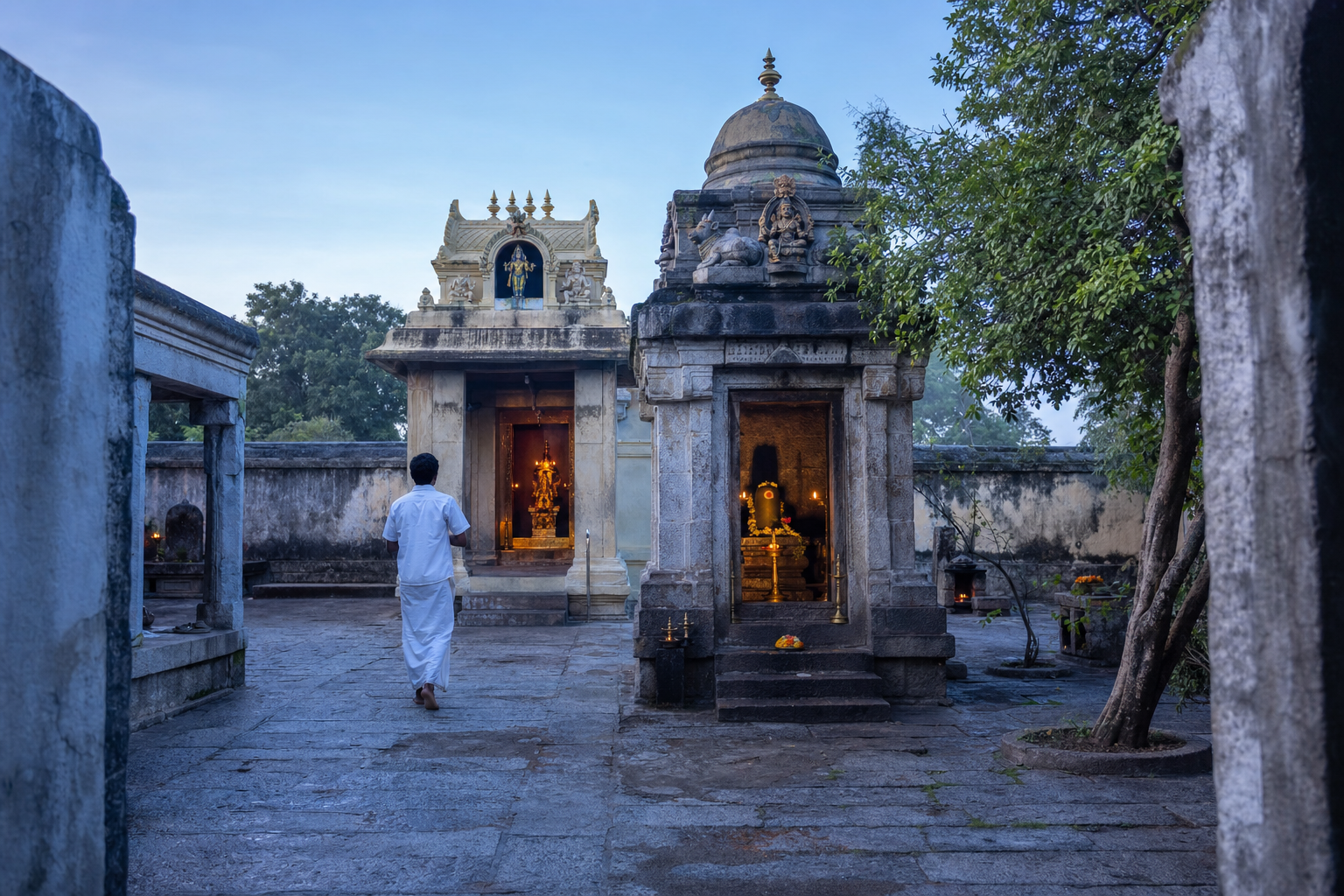
You may have found the name Adhi Kandhanatha Swamy while planning a Murugan pilgrimage and wondered whether Erakaram offers something different from a larger hill or festival temple. It does, but its distinction is quiet: Murugan stands in an independent sanctum immediately behind an adjacent Shiva temple, raising one hand in the fear-dispelling gesture of abhaya.
A useful visit begins when you stop treating this as another shrine to check off a list. Bring one real fear, duty, or decision. Read the relationship between the two sanctums, stand before the raised hand, and leave with one dharmic action you are prepared to take.
See the two sanctums as one theological movement
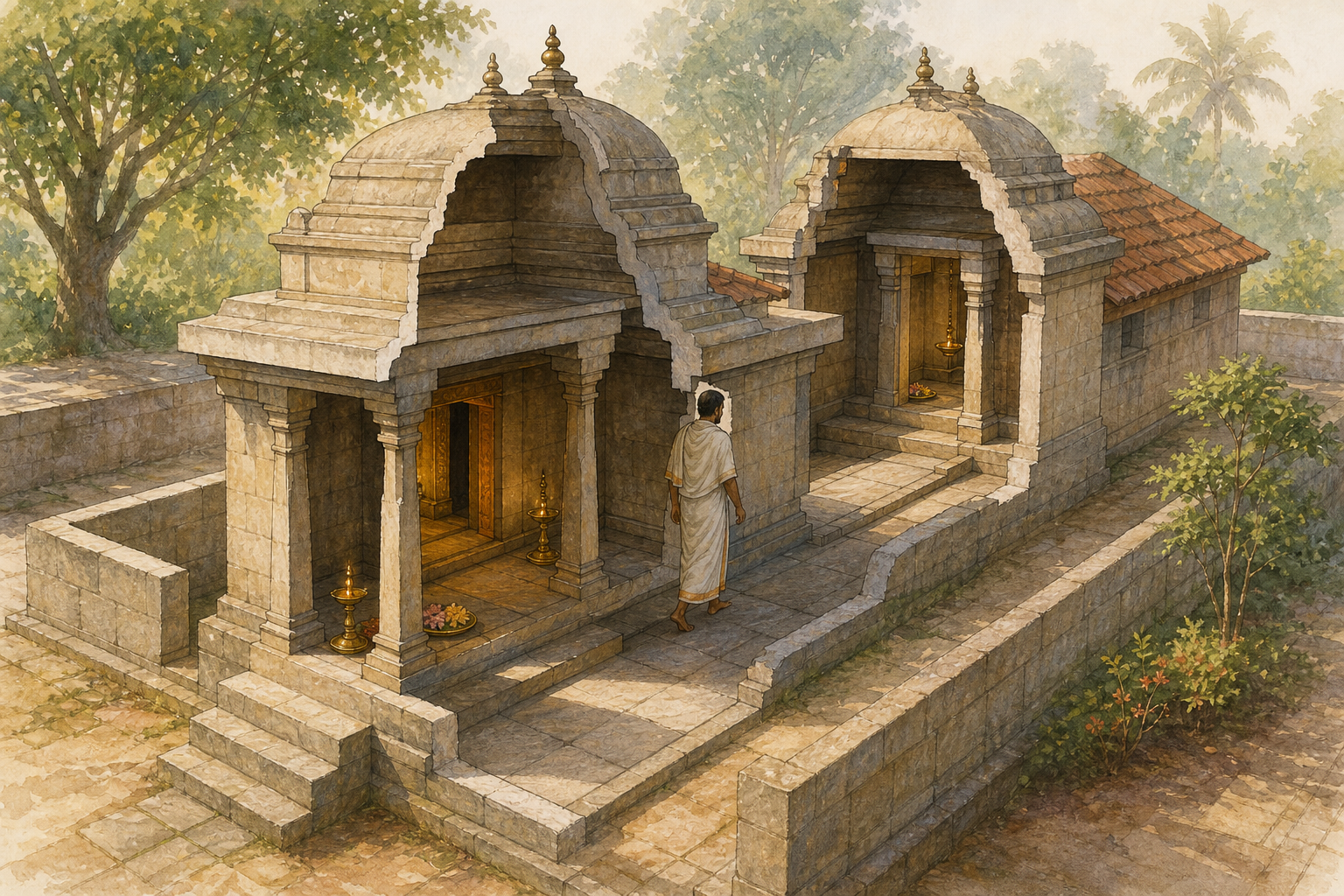
The temple’s defining feature is spatial. The Adhi Kandhanatha Swamy sanctum stands immediately behind the adjoining Shiva temple while remaining a distinct, harmoniously aligned place of worship. That arrangement asks you to see Shiva and Murugan together without collapsing one shrine into the other.
This is the theological world evoked by Somaskanda: Shiva, Parvati, and Skanda understood through divine family, continuity, and complementarity. At Erakaram, Murugan is not merely an ornamental figure placed at the edge of a larger complex. His separate sannidhi gives him a direct devotional presence, while its alignment keeps that presence within a Saiva sacred order.
Pause before entering the Murugan sanctum and notice the axis. Look at how the thresholds, approach, and ritual circulation connect the two sacred spaces. If a priest or local devotee indicates a customary order of worship, follow it. The point is not to impose a private theory on the plan, but to let the plan teach you how familial unity and distinct divine forms can coexist.
The modest prakara, granite base, and functional circulation belong to a temple culture built around continuing worship rather than monumental spectacle. If you arrive expecting a vast complex, you may overlook what matters. Measure this shrine by the concentration of its ritual life and the clarity of its icon, not by the height of a gopuram or the size of a courtyard.
Its chronology requires equal care. The present arrangement is compatible with architectural patterns found across Chola, Pandya, and Nayaka periods, but compatibility is not proof of a particular dynasty or date. A firm construction history would require epigraphic study and a careful reading of successive building phases. Until that work is available, you should not repeat an exact royal attribution merely because the stonework looks old.
Let the abhaya hand reshape the question you bring
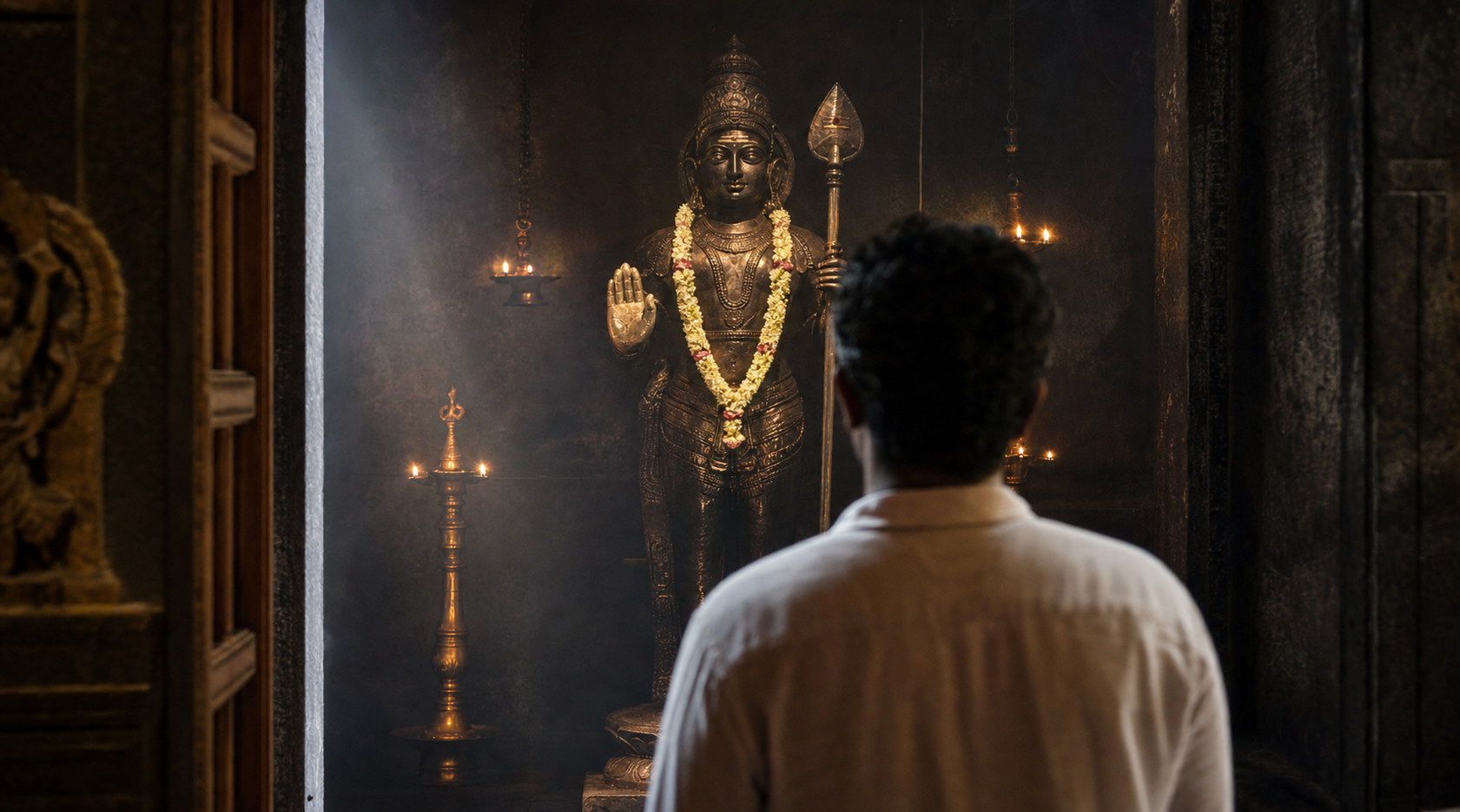
The name offers a devotional key. “Adhi” conveys the primordial or original, while “Kandhanatha” presents Murugan as Kandha, the youthful divine commander, and natha, the lord who guides. The combination holds together ancient protection and disciplined movement. It is not protection from the need to act; it is protection from allowing fear to govern action.
That distinction is visible in the standing deity’s abhaya hastam. The open palm communicates safety and reassurance. Murugan’s wider iconographic world also carries the vel, with its associations of piercing insight, strength, and the defeat of adharma. Abhaya prevents that martial symbolism from being mistaken for aggression. Strength is placed under compassion, and courage is directed toward dharma.
Do not treat the gesture as a transactional promise that every preferred outcome will occur. Read it as an instruction: see the danger clearly, refuse panic, and do the right thing available to you. That makes the darshan useful whether your concern involves family responsibility, work, service, or an inner habit you have avoided confronting.
You can use the following personal practice while remaining attentive to temple custom. It is a method of reflection, not a compulsory temple rite.
- Name one fear precisely. Avoid a vague request to remove every obstacle.
- Ask which duty is already clear even if the final outcome is not.
- Choose one bounded sankalpa: a conversation to begin, an obligation to complete, an apology to make, or a concrete act of seva.
- Look once more at the open palm before leaving and carry that commitment with you.
Arunagirinathar’s association with the shrine adds a second discipline: listening. Thirupukazh hymns combine intricate chanda, musical movement, praise, and moral remembrance. Their value is not confined to performance. Sung communally, they make theology memorable and allow children, elders, trained singers, and ordinary devotees to inhabit the same act of worship.
If a Thirupukazh rendering is underway, listen for its rhythmic order before joining. Follow the community’s pace instead of trying to dominate it. If you do not know the words, attentive silence is a complete form of respect. You can learn a familiar Murugan hymn before a later visit, but do not claim a shrine-specific composition unless its connection to Erakaram has been verified.
Choose quiet darshan or festival worship deliberately
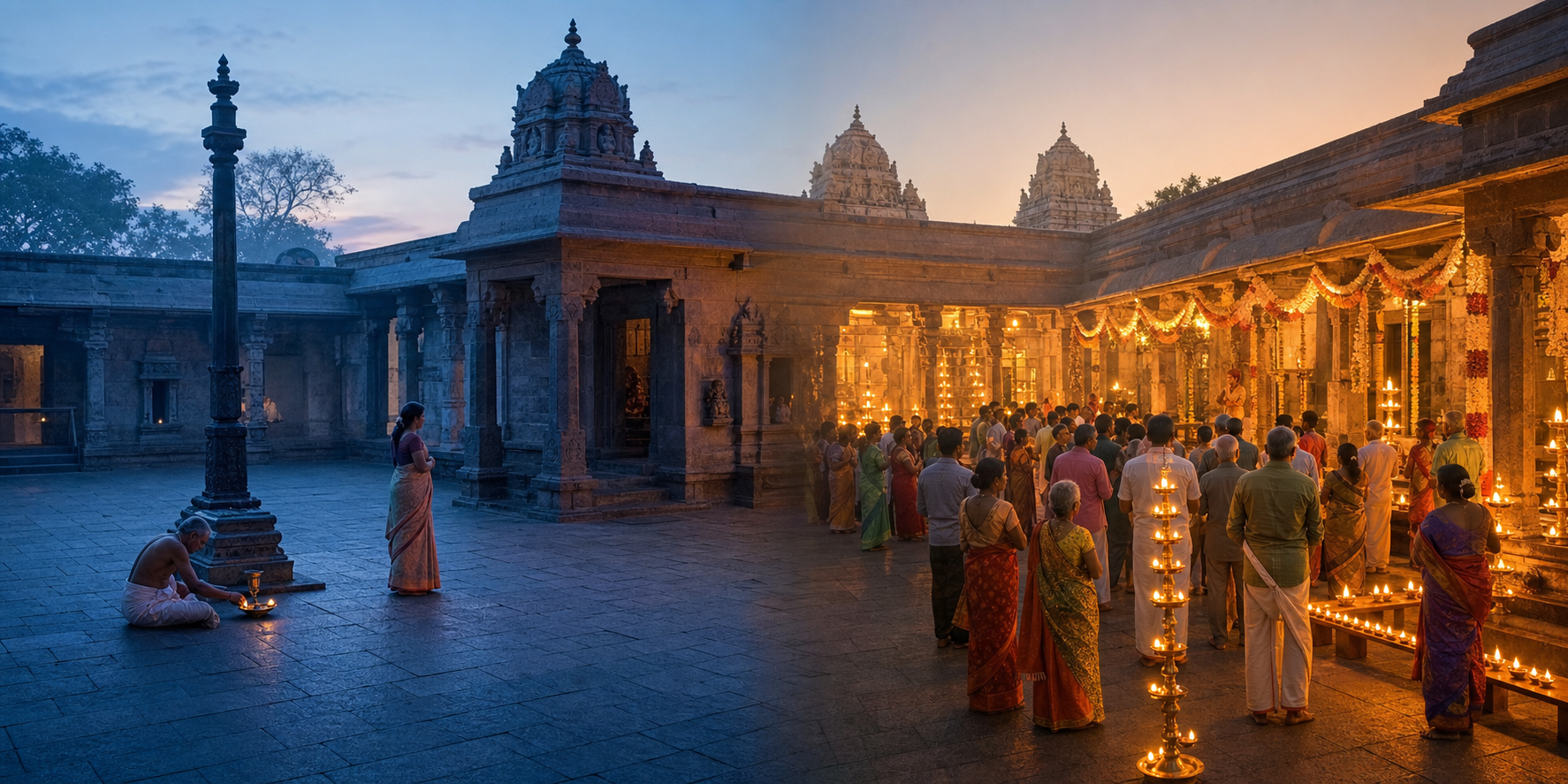
Erakaram participates in the living ritual calendar of Tamil Murugan worship, including abhishekam, alankaram, lamps, archana, and recitation. Your experience will depend greatly on whether you come for stillness or for the energy of collective observance. Neither is inherently superior; they serve different devotional needs.
| Observance | Devotional focus | Choose this setting when |
|---|---|---|
| Skanda Sashti | Murugan’s triumph of dharma and disciplined courage | You are confronting a struggle that requires endurance rather than impulsive force |
| Vaikasi Visakam | The advent of Murugan and spiritual renewal | You want to begin or renew a sankalpa under Murugan’s guidance |
| Karthigai Deepam and Karthigai days | Light, remembrance, deepa-seva, and continuity | You value lamp worship and a visibly communal expression of devotion |
| Thaipoosam | Purification, dedication, and devoted service | You want worship to culminate in disciplined offering and seva |
The major Murugan observances associated with Erakaram include Skanda Sashti, Vaikasi Visakam, Karthigai Deepam, Karthigai days, and Thaipoosam. Festival dates and worship times change with the religious calendar and local arrangements. Confirm the current schedule with the temple community before making a long journey, especially if witnessing a particular abhishekam is central to your visit.
If your purpose is unhurried meditation before the abhaya form, an ordinary worship day will usually suit you better than a major festival. If you want alankaram, shared hymnody, deepa-seva, and a strong sense of inherited community memory, choose a festival setting and accept that private contemplation may be limited.
Once there, use a simple sequence:
- Arrive in respectful attire and lower your voice before entering the inner precinct.
- Observe the relationship between the Shiva and Murugan sanctums before focusing on isolated architectural details.
- Follow local directions concerning the order of darshan, offerings, and access near the sanctum.
- Walk clockwise during pradakshina where the temple route permits it.
- Participate in abhishekam, archana, or recitation only according to the cues of the priest and worshipping community.
- Remain still for a moment after darshan instead of immediately reaching for a phone or beginning a conversation.
- Before leaving, name the specific action through which your prayer will enter family or community life.
Place Erakaram on the wider dharmic map carefully
Murugan’s significance is deeply Tamil, but it is not confined to one regional or sectarian vocabulary. In Sri Lanka, the deity is worshipped at Kataragama as Kataragama deviyo by Hindus and Buddhists. In East Asian Buddhist settings, the related guardian Skanda, often known as Wei Tuo, represents steadfast protection of the Dharma. These resonances make courage, wisdom, vigilance, and compassionate protection intelligible across cultural boundaries.
The right word is resonance, not equivalence. Kataragama worship, Tamil Murugan bhakti, and East Asian Buddhist devotion do not become a single ritual system merely because protective motifs correspond. Nor should Hindu, Buddhist, Jain, and Sikh understandings be flattened into an artificial sameness. The useful comparison lies in the ethical question each community can recognize: how should power be disciplined so that it protects life, truth, and righteous conduct?
You can use this distinction when introducing the shrine to children or visitors from another tradition. Begin with the image itself: Murugan stands as a capable warrior, yet the hand presented to the devotee is open and reassuring. Ask what changes when strength is joined to compassion. That question creates genuine dharmic conversation without pretending that doctrinal differences do not matter.
Erakaram also belongs within a wide textual field. The early Tamil Tirumurukarruppatai, the Kanda-centered traditions associated with the Skanda Purana, and later hymnic works such as Subrahmanya Bhujangam place Skanda-Murugan within enduring conversations about valor, wisdom, devotion, and dharma. These texts illuminate the deity’s broader theological world; they do not, by themselves, prove the date of the Erakaram temple or establish that every work names this particular site.
That restraint matters when you document or share the temple. Label photographs conservatively, never attach an unsupported dynastic date, and ask permission before recording worshippers or oral histories. If an elder shares a sthala-purana, preserve the speaker’s name, the date, and the words carefully while identifying it as oral memory rather than converting it into an unqualified chronological claim.
Heritage care begins with the same discipline. Do not scratch stone, lean burning lamps against architectural surfaces, or apply substances to old stone or stucco on your own initiative. Conservation belongs to authorized custodians working with the temple community. A pilgrim’s first contribution is restraint, followed by accurate remembrance and respectful transmission.
Key takeaways for your visit
- Approach the Shiva and Murugan sanctums as related sacred spaces, while respecting the independent identity of Adhi Kandhanatha Swamy’s sannidhi.
- Read abhaya as courage for dharmic action, not as a guarantee that every difficulty will disappear.
- Choose an ordinary day for stillness or a major Murugan observance for alankaram, lamps, hymnody, and collective worship.
- Do not assign the temple an exact Chola, Pandya, or Nayaka date without epigraphic evidence.
- Let Thirupukazh teach attentive participation: sing with the community when you can, and listen respectfully when you cannot.
- Protect the shrine through correct etiquette, cautious historical claims, consent-based documentation, and one act of seva after darshan.
Before you travel, decide whether you seek a quiet encounter or festival participation, then confirm the current worship time locally. At the sanctum, do not ask the raised hand to erase every uncertainty. Let it narrow your question to this: what is the next righteous act you can perform without being ruled by fear?
Do that act after darshan. That is how Adhi Kandhanatha Swamy Temple becomes more than another pin on a pilgrimage map.
References
