
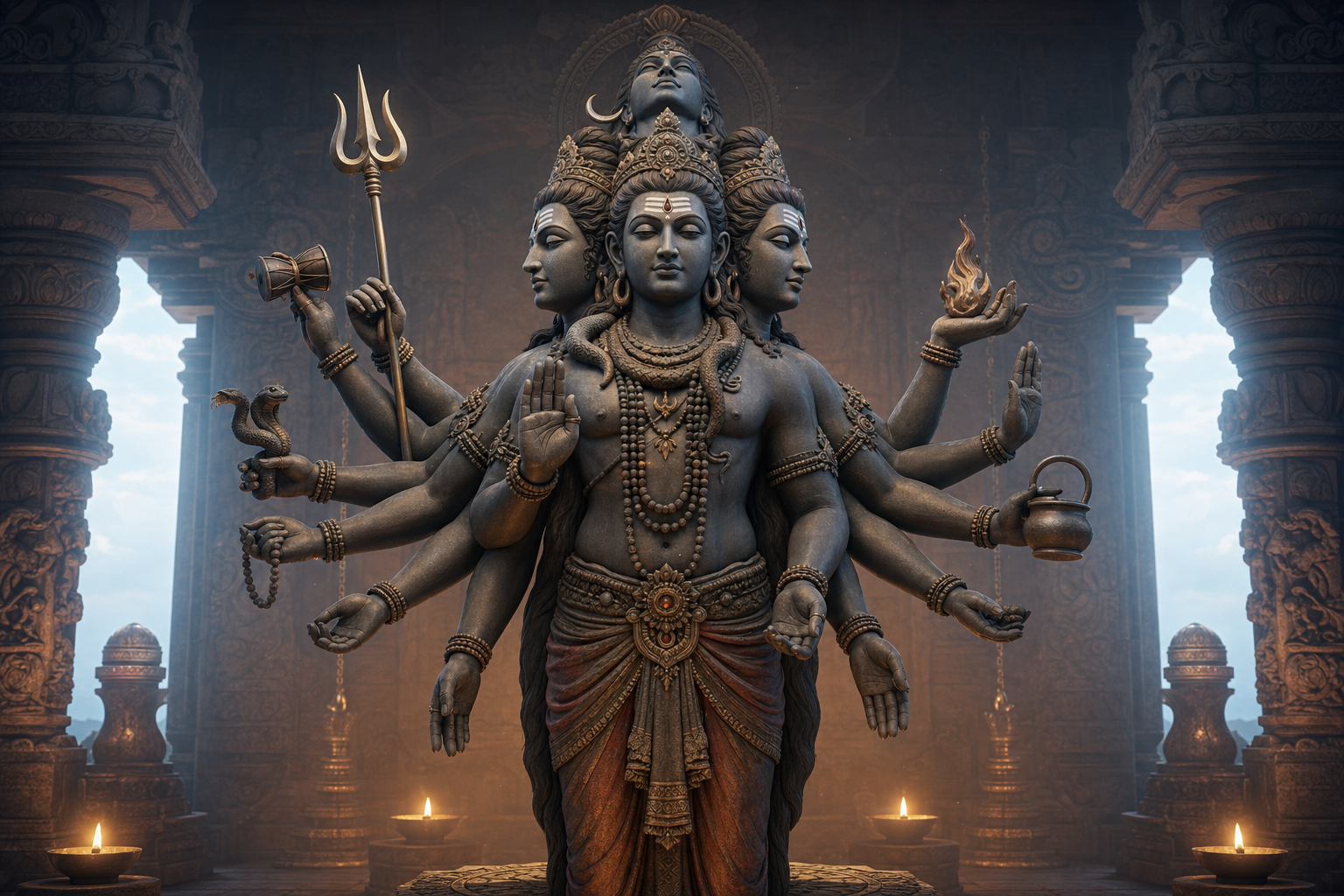
You are standing before a Shiva murti with faces turned toward different directions and ten hands holding what looks like an entire treasury of sacred objects. Your immediate question is probably simple: what are you actually meant to see?
Don’t begin by identifying every implement. Read the image in three passes: the five faces establish the cosmic field, the ten arms show the reach of divine power, and the individual objects explain how that power operates. This order turns an apparently crowded image into a coherent map of one consciousness acting in many ways.
Confirm the form before interpreting its details
The name Dashabhujeshwara joins daśa, meaning ten, bhujā, meaning arm, and īśvara, the Lord. Pañchamukha means five-faced. The first name identifies the ten-armed dimension of the form; the second identifies its fivefold facial geometry. In the complete Dashabhujeshwara visualization, the two dimensions work together.
They shouldn’t be treated as interchangeable labels for every multifaced or many-armed Shiva image. A Pañchamukha liṅga can express the five-faced doctrine without depicting ten arms. The celebrated Maheshmurti at Elephanta is triple-faced, so it belongs to the wider history of Shiva’s multifaced iconography but isn’t literally a five-faced, ten-armed Dashabhujeshwara. Identifying the form accurately matters because otherwise a useful symbol becomes a rigid checklist imposed on the wrong murti.
Use four checks when you encounter an unfamiliar image:
- Look for directional faces, not merely several faces arranged for visual symmetry. In a frontal photograph, some cardinal faces may be hidden, while the upward-facing Īśāna can be difficult to see.
- Count the arms only after accounting for the angle of the image. Ten arms support the Dashabhujeshwara identification, but regional works and different iconographic manuals don’t always use an identical arrangement.
- Look for recognizably Shaiva attributes such as the triśūla, ḍamaru, mṛga, akṣamālā or Pināka. No single object proves the identification, and not every valid murti carries the entire set.
- Read the setting. A freestanding murti, a relief and a mukhaliṅga can express related theology through very different sculptural solutions.
Here, canonical doesn’t mean photocopied. The stable element is the theological grammar: one Lord, fivefold manifestation and power extending through the whole field of existence. The number and placement of particular attributes can vary without cancelling that grammar.
The five faces form a sacred compass
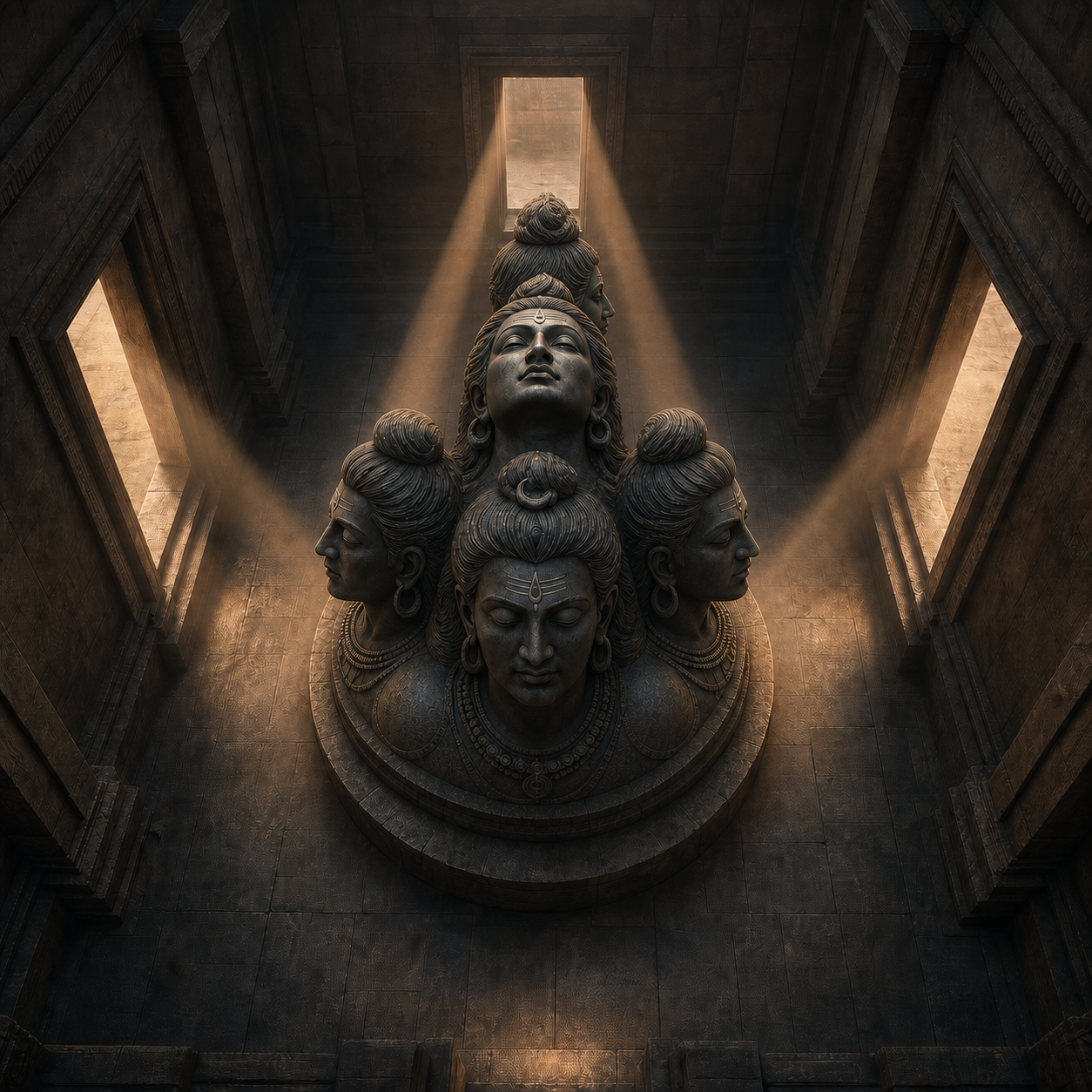
The faces aren’t five independent personalities assembled around one head. They place you inside a mandala. The established directional arrangement in Shaiva Tantra and Śilpa-Śāstra traditions is east, south, north, west and upward:
| Face | Direction | What to notice |
|---|---|---|
| Tatpuruṣa | East | The eastern point from which the standard directional reading begins. |
| Aghora | South | The face occupying the southern quarter of the sacred field. |
| Vāmadeva | North | The northern face, balancing the southward orientation. |
| Sadyojāta | West | The westward face completing the four cardinal directions. |
| Īśāna | Upward | The transcendental apex, not simply another face on the horizontal plane. |
This arrangement is symbolic geometry, not a demand that every sculpture behave like a compass placed on the ground. Temple orientation, the location of the shrine and local sculptural convention all affect what you can physically see. If you want to perform direction-based recitation, confirm the temple’s practice instead of guessing north and south from the apparent position of the faces.
The five faces collectively disclose the Pañcakṛtya, Shiva’s fivefold activity:
- Sṛṣṭi: emanation or the arising of manifestation.
- Sthiti: sustaining what has arisen.
- Saṃhāra: dissolution or reabsorption, not meaningless destruction.
- Tirobhāva: concealment or veiling.
- Anugraha: grace, through which bondage is overcome.
Schools and lineages vary in how they pair individual faces with particular functions and related correspondences. The safe reading is therefore precise but modest: the five faces hold the five acts together. Don’t circulate a universal face-to-function chart unless you know which Āgama, Tantra or paramparā it represents.
That restraint improves the encounter. You no longer have to force one face into a single mood. You can instead notice the deeper claim: arising, continuance, ending, concealment and liberating grace are not disconnected events. They belong to one field of consciousness.
The ten arms describe mastery, not ten separate beings
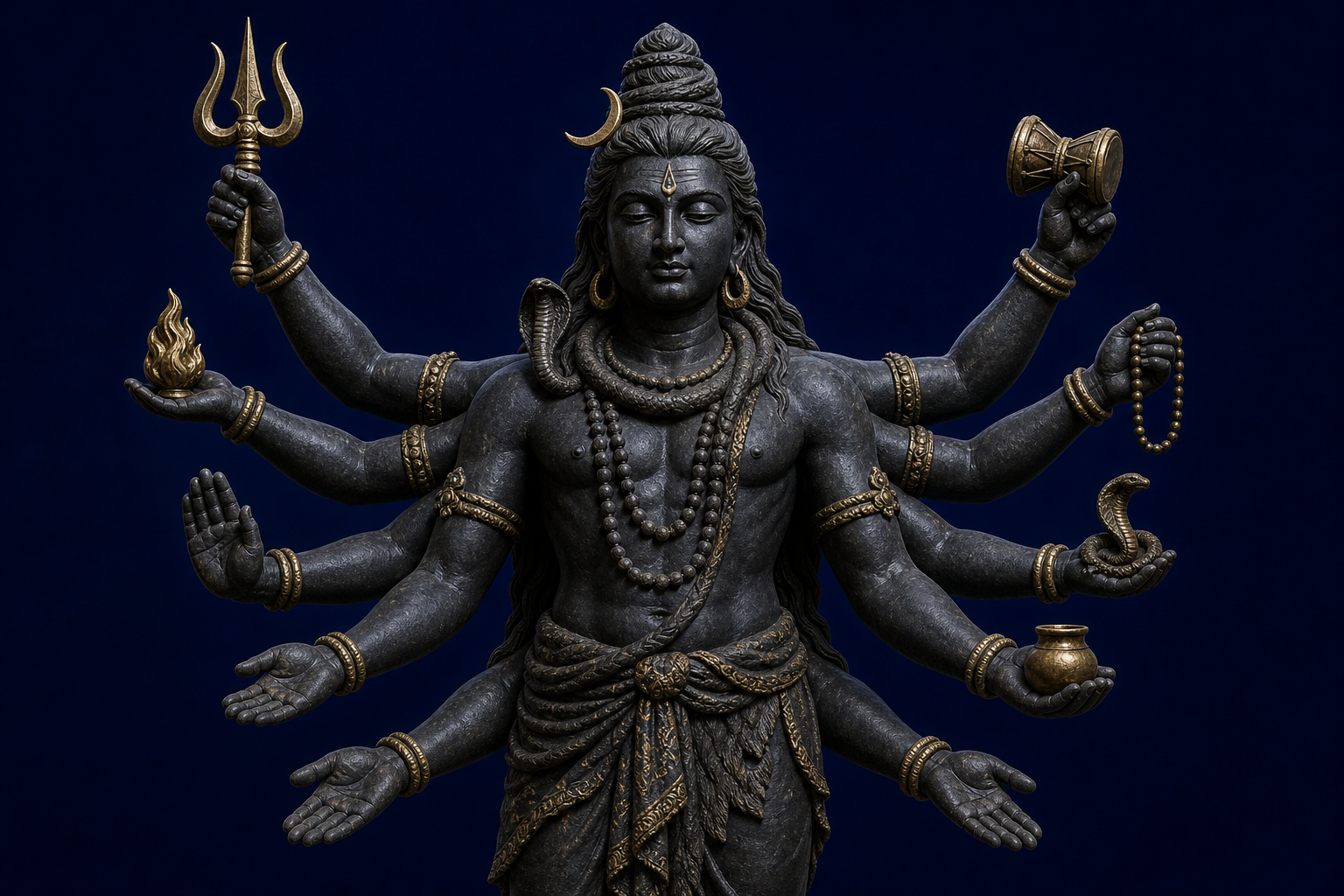
The arms carry two complementary meanings. First, ten signals sovereignty across the daśa-dik, the ten directions. No direction lies outside Shiva’s presence. Second, the number can gather the five jñānendriyas, the faculties through which experience is known, and the five karmendriyas, the faculties through which action is performed. The visual abundance therefore speaks about integrated capacity and mastery, not a multiplication of deities.
Read each implement as a verb
A useful way to avoid getting lost is to ask what each object does. The implements aren’t decorative inventory. They make divine activity visible:
- The ḍamaru establishes rhythm. It directs your attention to ordered cosmic movement rather than static existence.
- The triśūla conveys penetrating discernment and the power to sever bondage.
- The pāśa draws in or restrains, while the aṅkuśa redirects and guides. Read together, they show that spiritual governance can involve both containment and correction.
- The paraśu cuts through inertia. Its force is purposeful rather than uncontrolled.
- The mṛga, or deer, evokes nature brought into serenity under enlightened care.
- The akṣamālā points toward meditative repetition and disciplined attention; the kapāla, or skull-bowl, keeps impermanence within view.
- Pināka and the arrow hold action in readiness. They suggest concentrated, ethically directed will rather than restless aggression.
- Abhaya offers fearlessness, while varada communicates giving, blessing and grace. These open-handed gestures often provide the emotional key to the entire murti.
These meanings belong to a flexible iconographic vocabulary. One temple may emphasize meditation and impermanence through the rosary and skull-bowl. Another may foreground guidance, restraint and decisive action. An absent implement doesn’t automatically make the image defective.
A thirty-second method for reading the hands
- Find abhaya and varada first. They tell you how the murti addresses the devotee: with fearlessness and grace.
- Locate the ḍamaru and akṣamālā. These establish rhythm, repetition and contemplative order.
- Pair the pāśa with the aṅkuśa. Ask how restraint and redirection work together.
- Notice the triśūla, paraśu, bow and arrow. These express discernment, removal and concentrated action.
- Step back before assigning a final meaning. The complete arrangement matters more than any isolated object.
This sequence also prevents the common mistake of reading every weapon as evidence of anger. The same image that carries an axe or trident can extend an open palm in reassurance. Power and benevolence are being shown simultaneously.
Turn the icon into contemplation without inventing a ritual
You don’t need to reproduce a temple liturgy to learn from the fivefold form. A non-liturgical contemplation can begin with five direct questions:
- What is arising in your life and therefore needs conscious direction?
- What deserves to be sustained rather than constantly replaced?
- What has completed its purpose and should be allowed to dissolve?
- What remains concealed by habit, fear or incomplete understanding?
- Where is grace already making freedom possible?
These questions don’t assign private psychological meanings to particular faces. They use the well-established five acts as a disciplined lens. That distinction matters: personal contemplation can be sincere without being advertised as an ancient or universally prescribed sādhana.
The Pañcabrahma names used in worship are Sadyojāta, Vāmadeva, Aghora, Tatpuruṣa and Īśāna. Fuller ritual may include the corresponding mantras, nyāsa, mudrās and directional turns. Their order and application should come from your paramparā or a knowledgeable priest because liturgical details vary.
Many traditions also connect the five syllables Na-Ma-Śi-Vā-Ya with the five faces and the five elements. Treat that as a lineage-bearing correspondence, not a licence to invent a fixed chart from memory. If your inherited practice teaches a particular mapping, follow it consistently. If it doesn’t, reciting Namaḥ Śivāya with attention is more honest than improvising an elaborate system.
Some practitioners bring the five-faced structure into breath awareness, allowing inhalation, the arc of the breath, exhalation and stillness to recall Shiva’s activity and the witnessing presence of Īśāna. Such breath mappings also differ by lineage. Use them only at the level you have actually been taught.
Let the shrine tell you how the form is meant to be approached
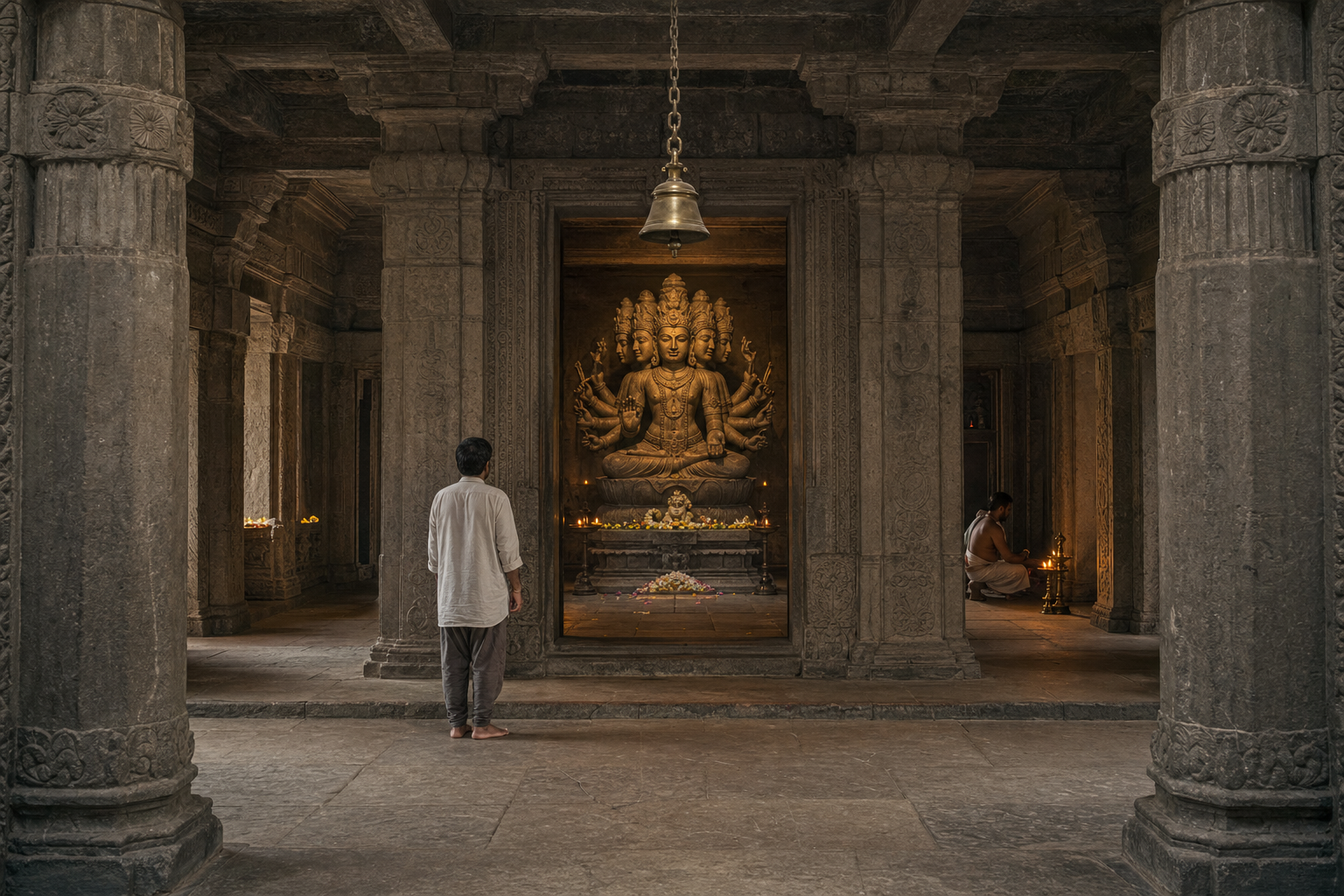
In a temple
Before reaching for a phone or an iconographic chart, observe how the shrine organizes your movement. Which face meets the entrance? Can you circumambulate the sanctum? Does the priest turn toward different directions during recitation? Temple architecture can teach the fivefold structure through your feet, eyes and breath before anyone explains it verbally.
A Pañchamukha liṅga makes the relation between the unmanifest and manifest especially clear. Cardinal faces appear upon the shaft while Īśāna occupies the summit. The faces don’t replace the liṅga; they emerge from it. You are being shown that transcendent reality and its knowable manifestations aren’t two competing principles.
Regional differences are meaningful. Tamil and Karnataka traditions can emphasize fluid drapery and dynamically balanced limbs. Odisha is especially associated with architecturally lucid mukhaliṅgas, while Himalayan shrines may present directional heads in wood within compact mountain sancta. Elephanta, Ellora, and later Chola and Hoysala work belong to a long history of artists making dense Shaiva theology visually balanced. Variation is therefore something to investigate, not immediate evidence that a murti is non-canonical.
Mahāśivarātri and Kārttika observances may give you a particularly good opportunity to encounter Pañchamukha worship, abhiṣeka and Pañcabrahma recitation in their liturgical setting. If a temple follows a directional sequence, let its priest or established custom lead you rather than turning independently around a crowded sanctum.
At a home shrine
Home worship can remain simple. Where the murti’s material and your household practice permit it, offer water in abhiṣeka, bilva leaves, a lamp and incense. Recite Namaḥ Śivāya or the five Pañcabrahma names with attention. Complexity isn’t required for reverence.
Don’t add nyāsa, specialized mudrās or direction-based turns merely because the icon has five faces. Those actions belong to specific ritual systems. If you want to move beyond straightforward offerings, ask which procedure your family tradition, sampradāya or local temple actually follows.
Key takeaways
- Pañchamukha identifies the five-faced dimension; Dashabhujeshwara identifies the ten-armed Lord. Related forms such as a Pañchamukha liṅga need not display ten arms.
- The standard directional map places Tatpuruṣa east, Aghora south, Vāmadeva north, Sadyojāta west and Īśāna upward.
- The five faces collectively express emanation, sustenance, reabsorption, veiling and grace. Exact face-to-function correspondences can vary by school.
- The ten arms indicate mastery of the ten directions and can also represent integration of five faculties of knowledge with five faculties of action.
- Attribute combinations vary. Read the implements as coordinated actions rather than demanding one immutable inventory.
- Simple home offerings are sufficient; fuller mantra, nyāsa, mudrā and directional practice should follow a real paramparā.
The next time you meet this form, give the first minute to orientation rather than identification. Find the directional structure, then the gestures of fearlessness and grace, and only then the remaining implements. What first appeared crowded will begin to disclose a single proposition: every direction, faculty and cosmic transition rests within Shiva.
References
