
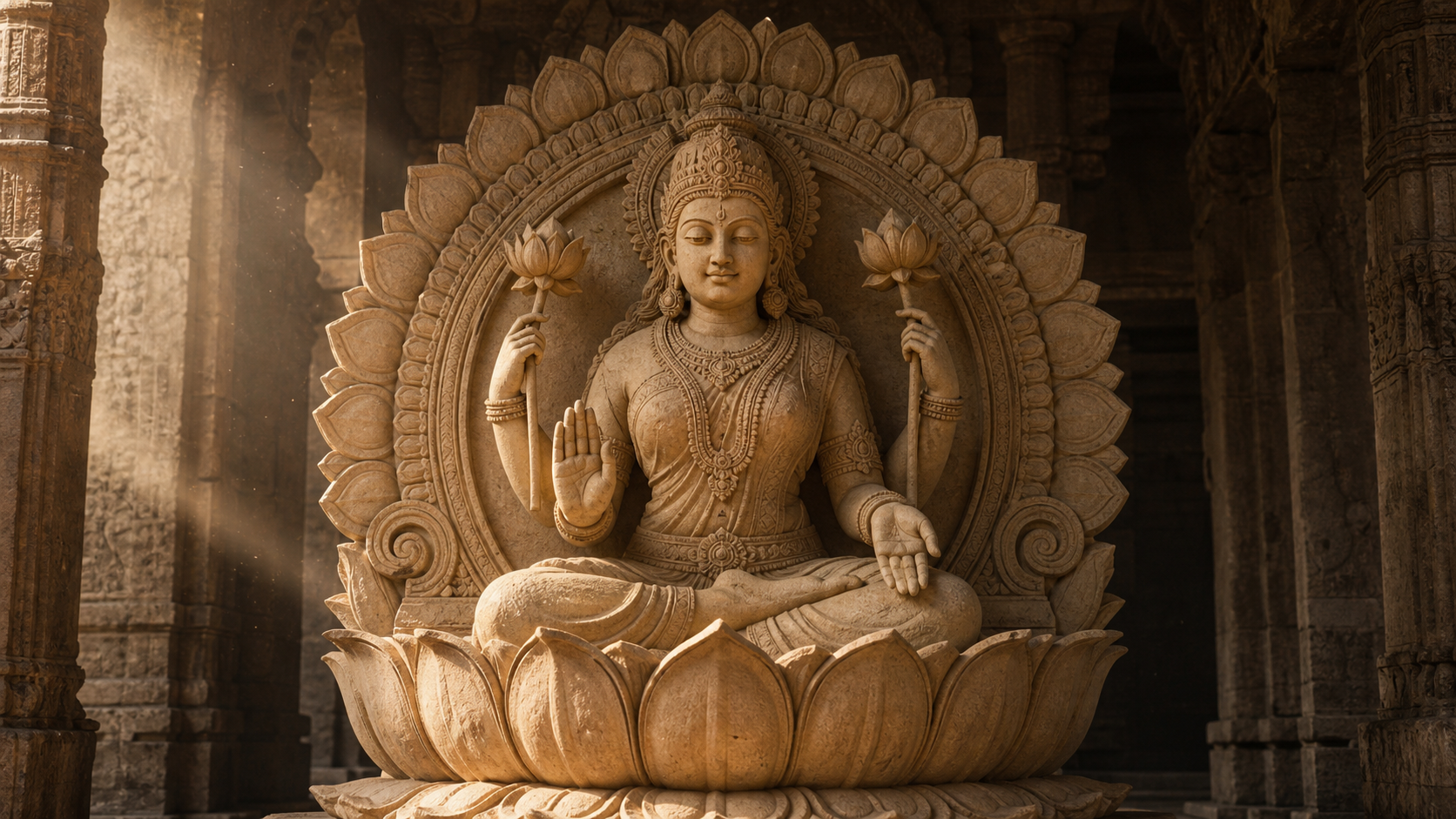
You are standing before a Hindu sculpture and can see the lotus immediately. It may be held in a hand, spread beneath a deity’s feet, carved around a halo, or repeated across a ceiling. Calling it a symbol of purity is not wrong, but it is rarely enough to explain what the sculptor has made visible.
You can read the lotus more accurately by asking four questions: Where is it placed? How far has it opened? Which deity or figure is connected to it? How do its petals organize the sculpture? Those questions turn a familiar flower into a precise part of Hindu sacred language.
Begin with placement: held, seated, standing, or encircled
Placement tells you what the lotus is doing. In Hindu iconography, the padma can function as an attribute, a pedestal, a nimbus, or a form of yogic and tantric geometry. These are not interchangeable uses. The flower changes from an identifying sign into a cosmic support, a field of radiance, or an image of inward realization.
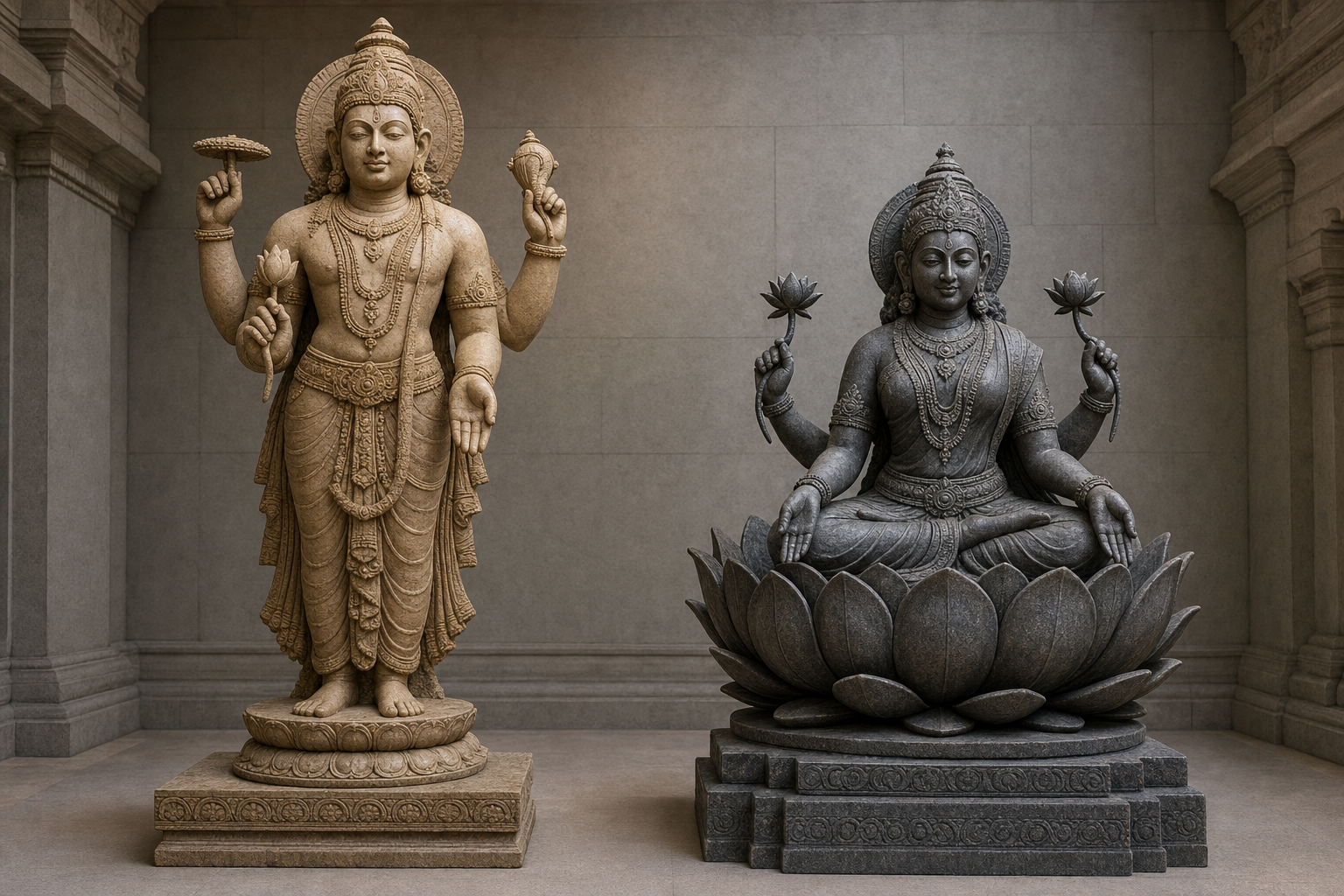
A lotus held by a deity belongs to the figure’s set of attributes. Read it alongside the other objects, the hand gesture, and the deity’s posture. Do not interpret it as an isolated emblem. The padma in Vishnu’s hand, for example, participates in a visual sentence that also includes the shankha, chakra, and gada. Its gentleness does not cancel the authority of the other attributes; it places fecundity, auspicious unfolding, and cosmic order within that authority.
A lotus beneath a figure has a different task. The padma-pitha, or lotus pedestal, commonly combines downturned petals in a lower tier with upturned petals above. Structurally, this gives the sculpture a broad and rhythmically ordered base. Theologically, it presents the deity as supported by a purified cosmic order rather than by ordinary ground. When you encounter a double-lotus pedestal, look at both tiers. The lower petals establish weight and containment; the upper petals visually open toward the sacred figure.
A lotus around the head or body works as a field rather than an object. Petal-shaped halos and concentric rosettes make sanctity radiate outward through repetition. A ceiling lotus reverses your normal viewing direction: instead of supporting a deity from below, it draws your gaze upward through successive rings. In western Indian Maru-Gurjara and Jain temple traditions, the intricately carved ceilings at Delwara and Ranakpur turn this upward movement into a stone mandala.
Keep the lotus pedestal distinct from padmasana, the lotus posture. One is a carved support; the other organizes the body. In padmasana, crossed legs, a stable torso, and a centered axis convey disciplined stillness and the gathering of prana. A meditative figure may sit in lotus posture upon a lotus base, but each element contributes separately: the posture establishes inner equipoise, while the pedestal locates that equipoise within a sacred cosmic field.
Read the flower’s stage before assigning a meaning
The second question is whether the flower is closed, opening, or fully open. Hindu sculptural vocabulary distinguishes the closed bud, or mukula; the partially opened ardhavikasita form; and the fully blossomed vikasita padma. This progression gives you a practical interpretive scale.
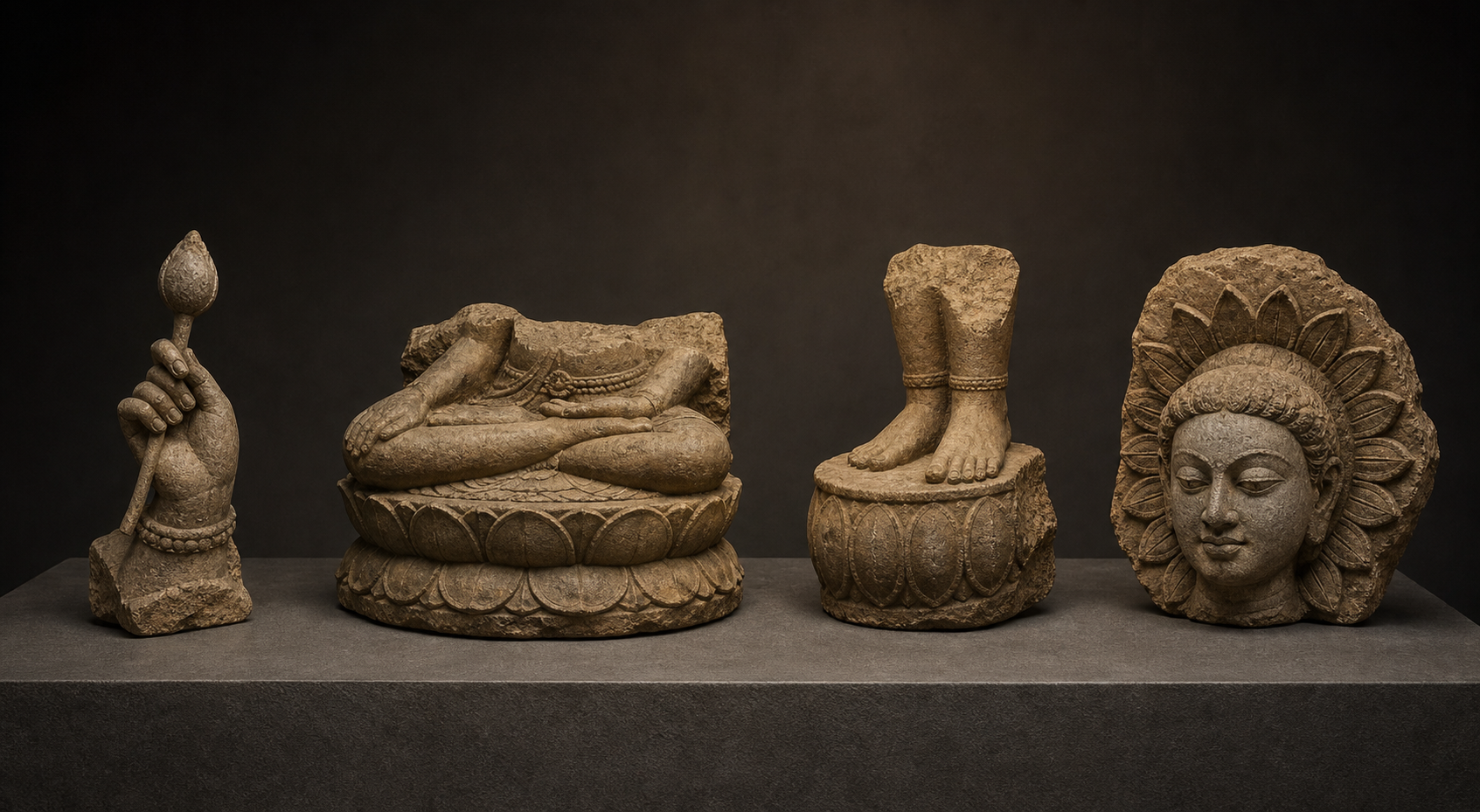
A bud suggests contained power, restraint, or a possibility that has not yet manifested. A partially opened flower introduces movement and becoming. A full blossom indicates revelation, fullness, grace, or an auspicious presence made manifest. Before deciding that every lotus means enlightenment or purity, check its stage. A celestial attendant carrying a slender bud is not making exactly the same statement as Lakshmi enthroned upon a completely open flower.
Color can narrow the meaning when paint, polychromy, or textual context preserves it. White is associated with clarity and sattva; red with vitality and abundance. The blue utpala conveys serenity and depth. Padma or kamala generally denotes the true lotus, while utpala refers to the blue water lily. Careful carving may preserve differences in petal profile or stamen treatment, but bare stone does not tell you its lost color with certainty. Treat a color identification as provisional unless the sculpture, its surviving finish, or its iconographic setting supports it.
Now examine orientation. Upright petals make a receiving or unfolding surface. Downturned petals can close and stabilize a lower register. Buds held vertically introduce aspiration and poised potential. A full flower viewed from above emphasizes radial order. The motif’s meaning therefore lies not only in the noun – lotus – but also in the visual action created by opening, turning, supporting, or radiating.
This is also where a central Dharmic teaching becomes visible. The lotus grows in water yet remains a sign of unsoiled presence. The Bhagavad Gita uses the lotus leaf to express action without clinging, while the hridaya-padma, the lotus of the heart, gives inner realization a spatial form. In sculpture, cleanly separated petals make that principle tangible: the sacred figure can inhabit the world without being reduced to its disorder.
Let the deity complete the visual sentence
A symbol does not carry one fixed translation wherever it appears. The associated deity determines which part of the lotus’s semantic range comes forward. Use the figure, the lotus’s position, and the surrounding narrative together.
| Figure | Typical lotus relationship | What to notice |
|---|---|---|
| Vishnu | Holds the padma among his principal attributes | Read fecundity and cosmic order alongside the shankha, chakra, and gada, not apart from them. |
| Brahma | Sits upon or emerges with the lotus rising from Vishnu’s navel | The flower becomes the emergence of ordered creation and speech from the depth of the cosmic waters. |
| Lakshmi | Sits or stands upon a fully open lotus | The blossom intensifies abundance, fertility, auspiciousness, and sovereign grace. |
| Saraswati | Is associated with a white lotus seat | Whiteness, balance, and stillness support the clarity and discipline of knowledge and the arts. |
| Ganesha or Surya | May hold or stand upon a lotus | With Ganesha it can suggest perfected intention; with Surya it can express radiant sovereignty. |
The Vishnu-Brahma relationship offers the clearest lesson in relational reading. In images of Vishnu Anantasayana, Brahma appears upon a lotus issuing from Vishnu’s navel. The Gupta-period panel at Deogarh is a major sculptural formulation of this cosmogony. Here the lotus is neither a decorative flower nor merely Brahma’s seat. Its stem connects latent cosmic depth to manifested order. The name Padmanabha, meaning the lotus-naveled one, keeps that relation present in living Vaishnava worship.
Lakshmi changes the emphasis. In Gaja Lakshmi reliefs, elephants pour water over the goddess as she occupies an open lotus. Flower, water, elephants, and enthroned goddess work together. Removing any one of them from your reading weakens the whole composition. The lotus establishes auspicious emergence; the elephants add royal abundance and purification; Lakshmi gathers those meanings into a concentrated presence that extends into the temple’s built space.
Do not force this Hindu grammar into an exclusively Hindu boundary. The lotus carries a shared yet differently inflected Dharmic vocabulary. Buddhist images of Padmapani and lotus-throned Buddhas, Jain Tirthankaras in padmasana, the lotus emblem of Padmaprabha, and the Sikh metaphor of remaining unattached while living in the world all preserve related ethical and contemplative possibilities. The continuity matters, but so do the distinctions: identify the figure and tradition before interpreting the flower.
Petal geometry is disciplined meaning, not decorative excess
Once you have identified placement, flower state, and deity, move closer to the geometry. The lotus is exceptionally useful to sacred artists because a natural blossom already offers a center, radiating axes, repeated units, and nested layers. Hindu sculptors can therefore make theological order visible without abandoning organic beauty.
Shilpa Shastra and Agamic traditions regulate petal counts, tiers, curvature, symmetry, and proportion. The Vishnudharmottara Purana belongs to this wider body of guidance that converts sacred meaning into craft rules. Measurement is not the enemy of devotion here. It is the means by which an individual artisan places a murti within a transmissible iconographic discipline.
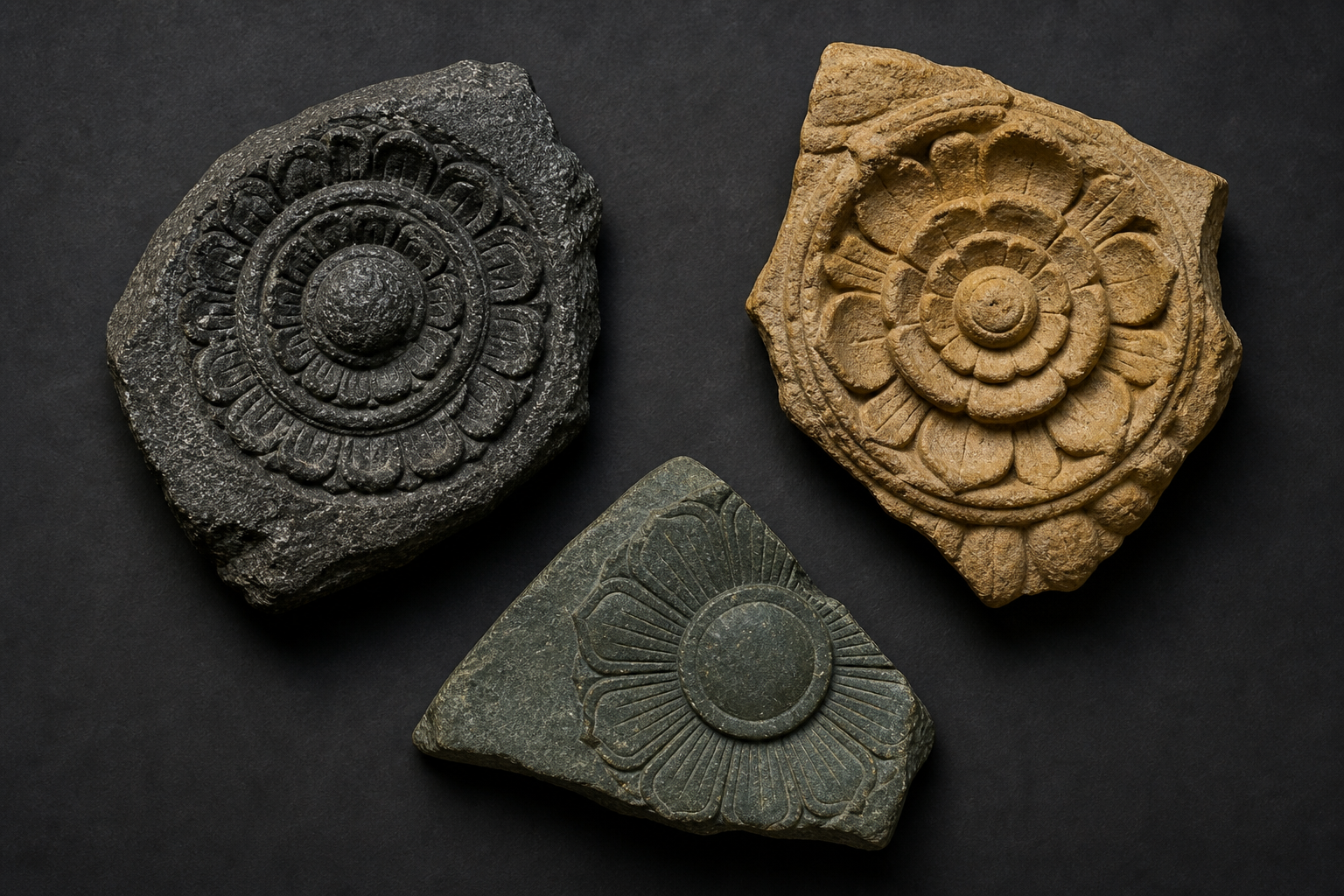
Petal counts such as ashtadala, shodashadala, dvatrimshat-dala, and chatushashti-dala correspond to eight, sixteen, thirty-two, and sixty-four petals. Yogic and tantric visualizations also conceive chakras as lotuses with prescribed numbers of petals. Yet counting should make you more careful, not more speculative. An eight-petaled rosette is not automatically a coded reference to a particular chakra. First ask whether the count is deliberate and legible, whether the lotus belongs to a halo, throne, ceiling, or bodily diagram, and whether nearby elements support the same interpretation.
Regional style changes the accent
Local ateliers preserve the lotus’s central meanings while giving it a regional rhythm. Chola bronzes use crisp petals on double-lotus bases to steady a figure whose body may carry remarkable movement. Pala-Sena black stone images often join lotus bases to beaded borders and scrolling ornament. Hoysala sculptors elaborate lotus and lily scrolls with dense, lace-like cutting, while Dravida temples repeat lotus bands along bases, pilasters, and kalasha-and-lotus capitals.
These differences help you separate iconography from style. The pedestal may retain the same sacred function even when the petal edge, depth of carving, surrounding border, and overall silhouette change. When comparing two sculptures, ask first what the lotus does and only then how the regional workshop chose to articulate it.
The same principle travels beyond Bharat. Khmer and Cham sculptural programs adapted lotus pedestals, buds, guardians, and dance reliefs to local visual languages. Devatas at Angkor frequently hold lotus buds. The regional form changes, but purity, blessing, poised potential, and sacred order remain recognizable within the broader Indic field.
Light reveals the sculptor’s argument
Look at the cuts between petals rather than only at the outer silhouette. Stone carvers use alternating depth and softer transitions to produce bands of light and shadow. Lost-wax bronze casting permits thin petal rims that can make a heavy metal base appear buoyant. This is not craftsmanship added after meaning. Light moving over measured surfaces is one of the ways the sculpture communicates emergence, radiance, and ordered life.
If a lotus appears worn, resist mentally restoring every missing detail. Start with what remains reliable: the central axis, number of visible tiers, direction of the petals, relation to the body, and repeated forms elsewhere in the composition. A damaged lotus can still tell you whether it supports, opens, radiates, or identifies.
Key takeaways: a six-step reading practice
- Locate the lotus. Decide whether it is held, placed beneath the figure, arranged around the figure, built into the architecture, or expressed through bodily posture.
- Identify its stage. Classify it as a bud, partial blossom, or full flower. Read these as contained possibility, unfolding, and manifest fullness rather than treating them as equivalent decorations.
- Read the whole figure. Identify the deity or attendant, then examine the other attributes, gestures, posture, accompanying figures, and narrative setting.
- Inspect orientation and color carefully. Note upturned and downturned petals. Use surviving color when it exists, but do not assign white, red, or blue to unpainted stone without contextual support.
- Count only what is clearly designed to be counted. Eight, sixteen, thirty-two, and sixty-four petals may carry yogic or tantric significance, but geometry needs confirmation from the rest of the iconographic program.
- Separate function from regional style. Determine what the lotus means in the composition before comparing the crispness, density, borders, or carving depth associated with Chola, Pala-Sena, Hoysala, Maru-Gurjara, Khmer, or Cham work.
On your next temple or museum visit, give the sculpture two passes. Read the broad relationship first: flower, body, attributes, and architectural setting. Then move to bloom stage, petal direction, count, and workmanship. That short pause is often enough for the lotus to stop being background ornament and begin doing its real work as sacred form.
References
