
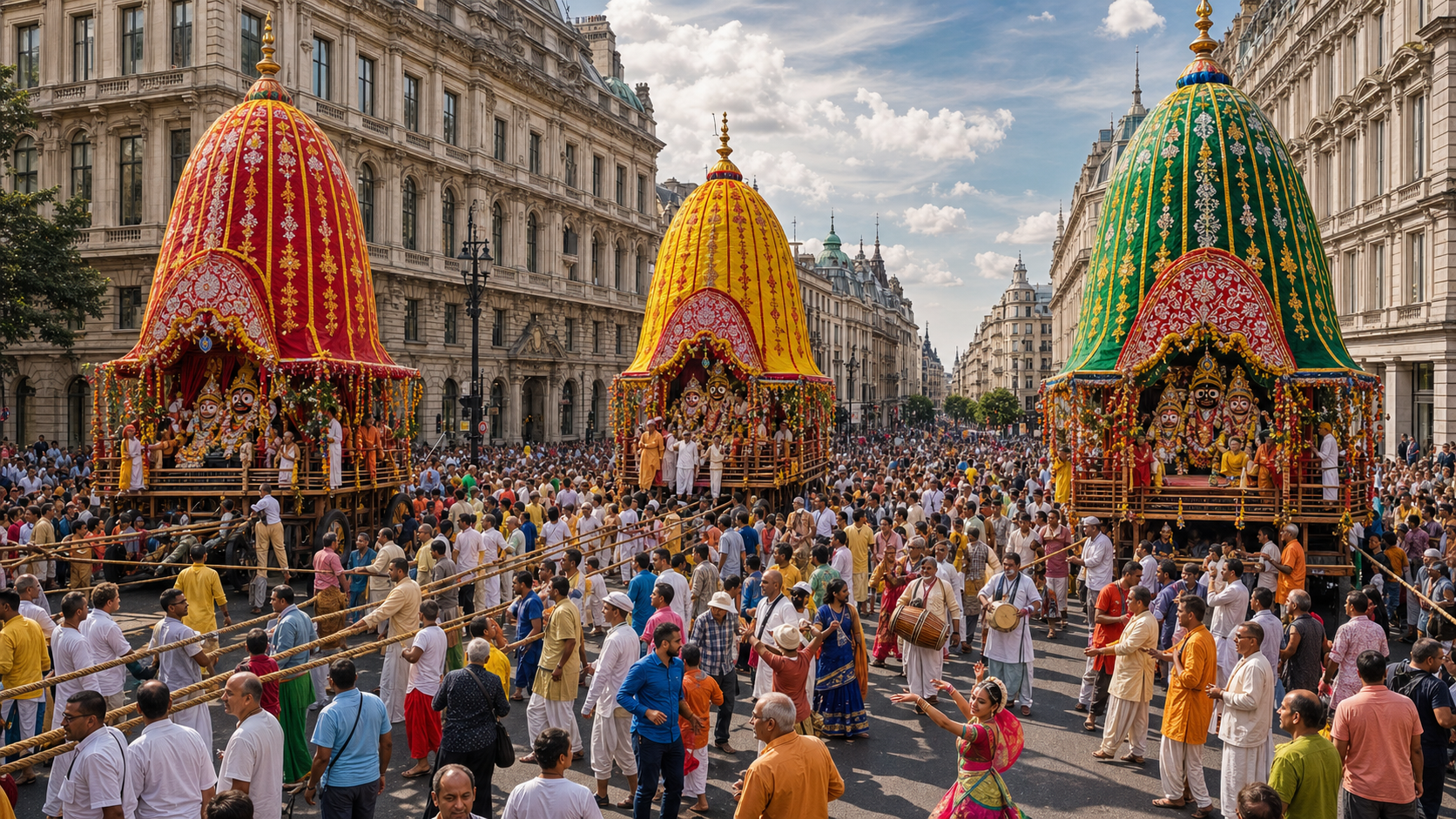
If you saw images of enormous chariots moving past Piccadilly and wondered whether London Rathayatra was a parade, a temple ritual, or a public statement of Hindu belonging, the honest answer is that it was all three. The religious meaning did not disappear when the procession entered the West End; it became visible to people who might never enter a temple.
Understanding the event changes what you notice. The ropes are not crowd-control props, the chanting is not background entertainment, and the arrival at Trafalgar Square is not merely the end of a route. Each belongs to a connected practice of darshan, kirtan, seva, and prasadam.
The 2026 procession at a glance
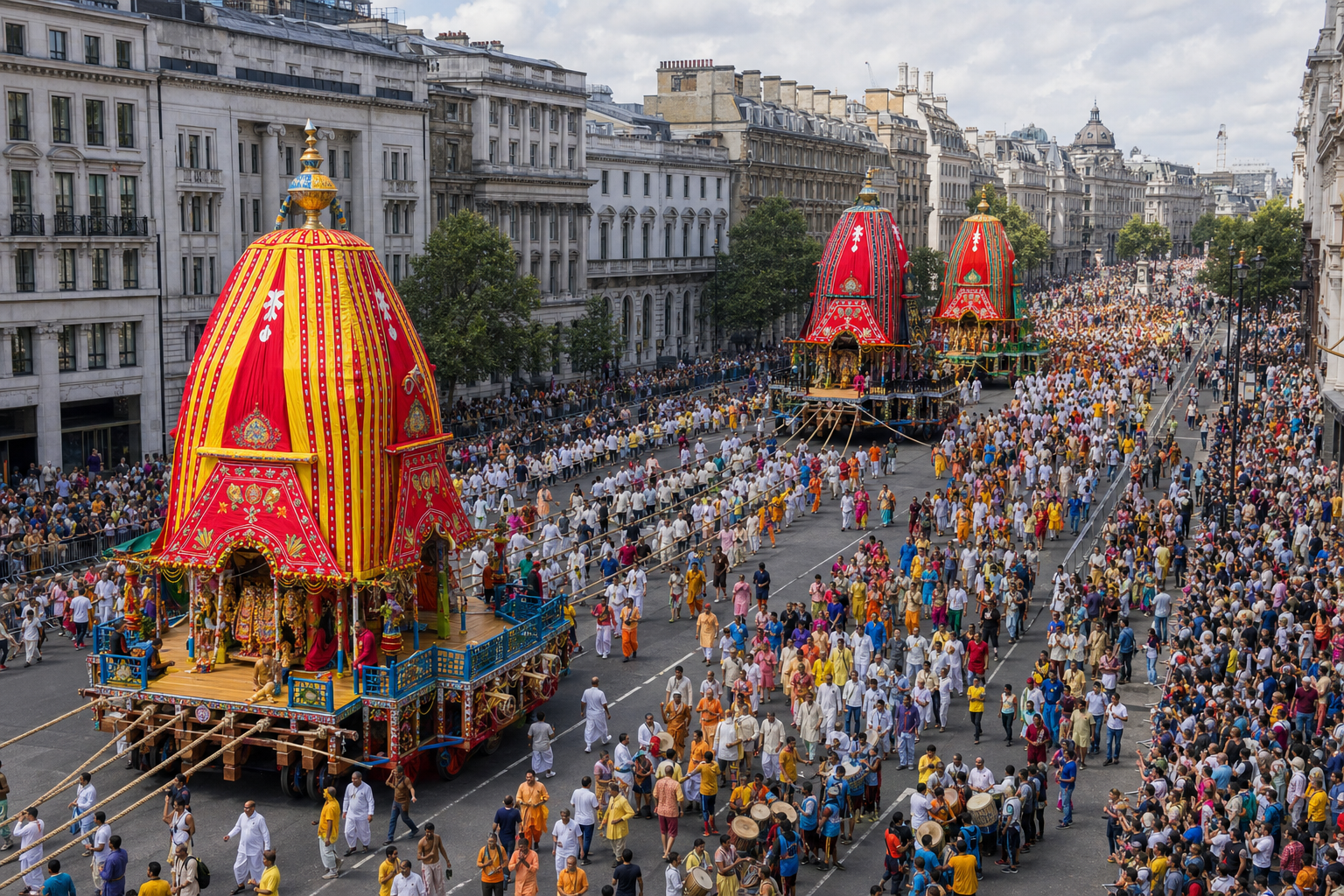
London’s 57th Rathayatra took place on 24 May 2026. The procession was scheduled between 2:00 pm and 5:00 pm, beginning near Park Lane and Hyde Park Corner before travelling along Piccadilly, passing through Piccadilly Circus, and concluding at Trafalgar Square.
That distinction between procession and recording matters if you are encountering the festival through the documented walking tour. The continuous film runs for 1 hour and 13 minutes, while the public procession occupied a three-hour window. It captures one sustained passage through the event rather than reducing the entire day to selected highlights. Do not read the recording’s beginning and ending as the formal opening and closing of the festival.
The one-take format is especially valuable for a procession whose meaning unfolds through movement. You hear the volume change beneath buildings and across open junctions. You see how quickly an ordinary pedestrian becomes a participant, and how frequently the chariots must slow or halt. The pauses are part of the event’s practical and devotional rhythm, not interruptions to it.
Three different time scales therefore sit inside the 2026 Rathayatra. There is a London tradition dating to 1969, a three-hour civic procession, and a 73-minute continuous record of one person’s movement through the crowd. Keeping those scales separate prevents a common mistake: treating a striking video clip as though it represents the whole ritual.
What the chariots, ropes, chanting, and food mean
Rathayatra means the journey of the chariot. Its ritual home is the Jagannath tradition of Puri in Odisha, where the Divine comes out in procession rather than remaining enclosed within a sanctuary. ISKCON carried the festival into new public settings in the late 1960s. The first Western Ratha Yatra was held in San Francisco in 1967, and London began its annual celebration in 1969.
Lord Jagannath travels with Balabhadra and Subhadra on large decorated chariots. The canopies, flowers, garlands, and sacred motifs make each vehicle a mobile sanctum. That is why devotees speak of darshan rather than simple spectatorship. You are not merely looking at an art object or festival float; you are approaching the deities in a setting deliberately opened to the wider community.
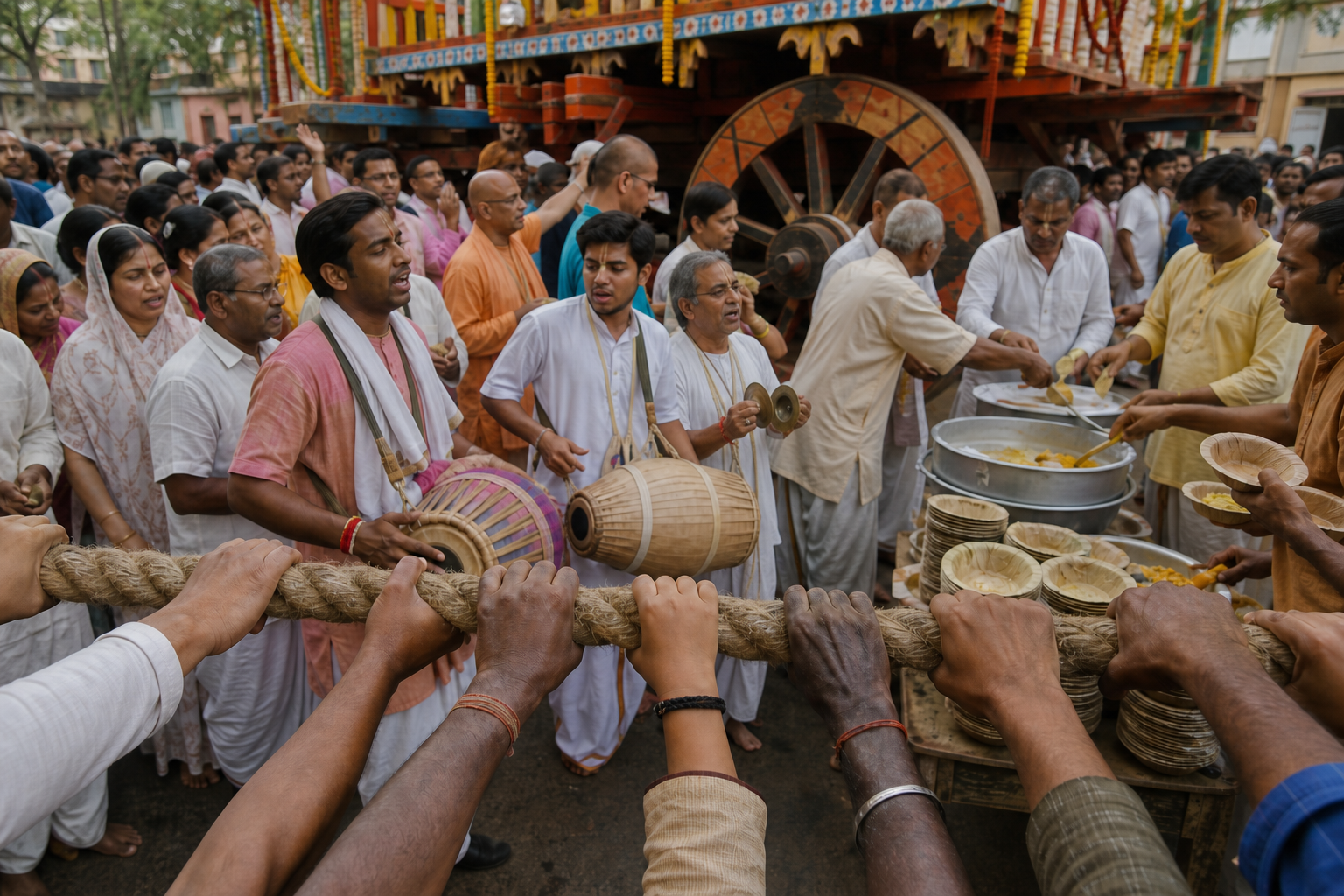
Pulling a chariot rope is similarly more than a good vantage point. It is understood as a meritorious act and as participation in bringing the Divine into the shared civic world. The rope also carries an obvious physical responsibility. Volunteers regulate access, maintain clear space near the wheels, operate the braking arrangements, and keep the chariot moving at a measured pace. If you join a future procession, wait for a steward’s direction rather than reaching through the crowd or crossing into the chariot’s path.
Kirtan gives that movement its shared cadence. Mridanga drums, kartals, harmonium, and the call-and-response chanting of the Hare Krishna maha-mantra allow people to participate without needing a programme or prior rehearsal. You can listen, repeat the response, dance, or walk quietly beside the singers. Participation is invited, not tested.
The periodic halts have their own meaning. They allow time for arati, offerings, adjustments around the ropes, and safe management of the crowd. When watching the procession, notice what happens during these still moments: attention shifts from forward travel to worship, and the chariot’s character as a sanctum becomes clearer.
Prasadam completes the movement from seeing and singing to receiving. It is sanctified vegetarian food, not simply a complimentary meal placed beside a cultural performance. Accept it respectfully, avoid waste, and remember that the people preparing and distributing it are performing seva, or selfless service. These terms are not ornamental Sanskrit labels. They identify different ways of entering the same devotional encounter.
How to follow the route with attention
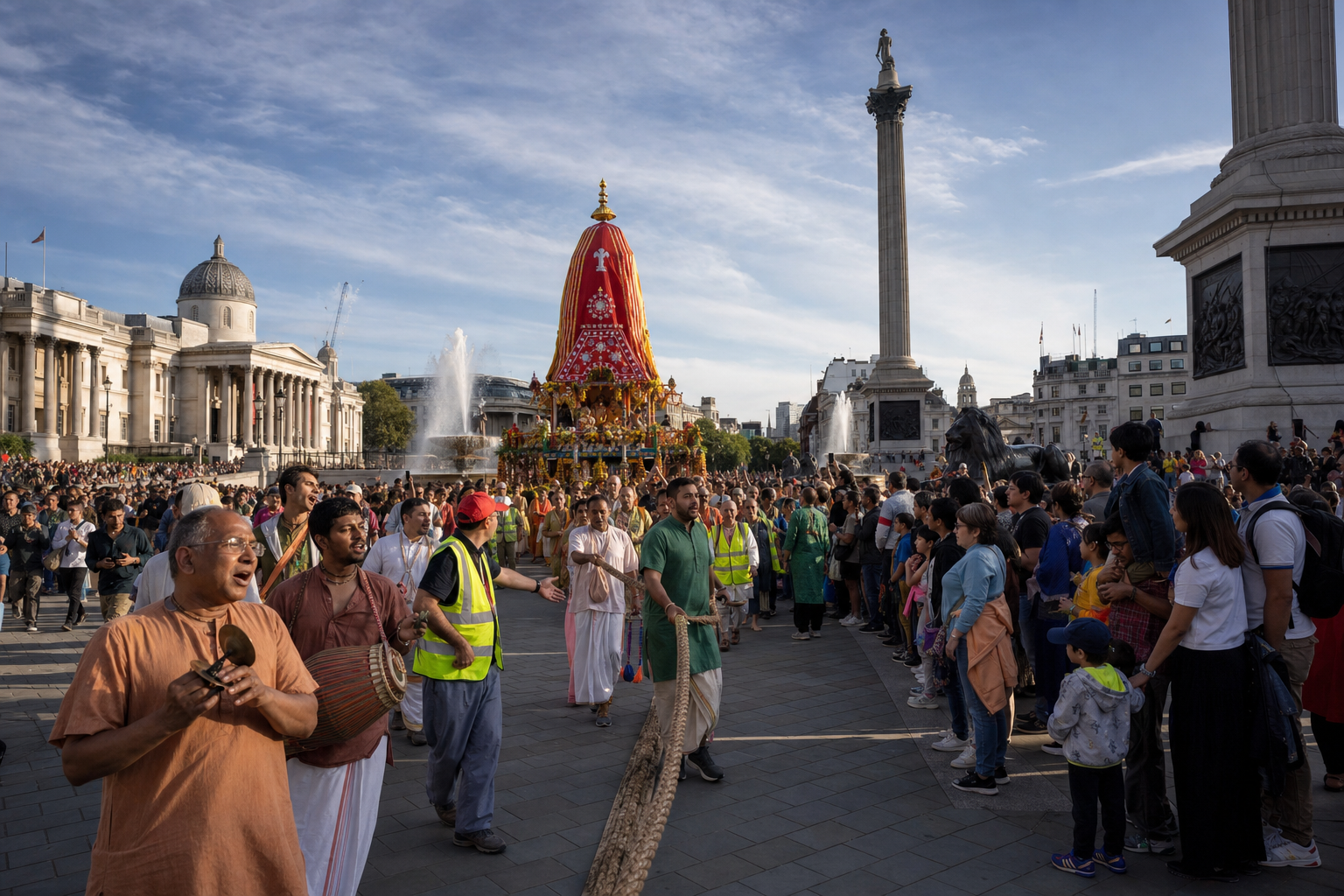
The 2026 route offered three distinct ways to experience the procession. The stretch from Hyde Park Corner into Piccadilly placed people close to the chariots and kirtan groups. Piccadilly Circus supplied the most dramatic urban contrast, with the chariot canopies moving through one of London’s most recognisable commercial spaces. The approach to Trafalgar Square opened the sightlines and released the procession into a larger gathering place.
If you are watching the walking tour, use those changes in the streetscape as chapter markers. Near Hyde Park Corner, watch how the crowd assembles around the moving sanctums. Along Piccadilly, notice the work of marshals and rope volunteers. At Piccadilly Circus, listen to the kirtan reverberate against a dense urban backdrop. As Trafalgar Square approaches, watch the narrow procession become a settled festival audience.
The concluding programme at Trafalgar Square included devotional music, educational displays, and prasadam distribution. Information about the Bhagavad Gita and the Jagannath tradition helped visitors connect the street experience with its philosophical and ritual foundations. The square’s terraces and open space also gave families, children, and older visitors room to rest after the denser procession.
The practical lesson for a future London Rathayatra is to choose your experience before the chariots arrive. For proximity, position yourself early on a wider section between Hyde Park Corner and Piccadilly. For the strongest visual relationship between the chariots and London, Piccadilly Circus is the obvious setting, but it also concentrates pedestrians. For space, rest, exhibits, and food, prioritise Trafalgar Square. Do not assume that a future edition will repeat the 2026 route or timetable; verify the announced arrangements before travelling.
Green Park, Piccadilly Circus, Charing Cross, and Embankment provided different approaches to the 2026 route. Anyone requiring step-free travel should check the current status of the relevant station before leaving home. A station that is generally accessible can still be affected by temporary works, crowd-management measures, or an unavailable lift.
Comfort is easiest to protect before the crowd becomes dense. Wear shoes suitable for several hours of slow walking and standing, carry water, and bring sun protection when conditions require it. Continuous percussion and amplified chanting can be intense for people with sound sensitivity, so ear protection is a sensible preparation rather than a barrier to participation. Agree on a meeting point with companions before joining the procession because the rope lines and rolling street closures can make short distances difficult to cross.
Photography is welcome in public areas, but the camera does not give you priority over worshippers, stewards, or the moving chariot. Remain outside the forward path, do not cross the ropes for a clearer angle, avoid flash close to the deities, and follow any request from a steward. An outer edge of the crowd, or a permitted island median, can offer a cleaner view without creating a hazard beside the wheels.
Why public devotion in central London matters
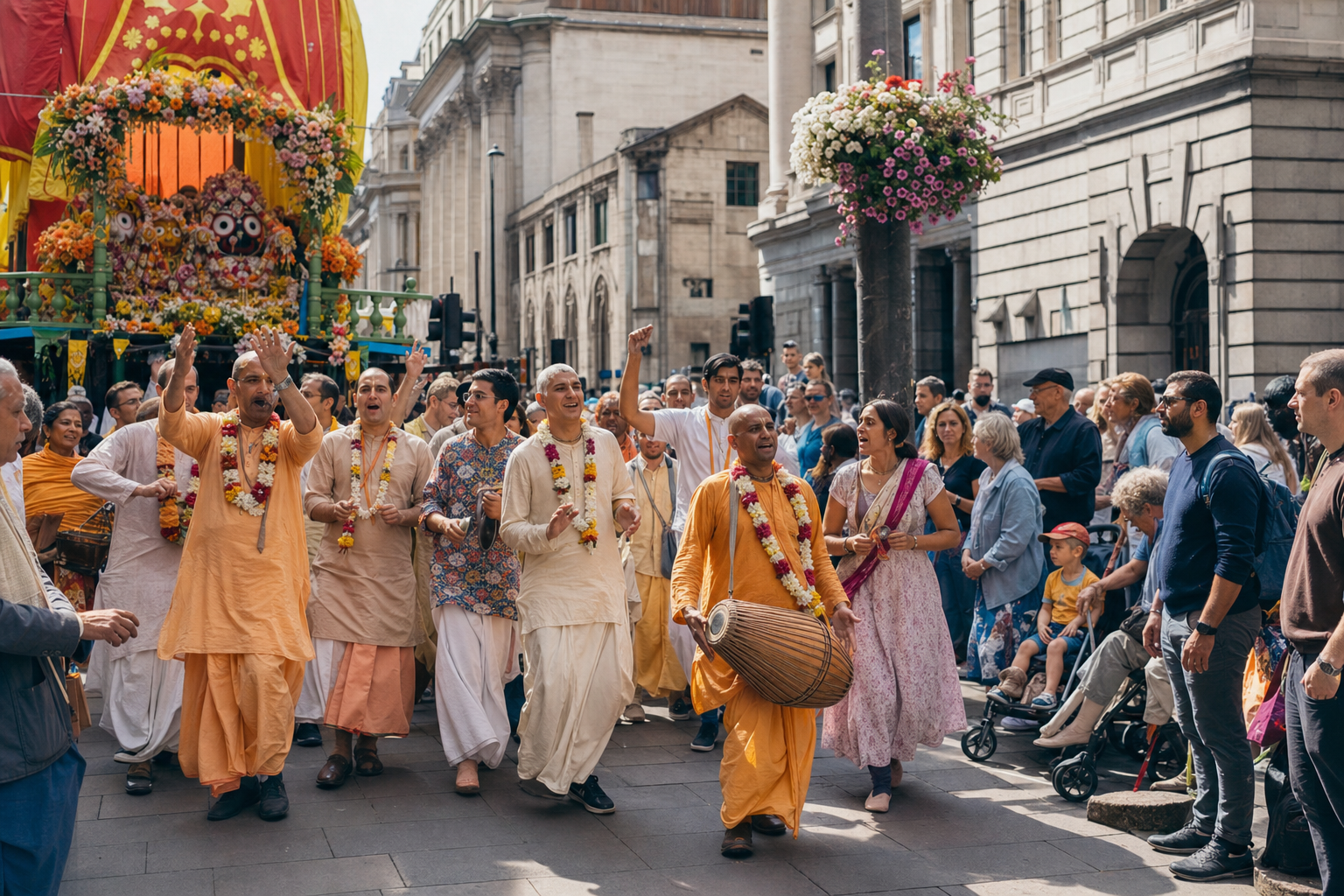
Calling such an event a Hindu “takeover” may produce a provocative caption, but it misdescribes what happened. This was a permitted, stewarded procession conducted with coordination involving the Metropolitan Police, Westminster City Council, and Transport for London. It was free, open to the public, and organised around music, worship, education, and the sharing of food.
Rejecting the takeover frame does not require diminishing the festival’s Hindu character. The more accurate point is stronger: an unmistakably Dharmic tradition occupied a prominent civic space openly, peacefully, and on its own devotional terms. Jagannath did not need to be translated into a generic mascot before entering Piccadilly, and kirtan did not need to become secular entertainment before being heard in Trafalgar Square.
Nor does openness mean that every person present holds the same theology. Hindus were joined by Buddhists, Jains, Sikhs, people of other faiths, and people with no religious affiliation. Their participation can be understood through hospitality and shared ethical language – compassion, ahimsa, and seva – without pretending that the Dharmic traditions are interchangeable. Respectful unity does not require erasing real differences.
This is where Vasudhaiva Kutumbakam, the world as one family, becomes practical rather than decorative. People are welcomed through a chant they can answer, a rope they may help pull under guidance, food they may receive, and explanations they may explore. The host tradition remains visible while the invitation crosses community boundaries.
The civic organisation matters for the same reason. Marshals, wheel clearances, controlled pacing, rolling closures, accessible approaches, and responsible waste disposal are not separate from the festival’s spiritual claims. They are how care for other people and respect for shared space become observable. Bringing a refillable bottle, using public bins, avoiding single-use plastic where possible, and travelling by public transport are small acts, but they align conduct with a tradition that speaks of stewardship and regard for life.
London Rathayatra therefore offers a useful standard for judging public religious expression. Ask whether a community can remain faithful to its tradition, welcome the unfamiliar, protect participants, cooperate with civic institutions, and leave the shared space responsibly. The 2026 procession demonstrated that visibility and hospitality can reinforce each other.
Key takeaways for viewers and future visitors
- The 57th London Rathayatra ran on 24 May 2026 from Park Lane and Hyde Park Corner through Piccadilly and Piccadilly Circus to Trafalgar Square.
- The 1-hour, 13-minute walking tour documents one continuous passage through a procession scheduled over three hours; it is not a compressed record of the whole programme.
- Jagannath, Balabhadra, and Subhadra travel on mobile sanctums. Darshan, pulling the ropes, chanting, receiving prasadam, and offering seva are distinct forms of participation.
- The best position depends on your purpose: Piccadilly for proximity, Piccadilly Circus for urban imagery, and Trafalgar Square for open views, rest, exhibits, music, and prasadam.
- Stay outside the rope line unless directed, keep clear of the wheels and forward path, follow stewards, and check future route and accessibility details rather than assuming the 2026 arrangements will repeat.
- The procession was a specifically Dharmic act of public devotion and an open civic festival. Its inclusiveness did not require weakening its Hindu identity.
If you watch the 2026 walk, keep the sound on and look beyond the chariot canopies. Notice the volunteers at the ropes, the alternation between movement and worship, the response of passersby, and the way the crowd changes as it enters Trafalgar Square. That is where the deeper story appears: not in a city being conquered, but in a sacred journey being shared.
If you plan to attend a future edition, make three decisions before you travel: where on the route you want to stand, how you will reunite with companions if separated, and whether you want to observe or join the kirtan and rope pulling. Then arrive early enough to act on those choices without pushing through a moving crowd.
References
