

You may trust your physician, value prayer, and still hesitate when a diagnosis is uncertain or a treatment carries risk. You do not have to choose between cold, mechanical care and blind spiritual surrender.
Dharmic healthcare asks more of everyone involved. You receive suitable medicine with gratitude, verify how it should be used, participate honestly in treatment, and hold the healer to a high standard of competence and compassion. The invocation Aushadhi Jahnavi Toyam Vaidyo Narayano Harihi gives that relationship a sacred form without asking you to abandon clinical judgment.
Key takeaways
- Calling medicine sacred does not prove that every remedy is safe or effective. It changes how carefully and gratefully you receive an appropriately chosen treatment.
- Seeing the physician as Narayana honors the healing function. It does not make an individual practitioner infallible or exempt from questions.
- Ayurveda’s four pillars of therapy are the physician, medicine, attendant, and patient. A plan becomes fragile when any one of them is ignored.
- Reverence is reciprocal: the patient practices responsible adherence, while the healer owes competence, truthfulness, humility, non-harm, and care without bias.
- A brief prayer may support calm attention and adherence, but it must never replace diagnosis, correct dosage, monitoring, or urgent medical help.
Sacredness should sharpen discernment, not suspend it
The words of the invocation carry a precise ethical image. Aushadhi means a medicine or therapeutic substance. Jahnavi is the Ganga, and toyam is water. Vaidya means physician, while Narayana and Hari are names of Vishnu. Medicine is to be approached with the inward purity and gratitude associated with Ganga water; the healer is to be respected as a channel of Narayana’s preserving compassion.
This is a devotional equivalence, not a literal claim. A tablet does not acquire safety merely because someone blesses it. A practitioner does not become omniscient because a patient offers reverence. The sacred attitude begins after discernment has identified a suitable treatment and continues through correct use, honest monitoring, and responsible follow-up.
The same distinction protects both faith and medicine. Vedantic thought permits you to recognize the Divine working through functions that preserve life and support lokasangraha, the welfare of the world. Dhanvantari represents the meeting of medical knowledge, clinical skill, and compassionate intention. Yet an instrument of the Divine remains an instrument: human training, judgment, limitations, and accountability still matter.
No therapy becomes ethically superior simply because it is labeled Ayurvedic, natural, modern, or integrative. Ask whether it is appropriate for the condition, responsibly supported, administered by qualified people, and coordinated with the rest of the patient’s care. Do not combine remedies merely because both carry sacred associations.
What you should be able to ask
Shraddha is disciplined trust, not enforced silence. Before agreeing to a plan, you should be able to ask:
- What problem or therapeutic goal is this treatment addressing?
- How should it be taken or administered, and what must not be changed without advice?
- What important risks, uncertainties, or alternatives should inform the decision?
- How will response to treatment be assessed?
- Whom should you contact if the instructions are unclear or the condition changes?
A qualified healer should not treat these questions as an insult. If instructions conflict, a label is unclear, or something about the plan appears wrong, pause and verify it with the prescriber or pharmacist. Do not change a prescribed amount on the strength of intuition, ritual symbolism, or an online claim.
What the sacred role demands from a healer
The title of vaidya raises the ethical standard; it does not lower accountability. Classical Ayurvedic ideals describe the healer as learned, experienced, self-controlled, and committed to every patient’s welfare without bias. In practice, that means staying within one’s competence, explaining material information truthfully, seeking help when a case exceeds one’s scope, and placing the patient’s welfare above prestige.
- Seva: Treat clinical work as service to a person, not an opportunity to cultivate personal worship.
- Daya: Communicate with compassion, including when the news is difficult or certainty is limited.
- Ahimsa: Consider avoidable harm as carefully as hoped-for benefit.
- Integrity: Do not hide uncertainty, exaggerate a remedy, or offer different standards of care because of identity or status.
- Humility: Recognize that healing depends on a wider team and is never the personal possession of one practitioner.
Be cautious when someone uses sacred language to make credentials seem irrelevant, guarantee a cure, dismiss safety questions, demand personal devotion, or portray a second opinion as spiritual disloyalty. Those claims invert Vaidyo Narayano Harihi. They center the practitioner rather than the preservation of life. Seek another qualified opinion instead of allowing reverence to become coercion.
Use Ayurveda’s four pillars to test the whole treatment plan

The Charaka Samhita and Sushruta Samhita describe the chikitsa chatushpada, the four supports of successful therapy: bhishak, dravya, upasthata, and rogi. This model prevents a common ethical mistake: discussing a medicine as if the substance alone determines the outcome.
| Pillar | Ethical meaning | Your practical check |
|---|---|---|
| Bhishak: physician | Knowledge, experience, judgment, self-control, and commitment to the patient’s welfare | Verify appropriate qualifications and scope. Expect clear reasoning, honest uncertainty, and willingness to coordinate or refer. |
| Dravya: medicine | A therapy suitable for its intended purpose and used correctly | Know the exact medicine, intended goal, amount, timing, route, and relevant precautions. Do not substitute or combine products by guesswork. |
| Upasthata: attendant | Competent nursing, caregiving, preparation, administration, and observation | Decide who is responsible for each task, especially when the patient is a child, an elder, or too unwell to manage the plan alone. |
| Rogi: patient | Understanding, consent, participation, adherence, and truthful reporting | Make sure the patient can explain the plan in plain language, raise concerns, and report changes rather than being treated as a passive recipient. |
The patient being one pillar does not justify blame when treatment is difficult. It tells you to investigate the obstacle. A complicated schedule may require written instructions. A bitter medicine may require an appropriate alternative formulation. Confusion may require clearer language. Limited support may require a named caregiver. The ethical response is to strengthen the weak pillar, not shame the person standing beneath it.
For a multi-step regimen, make the structure visible. Keep one current record of the medicine or therapy, its instructions, the person responsible for administering it, the signs that require a call, and the correct clinical contact. If Ayurvedic and biomedical treatments are being used together, each qualified practitioner should know what else the patient is taking. Sacred intention cannot protect someone from an undisclosed contradiction between treatment plans.
A brief ritual for receiving medicine responsibly
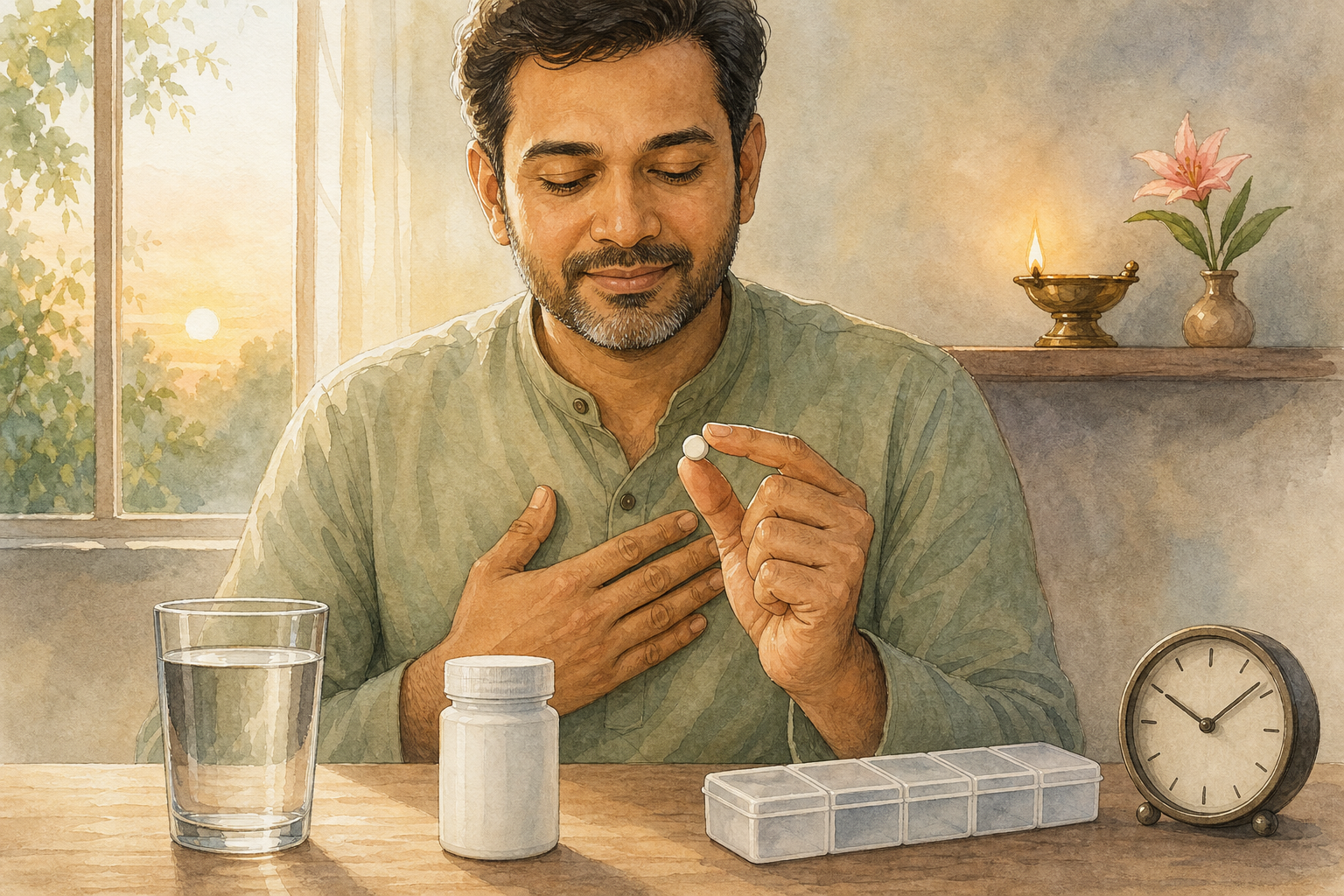
A useful ritual should make correct care easier. It should not add elaborate rules, delay treatment, or turn a prescribed substance into an object of superstition. You can use the following sequence before a routine dose or, where circumstances permit, before a procedure:
- Prepare cleanly. Wash and dry your hands when appropriate, and place the medicine and necessary equipment in a clear space.
- Verify the instructions. Check that this is the correct medicine for the correct person, in the directed amount, at the directed time and by the directed route.
- Pause for one comfortable breath. Do not force or prolong the breath. The purpose is to interrupt haste and bring attention to the act.
- Recall the invocation. Silently or aloud, say Aushadhi Jahnavi Toyam Vaidyo Narayano Harihi.
- Form a simple sankalpa. You might inwardly resolve that this treatment be used correctly and serve healing, clarity, and the welfare of everyone providing care.
- Follow the clinical direction exactly. Do not add, split, skip, repeat, or otherwise alter a dose unless the instructions permit it or a qualified professional advises the change.
- Complete the care task. Record the dose if the regimen requires tracking, store the medicine as directed, and report relevant changes through the agreed clinical channel.
The contemplative pause has a modest but meaningful role. Trust, positive meaning, and a calmer state may improve receptivity and adherence, reduce resistance, and potentially ease anxiety or pain perception. These effects complement treatment; they do not establish that a mantra directly treats the disease or changes a medicine’s pharmacological action.
If a dose is missed, vomited, or administered incorrectly, do not invent a corrective dose. Ask the prescriber or pharmacist what applies to that particular medicine and patient. A suspected serious reaction or rapidly worsening condition requires prompt medical assessment, not a longer ritual. Never reinterpret a dangerous symptom as purification, karma being discharged, or evidence that a remedy is working.
Caregivers can adapt the pause for children without deception. Explain in age-appropriate language that it is medicine, why a trusted clinician has recommended it, and that the prayer helps the family take it carefully. Do not call medicine prasad merely to override fear or resistance. If a child cannot take the prescribed formulation, contact the clinician rather than improvising the amount or method.
A pan-Dharmic test for compassionate healthcare

Sacred healing is not confined to one Dharmic sampradaya. Hindu, Buddhist, Jain, and Sikh traditions use different theological language, yet they converge on a demanding principle: care must relieve suffering through compassionate and skillful action, without making identity a condition of mercy.
Buddhism: compassion must also be skillful
Bhaisajyaguru, the Medicine Buddha, gives healing work a sacred archetype. Metta supplies loving-kindness; upaya supplies skillful means. Their combination matters. A warm intention without adequate knowledge may still cause harm, while technical skill without humane attention can leave suffering needlessly intensified. Before acting, ask both whether the intervention is compassionate and whether it is competently suited to the person and circumstances.
Jainism: minimize harm while preserving life
Jain commitments to ahimsa and aushadha-dana, the gift of medicine, join restraint with active care. Non-harm is not fulfilled by refusing to make a decision; illness and neglect also have consequences. The practical task is to weigh benefit, burden, and avoidable injury carefully, then choose a proportionate path with qualified guidance.
Sikhism: serve the person before judging the person
Seva and Sarbat da bhala orient care toward the welfare of all. Bhai Kanhaiya’s service to wounded people on opposing sides gives this ethic a sharp clinical form: suffering establishes the claim to care, not political, communal, or personal alignment. A Dharmic healthcare institution should therefore examine whether bias changes who receives attention, dignity, pain relief, information, or timely referral.
When you face a difficult healthcare decision, use four questions as a common Dharmic test:
- Competence: Is the person making or executing the decision qualified for the task?
- Truth and participation: Has the patient received a fair explanation and a meaningful opportunity to ask, consent, or decline within the realities of the situation?
- Proportionate non-harm: Are foreseeable burdens and safer alternatives being considered alongside the hoped-for benefit?
- Universality: Would the standard of care remain the same if the patient’s religion, caste, wealth, nationality, or relationship to the caregiver changed?
At your next dose, pause, verify, remember, and follow the plan precisely. At your next consultation, ask the questions that responsible participation requires and judge sacred service by knowledge, compassion, integrity, and humility. When gratitude makes care more attentive and accountability makes reverence safer, medicine becomes an expression of dharma.
References
