
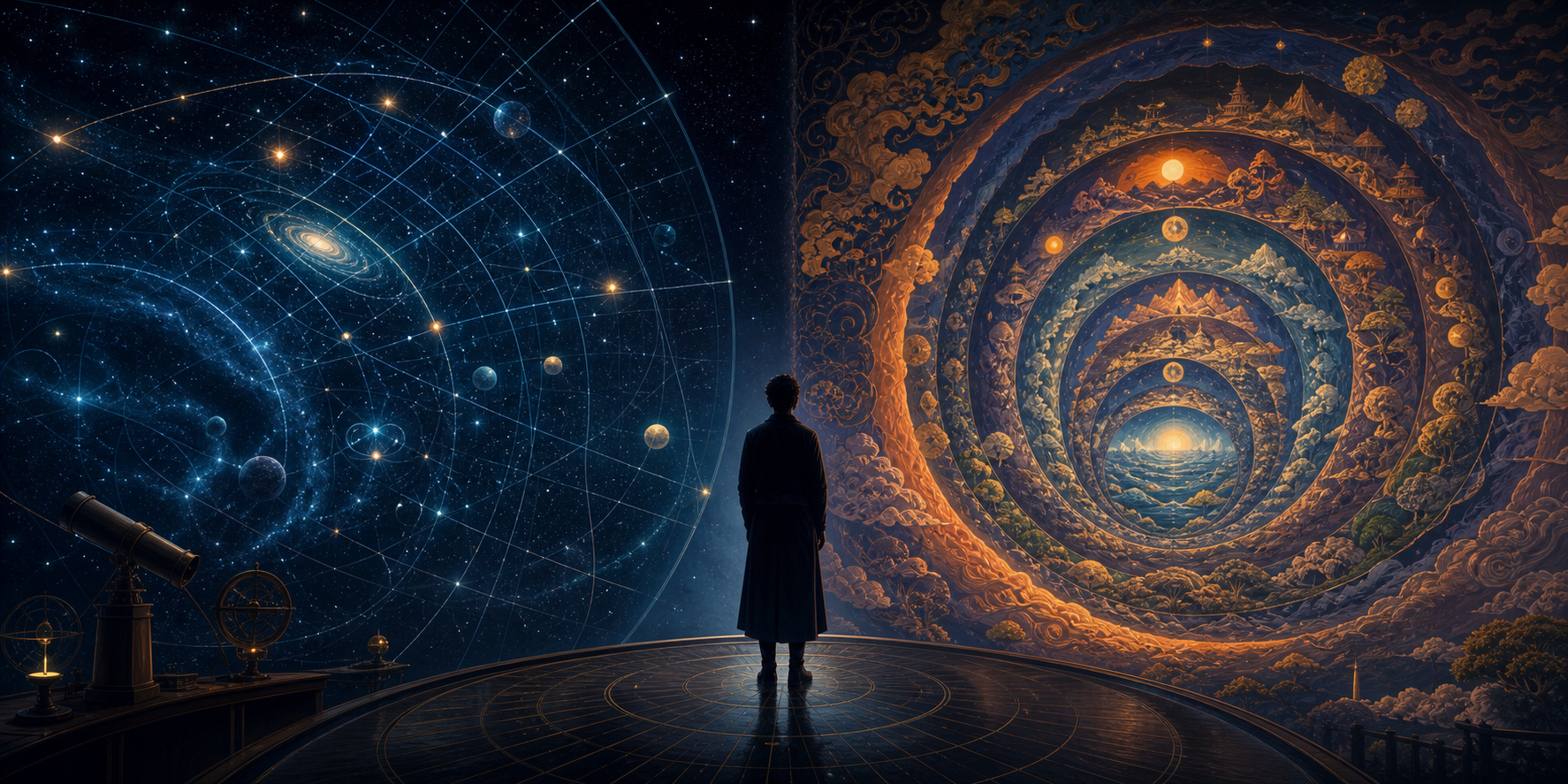
You may have arrived here after hearing a striking claim: modern science says space evolves, while Dharmic wisdom says time is constant. Is this an ancient anticipation of relativity, a contradiction between science and Dharma, or merely a confusion of words?
The defensible answer is more useful than any slogan. Relativity and Dharmic cosmologies can illuminate one another, but they aren’t interchangeable accounts of the same thing. Physics measures relationships within the observable cosmos. Hindu, Buddhist, Jaina, and Sikh traditions also ask what time and space are, how they appear in consciousness, and what—if anything—is beyond them. Once you identify which question is being asked, much of the apparent conflict disappears.
First ask what “time” and “space” mean

The word “time” can point to several different things. It can mean the interval registered by a clock, the ordering of events, the mind’s experience of succession, a parameter in a cosmological model, a real metaphysical principle called kāla, or the whole condition of temporal becoming. These meanings overlap, but they aren’t identical.
“Space” is just as slippery. In physics it may mean spatial distance, geometry, curvature, or the spatial dimensions of spacetime. In Indic philosophy, ākāśa can refer to an accommodating expanse or a metaphysical substance, while dik may concern direction and spatial relation. In contemplative language, citta-ākāśa or cid-ākāśa may indicate the experienced field of mind or awareness. Translating all of these as “space” doesn’t make them one concept.
Before accepting any comparison, sort the claim into one of these registers:
- Measurement: What will a clock, ruler, or observer actually register?
- Cosmology: How do large-scale creation, expansion, transformation, and dissolution unfold?
- Metaphysics: Is time or space a substance, a relation, a condition of change, or a conceptual designation?
- Phenomenology: How do duration, succession, extension, and spaciousness appear in experience?
- Soteriology: What must be understood or transcended for liberation?
This classification is the first practical safeguard. If one statement concerns atomic clocks and another concerns awareness beyond succession, agreement between them can’t be established merely because both use the word “time.” Rewrite the comparison explicitly: “At the level of measurement, time means…” or “At the level of liberation, timeless means….” If the rewritten sentences no longer resemble each other, you have found a change of register rather than a scientific confirmation.
Relativity makes both temporal measurement and spatial geometry relational
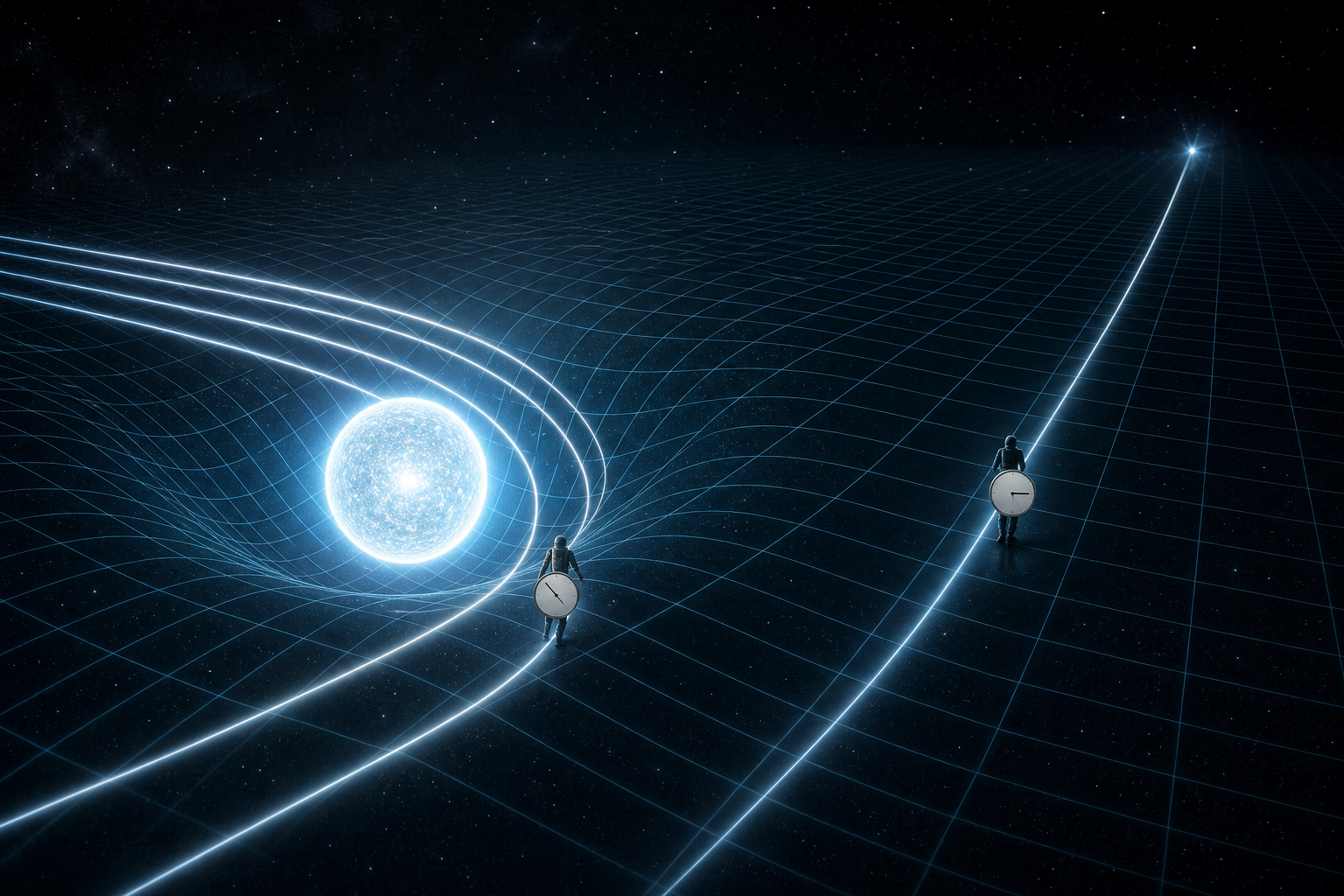
Modern physics doesn’t preserve the old picture of an unchanging spatial container accompanied by one universal clock. Space and time are joined as spacetime, and its geometry responds to matter and energy. Under general relativity, curvature isn’t a decorative feature laid over a fixed arena; it is part of the physical description of that arena.
Cosmology makes this dynamism especially visible. In the Friedmann–Lemaître–Robertson–Walker framework, a scale factor, conventionally written as a(t), describes change in the universe’s large-scale spatial geometry. Saying that “space evolves” can therefore be legitimate shorthand, provided the speaker means an evolving metric or scale factor rather than a substance stretching inside some larger, unseen room.
Time isn’t an absolute backdrop either. Relativity provides no single observer-independent “now” shared across the cosmos. Proper time is the interval measured by a clock along its own worldline. Coordinate time belongs to a chosen system for assigning temporal coordinates. Differences in motion and gravitational conditions can produce different elapsed times, so “time varies” must always be completed with a question: which clocks, following which paths, under which conditions?
The invariant quantity in relativity isn’t space alone or time alone. The spacetime interval combines spatial and temporal separation, while the speed of light c remains invariant. Different observers can divide spacetime into spatial and temporal components differently without making every description arbitrary. Relativity replaces an absolute separation of space and time with precise transformation rules and invariants.
The phrase “flow of time” introduces another issue. Physics distinguishes measured intervals from arrows of time. The thermodynamic arrow concerns increasing entropy; the cosmological arrow concerns cosmic expansion; the psychological arrow concerns our felt movement from remembered past toward anticipated future. Calling all three “time flowing” conceals the mechanism that needs explanation.
Questions that expose a weak science claim
When someone invokes relativity in a spiritual discussion, ask the following:
- Does “relative” refer to velocity, gravitational conditions, a coordinate choice, or merely personal opinion?
- Is “space changes” a claim about curvature, cosmic scale, measured distance, or subjective spaciousness?
- Is “time stops” meant literally for a clock, or phenomenologically as the absence of noticed succession?
- What remains invariant in the proposed comparison?
These questions don’t obstruct dialogue. They keep a precise physical claim from being converted into a vague metaphysical endorsement. Relativity can show that temporal and spatial measurements aren’t absolute in the Newtonian sense. It doesn’t, by itself, prove that time is illusory, that consciousness creates the cosmos, or that a particular path to mokṣa or nirvāṇa is correct.
Dharmic traditions offer several cosmologies, not one formula
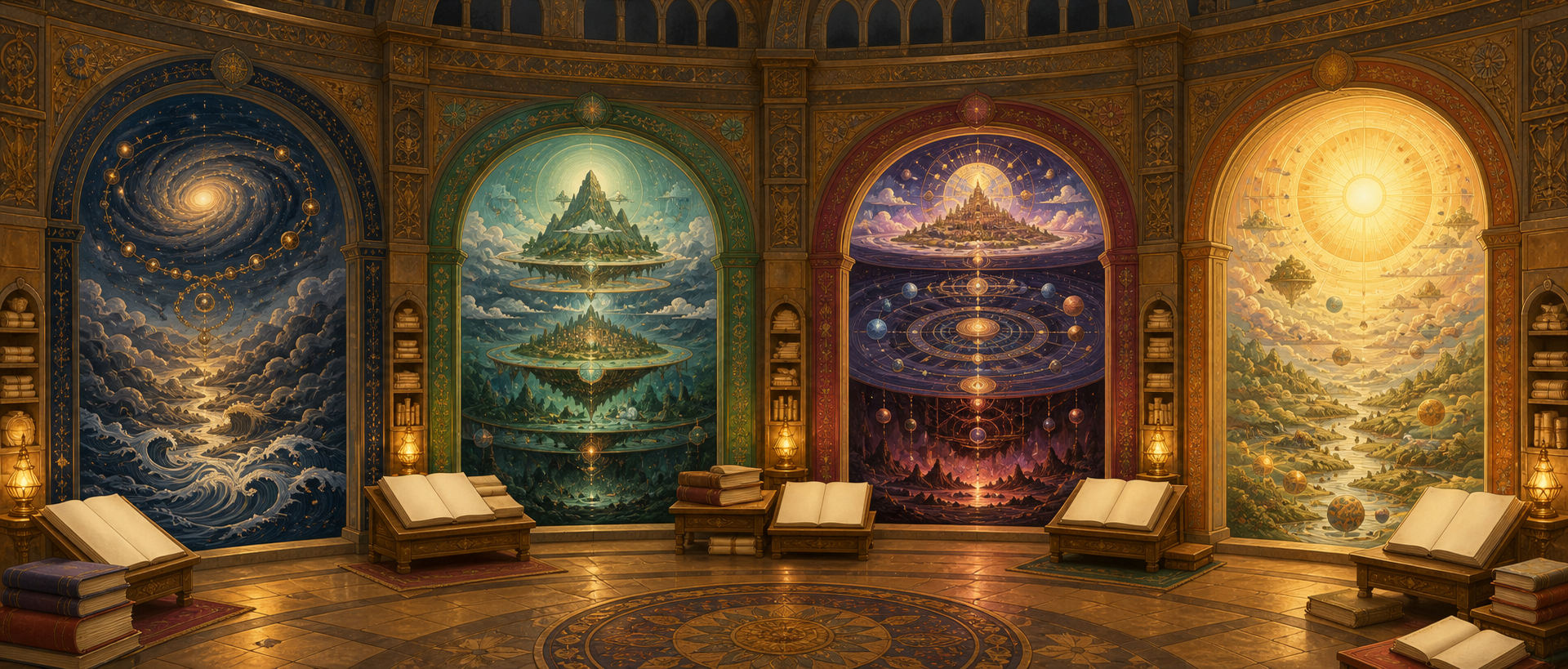
“The Dharmic view” is too broad when discussing time and space. The traditions share recurring concerns—causation, cyclicality, transformation, bondage, liberation, and realities not exhausted by ordinary succession—but they don’t reduce kāla and ākāśa to a single doctrine. Their disagreements are philosophically productive and should remain visible.
Nyāya–Vaiśeṣika: real frameworks for relation
Classical Vaiśeṣika places kāla and ākāśa or dik among real dravyas. Within this outlook, time and space are beginningless and pervasive conditions through which objects and events can be temporally and spatially related. Their eternal status doesn’t imply that events are frozen. It means change occurs within frameworks that aren’t themselves manufactured by each passing event.
If you encounter the sentence “time is constant” in this context, “constant” should not be read as “every clock everywhere advances at the same rate.” The intended issue is the ontological status of kāla as a dravya, not a comparison of clocks in different gravitational fields.
Sāṅkhya, Yoga, and Vedānta: transformation and the timeless
Sāṅkhya and Yoga place transformation on the side of prakṛti. Mental events, including the vṛttis through which succession is noticed, belong to that changing domain. Puruṣa is the witnessing principle and isn’t another object moving through the sequence it illuminates. Here, timelessness means freedom from temporal modification, not an infinitely long duration.
That distinction matters. “Eternal” can mean lasting through all time, but “beyond time” means not participating in temporal succession at all. An endless sequence and freedom from sequence are conceptually different. Treating them as synonyms turns a liberation teaching into a claim about longevity.
Vedāntic analysis often sharpens the distinction through levels of reality. At the vyāvahārika, or empirical, level, yugas, manvantaras, kalpas, creation, and dissolution unfold in ordered cycles. At the pāramārthika, or ultimate, level, Brahman or ātman is nitya and beyond kāla and ākāśa. The changing sequence isn’t denied merely because its ground is described as changeless; the two statements answer questions at different levels.
Buddhist analysis: succession without an independent temporal substance
Buddhist approaches resist being folded into a Vedāntic language of an eternal witnessing Self. Abhidharma discussions of momentariness describe conditioned phenomena as arising and ceasing in kṣaṇas. Time can then be understood through the succession of dharmas rather than as an independently flowing container.
Some Buddhist classifications treat the space element as unconditioned. Madhyamaka takes a different analytical route: time and space lack inherent, independent existence and function as dependently arisen designations. Emptiness here isn’t a hidden substance behind appearances. It is the absence of self-established existence. Replacing śūnyatā with “timeless cosmic consciousness” therefore erases a major doctrinal difference.
The Kālacakra, or Wheel of Time, joins cosmological cycles to inner yogic processes. Its presence is a reminder that Dharmic temporal language can operate cosmologically, ritually, bodily, and contemplatively at once. You still have to identify which operation is relevant in the passage or teaching before drawing a scientific analogy.
Jaina and Sikh thought: eternal realities, changing modes, and Akaal
Jaina cosmology distinguishes six dravyas: jīva, pudgala, dharma as the medium of motion, adharma as the medium of rest, ākāśa, and kāla. In this system, dharma and adharma aren’t moral merit and demerit in this particular technical usage. They are cosmological media, so translating them without qualification can misdirect the entire discussion.
Ākāśa and kāla are beginningless, yet dravyas undergo paryāya, or modes. This provides a disciplined way to hold endurance and change together: a substrate may be enduring while its modes transform. Jaina kāla is therefore neither a disposable illusion nor simply the same thing as relativistic coordinate time. It is real and necessary for the intelligibility of transformation within its own metaphysical system.
Sikh teaching names the Ultimate as Akal Purakh, the Timeless One. Creation nevertheless unfolds within hukam, the cosmic order governing temporal and spatial processes. Akaal doesn’t mean that physical clocks secretly share one absolute rate. It names divine reality as free from temporal succession. Its closest dialogue with other Dharmic formulations lies in the distinction between conditioned becoming and the Ultimate, not in a shared physics equation.
Build the dialogue without claiming that the systems are identical
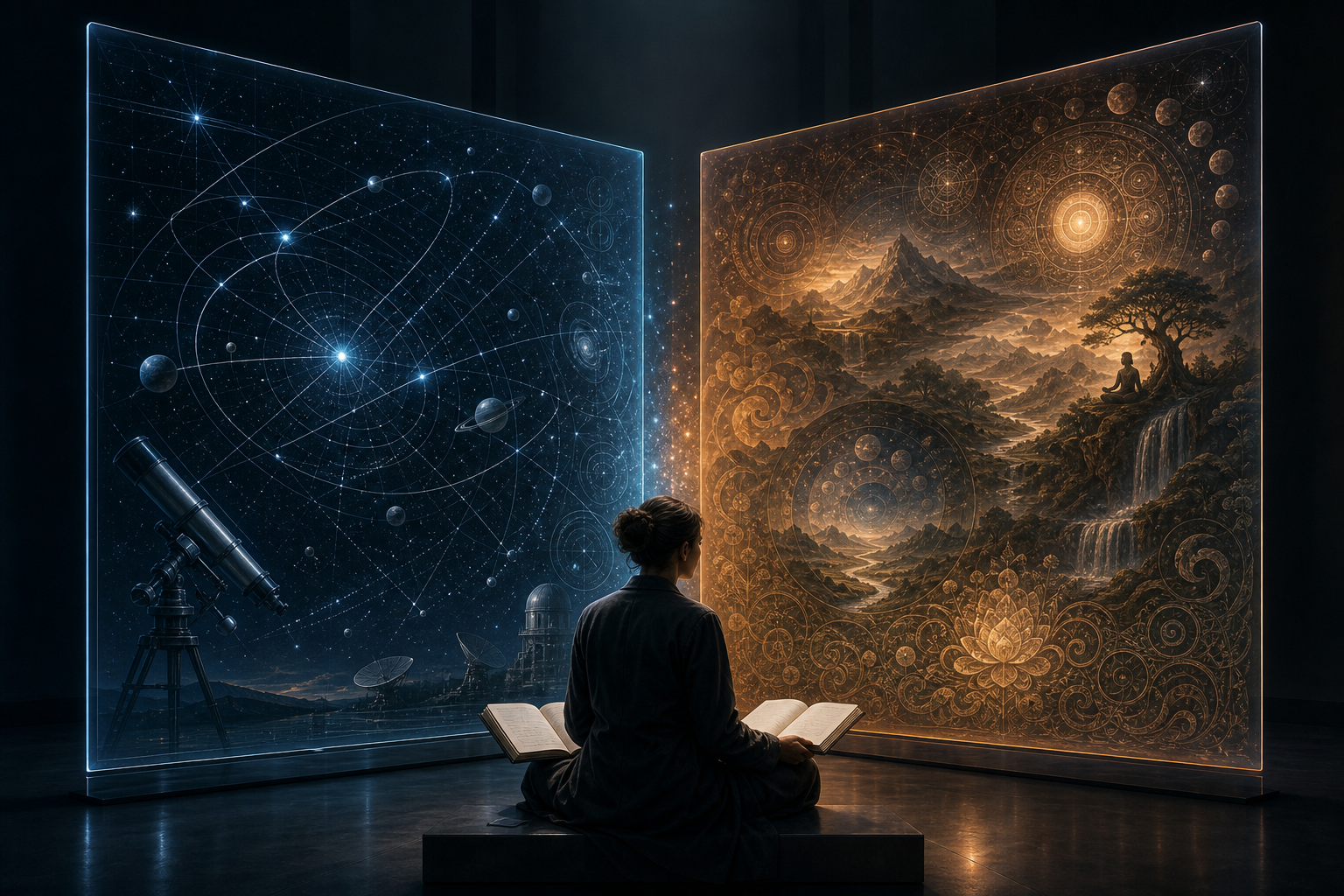
A two-level model can organize the conversation. On an empirical or relational level, physics describes dynamic geometry and observer-dependent temporal intervals. On an ultimate or contemplative level, Dharmic teachings may speak of nitya ātman, puruṣa, Akaal, emptiness, or liberation from reification. The model is useful as a map of questions. It becomes misleading when the items on the second level are treated as synonyms or as experimentally verified consequences of the first.
Use this sequence whenever you assess a proposed meeting of science and Dharma:
- Name the register. Decide whether the statement concerns measurement, cosmology, metaphysics, experience, or liberation.
- Define the key noun. Replace “time” with proper time, coordinate time, causal succession, kāla, remembered duration, or timeless awareness—whichever is actually intended.
- Identify what changes. Is it a metric, a scale factor, a clock reading, a mental vṛtti, a paryāya, or a conditioned dharma?
- Identify what is claimed not to change. Is it a spacetime invariant, an eternal dravya, puruṣa, Brahman, Akaal, or merely the felt presence of awareness?
- State the limit. Add one sentence explaining what the comparison doesn’t establish.
Consider the popular claim, “Relativity proves that the sages knew time is unreal.” The register test immediately reveals the problem. Relativity concerns the structure of spacetime and the relations between physical measurements. “Unreal” may refer to dependent designation in Madhyamaka, empirical appearance in Vedānta, or a loose claim that clocks don’t matter. Those are different propositions. A more accurate conclusion is that relativity undermines a universal Newtonian clock, while some Dharmic schools independently challenge the idea that experienced or conceptual time is self-existent.
The same repair works on “Dharma teaches that time is constant while space evolves.” Nyāya–Vaiśeṣika and Jaina thought can regard time and space as beginningless realities. Vedānta can describe empirical cycles while locating the ultimate beyond both time and space. Buddhist analysis may derive time from succession or treat it as dependently designated. Sikh teaching locates Akaal beyond temporal succession. No single clause accurately replaces all of those positions.
Let contemplation clarify experience, not certify cosmology
You can investigate one part of the question directly. During a quiet sitting, notice sounds, bodily sensations, and thoughts as events appearing in an experienced field. Observe whether that field feels constricted when attention contracts around one thought and more spacious when attention opens. Then distinguish three things in your notes: the changing contents, the felt width or narrowness of the field, and the awareness by which both are known.
This exercise can make the language of citta-ākāśa, cid-ākāśa, vṛtti, and witnessing more intelligible. It can also reveal that psychological duration isn’t identical to a clock reading. It cannot demonstrate an evolving spacetime metric, prove an eternal metaphysical substrate, or settle the disagreements among Vedānta, Buddhism, Jainism, and Sikh thought. That boundary protects both contemplative insight and scientific reasoning from being asked to do work they weren’t designed to do.
Key takeaways
- Relativity treats spacetime as dynamic; it doesn’t teach that space is fixed while only time changes.
- Temporal intervals depend on worldlines, motion, gravity, and coordinate choices; this is more precise than saying simply that “time is relative.”
- Dharmic traditions don’t offer one doctrine of kāla and ākāśa. Some regard them as real dravyas, some analyse time through succession, and some distinguish empirical becoming from an ultimate beyond time.
- Timelessness usually means freedom from succession or modification, not a clock that runs forever at a constant rate.
- Scientific invariance, metaphysical eternity, dependent designation, and contemplative stillness must not be treated as interchangeable.
- A responsible comparison names the register, defines the terms, identifies what changes and what doesn’t, and states the limit of the analogy.
The next time you encounter a grand claim linking quantum theory, relativity, or cosmology to Dharma, write three lines before accepting or rejecting it: what “time” means, what “space” means, and what the comparison actually proves. That small discipline leaves room for genuine resonance without sacrificing the distinctions that make either tradition worth understanding.
References
