
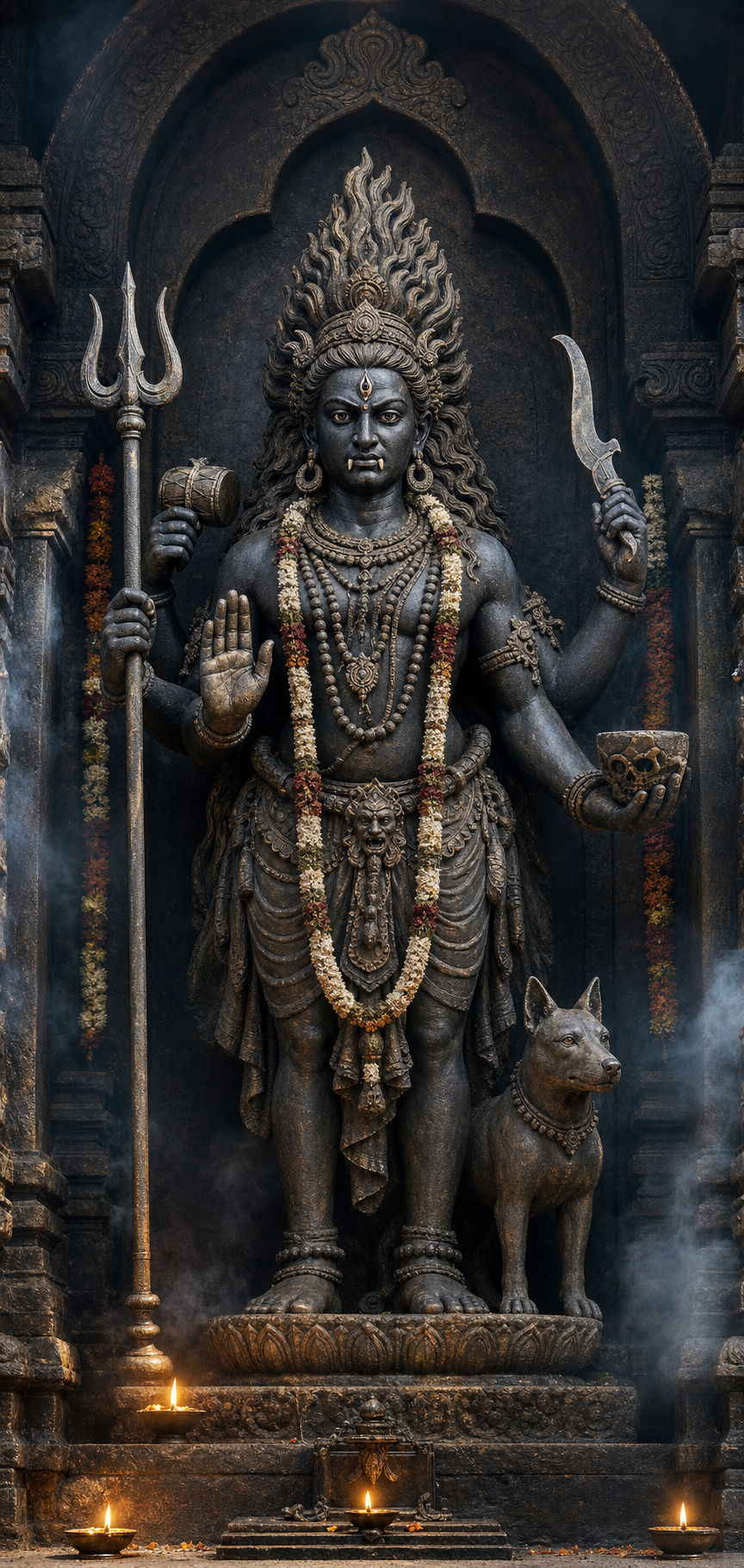
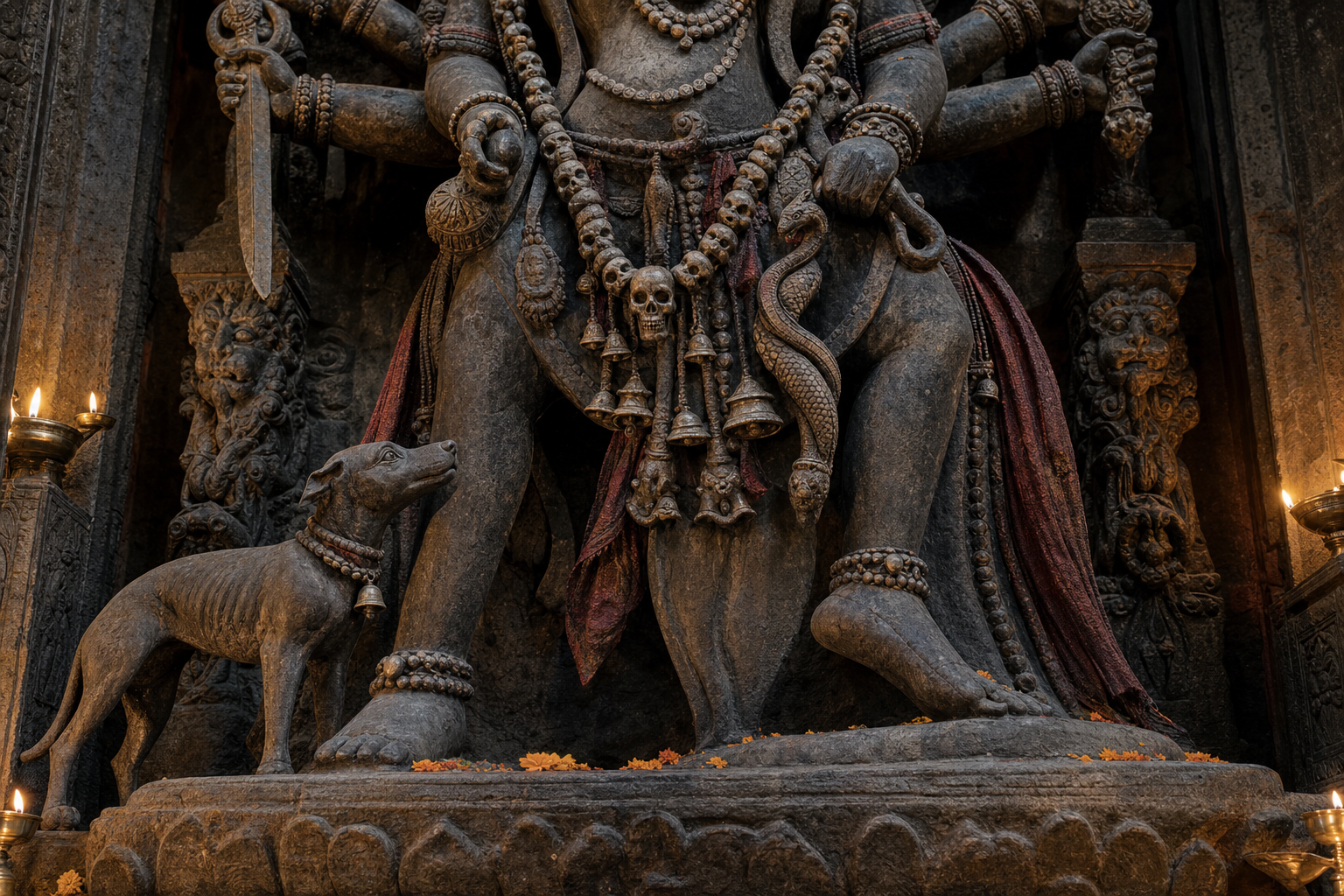
You are standing before a fierce Shaiva image: three eyes, raised weapons, fangs, skulls, perhaps a dog near the feet. Is this specifically Canda Bhairava, or are you looking at another form of Bhairava? The honest answer rarely comes from one weapon or vehicle.
A reliable identification works in layers. First establish the Bhairava visual grammar. Then examine the figure’s place in an eightfold or sixty-fourfold arrangement, its locally transmitted name, its hands and gestures, its vehicle, and its position in the temple. This method lets you read the image without forcing every regional murti into a single modern checklist.
Begin with Canda’s place in the Bhairava family
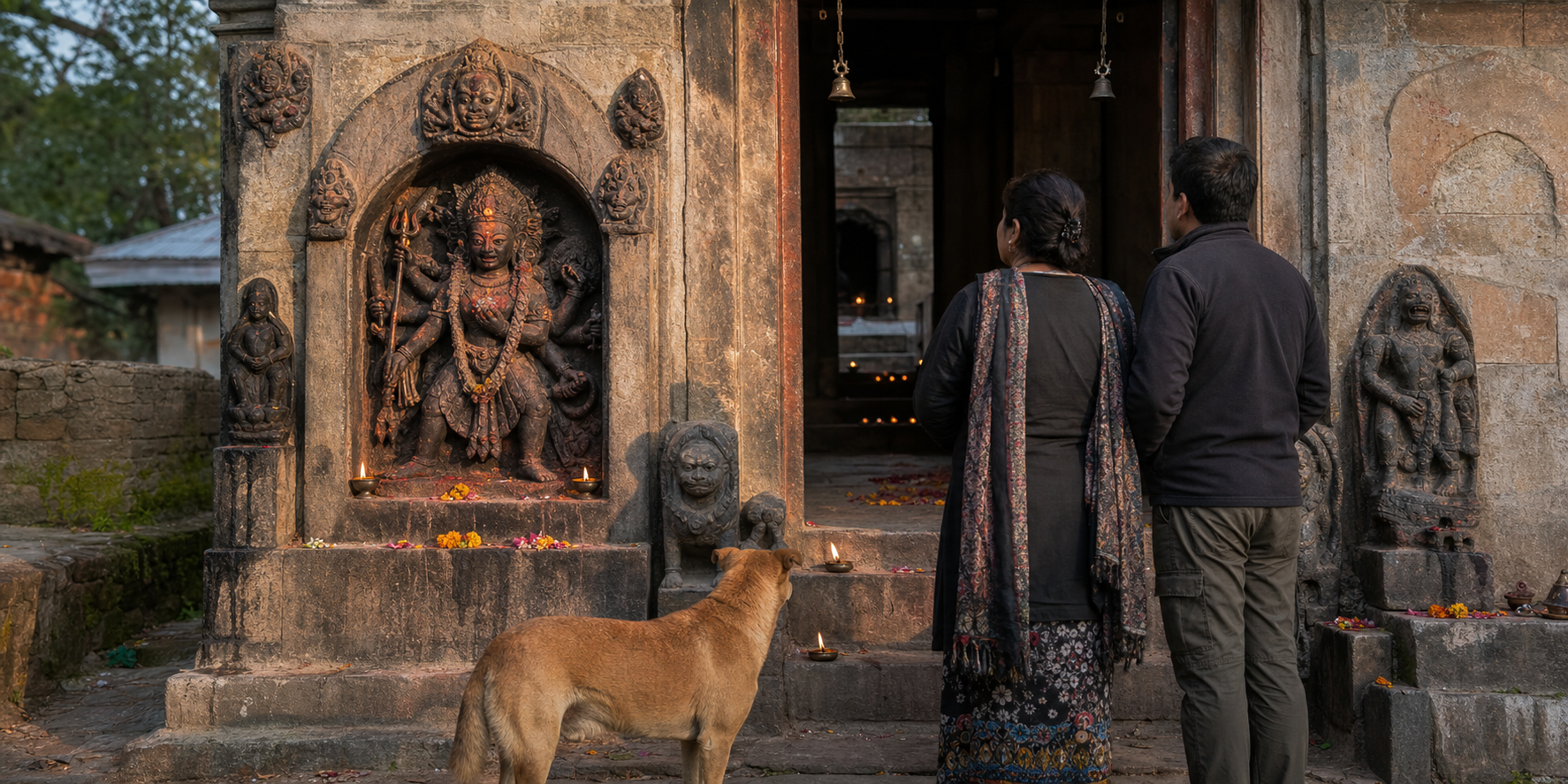
Canda, also written Chanda, means fierce, impetuous, or terrible. The name describes intensity, but it does not mean uncontrolled violence. In Shaiva Tantra and Agamic worship, Bhairava concentrates Shiva’s powers as guardian, dissolver, purifier, and ruler of boundaries. He belongs at places where distinctions must be defended or crossed with care: temple perimeters, thresholds, crossroads, circumambulatory turns, and cremation grounds.
The larger classification matters. Bhairava traditions commonly organize the deity into eight principal Bhairavas and sixty-four more particular manifestations. The sixty-four are arranged as eight groups of eight, with Canda presiding over the third group. Lists of individual names can differ among manuscripts, temples, and regions, but the eight-by-eight structure provides the basic map.
This gives you an important rule: the identity assigned by the temple’s own lineage carries more weight than resemblance to an isolated photograph. If a figure occupies Canda’s position in a locally recognized Bhairava series, that context may identify him more securely than a particular arm count. If the local arrangement follows another recension, you must read it on its own terms.
Key takeaways
- Do not identify Canda Bhairava from fangs, a trident, or a dog alone; those belong to the wider Bhairava vocabulary.
- Start with the temple’s name for the form and its position within an eightfold or sixty-fourfold arrangement.
- Expect four, six, or eight arms rather than treating one arm count as compulsory.
- Use weapons, mudras, vehicle, shrine direction, and visual mood as a cluster of evidence.
- Read fierceness as disciplined protection and the destruction of falsehood, not as permission for aggression.
Read the face, body, and setting before the weapons
The first impression is deliberately unsettling. Bhairava’s wide eyes hold the viewer rather than allowing a casual glance. The third eye intensifies that scrutiny. Visible fangs, a slightly open mouth, and rising matted locks create a raudra, or fierce, presence. Yet fear is not the final message. The image confronts whatever you would rather evade so that fear can be converted into alertness.
- The three eyes: Notice their direction and force. They make seeing an ethical act. You are being asked to look steadily, including at consequences that comfort might conceal.
- The jata: The mass of matted hair presents yogic power as active and radiant rather than withdrawn. When the locks rise like a corona, the sculptor is making contained energy visible.
- Ash and limited clothing: Bhairava may be sky-clad or wear a tiger or elephant hide. Ash and the exposed body remove the ordinary markers by which status and permanence are asserted.
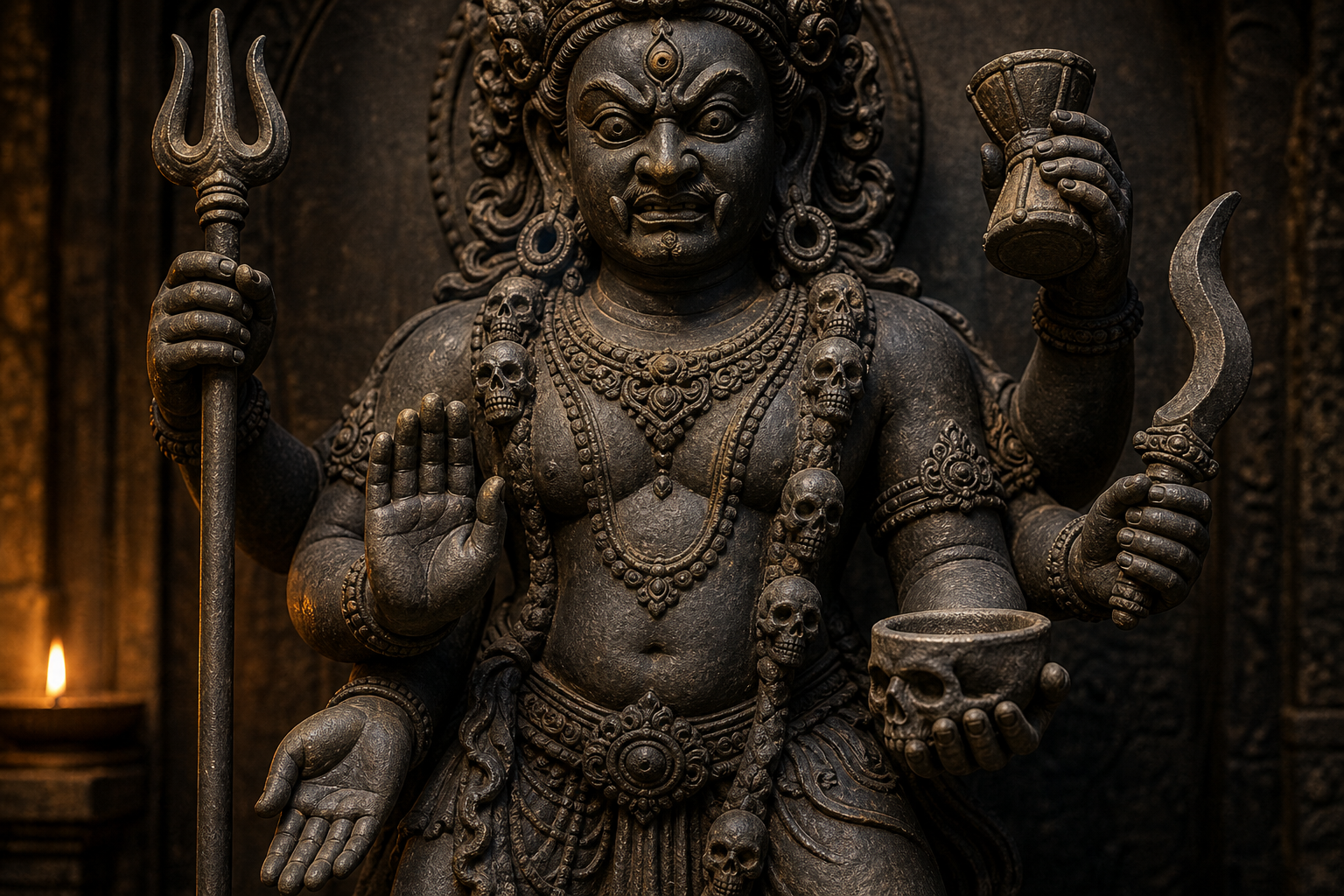
- The mundamala: A garland of skulls turns mortality into instruction. Its purpose is not decorative horror; it brings the limits of ego and the urgency of discernment into view.
- Serpents, bones, and charnel ornaments: These show mastery of the apparent opposition between life and death. The deity does not flee what ordinary consciousness treats as contaminating or frightening.
- The cremation-ground atmosphere: Flames, skulls, bones, or related motifs on the aureole place the image where arising and passing cannot be hidden behind social convention.
Colour can strengthen this reading. Some south-facing shrines use red-ochre or flame-like tones to express Canda’s heat. A stone image can communicate the same force without pigment through deeply cut hair, sharply defined fangs, a taut stance, and the rhythm of the arms. Missing paint is therefore not missing meaning.
Look closely at craftsmanship as well as attributes. Agamic image-making uses canonical tala proportions, ordered weapon placement, and carefully directed sightlines. The angle of the head, eyes, and fangs can make the deity’s attention seem to meet yours. Weathering or later workshop simplification may obscure these details, so do not turn a damaged or abbreviated feature into a theological conclusion.
Translate the objects instead of merely counting them
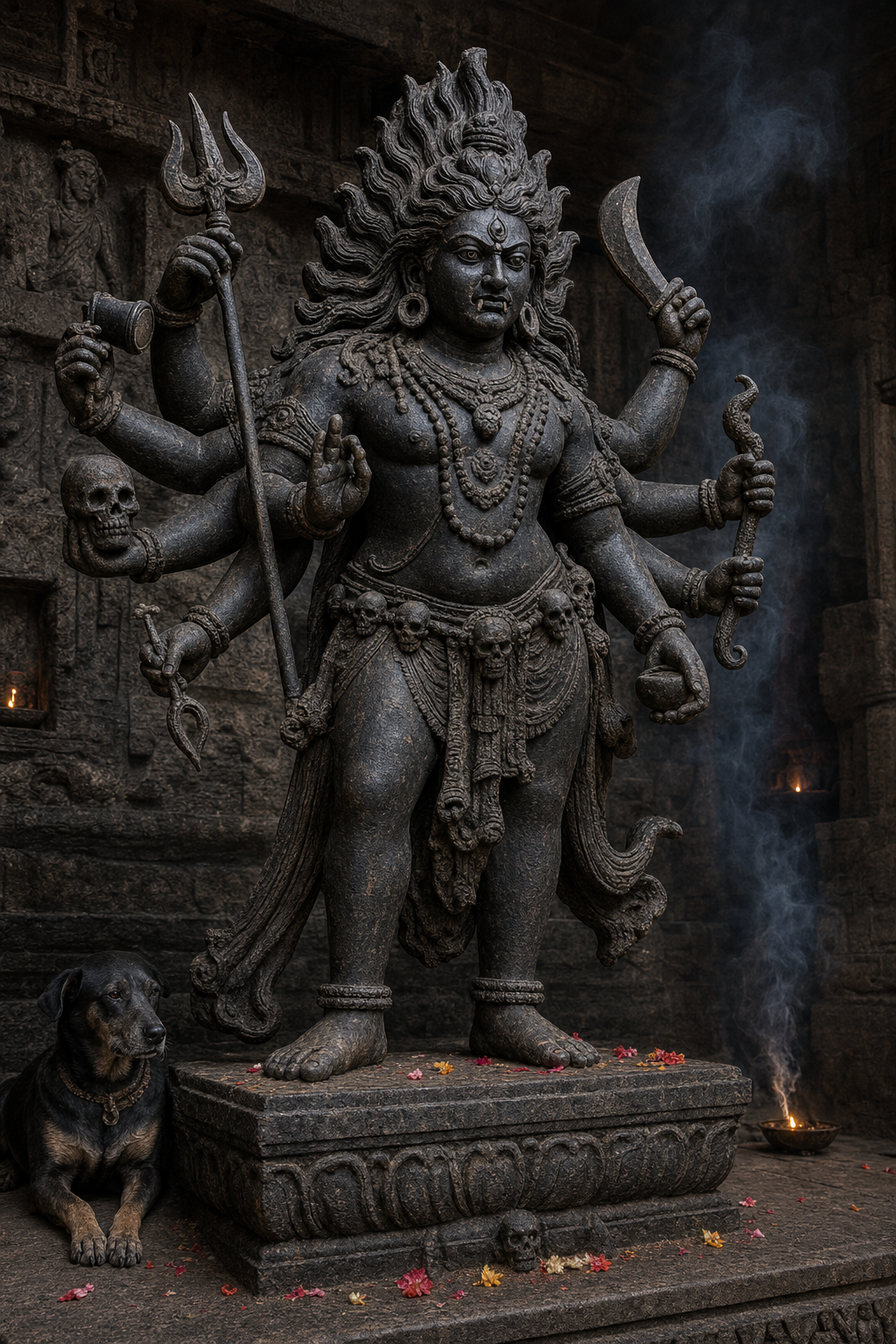
Canda Bhairava may have four, six, or eight arms. That variation is normal. More arms allow a sculptor to present a fuller symbolic ensemble, but they do not make one image more authentic than another. The useful question is not simply how many objects appear. Ask what kind of inner and social disorder each object addresses.
- Trishula: The trident carries Shiva’s sovereignty and the power to establish a decisive limit. In contemplation, it asks where discernment must become duty rather than remain an opinion.
- Damaru: The drum evokes rhythm, manifestation, and withdrawal. It directs attention to things arising and passing instead of being mistaken for permanent possessions.
- Kapala: The skull-bowl refuses the fantasy that mortality can be kept outside sacred life. It receives what the ego rejects and turns impermanence into clarity.
- Khadga or kartrika: The sword or cutting knife represents a clean break with ignorance, hypocrisy, and self-deception. Its target is falsehood, beginning with one’s own.
- Pasha: A noose can appear in the larger arm sets. Read it within the protective ensemble rather than treating it as an independent proof of identity.
- Ghanta: A bell may accompany the principal weapons, contributing to the ritual and sensory field of the image.
- Khatvanga: The club-like charnel implement reinforces the cremation-ground language of non-attachment and fearless contact with mortality.
The trident and drum often appear on the right, while the skull-bowl and sword or knife often appear on the left. The word often matters. Regional conventions, the number of arms, restoration, and the needs of a particular composition can alter the arrangement. Treat handedness as corroboration, not an infallible test.
The ensemble can be read as a sequence. Attention is awakened, disorder is brought to a limit, delusion is cut, and impermanence is accepted. This is why the weapons should not be read as a catalogue of violence. They visualize an economy of force placed in the service of dharma.
Use mudra, vehicle, and shrine position to narrow the reading
The hands that do not hold weapons can clarify the deity’s intention. Abhaya mudra grants fearlessness. Varada offers a boon or the possibility of forward movement after an obstruction. Tarjani, the raised admonishing finger, warns that protection includes ethical limits. Katyavalambita, with a hand resting at the hip, conveys command and royal composure. None of these gestures cancels the fierce mood. They explain what the fierceness is for.
The dog is Bhairava’s most persistent vehicle and insignia. It expresses fidelity, vigilance, boundary-keeping, and perception that does not turn away. It is therefore a strong clue that you are looking at Bhairava, but it does not by itself prove that the form is Canda.
Some recensions differentiate the vehicles of the eight Bhairavas. Regional images of Canda may include leonine or peacock imagery to emphasize martial poise or radiant movement. A lion or peacock is not automatically a sculptural error, and the absence of a dog does not automatically rule Canda out. Vehicle, like arm count, must be checked against the local sthala tradition.
Direction and ritual time require the same caution. In a number of South Indian temple arrangements, Canda is associated with the southern quarter and the heat of midday rites. These correspondences vary across lineages and locations. A south-facing placement can support an identification, but it should not overrule the temple’s own transmitted name.
A practical identification sequence
- Check whether the shrine, inscription, temple record, priest, or local tradition explicitly names Canda or Chanda.
- Determine whether the image stands alone or forms part of an Ashta Bhairava or sixty-four-Bhairava arrangement.
- Record what is actually present before interpreting it: number of arms, objects, mudras, vehicle, direction, ornaments, and surrounding figures.
- Separate generic Bhairava signs from Canda-specific contextual clues. Three eyes, fangs, skulls, a trident, and a dog establish the family more readily than the individual form.
- Check whether apparent anomalies reflect a regional recension, damage, restoration, or a different vehicle tradition.
- State the identification at the level the evidence supports. When local confirmation is absent, Bhairava with features consistent with Canda is more accurate than a categorical label.
For example, a four-armed figure holding trident, drum, skull-bowl, and sword, accompanied by a dog, is recognizably Bhairava. Calling it Canda becomes firmer when the shrine name, its third position in a recognized series, or the temple’s own tradition supplies the missing context. This distinction prevents confident mislabelling while still allowing a meaningful iconographic reading.
Let the fierce form change how you meet fear
Canda’s iconography becomes useful when you stop treating it as a puzzle of names and begin allowing its symbols to question you. Fierceness here is disciplined energy. It faces fear, anger, volatility, and dishonesty without letting them dictate the response. The result sought is not greater agitation, but clearer action and stronger protection of sacred and social boundaries.
- Meet the gaze without immediately looking away. Notice the impulse to retreat, dismiss, or turn the image into spectacle.
- Look at the skull-bowl and skull garland. Identify something you have been treating as permanent even though it is passing.
- Look at the cutting weapon. Name the self-deception, evasion, or hypocrisy that must be ended rather than decorated with spiritual language.
- Look at the trident and protective gesture. Decide which duty, promise, or boundary now requires a clear response.
- Look at the drum. Remember that both the difficulty and your reaction to it arise, change, and pass.
This reading also explains Bhairava’s connection with thresholds, vows, restitution, and truth-pledges. A guardian does more than exclude danger. A guardian preserves the conditions under which trust can exist. Canda’s intensity therefore points outward toward public order and protection of the vulnerable, and inward toward command of one’s own anger and evasions.
Do not improvise ritual offerings from iconography alone. Bhairava worship ranges from orthodox pancopachara and ashtopachara sequences to locally authorized Tantric upacharas; some regions also preserve symbolic madya offerings and protective vows. Follow the practice of the shrine, its priesthood, and your lineage. A fierce image is not a licence to invent a fierce ritual.
The same distinction helps when noticing wider Dharmic resonances. Vajrayana forms such as Mahakala use skull-cups and cremation-ground imagery to transform fear into liberating awareness. Certain Jain temples preserve Kshetrapala-Bhairava guardians as protectors of sacred space. The Sikh value of nirbhau, fearlessness, resonates ethically with Bhairava’s refusal of cowardice and falsehood. These are meaningful affinities, not claims that the traditions or their deities are interchangeable.
On your next temple visit, begin with context, then move from face to body, hands, vehicle, and placement. If the local tradition confirms Canda, you will understand why each feature belongs. If it does not, resist the urge to force certainty. Careful seeing is already part of the discipline the image demands.
References
