
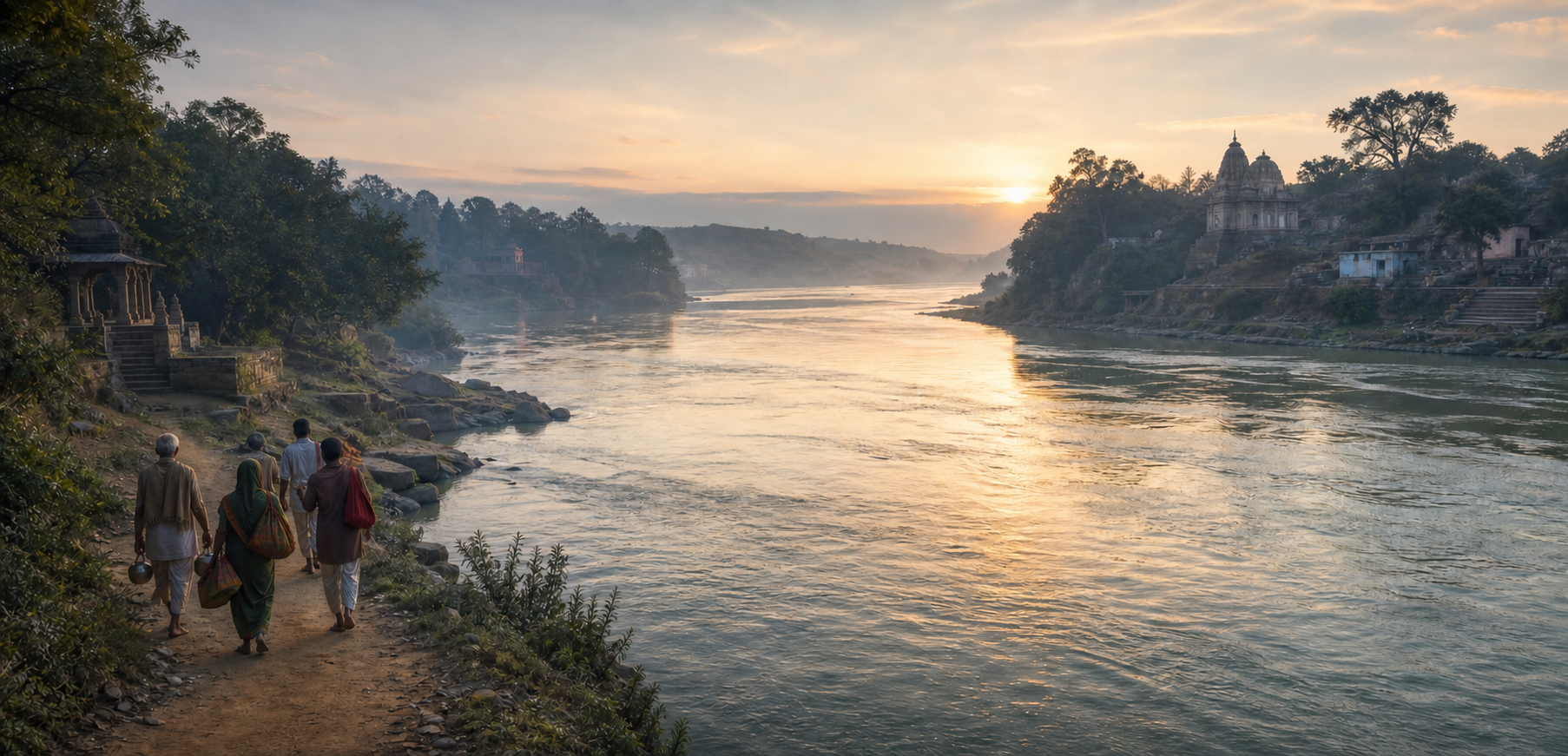
Perhaps you want to undertake Narmada Parikrama, or perhaps you can visit only a few tirthas, and you are unsure what fidelity to the Reva Khanda tradition actually requires. The answer is not how many celebrated places you can collect. Your journey becomes a Reva pilgrimage when Maa Narmada remains its sacred centre and your route, worship, restraint, and treatment of others all answer to that centre.
You can begin on those terms before reaching the river. Decide what vow you can honestly keep, distinguish a full parikrama from a shorter yatra, and prepare to receive each tirtha as an instruction rather than an attraction.
Begin with the vow, not the itinerary
You may encounter different shrine lists, ritual details, and arrangements under the name Reva Khanda. That variation belongs to a layered Puranic transmission: Narmada-centred material appears most visibly in the Skanda Purana and in affiliated Vayu Purana traditions, while manuscript lineages and regional redactions preserve distinctive details. A difference between editions is therefore not automatically a contradiction or a licence to choose whichever rule is easiest.
For practical purposes, choose one coherent lineage of observance before you leave. If a guru, ashram, experienced parikramavasi, or inherited family tradition guides you, clarify its rules directly. Use other recensions to deepen your understanding, not to assemble convenient exemptions after the journey has begun.
Write your intended vow in plain language. It should answer four questions:
- What journey are you undertaking? Name it accurately: a complete Narmada Parikrama, a shorter pilgrimage along part of the river, or a visit to selected tirthas.
- What boundaries will you observe? State your rule concerning river crossings, transport, food, lodging, worship, and periods of rest instead of leaving them to momentary convenience.
- What daily disciplines will remain constant? Choose a sustainable rhythm of prayer, walking, cleanliness, study, and service rather than an impressive schedule that collapses after a few days.
- Who will help interpret uncertainty? Identify the tradition or experienced guide you will consult when local geography and your vow appear to conflict.
A traditional full parikrama is often associated with three years, three months, and thirteen days. That duration expresses sustained austerity; it is not a badge that every devotee must claim. Shorter pilgrimages have long been shaped by capacity and season. If your responsibilities or physical limits permit only a shorter journey, name it honestly and keep it faithfully. Borrowing the status of a full observance while quietly changing its defining disciplines weakens the very quality the vow is meant to cultivate.
The river is the sacred centre of the route
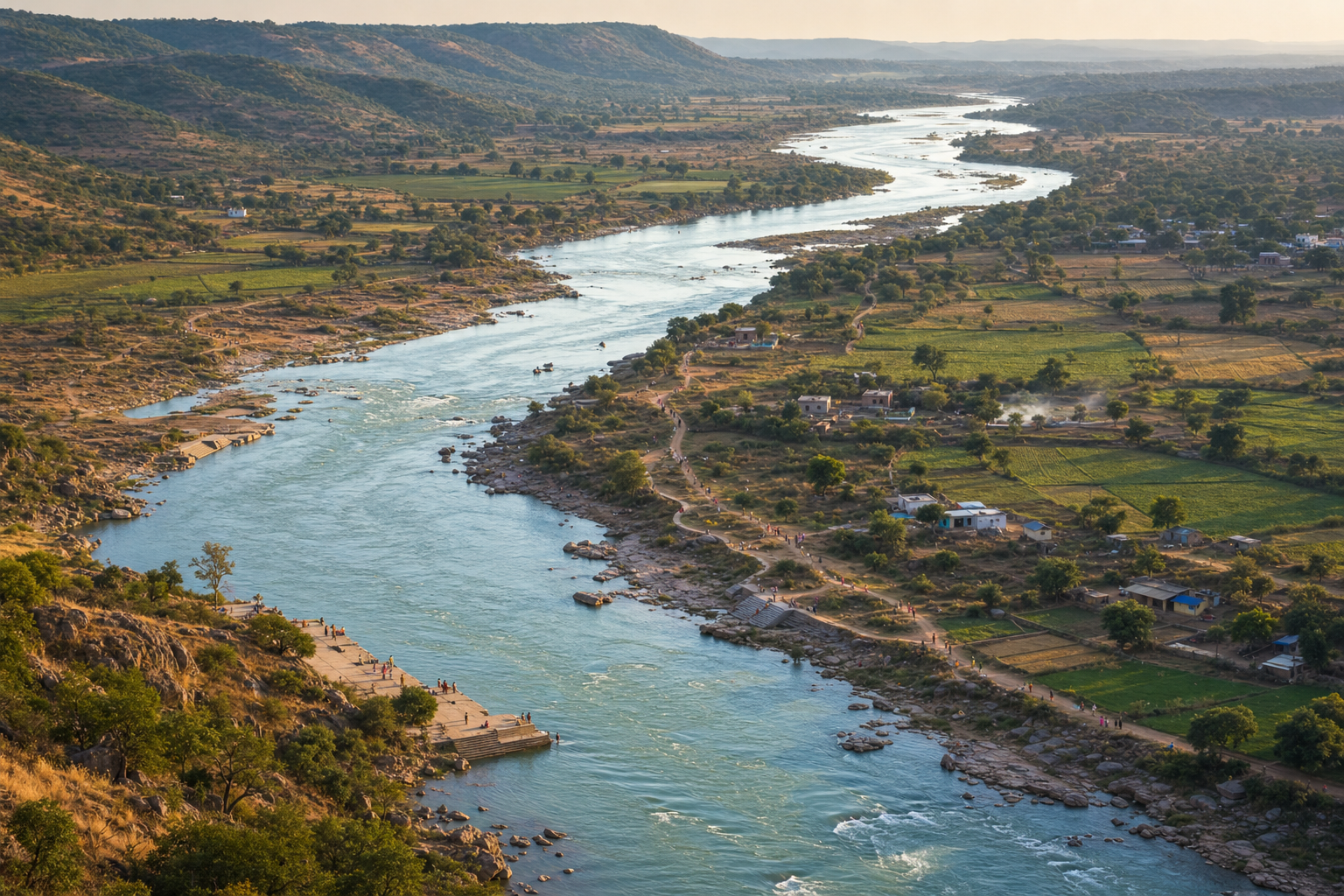
In a traditional full observance, the pilgrim travels from the source at Amarkantak to the meeting with the sea and returns along the opposite bank, ordinarily avoiding a crossing until the estuary. That form turns a long route into circumambulation. As the murti or sanctum remains the centre during temple pradakshina, Maa Narmada remains the centre here across forests, settlements, ghats, shrines, confluences, and difficult stretches.
This distinction protects you from treating the journey as religious tourism. A tour asks what can be fitted into the day. A parikrama asks what conduct preserves the relationship around which the day is ordered. Transport may save time, but it can also alter the vowed form. A convenient crossing may shorten the route, but it can break a boundary you deliberately accepted. Resolve such choices when defining the pilgrimage, not when fatigue makes one answer especially attractive.
The river’s two sacred names also teach you how to look. Narmada is commonly understood as the giver of joy, while Reva evokes the leaping or undulating movement of the river. Her westward course from the Maikal Hills, between the Vindhya and Satpura landscapes, toward the Arabian Sea is more than a line connecting shrines. Motion, stone, water, bank, and changing terrain all participate in the sacred geography.
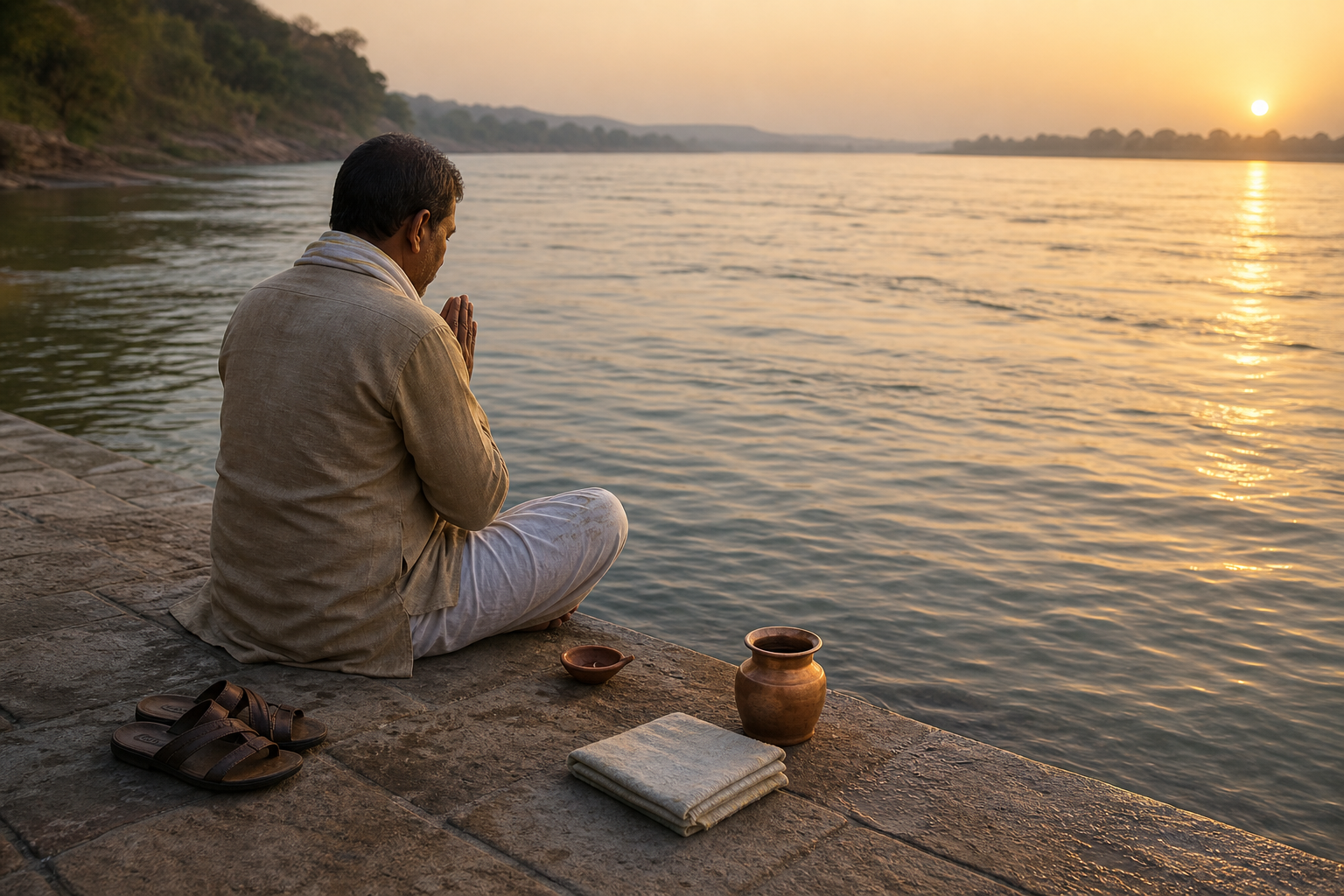
At the river, work with three traditional modes of encounter: darshana, sparsha, and snana – sacred sight, respectful touch, and bathing. Begin with darshana. Stop moving, put aside the urge to photograph immediately, and look. Let sparsha remain reverent rather than casual. Undertake snana only where the water, bank, your health, and local guidance make it safe. A sacred affirmation of bathing is not a guarantee that every current or access point is physically safe; when conditions are unsafe, receive darshana and pray from the bank.
Reverence for Reva also need not become competition with other sacred rivers. The traditional seven-river invocation places Narmada alongside Ganga, Yamuna, Sarasvati, Godavari, Sindhu, and Kaveri. You can honour the distinctive grace of Maa Narmada without diminishing another Dharmic tirtha. That plurality is part of the tradition, not a concession outside it.
Read five places as stages of practice

The major places along Narmada are not interchangeable stops. Each reveals a different relationship among water, Shiva, memory, worship, and human stewardship. If your pilgrimage includes the following places, give each one a distinct purpose.
Amarkantak: make emergence deliberate
At Amarkantak, springs and kunds give ritual form to the river’s emergence. Narmada’s sacred origins are variously associated with Shiva’s ascetic power, penance, divine perspiration, or cosmic dance. These variations direct attention to divine energy becoming a terrestrial presence; they need not be flattened into a single mechanical account.
Use the source as the place where intention becomes commitment. State the form and boundaries of your vow, offer worship appropriate to your tradition, and resist beginning in a rush. A confused beginning does not become clearer merely because you have started walking.
Narmadapuram: distinguish a crossing place from permission to cross
Narmadapuram is remembered as a significant ritual crossing in the river’s sacred itinerary. Its importance does not, by itself, cancel the crossing discipline of a full traditional parikrama. Geography can present a possibility without turning that possibility into permission under your vow.
Treat such a place as a test of clarity. Before acting, ask which rule governs your particular observance. If the answer is uncertain, consult the tradition guiding you rather than deciding that a prominent ghat must make every crossing acceptable.
Omkareshwar: let mantra, form, and movement converge
At Omkareshwar, also known as Mandhata, the jyotirlinga and the island traditionally understood through the form of Om unite Shiva’s light, sacred sound, land, and flowing water. Circumambulation of the island, offerings of bilva leaves, and repetition of Shiva’s names turn the landscape into performed worship.
Do not reduce the visit to obtaining darshana as quickly as possible. Choose a manageable practice – island circumambulation where appropriate, attentive nama-japa, or quiet worship by the river – and give it enough time to gather your attention. Omkareshwar teaches concentration: several dimensions of sacred life can meet in one disciplined act.
Maheshwar: notice the labour that keeps a tirtha alive
Maheshwar reveals that sacred inheritance depends on stewardship. Its temples and ghats, including the Ahalyeshvara Mahadeva Temple and the works associated with Maharani Ahilyabai Holkar’s patronage, join Puranic sanctity to historical care. Stone steps, places of worship, and facilities serving pilgrims endure because people accepted responsibility for them.
At Maheshwar, add seva to sight. Keep the ghat clean, participate respectfully in worship, and support a legitimate temple, community kitchen, or pilgrim service if you are able. The important recognition is simple: receiving the benefit of a tirtha and helping preserve it belong to the same Dharmic relationship.
Bharuch and the sea: treat arrival as a turning point
Near Bharuch, the Reva-sagara sangama marks Narmada’s meeting with the sea. For a full parikramavasi, this is not merely a finish line. It is the great transition between the outward movement from Amarkantak and the return along the other bank.
Approach the confluence without the mentality of having conquered a distance. Review the vow before beginning the return. Fatigue and the emotional force of reaching the sea can tempt you to relax the discipline precisely when continuity matters most. The circuit remains unfinished until the return relationship with the river has been honoured.
Carry dharma between the tirthas
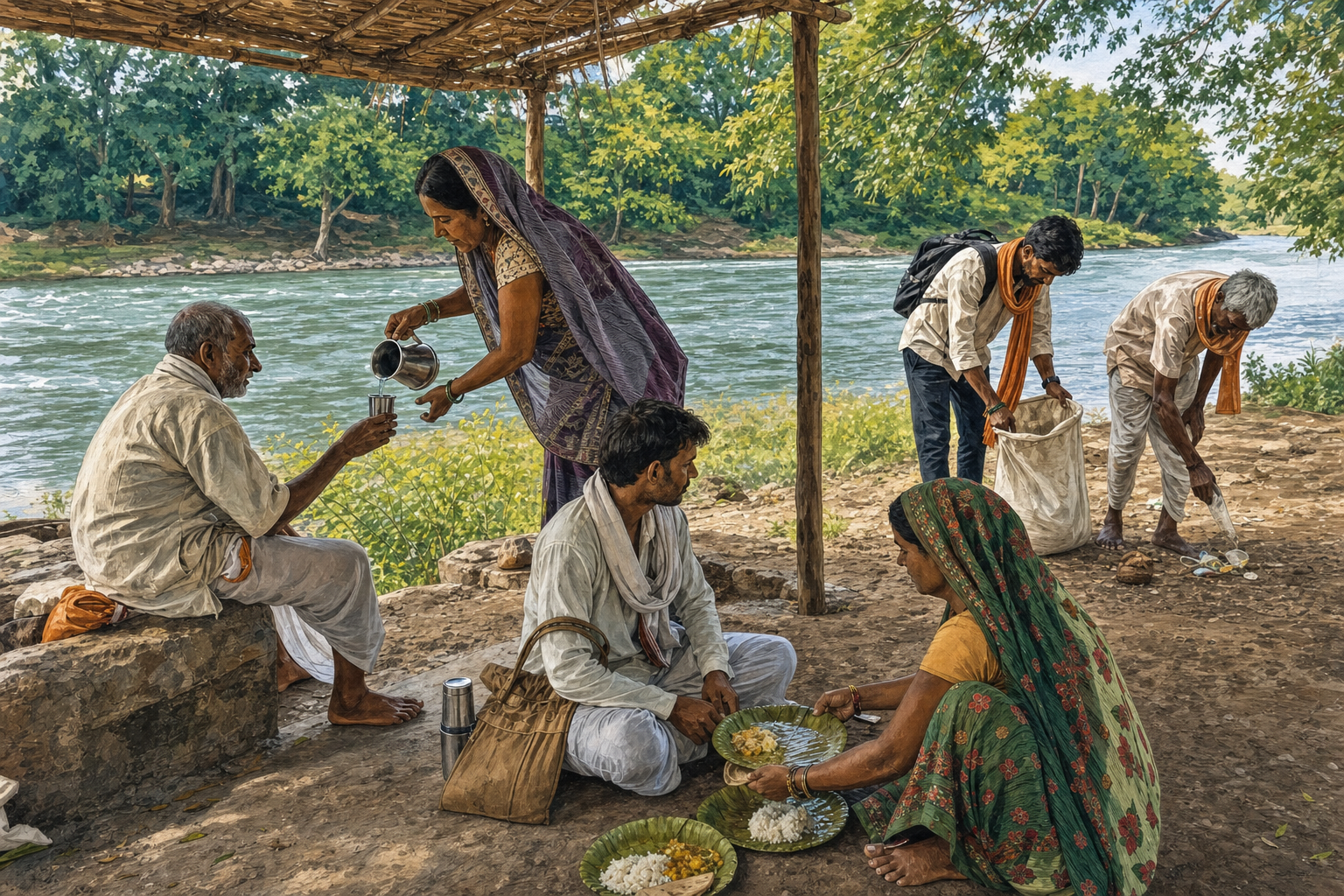
The famous shrines are not the hardest part of pilgrimage. The harder test comes between them, when there is no ceremonial setting and no audience. In the Reva tradition, ahimsa, satya, shaucha, hospitality, mindful almsgiving, and care for fellow pilgrims are not optional courtesies added to sacred travel. They are part of its discipline.
- Practise ahimsa in ordinary decisions. Do not make another person, animal, or riverbank bear an avoidable cost for your speed or comfort. A demanding vow does not authorize harshness toward those travelling with you.
- Keep satya in the account you give of your journey. Describe the distance, transport, crossings, austerities, and interruptions honestly. A pilgrimage is not improved by presenting a partial observance as something it was not.
- Make shaucha visible. Leave resting places, ghats, and banks cleaner than you found them. Use offerings responsibly and do not leave packaging or ritual residue for the river or another person to remove.
- Practise hospitality without performance. Share food, information, or practical help within your capacity. Receive legitimate help with gratitude rather than treating dependence on others as an entitlement created by pilgrim status.
- Give alms mindfully. Let dana serve a real person, temple, sadhu, kitchen, or community need. The value lies in responsible giving, not in being seen to give at every prominent stop.
- Respect natural features as sacred, not collectible. Riverine life, forests, banks, and Narmada’s smooth stones belong to a sacred ecology. Do not assume that an object which moves you spiritually is therefore yours to remove.
You can test this discipline each evening with five questions: Did anything you did damage or pollute the bank? Were you truthful about how you kept the vow? Did convenience create avoidable harm? Did you support or burden the people around you? Is tomorrow’s plan compatible with your actual capacity and current conditions? Write down any needed correction while it is still small.
Statements of merit attached to baths, lunar observances, confluences, and vows can motivate sustained remembrance, but they should not become a private accounting system. Amavasya, purnima, festival snanas, and place-specific observances sanctify time as well as place. Consult the local ritual calendar when planning them, then judge your practice by steadiness and conduct rather than by an imagined total of rewards.
Nor should perseverance become recklessness. If illness, injury, dangerous water, severe weather, or an unsafe route makes continuation hazardous, pause and obtain appropriate local or medical help. Record how the interruption affects your vow and seek guidance about resuming it. Concealing a necessary pause does not preserve spiritual integrity; truthful discernment does.
Key takeaways for a responsible Reva pilgrimage
- A Narmada pilgrimage is defined by the river-centred vow and your conduct, not by the number of famous tirthas visited.
- A traditional full parikrama goes from Amarkantak to the sea and returns along the opposite bank, ordinarily preserving a strict rule against intermediate crossings.
- The often-cited duration of three years, three months, and thirteen days is a classical austerity, not a target you should claim without the capacity and commitment to observe it.
- A shorter yatra should be named as such and given clear disciplines of its own; honesty is more important than borrowed status.
- Darshana, sparsha, snana, worship, seva, and care for the river turn sacred geography into practice. Bathing must still be physically safe.
- Ahimsa, satya, shaucha, hospitality, responsible offerings, and ecological restraint remain binding between the celebrated shrines.
Before booking transport or choosing your first stop, make a four-line pilgrimage note: the form of your journey, the crossing rule, the disciplines you will keep each day, and the conditions under which you will pause for safety or seek guidance. Carry that note with you. If each decision can still answer to it when the route becomes difficult, you will be walking with Reva rather than merely travelling beside her.
References
