
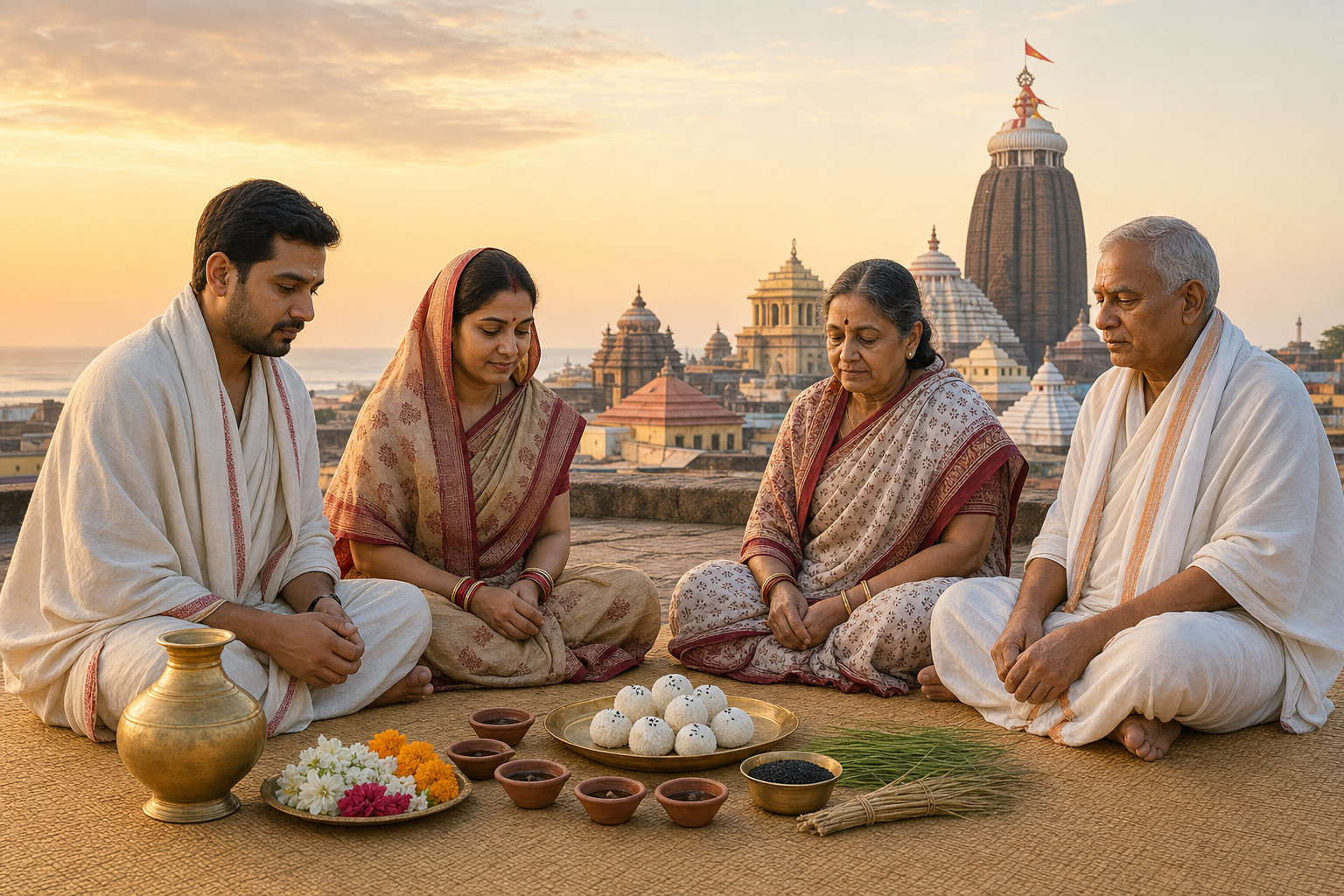
You may be going to Puri because an annual tithi is approaching, because your family must complete an ancestral duty, or because you want to remember elders from both sides of a marriage. The difficult part is often not devotion. It is knowing which rite you are arranging, how family custom should guide it, and where Jagannath belongs within the observance.
A coherent Puri observance joins three elements without confusing them: your inherited obligations to the Pitṛs, the sacred geography of Puri, and the grace of Lord Jagannath. Settle the family and ritual questions before reaching the shore. You can then approach tarpaṇa, piṇḍadāna, darśan and Mahāprasād as one purposeful act rather than a collection of religious stops.
First decide which ancestral rite you are arranging
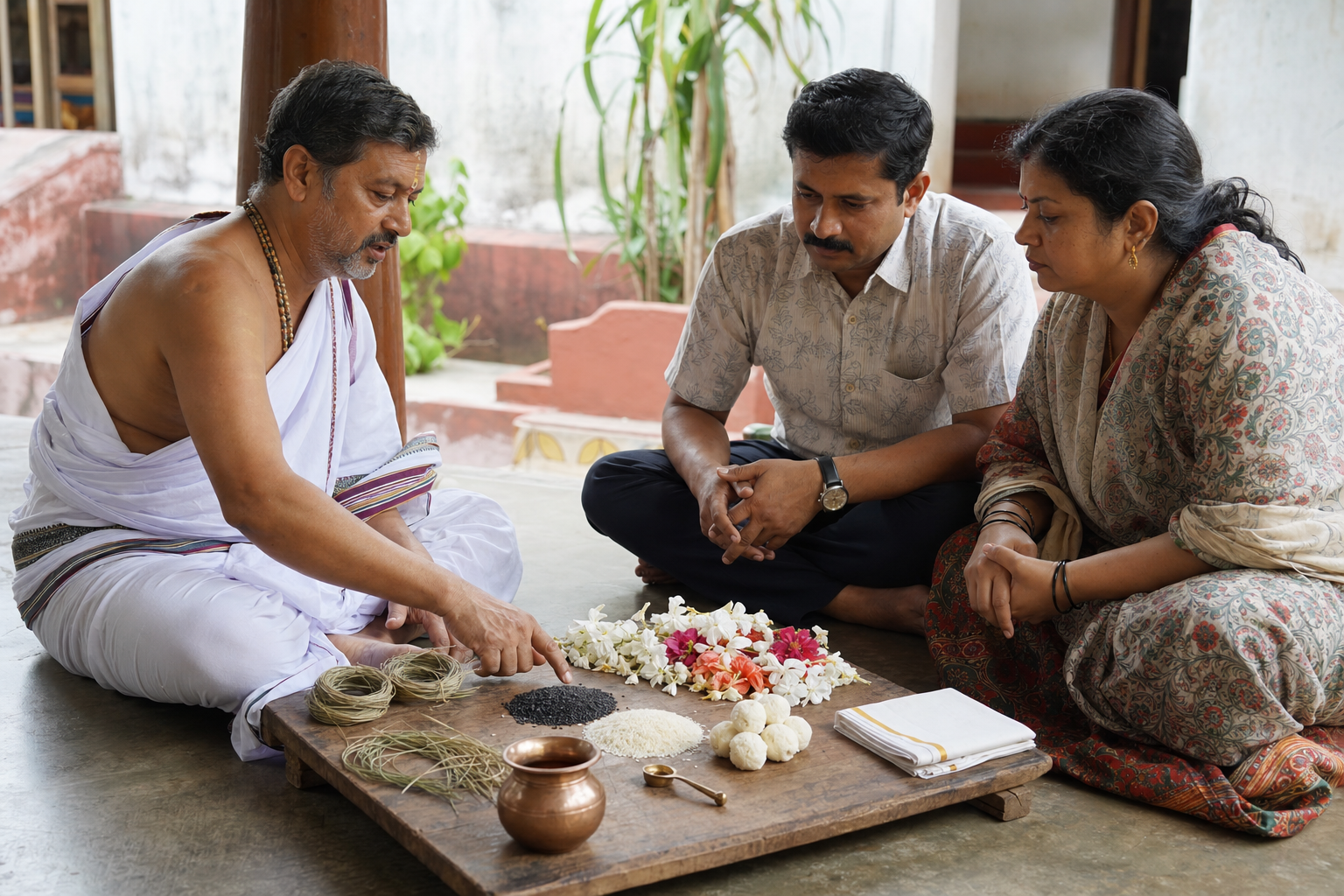
Begin with a distinction that prevents many later misunderstandings. Antyeṣṭi comprises cremation and the rites immediately connected with death. Śrāddha is the continuing expression of gratitude and duty toward the ancestors. A cremation at Swargadvāra and a later memorial offering may belong to the same sacred responsibility, but they are not interchangeable rites.
Śrāddha is tied to lunar tithi rather than merely to a convenient civil-calendar date. Amāvasyā is important for ancestral observances, while Pitru Paksha, culminating in Mahālaya Amāvasyā, draws particular attention to them. If your family is observing a specific ancestor’s appointed tithi, confirm that tithi with a competent priest instead of assuming that any day during a pilgrimage will serve equally well.
A typical observance can include sankalpa, tarpaṇa with water and til, piṇḍadāna, and feeding or gifting performed for the benefit of the departed. These are not interchangeable devotional gestures. Sankalpa identifies the intention; tarpaṇa offers libations; piṇḍadāna gives ritual form to remembrance; and annadāna or brāhmaṇa-bhojana carries the duty into an act of nourishment. The precise arrangement remains subject to your lineage and inherited practice.
Before making travel plans, ask the priest who will guide you one direct question: “Which rite and tithi apply to this observance, and which family procedure will you follow?” A clear answer is more useful than booking a generic ritual package whose scope has never been explained.
Bring both family lineages into the conversation early
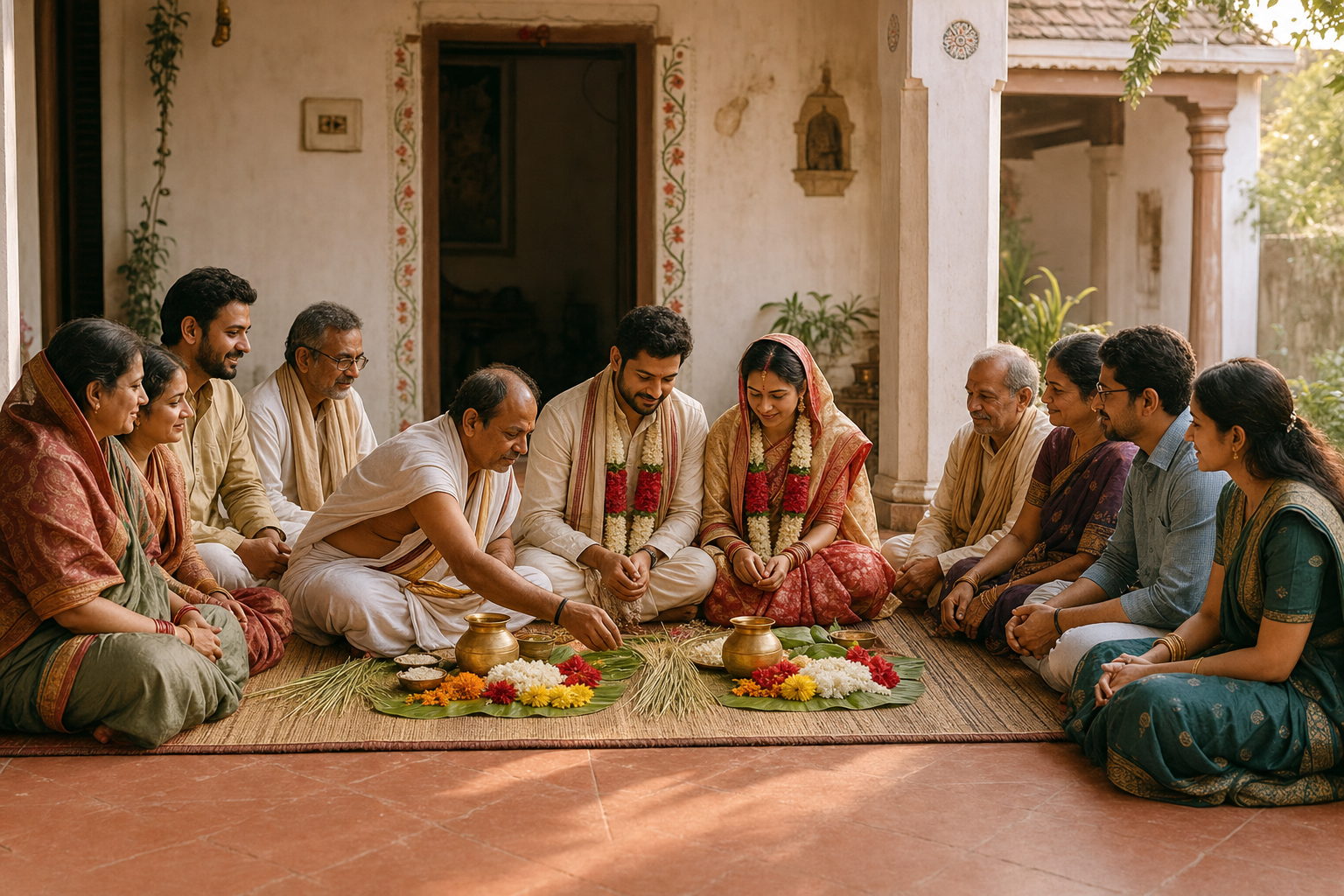
The Odia devotional expression Four Parents, One Lord places the father and mother of both the natal and marital families before one compassionate Lord. Its force is ethical as well as ritual. Marriage does not erase one household’s debt of gratitude or make the other household’s ancestors secondary. Jagannath becomes the unifying centre of remembrance without dissolving the distinct relationships being honoured.
This inclusive principle should not be used to improvise a sankalpa at the last moment. Family traditions can differ over who is named, who serves as the human kartā, and how separate ancestral lines are ritually remembered. The phrase invites fairness between families; it does not replace the procedures through which that fairness is expressed.
Resolve the following matters before you arrive in Puri:
- Which ancestor or ancestral line is the immediate subject of the rite.
- Whether the family intends to remember one lineage or elders from both spouses’ families.
- Which lunar tithi governs the observance.
- Who will act as kartā under the family’s accepted practice.
- Which parts of the inherited procedure the local priest will preserve, and which parts reflect Puri custom.
- Whether Mahāprasād, annadāna or brāhmaṇa-bhojana will form part of the family’s dedication.
Write these decisions down. Grief, travel and the movement of a busy pilgrimage city are poor conditions for settling a disagreement about whose parents are included. A short family conversation in advance protects the dignity of the sankalpa and allows each household to understand what is being done.
Understand what it means for Jagannath to complete the offering
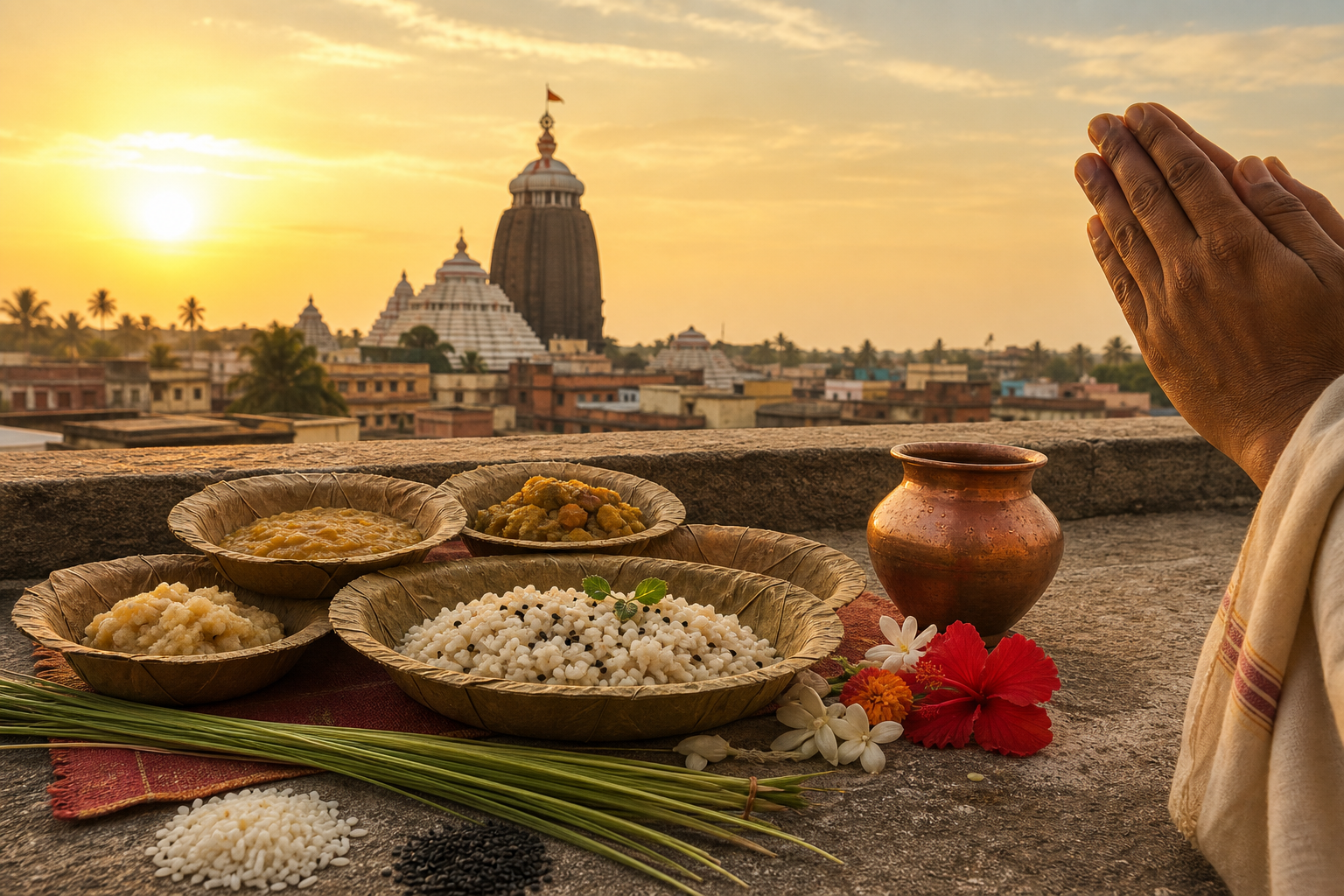
The cherished idea that the Lord performs śrāddha should be understood theologically, not literally. Jagannath does not replace the human kartā or cancel the family’s duty. The devotee undertakes the rite; Jagannath, worshipped as Viṣṇu, receives and perfects the offering. The conviction is that what is offered through Viṣṇu reaches the Pitṛs.
This distinction protects you from two opposite errors. The first is thinking that a visit to Jagannath substitutes for the ancestral rite your family must perform. The second is treating darśan as an optional ornament added after the “real” ritual. In Puri, responsibility and grace belong together: you perform the duty entrusted to you, and you place its fulfilment before the Lord.
Mahāprasād makes that relationship tangible. It is not simply food purchased after worship. It is Jagannath’s consecrated anna, revered in Puri as kaivalya-prada, a bestower of liberation. Families may dedicate the merit of receiving and sharing it to their ancestors. The ritual movement therefore does not end with an offering placed down and left behind. It proceeds toward food received as grace and shared with others.
That shared meal also gives the rite a social dimension. Mahāprasād is shared across social boundaries, turning private memory into a practice of fellowship. If you include it, decide beforehand how it will be received, shared and treated reverently. Do not reduce it to a token carried home while overlooking the act of sharing that gives the observance much of its communal meaning.
Move through Puri as one sacred sequence
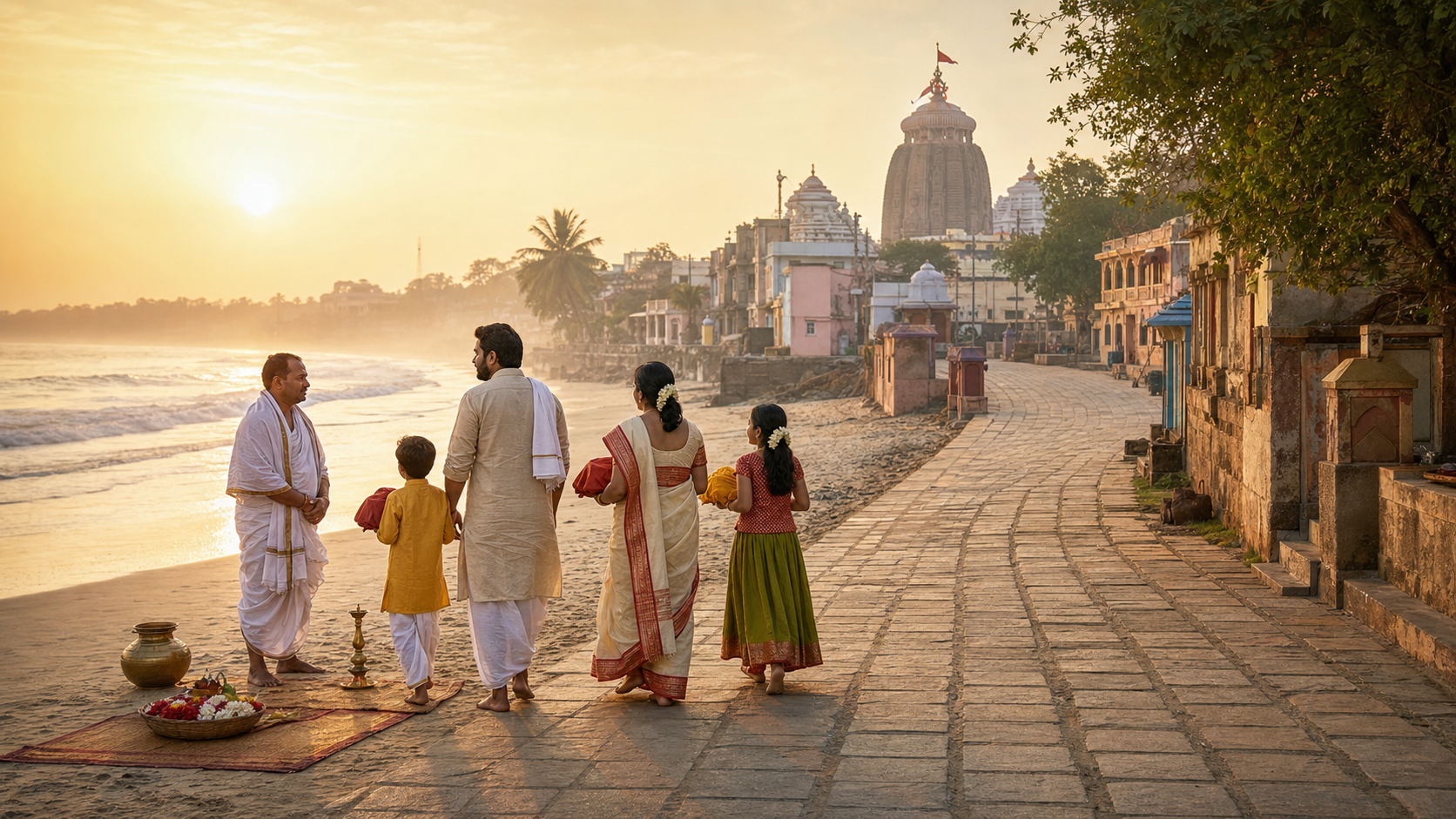
Puri’s ritual landscape gathers water, earth, temple and consecrated food into a single field of remembrance. Swargadvāra, whose name evokes a gateway to higher realms, is both a cremation ground and a place deeply associated with passage. Families perform tarpaṇa in the Mahodadhi at or near this shoreline, while Śvetagaṅgā is another consecrated body of water connected with observance. Darśan centres on the Chaturdha Mūrti: Jagannath, Balabhadra, Subhadrā and Sudarśana.
The following is a planning map, not a substitute for the liturgy of your family or the instructions of the officiating priest:
- Confirm the sankalpa and tithi. Establish whom you are remembering, why the rite is being performed and which inherited procedure applies before beginning at the water.
- Perform tarpaṇa at the designated place. Water and til are offered to the Pitṛs under guidance. Use the location approved for the rite rather than choosing a stretch of shore only for convenience or privacy.
- Undertake piṇḍadāna as instructed. A customary Puri observance may use piṇḍas formed with rice, ghee and kuśa. Let the priest direct their preparation, offering and disposition.
- Dedicate the observance to Jagannath. Join the ancestral intention to Viṣṇu in Jagannath’s form, integrating it with darśan according to the practical and ritual order given to your family.
- Receive and share Mahāprasād. Treat the consecrated food as part of the sacred action. If the family has undertaken annadāna or brāhmaṇa-bhojana, arrange it deliberately rather than adding it as an afterthought.
The sea’s sanctity does not make it a place for careless disposal. Follow local directions, use only the ritual materials required, and keep ordinary packaging or travel waste away from the water. Reverence at designated sites and environmental restraint are part of preserving the shore for the families who will come after yours.
Nor should speed become the measure of efficiency. The physical actions—pouring water, forming piṇḍas, standing before Jagannath and sharing anna—give grief and gratitude a disciplined form. Leave enough room in your plan to perform them attentively. A tightly compressed itinerary can turn a connected observance into a race between unrelated appointments.
Key takeaways before you make the journey
- Distinguish immediate funerary rites from periodic śrāddha before arranging anything in Puri.
- Confirm the governing lunar tithi; do not rely solely on a convenient travel date.
- Let family procedure determine the sankalpa, the human kartā and the ancestral lines included.
- Understand “the Lord performs śrāddha” as divine acceptance and completion, not as a release from human duty.
- Plan tarpaṇa, piṇḍadāna, Jagannath darśan and Mahāprasād as a connected observance.
- Use designated ritual places and protect the Mahodadhi shoreline through restrained, responsible conduct.
Your most useful preparation is a one-page ritual brief. Record the purpose of the observance, the ancestor or lineages to be remembered, the tithi, the proposed kartā, the relevant family custom and the intended place of Mahāprasād or annadāna. Give it to the priest in advance and let any uncertainty be corrected before the sankalpa begins.
Then go to Puri prepared to do more than complete a duty. Offer carefully, receive Jagannath’s grace without treating it as a substitute for responsibility, and share what has been consecrated. That is how remembrance becomes a living bond between the Pitṛs, the family standing at the shore and the generations still to come.
References
