

A message arrives, criticism lands, or an old memory surfaces. Before you have chosen a response, the body tightens and the mind begins building a case. The event may be small, yet it feels total because, for that moment, you aren’t merely experiencing agitation; you have become the agitation.
Witness-consciousness gives you another place from which to meet the moment. You remain fully present to sensation, thought, duty, and relationship, but you stop treating every movement within experience as your identity or your command. Hindu, Buddhist, Jain, and Sikh traditions all cultivate some form of this freedom. They do not, however, explain it through one interchangeable doctrine. Knowing both the practical convergence and the philosophical differences will help you practise without confusion.
The shared practice is not a single shared metaphysics
The useful common ground is decentring: a thought can be known without being obeyed, a sensation can be felt without being turned into an identity, and an emotion can be honoured without being given control of speech or conduct. This is the practical heart of the Dharmic distinction between changing experience and lucid awareness.
But the word witness carries different philosophical weight in each tradition. Treating all four traditions as if they secretly teach the same permanent Self would misrepresent Buddhism. Treating witness-consciousness as mere psychological distancing would misrepresent the Hindu and Jain accounts of consciousness. Treating it as private inwardness would miss the devotional and ethical direction of Sikh practice.
| Tradition | Working account of witnessing | What you should not flatten it into |
|---|---|---|
| Hindu darshanas | Samkhya and Yoga distinguish purusha, pure consciousness, from prakriti, the changing field of body, senses, and mind. Advaita Vedanta discriminates the atman from every object of experience and ultimately teaches non-dual recognition. | A generic relaxation method. Even within Hindu thought, Samkhya-Yoga and Advaita do not make identical metaphysical claims. |
| Buddhism | Sati and vipashyana observe sensations, feelings, and thoughts as impermanent, unsatisfactory when clung to, and not-self. | A hidden eternal observer. The decentered quality of mindfulness does not cancel the teaching of anatta. |
| Jainism | The distinction between jiva and ajiva supports recognition of the conscious being apart from non-conscious conditions. Anekantavada also loosens attachment to one absolutized viewpoint. | Passive neutrality. Jain witnessing is tied to freedom from passions and to disciplined, non-harming conduct. |
| Sikhism | Naam Simran, remembrance of the Divine Name, draws attention out of egoic reactivity and toward sahaj, natural equipoise, lived in alignment with Hukam. | A secluded spectator-self. Its authenticity appears in humility, compassion, and seva. |
You can therefore learn across traditions while still respecting their boundaries. The shared exercise is to stop appropriating every event as me and mine. The meaning of what remains must be understood within the path you actually follow.
Identification happens between experience and reaction

Witnessing becomes practical when you see where identification enters. Hindu accounts of the antahkarana, the inner instrument, offer a precise diagnostic vocabulary. Manas coordinates sensory impressions and alternatives. Ahamkara is the I-maker that appropriates experience. Buddhi discriminates and decides. Citta carries the impressions and tendencies that make familiar reactions feel immediate.
Suppose someone questions your work. Heat appears in the face, pressure gathers in the chest, and defensive sentences form. None of those events has yet forced you to retaliate. Identification is added when the mind concludes: this threat is happening to the self I must defend, this anger is mine, and this reply must be sent now.
The witness does not pretend that the heat or anger is absent. Buddhi recognizes what is happening: bodily activation is present; aversion is present; an old defensive pattern is offering a response. That small change in grammar, from I am this to this is present, creates room for discernment. It isn’t a verbal trick. It works only when you continue feeling the experience rather than using spiritual language to push it away.
Samkhya describes the changing field through the three gunas: sattva as clarity, rajas as activity and agitation, and tamas as inertia or obscuration. This gives you a second useful shift. Instead of condemning yourself as an angry, lazy, or restless person, notice the present configuration of the field. Rajas may be surging; tamas may be weighing down attention; sattva may be available but faint. Conditions can be met and reshaped. An identity feels fixed.
The five kleshas named in Yoga sharpen the diagnosis further: avidya, misapprehension; asmita, ego-identification; raga, grasping; dvesha, aversion; and abhinivesha, clinging to continuity. When a reaction takes hold, ask which link is active. Are you trying to secure praise, escape discomfort, defend an image, or preserve control? Naming the active tendency is more useful than issuing a vague command to calm down.
Use notice, name, and know before you respond

You do not need an ideal meditation setting to begin. Formal practice develops stability, but ordinary friction reveals whether that stability is real. Use the following sequence when a conversation, notification, memory, or craving pulls you into immediate identification.
- Stabilize the body. Let your posture become deliberate. Feel contact with the floor, chair, or ground. Do not begin by arguing with the thought; establish contact with the body that is already here.
- Balance the breath without forcing it. Allow inhalation and exhalation to become even and comfortable. If deliberate breath control causes strain or distress, return to natural breathing. The purpose is steadiness, not a performance.
- Gather scattered attention. Stop scrolling, put down the second task, and choose one anchor: breath, bodily contact, a mantra, or the immediate soundscape. This is practical pratyahara, intelligent reduction of sensory input rather than suppression of the senses.
- Notice raw experience. Find pressure, warmth, vibration, an inner image, or words forming in the mind. Stay close to what is actually present before adding a story about what it proves.
- Name the event lightly. Use a simple label such as thinking, tightening, wanting, remembering, fear, or aversion. A light label clarifies experience; repeated commentary merely becomes another thought-stream.
- Know its movement and choose. See that the event arose, is changing, and need not own the next action. Then decide what dharma requires: speak, remain silent, correct an error, set a boundary, apologize, serve, or wait for greater clarity.
In a tense exchange, take three unforced breaths before replying. Feel the bodily surge and name the dominant tendency. If the mind is composing an answer whose real purpose is humiliation, do not send it under the respectable label of truth. Satya without ahimsa easily becomes aggression wearing Dharmic vocabulary.
This sequence follows a gross-to-subtle logic. The body is steadied through asana; the breath is balanced through pranayama; sensory dispersal is reduced through pratyahara; attention is placed through dharana; and sustained, less effortful awareness matures as dhyana. These capacities reinforce one another. If attention is overwhelmed, return to the body and breath instead of trying to force an elevated state.
Abhyasa, repeated practice, matters because the decisive pause must become available under pressure. Vairagya, non-grasping, matters because practice fails when it becomes another attempt to manufacture a preferred feeling. You are learning to know the field clearly, not to guarantee that the field will always be pleasant.
Choose a doorway that remains faithful to your path
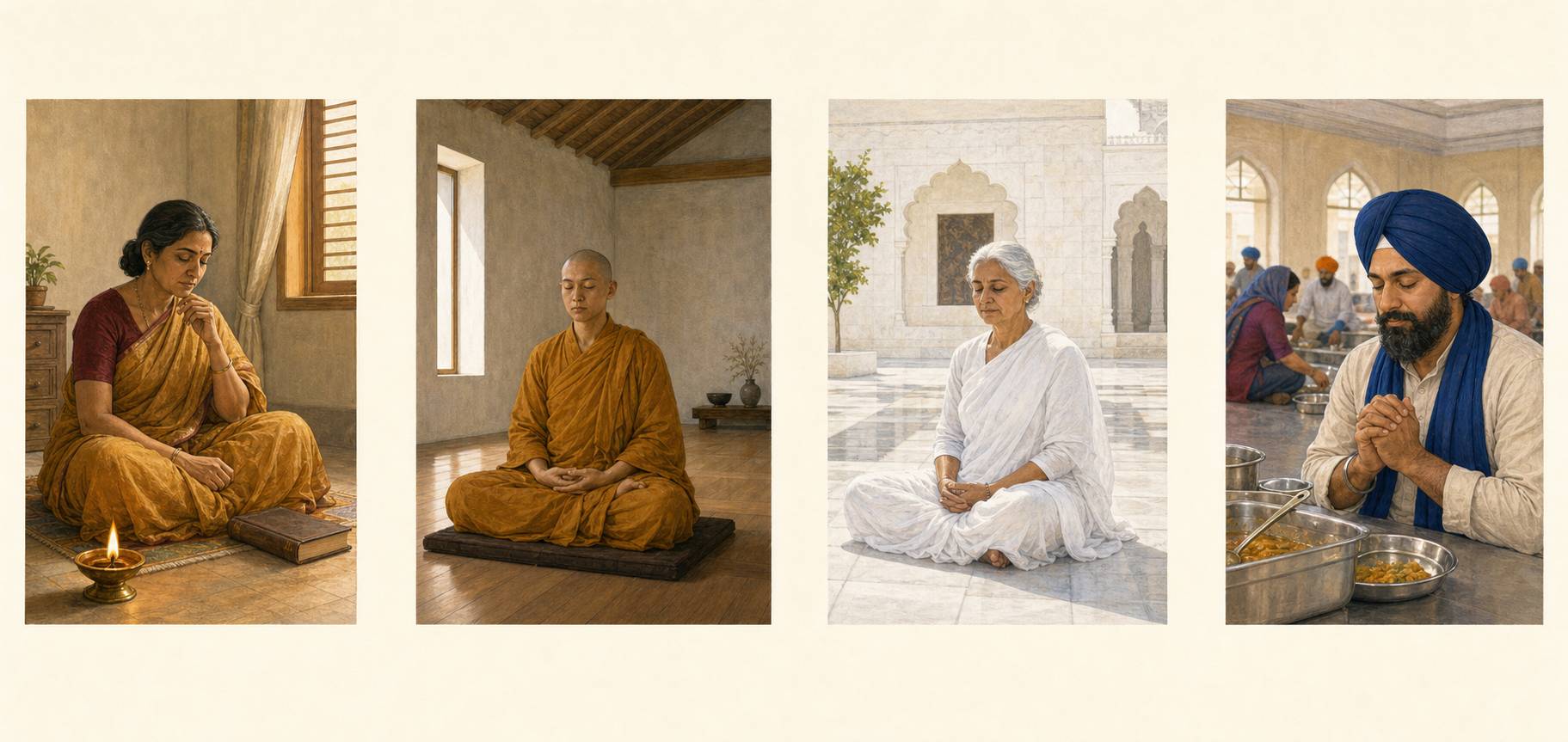
Mixing vocabulary can be intellectually attractive but spiritually imprecise. Begin from the discipline in which you are grounded. You can appreciate a neighbouring tradition without borrowing its language as decoration or using it to erase a real doctrinal difference.
In Samkhya, Yoga, and Advaita Vedanta
If Samkhya-Yoga supplies your framework, distinguish the seer from the movements of prakriti. When agitation appears, observe it as a movement involving body, senses, mind, and gunas. Patanjali’s formulation citta-vritti-nirodhah points toward stilling the fluctuations so that consciousness no longer appears confined to them.
If Advaita Vedanta supplies your framework, use neti neti, not this, not this, as discrimination rather than rejection. The body is known, so it is an object of knowledge. Breath and vitality are known. Thought, judgement, and even a peaceful meditative condition are known. The five-sheath inquiry moves through annamaya, pranamaya, manomaya, vijnanamaya, and anandamaya without declaring any changing sheath to be the final Self.
Do not turn this into hostility toward embodiment. Food, breath, emotion, and intellect are not dismissed as useless; they are understood as experienced layers rather than the limitless identity of the experiencer. The Bhagavad Gita’s phrase gunah vartante guneshu, the gunas moving among the gunas, helps depersonalize activity without excusing misconduct. Action continues, but possessiveness around action can soften.
In Buddhist mindfulness and insight
Use witness as a provisional description of non-reactive observation, not as proof of an eternal witness behind experience. Through sati, know sensation as sensation, feeling as feeling, and thought as thought. Through insight, notice anicca, change; dukkha, the strain of clinging; and anatta, the absence of a phenomenon that can rightly be secured as a permanent self.
When anger arises, the useful observation is not that a true Self stands untouched behind it. Observe instead that anger depends on conditions, changes while being observed, and does not deserve automatic ownership. That preserves the practical freedom of decentring without importing an Advaita conclusion into Buddhist practice.
In Jain discipline
Use the distinction between jiva and ajiva to disentangle consciousness from the conditions and passions that obscure its luminosity. Then bring anekantavada directly into moments of conflict. State your view, but also ask what aspect of reality the other person may be seeing that your present standpoint excludes.
This is not indecision and does not mean every claim is equally sound. It is a discipline against turning one partial perspective into the whole. Anger-driven raudra dhyana and pain-absorbed arta dhyana narrow the field around injury and retaliation. A movement toward dharma dhyana begins when attention becomes ethically discerning rather than passion-led. The test is not how detached your vocabulary sounds, but whether anger, pride, deceit, and greed are losing command.
In Sikh remembrance
Let Naam Simran interrupt the closed circuit of egoic commentary. Repetition of Waheguru is not merely a neutral attentional device; it is remembrance of the Divine. Hukam places the difficult moment within an order larger than personal preference, while sahaj names an unforced equipoise rather than emotional deadness.
Then look outward. If remembrance leaves you fascinated with your own serenity but less available for seva, patience, or compassion, the practice has curved back toward ego. In the Sikh frame, stable awareness should make responsible participation more natural, not make withdrawal appear spiritually superior.
The decisive test is greater contact and better conduct

Witness-consciousness is often confused with numbness because both can reduce visible reaction. Their inner movements are opposite. Numbness reduces contact. Witnessing increases contact while loosening compulsion. Numbness says nothing matters. Witnessing sees that the moment matters too much to surrender it to reflex.
Ask what the pause produces. Can you feel the body more clearly? Can you name hurt without converting it into accusation? Can you admit your own mistake? Can you take necessary action without feeding hatred? Can you remain with grief without pretending that the spiritual Self, impermanence, karma, or Hukam makes grief irrelevant? If the answer is repeatedly no, you may be using the idea of the witness to avoid experience.
Ethics protects the practice from that distortion. Ahimsa tests whether reduced reactivity becomes reduced harm. Satya tests whether stillness supports honest speech. Aparigraha tests whether inner sufficiency weakens grasping. Seva tests whether contemplation remains available to others. Compassion tests whether insight has reached the heart.
Formal practice also needs supportive conditions. Reduce unnecessary notifications before meditation. Finish one task before opening another. Keep a period of silence in which attention is not continuously claimed by a feed. This is not hostility toward technology or the senses. It is pratyahara applied to an environment designed to keep the mind externally hooked.
If a witnessing exercise repeatedly leaves you distressed, detached from your body, or unable to carry out ordinary responsibilities, stop the exercise and seek help from a qualified mental-health professional. Contemplative practice should not be used as a substitute for appropriate psychological or medical care.
Key takeaways
- Witnessing means knowing an experience without automatically treating it as identity, possession, or instruction.
- Hindu, Buddhist, Jain, and Sikh practices converge in reduced reactivity, but their accounts of self and consciousness remain meaningfully different.
- Use the sequence notice, name, and know: contact the raw event, label it lightly, recognize its movement, and then choose the Dharmic response.
- A genuine witness makes you more embodied, truthful, compassionate, and responsible. Emotional withdrawal and neglected duty are warning signs, not attainments.
- Start where identification is visible. Your next difficult message, craving, criticism, or defensive impulse is sufficient material for practice.
At the next moment of friction, do one small thing differently: take three unforced breaths, locate the experience in the body, name the active tendency, and delay speech until you can identify the duty beneath the impulse. That pause is not yet liberation. It is where the training becomes real.
References
