
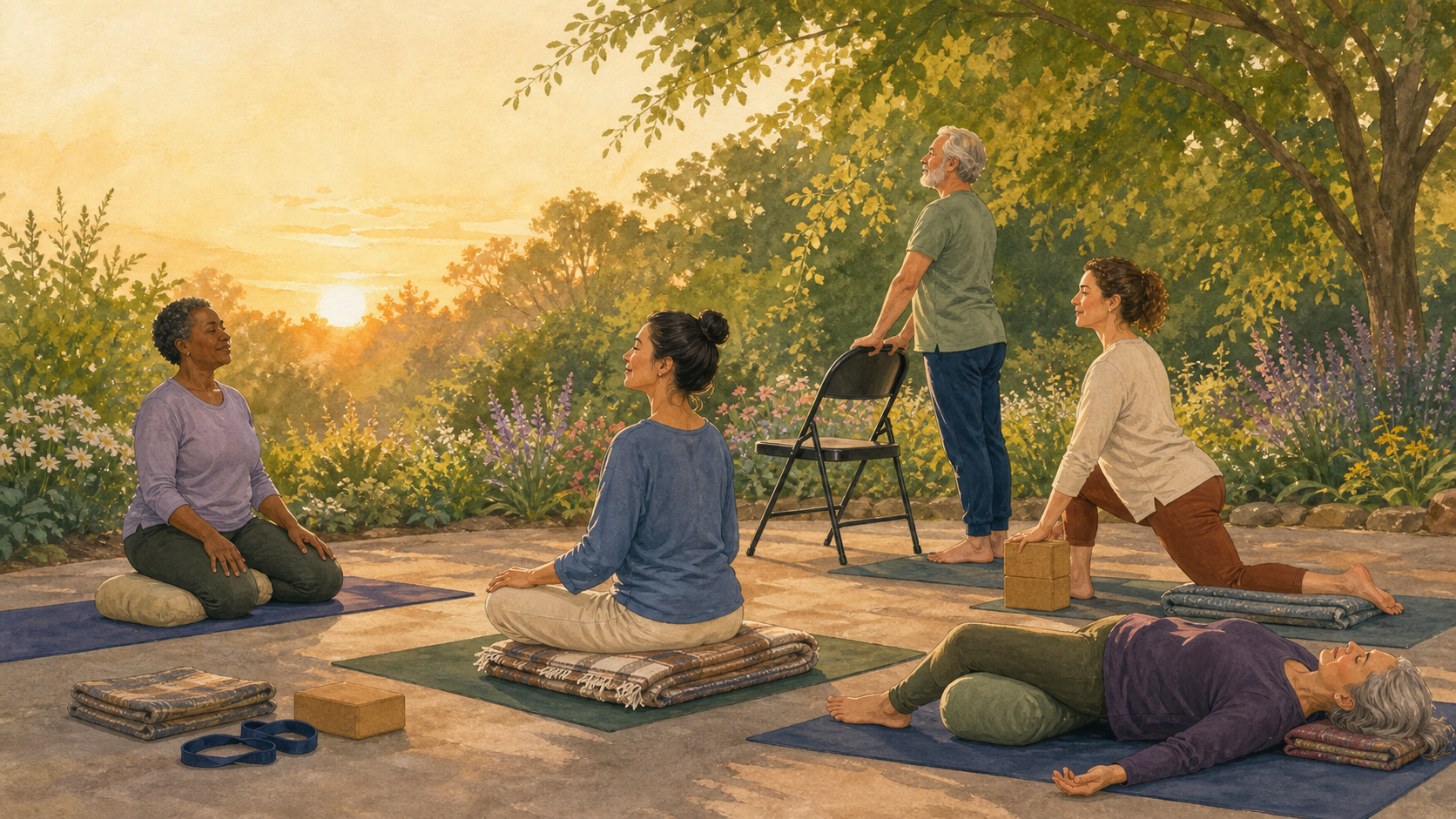
You may want to mark International Yoga Day without turning yoga into either a posture performance or a collection of medical promises. If your real question is whether one observance can contribute to your well-being, the answer is modest but useful: it can, when you choose a realistic goal, practise within your limits, and use 21 June as the beginning of a habit rather than the end of a ceremony.
The observance takes place on 21 June and was formally recognized by the United Nations through Resolution 69/131 on 11 December 2014. This year, give yourself 21 deliberate minutes. That is enough time to combine movement, breathing, attention, and a Dharmic intention without asking your body to prove anything.
Key takeaways for a useful International Yoga Day
- Choose one practical purpose before you begin: settling stress, restoring pain-free mobility, supporting balance, or training attention.
- Treat yoga as movement, breath, awareness, ethics, and discipline working together. A difficult posture is not evidence of a deeper practice.
- Use a gentle 21-minute sequence that leaves you steadier afterward. Pain, breathlessness, dizziness, or pressure to compete is a reason to stop or modify.
- Regard health benefits as possible outcomes, not guarantees. Yoga can complement appropriate care but should not replace medical or psychological treatment.
- Track a consistent marker after 21 June so that you can distinguish a sustainable benefit from the pleasant mood of a single event.
Randomized controlled trials and systematic reviews have found encouraging results for chronic low back pain management, perceived stress, anxiety and depressive symptoms, balance and fall risk among older adults, and some cardiometabolic markers. The strength of that evidence is not identical for every outcome or every person. Yoga is therefore best understood as an adaptable mind-body intervention, not as a universal cure.
Your first decision should be narrower than “improve my health.” If you feel chronically hurried, make slower breathing and reduced perceived stress your target. If prolonged sitting leaves you stiff, choose comfortable spinal and hip mobility. If balance is the concern, use supported standing work with a chair, wall, or qualified teacher. If mental scattering is the problem, give more of the session to breath awareness, mantra, or meditation. A defined purpose tells you what to emphasize and what to leave out.
Some of yoga’s effects have plausible physiological pathways. Slow diaphragmatic breathing and mindful movement can influence autonomic regulation, including parasympathetic activity and heart rate variability. Gentle mobility, isometric engagement, and balance work train muscular control and proprioception. Focused attention can reduce habitual stress reactivity. These mechanisms help explain why regular practice may support sleep, mood, pain coping, and recovery from daily strain, but they do not turn a yoga session into treatment for an undiagnosed condition.
Practise yoga as a system, not a posture display
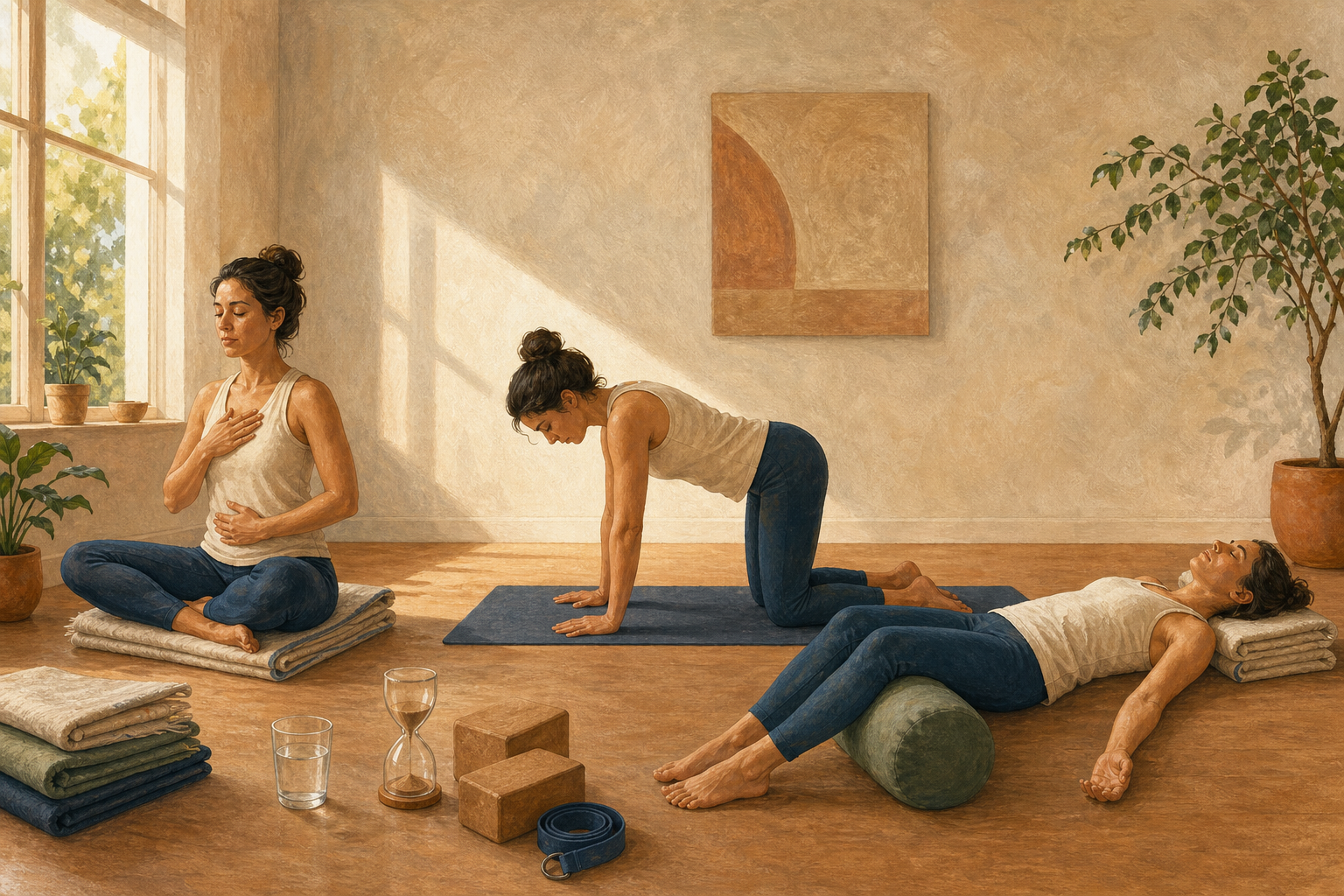
Patanjali’s Ashtanga framework places asana inside an eight-part discipline: yama, niyama, asana, pranayama, pratyahara, dharana, dhyana, and samadhi. Ethical restraint and observance come before posture; breath, regulation of the senses, concentration, and meditation continue after it. This order corrects a common modern mistake. The point is not to use ethics as decoration around exercise, but to make bodily practice serve clarity, restraint, and freedom from compulsive reaction.
You can bring that structure into an ordinary session without pretending to complete every limb. Begin with ahimsa by refusing to force a painful range. Use satya by acknowledging the condition of your body today rather than imitating someone else’s posture. Coordinate breath and movement. Withdraw briefly from screens and other demands. Hold attention on one sensation or mantra. Sit quietly long enough to notice what the practice has actually done to your mind.
This integrated view also creates an honest meeting place among Dharmic traditions. Hindu yoga, Buddhist mindfulness and metta, Jain commitments to non-violence and restraint, and Sikh simran all value disciplined attention and a reduction of harmful reactivity. They are not interchangeable systems, and their metaphysical claims should not be flattened into a generic wellness message. Their practical resonance is still meaningful: compassion, steadiness, self-restraint, remembrance, and service can guide what you do after leaving the mat.
The same care is needed when speaking about prana, nadis, and chakras. Yogic anatomy can help you attend closely to breath, vitality, tension, and subtle changes in felt experience. Modern physiology describes respiratory mechanics, balance, baroreflex activity, and signalling between the nervous system and the body. These languages can illuminate different aspects of practice, but a chakra should not be casually equated with an organ, gland, or proven biomedical mechanism. You do not have to erase traditional language to avoid making a scientific claim it cannot carry.
A safe 21-minute sequence for 21 June
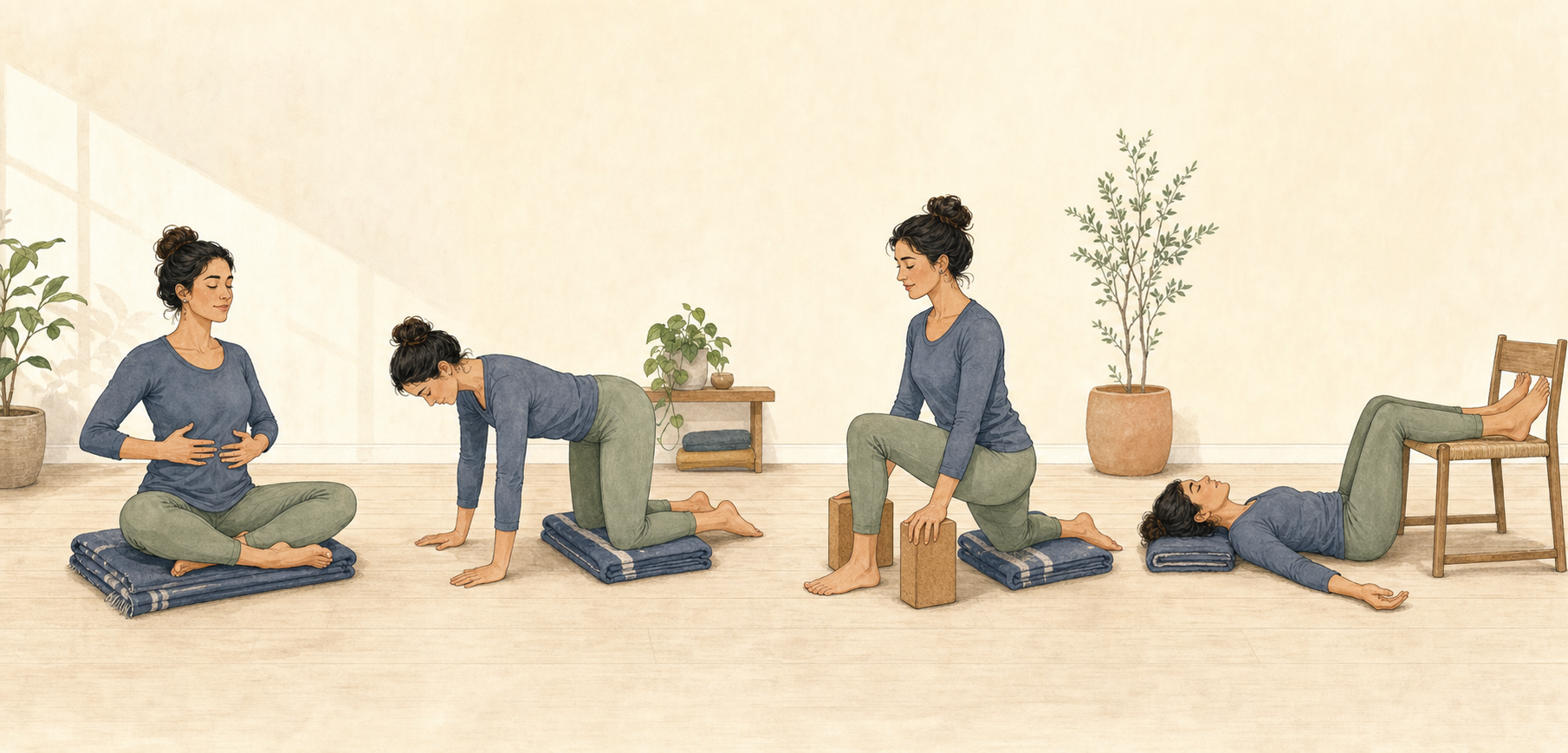
This sequence is deliberately moderate. Use a stable chair, wall, folded blanket, or other support whenever it improves control. Move within a pain-free range, keep the breath comfortable, and omit any posture that does not suit your body or health status.
- 0:00-2:00 – Arrive and breathe. Sit in a chair or in a comfortable supported seat. Let the abdomen and ribs move with an unforced diaphragmatic breath. Notice your level of agitation, fatigue, and physical discomfort without trying to correct everything immediately.
- 2:00-7:00 – Restore gentle mobility. Use shoulder rolls, comfortable hip circles, and cat-cow movements on hands and knees or in a chair. Let the breath set the pace. Make each repetition smaller if a joint feels pinched or the movement becomes jerky.
- 7:00-12:00 – Build supported steadiness. Practise tadasana, virabhadrasana II, trikonasana, and a supported forward fold at a sustainable intensity. Shorten the stance or keep a hand on a wall or chair when balance is uncertain. The aim is calm muscular engagement, not the deepest available shape.
- 12:00-16:00 – Regulate through breath. Choose nadi shodhana or comfortable box breathing. Slow breathing near six breaths per minute can support calm arousal and heart rate variability, but the cadence is not a test. If counting makes you tense, short of breath, or dizzy, return to an ordinary unforced rhythm.
- 16:00-21:00 – Sit, observe, and direct the benefit. Use breath-focused mindfulness, mantra japa, loving-kindness, or open monitoring. Close with an intention connected to compassion or service: a patient response, a restrained word, practical help for someone, or a less harmful choice later in the day.
If sun salutations are already familiar and comfortable, they can replace part of the standing segment. Use short, deliberate rounds with movement synchronized to breath. Treat them as mindful mobility rather than a speed or endurance challenge. Practising outdoors at sunrise can add morning light exposure that supports circadian timing, but neither sunrise nor a public gathering is required for a valid practice.
Limited mobility does not disqualify you. Seated spinal elongation, gentle hip rotation, shoulder movement, and chair-supported balance can preserve the essential combination of breath, attention, and controlled range. Older adults should prioritize stability and confidence over unsupported poses. Children and adolescents generally benefit more from short, playful movements and simple breath awareness than from long periods of rigid stillness.
Modify the practice before discomfort becomes harm
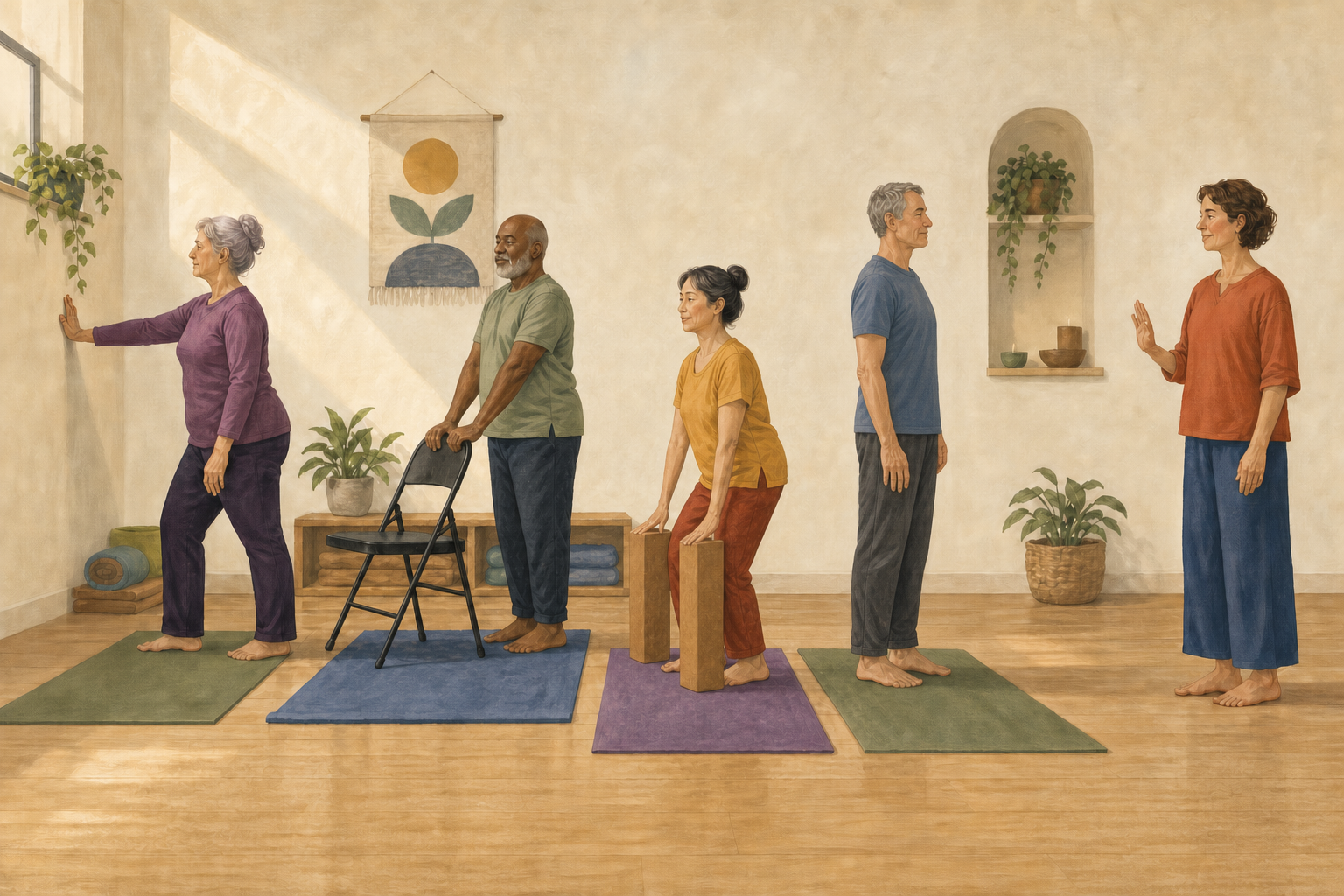
Yoga is adaptable, but adaptability is not the same as risk-free. Pain is a signal to reduce the range, change the position, or stop. A teacher’s instruction, a crowded event, or the appearance of the person beside you does not overrule that signal. The principle of ahimsa applies to your own tissues as directly as it applies to your conduct toward others.
- Osteopenia or disc pathology: approach end-range spinal flexion and loaded end-range rotation cautiously. Ask a suitably qualified teacher or healthcare professional for an appropriate variation rather than copying the full public sequence.
- Glaucoma or uncontrolled hypertension: avoid prolonged inversions unless a medical professional familiar with your condition has cleared and individualized the practice.
- Pregnancy or a postoperative state: strong abdominal-pressure techniques are not appropriate without specific guidance. Use pregnancy- or rehabilitation-informed instruction rather than relying on a general class.
- Uncontrolled hypertension, a hernia, glaucoma, or cardiovascular or retinal conditions: do not add forceful techniques such as kapalabhati or bhastrika without medical guidance. Gentle, ordinary breathing is the safer default.
- Cardiovascular, neurological, or ophthalmic conditions: tell the teacher before the session and make sure advice from your healthcare professional is reflected in the plan.
Stop immediately if the practice produces alarming symptoms rather than ordinary effort. Chest pain, severe breathlessness, fainting, or a new neurological symptom warrants prompt medical assessment, not another breathing exercise. Persistent pain, significant anxiety, depressive symptoms, or repeated loss of balance also deserves assessment by an appropriate healthcare professional. Yoga may be used alongside that care when it is safe; it should not delay it.
A suitable teacher makes modification normal. They should be willing to hear relevant health information, offer props and alternatives, and accept your decision to omit a technique. Be cautious when discomfort is praised as purification, breath retention is imposed despite distress, or a medical benefit is promised with certainty. Neither Sanskrit terminology nor physical virtuosity is a substitute for competent risk management.
Turn one observance into a measurable Dharmic habit
The useful question after your 21-minute practice is not whether it felt profound. Ask whether the chosen outcome changes as you continue. Select a body-based marker, such as morning resting heart rate, comfortable flexibility, or a supported balance check. Pair it with an experience-based marker, such as sleep quality, perceived stress, or minutes spent in slow breathing. Record the markers under similar conditions so that ordinary differences in timing do not masquerade as progress.
A single measurement proves very little. Resting heart rate varies, sleep has good and bad nights, and balance can change with fatigue. Look for a pattern over weeks, alongside how safely and consistently you are practising. If a metric becomes a source of obsession, choose a simpler observation such as whether you settle more readily before a meeting or recover more calmly after a difficult exchange.
Brief practices can keep the habit connected to daily life. Before a demanding meeting, take two minutes for slow nasal breathing. During screen-heavy work, spend a minute moving the eyes, neck, and shoulders gently. When sitting has produced stiffness, use a few minutes of comfortable seated twisting and hamstring movement. These are not replacements for sleep, medical care, or adequate physical activity. They are small interruptions to the accumulation of tension and distracted breathing.
If you are organizing a family, temple, campus, workplace, or community observance, make inclusion visible in the programme. Open with silent breath awareness, offer an all-levels sequence with chair and standing options, and close with a brief meditation on compassion. Readings can draw respectfully from the Yoga Sutra, Dhammapada, Jain aphorisms, or Sikh Gurbani around non-violence, equanimity, remembrance, and service. Introduce each reading in its own tradition instead of presenting all traditions as versions of the same doctrine.
Accessibility is part of the practice, not event administration added afterward. Choose a stable, reachable venue; leave space for chairs and mobility needs; avoid making floor work compulsory; and tell participants in advance what the session includes. Low-waste arrangements, reusable water bottles, public transport information, and an outdoor space where practical extend care beyond the individual body.
When 21 June arrives, set out the chair or mat, choose the outcome you want to observe, and practise the 21-minute sequence without performance or force. Before the day ends, place the next realistic practice window on your calendar. International Yoga Day becomes meaningful when one well-managed session grows into abhyasa: steady practice that makes clarity, compassion, and restraint more available in the life you return to.
References
