
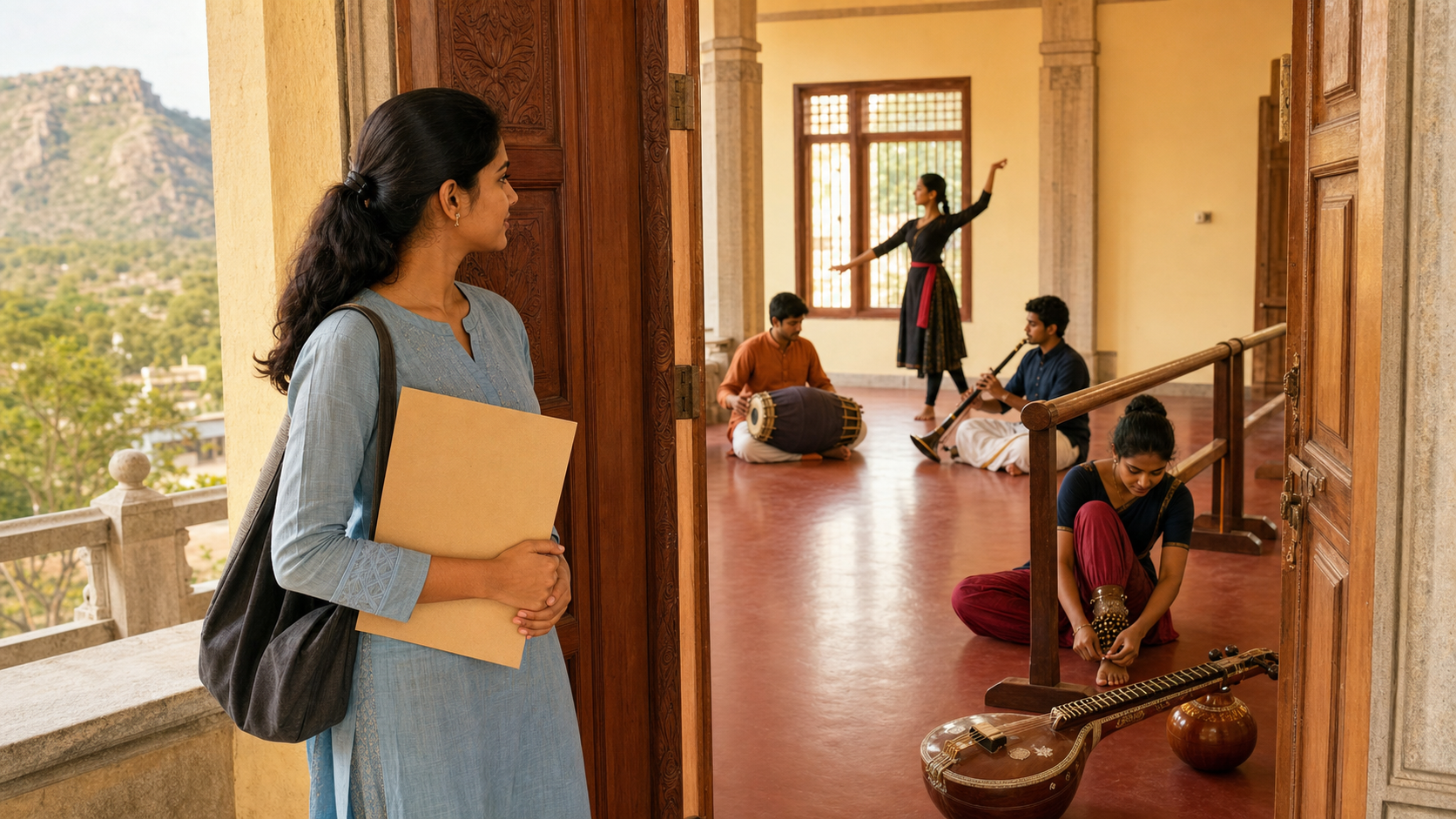
If you plan to apply for performing-arts training in Tirupati, your first risk is not an imperfect audition. It is treating customary admission patterns as confirmed rules. The 2026–27 call covers Sri Venkateswara Music and Dance College and SV Nadaswaram & Dolu School, but the exact course list, eligibility conditions, fees, deadlines and submission method must come from TTD’s official notification and prospectus.
You can still do most of the important work now. Choose the right pathway, assemble a clean application file and prepare for the skills likely to be examined. Then, when TTD publishes the operative particulars, you will be checking facts and submitting—not beginning from zero.
Choose the course before you chase the application form
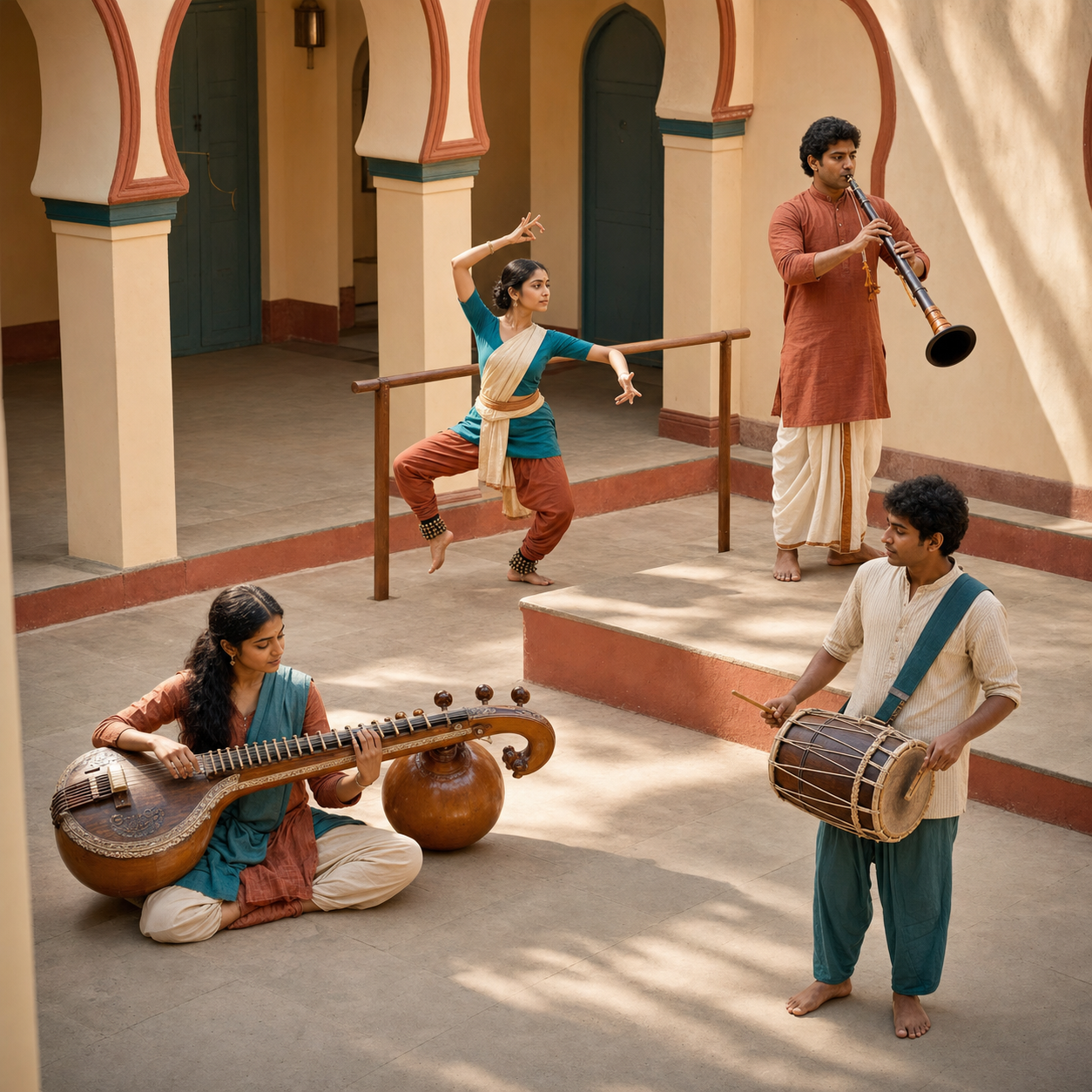
Start by distinguishing the two institutions. Sri Venkateswara Music and Dance College is the natural place to examine vocal, instrumental and dance pathways. SV Nadaswaram & Dolu School serves applicants seeking disciplined training in the traditional instruments closely associated with temple worship, processions and community ceremonies. Do not select a course merely because its title sounds more advanced.
Foundation, certificate, diploma, regular and part-time formats may serve very different applicants, but their availability and entry conditions can change with the admission cycle. Make four decisions before you fill any form:
- Discipline: Decide whether your primary application is for vocal music, a melodic instrument, dance, Nadaswaram or Dolu. Do not assume one application automatically covers several streams.
- Entry level: Separate genuine beginners from applicants who can demonstrate previous instruction, repertoire and theory. Prior exposure can support higher placement, while introductory routes may be more suitable for a capable beginner.
- Study format: Decide whether you can meet the demands of a regular course or need a part-time route. Confirm that the desired format is actually offered for your discipline in 2026–27.
- Purpose: Ask whether you want structured cultural education, stage preparation, teaching foundations, temple service or professional performance development. The answer should influence both the institution and the course level you select.
This is especially important for Nadaswaram and Dolu applicants. Temple-oriented training is not simply a shorter route to public performance. It can involve repertoire, ensemble discipline and conduct appropriate to ritual, procession and community settings. You should be willing to learn that context along with the technique.
The broader training model commonly joins śāstra and prayoga: theory and practice. Depending on the course, that can include compositions, pronunciation, regional languages used in the repertoire, stagecraft, ensemble work and basic pedagogy. If you want only occasional hobby instruction, compare that expectation carefully with the attendance and assessment obligations in the prospectus.
If you are employed, check the timetable before committing to a regular pathway. A No-Objection Certificate may also be required in some circumstances. Treat both points as unconfirmed until the 2026–27 rules state them explicitly.
Turn the official notification into a one-page control sheet

The usable application is the one tied to TTD’s official 2026–27 communication. A forwarded message, an old form or a general description may help you notice the opportunity, but none should determine where you pay, what you submit or when you report.
Create a one-page control sheet and fill it only from the notification and prospectus:
- Record the academic year, institution, exact course title and course code, if one is assigned.
- Copy the minimum and maximum age conditions, academic qualifications and prior-training requirements exactly as stated.
- Write down the opening date, closing date, application fee, payment method and submission channel. Do not infer any of these from an earlier admission cycle.
- Record whether documents must be uploaded, posted or submitted at a designated counter, and note the required file format or file-naming convention.
- Separate the application deadline from the audition, merit-list and reporting dates. They are different events and should have different reminders.
- Check reservation, concession and special-provision instructions only against the TTD and Government of Andhra Pradesh norms named for this cycle.
- Save the submitted form, payment proof and acknowledgement in both digital and printed form.
No fee amount, deadline or audition date should be guessed. If the form and prospectus use different course names, or if a mandatory field has no clear instruction, pause and use the contact route named in the official communication. An early clarification is easier to correct than an application filed under the wrong stream.
Build separate administrative and artistic application folders
One crowded folder makes omissions hard to see. Keep administrative proof in one folder and evidence of artistic preparation in another. This also prevents you from mistaking a strong audition portfolio for a complete application.
Administrative folder
Prepare clear copies of the documents commonly relevant to this admission process, then remove or add items according to the prospectus:
- Proof of identity and age.
- Recent passport-sized photographs in the required size and format.
- Academic certificates, mark sheets or transcripts relevant to eligibility.
- Caste or community certificate when you are claiming an applicable reservation or concession.
- Previous music, dance or examination certificates, if you have them.
- A medical-fitness document for a dance course only if the rules require one.
- A No-Objection Certificate from an employer only when applicable.
- Application-fee receipt, submitted-form copy and acknowledgement.
Run a consistency check before submission. Your name, date of birth and other identifying details should agree across the form and certificates. Confirm that every scan is readable, correctly oriented and complete. Follow TTD’s file-naming instructions instead of inventing your own format, and do not merge or compress files unless the application system asks you to do so.
Artistic folder
Create a brief and honest repertoire sheet. For each item you may present, record its title, rāga, tāla, composer or choreographic context where applicable, language and present level of readiness. Mark the items you can perform cleanly without prompting. A short list you genuinely command is more useful than an inflated list that collapses under a follow-up question.
Add prior grade certificates or training records if available, but do not treat certificates as a substitute for readiness. The audition can test whether you can hold śruti, maintain laya, articulate movement or rhythm, understand the material and recover calmly from a correction.
Prepare for the audition skill by skill
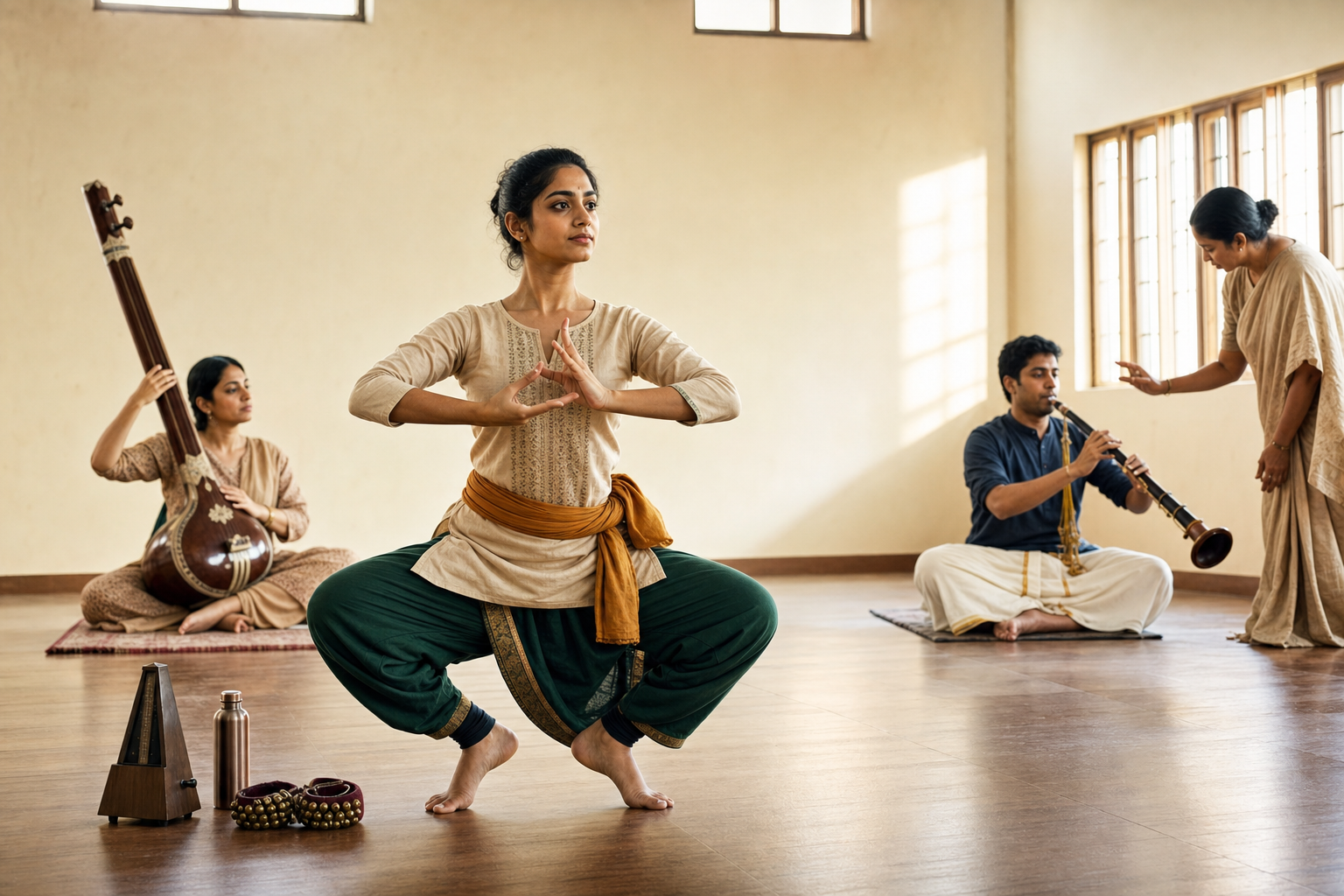
Selection is commonly audition-based, with expectations adjusted to the discipline and entry level. Until the official process says otherwise, prepare for a practical demonstration and short questions on theory, repertoire and conduct.
Vocal music and melodic instruments
Build your preparation around śruti stability, clear swara articulation, rāga recognition and dependable laya. Applicants seeking an advanced route should also be ready to show the level of ālāpana and repertoire knowledge appropriate to that route. A beginner should not imitate advanced elaboration at the cost of pitch and rhythmic control.
- Practise with a stable pitch reference and listen for drift at the ends of phrases.
- Present prepared material from beginning to end without stopping to repair every small imperfection.
- Review the rāga and tāla of each listed composition so that your spoken answers agree with what you perform.
- Check sahitya pronunciation and avoid letting difficult sangatis obscure the words.
- For Nadaswaram, include embouchure stability, clean fingering and instrument readiness in every practice run.
Dolu and other percussion preparation
Percussion readiness is more than speed. Prepare to recite and execute rhythmic material with a stable internal pulse. Relevant areas can include sollukattu, nāḍai changes, kālai, eduppu and mora or korvai structures.
- Recite a pattern accurately before relying on the instrument to carry it.
- Practise transitions without allowing the underlying tāla to shift.
- Know where a composition begins in relation to the cycle rather than entering by memory alone.
- Choose clarity over speed when the two begin to separate.
- Check the instrument before the audition so that tuning or maintenance problems do not consume your attention.
Dance preparation
Dance applicants should prepare the fundamentals that make repertoire believable: adavu precision, araimandi alignment, tāla comprehension and abhinaya. Familiarity with items such as alarippu, jatiswaram, śabdam, varnam, padam and tillana may be relevant at an appropriate level, but that does not mean every candidate should attempt a complete margam.
- Clean the adavus you already know before expanding the number of items.
- Use tāla consistently rather than following only the remembered shape of the choreography.
- Check posture and alignment when fatigue begins; late-run deterioration is still visible to an evaluator.
- Prepare the meaning and emotional situation of an abhinaya item, not only its facial sequence.
- Select material that reflects your real training level and that you can complete with control.
Theory, language and performance conduct
Practical fluency is stronger when you can explain what you are doing. Review the tāla structure, rāga-lakṣaṇa and sahitya of the pieces on your own list. Telugu and Sanskrit pronunciation may matter because they are common in the repertoire. Performance ethics can also include punctuality, respectful ensemble behaviour, care for instruments and an understanding that temple arts carry responsibilities beyond applause.
Arrange a mock audition with a teacher or experienced mentor. Ask for a single uninterrupted presentation followed by questions, rather than coaching during the performance. Review the result for pitch, pulse, diction, alignment, memory and recovery. In the final preparation period, protect vocal health, maintain the instrument, avoid unnecessary last-minute repertoire changes and arrive rested.
Key takeaways for a clean 2026–27 application
- Use TTD’s official 2026–27 notification and prospectus for every date, fee, eligibility rule and submission instruction.
- Choose the institution, discipline, entry level and study format before completing the form.
- Keep administrative documents separate from repertoire and training records.
- Treat fitness notes, employer certificates, reservations and concessions as conditional until the prospectus confirms them.
- Prepare for discipline-specific fundamentals: śruti and swara for melodic work, rhythmic structure for Dolu, and adavu, tāla and abhinaya control for dance.
- Retain the completed form, fee receipt and acknowledgement after submission, then track the audition, merit-list and reporting stages separately.
Your next move is practical. Open the two folders now, write down your intended institution and course level, and rehearse material you can already present cleanly. Replace every provisional assumption as soon as the official particulars are available. That sequence keeps you ready without turning guesswork into an avoidable application error.
References
