
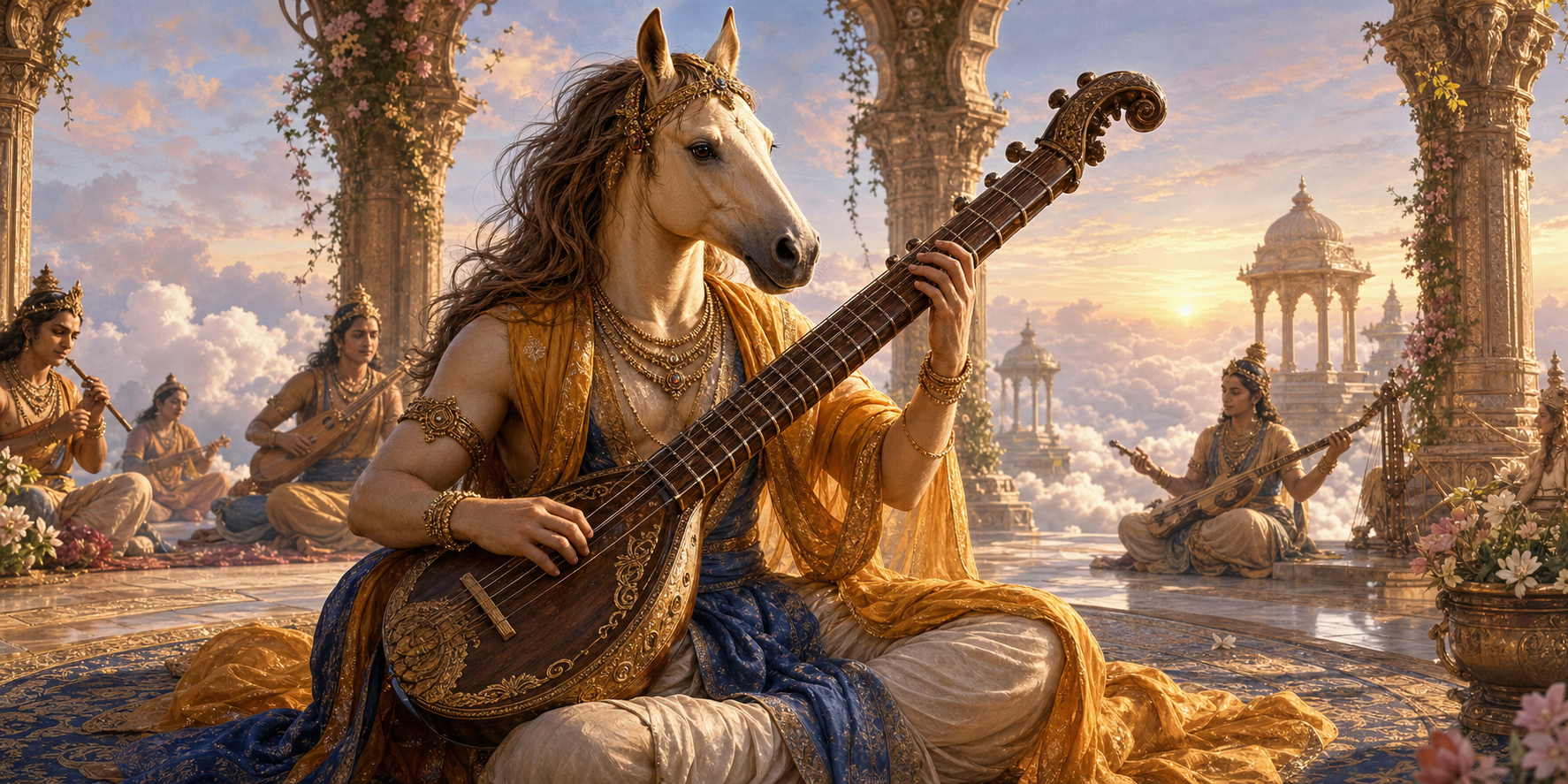
If you have encountered Tumburu and wondered whether his horse face is literal, frightening, or merely ornamental, begin with one correction: the face does not cancel the musician. It intensifies what his music represents.
You can read the image without inventing a secret code. Start with Tumburu’s identity, notice what the horse contributes, and then examine how those elements work together. That method reveals a coherent Dharmic symbol of vitality brought into rhythm, measure, and sacred expression.
Read the celestial musician before the horse
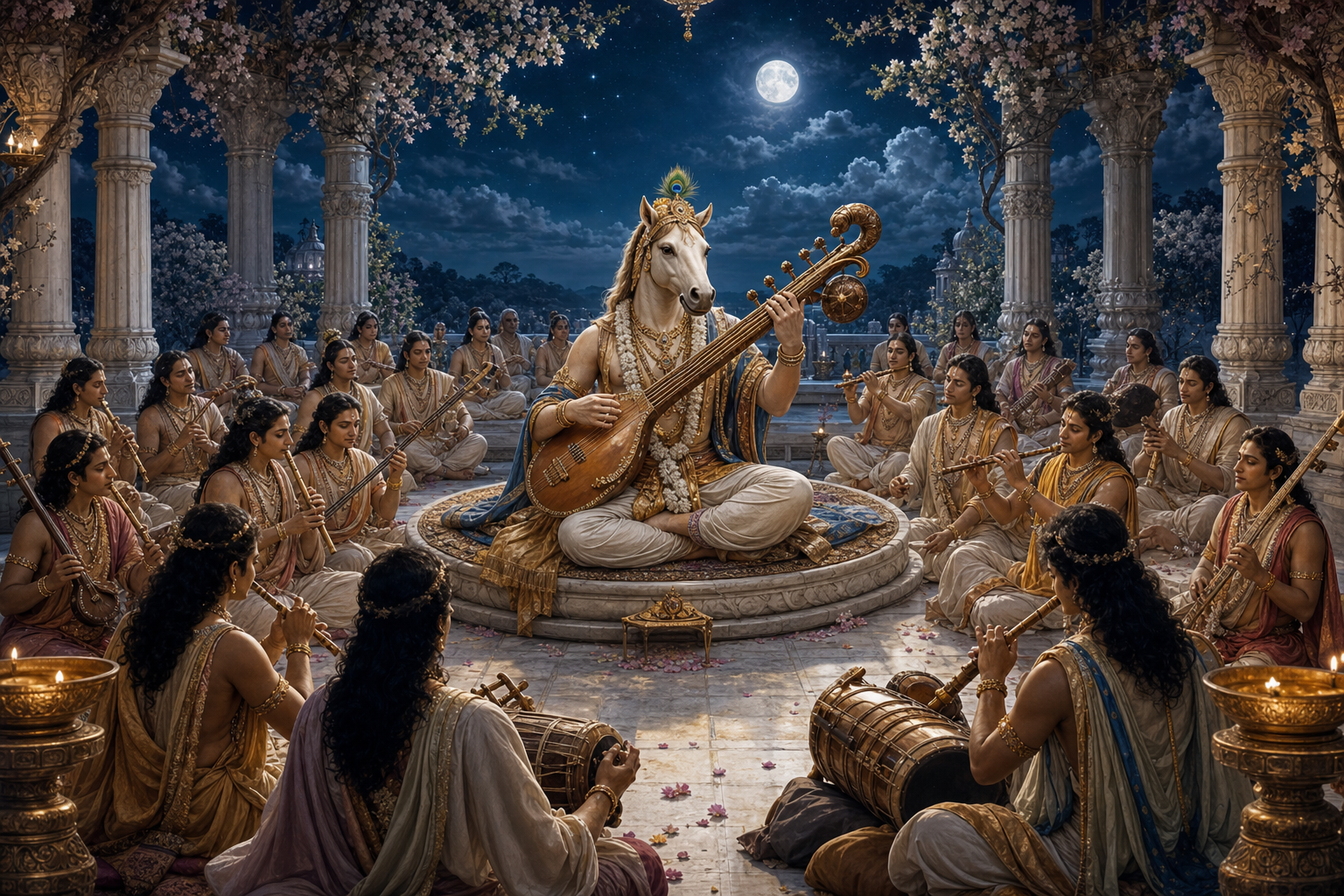
Tumburu is presented as the foremost Gandharva, a Deva Gandharva of the highest order, and a celestial musician of unsurpassed skill. Those details establish the center of the image. He is not primarily an animal figure who happens to make music. He is an exalted musician whose distinctive form changes how you understand his art.
This gives you a dependable rule for interpreting composite forms in Dharmic imagery: identify the being before isolating the unusual feature. The identity tells you which associations are relevant. In Tumburu’s case, the useful question is not simply, “What does a horse mean?” It is, “What does a horse face contribute to the form of a divine musician?”
His elevated status also rules out a crude interpretation. The horse face cannot, by itself, signify spiritual inferiority, loss of intelligence, or exclusion from the sacred. Tumburu remains a pre-eminent celestial being. The image therefore asks you to see animal vitality and divine refinement together rather than arranging them on a ladder of contempt.
That matters beyond this one figure. A human face is not the only possible vessel of consciousness, dignity, or sacred power in Dharmic art. When you begin from that premise, Tumburu’s form stops looking like a deviation from divinity and starts functioning as a teaching about its range.
What the horse face contributes to the music
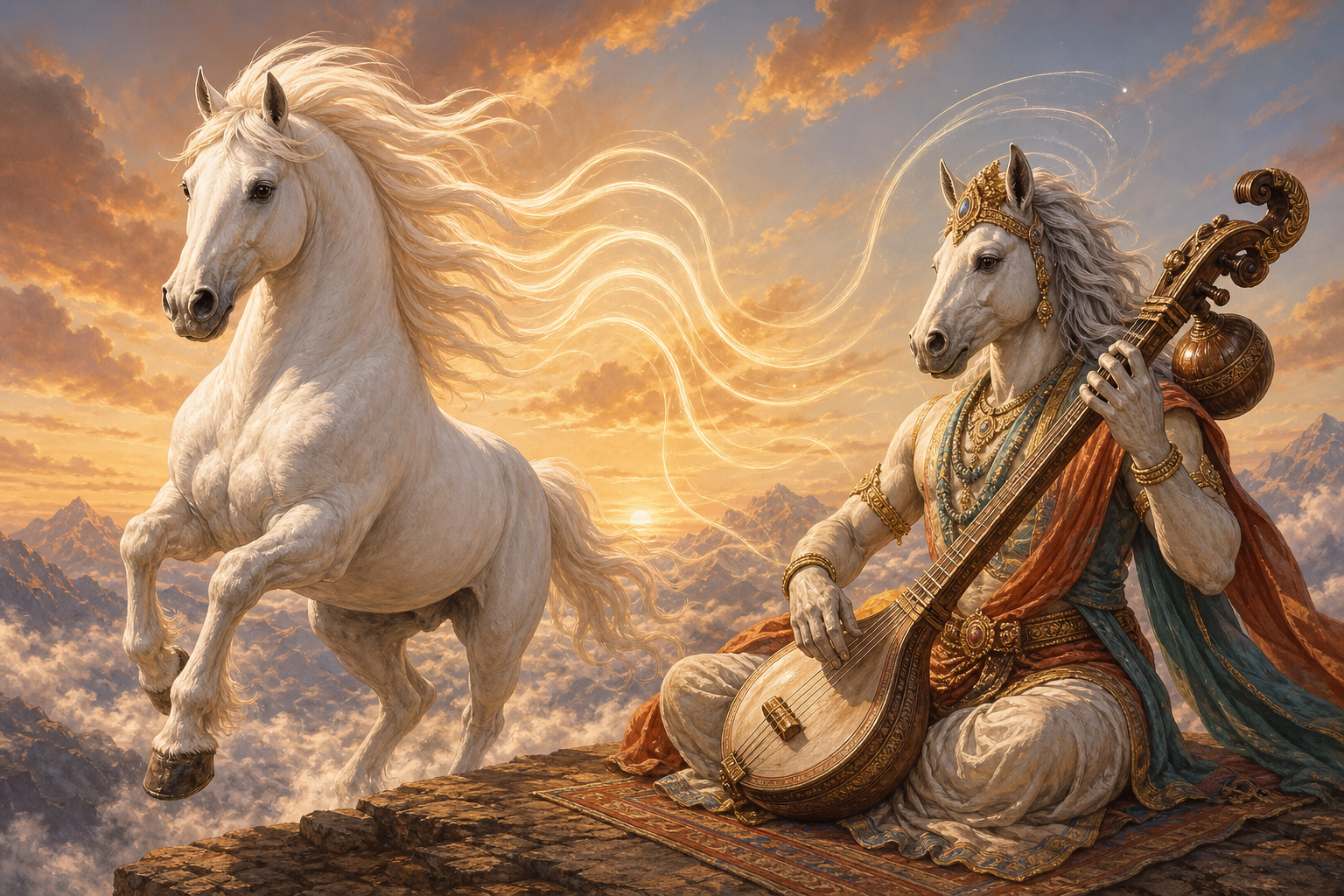
A horse naturally evokes concentrated vitality: breath, alertness, movement, endurance, and force directed forward. These are associations rather than a rigid one-word code. They become meaningful here because they have been joined to musical mastery.
Music is also organized movement. Sound unfolds through breath, timing, pitch, emphasis, restraint, and relation. Energy alone can become agitation; measure without energy can become lifeless. Tumburu’s form holds the two together. The horse contributes potency, while the musician gives that potency proportion and direction.
The location of the animal feature is important. This is a horse face, not an unrelated emblem placed beside him. The face is associated with breath, voice, hearing, expression, and attention. In a symbolic reading, the very seat of vigorous animal life becomes the seat of celestial song. Vital force is not rejected before sacred expression becomes possible. It is tuned.
This is why “control” is too narrow a word for the image. The point is not a human mind crushing an animal nature. A better reading is integration: strength becomes capable of beauty because it accepts rhythm, and discipline becomes alive because it carries strength.
Three common shortcuts obscure that relationship:
- Literalism: treating the horse face only as unusual anatomy and never asking what the complete form communicates.
- Dictionary symbolism: assigning the horse one universal meaning and forcing every appearance of it into that definition.
- Decorative dismissal: assuming the form exists merely to make a celestial musician look exotic or memorable.
Instead, test any proposed meaning against the whole figure. If an interpretation explains the horse but ignores music, it is incomplete. If it explains music but treats the horse as an embarrassment, it is equally incomplete.
Gandharva symbolism makes sound a form of order
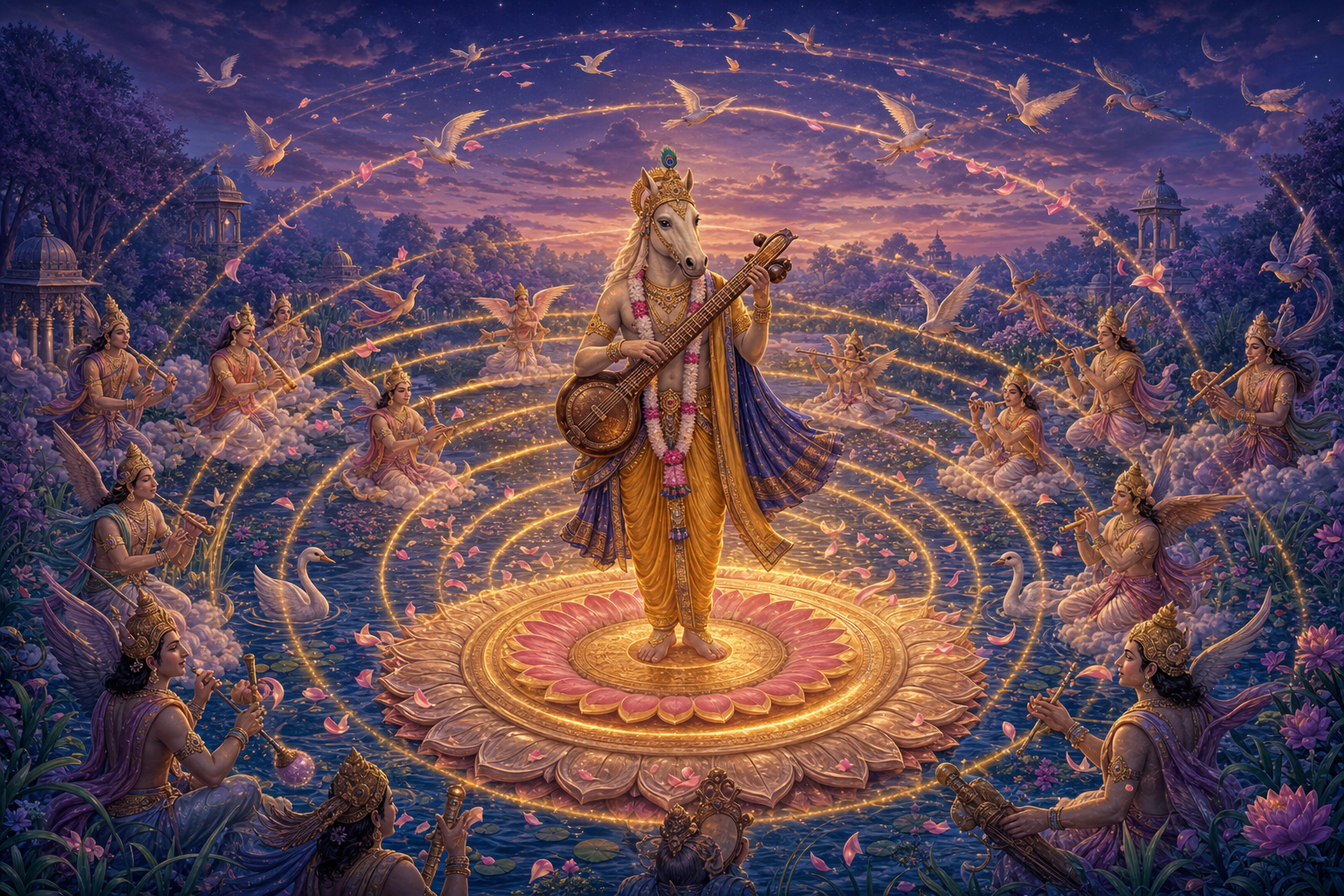
Tumburu’s Gandharva identity places music at the heart of the symbol. Celestial music here should not be reduced to entertainment transported into heaven. His foremost position makes musical excellence a sacred capacity: the power to shape movement into harmony.
Sound offers a particularly clear model for this transformation. You cannot hold a melody still and retain it as melody. It exists through ordered change. Each sound must arise, occupy its proper place, and yield to what follows. Too much force, delay, haste, or self-display can disturb the whole. Musical beauty therefore depends upon power that listens as well as acts.
That is the deeper connection between the Gandharva and the horse face. The horse represents no inert store of energy; it suggests energy in motion. Music does not eliminate motion; it makes motion intelligible. Tumburu can therefore be contemplated as an image of dynamic power finding its dharmic form.
The word “cosmic” is easy to misuse here. You do not need speculative claims about hidden frequencies or physical effects to understand the symbolism. Cosmic order can be read more soberly as right relationship: force related to measure, expression related to listening, and individual performance related to a larger harmony.
This also makes the symbol practical. When your speech has intensity but no timing, it becomes noise to the person receiving it. When devotion has emotion but no steadiness, it can dissipate as quickly as it arose. When discipline has no vitality, it becomes mechanical. Tumburu’s integrated form asks you to bring these divided qualities back into relation.
A three-level method prevents symbolic overreach
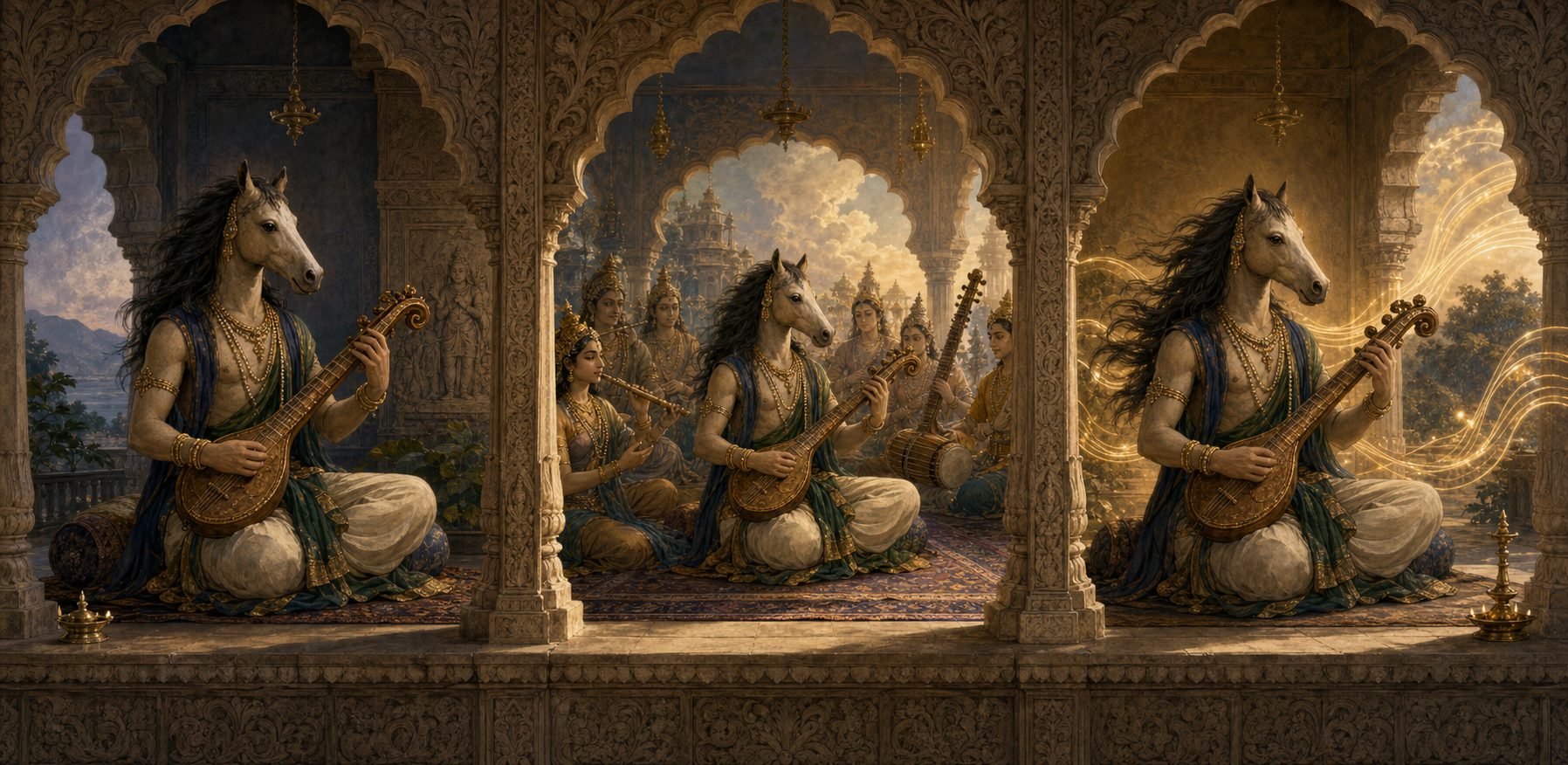
Dharmic symbolism loses credibility when a plausible meditation is presented as though it were an explicit scriptural definition. You can avoid that mistake by separating three levels whenever you explain Tumburu to yourself or someone else.
- State what is given. Tumburu is horse-faced, belongs to the exalted order of Deva Gandharvas, and is distinguished by celestial musicianship. These are the stable features from which interpretation begins.
- Explain what the combination supports. Equine vitality joined to musical mastery supports a reading of force shaped into rhythm, harmony, and sacred expression. This is reasoned symbolism, not a claim that the horse has only one permissible meaning.
- Mark your personal application. You may use the image to examine your own breath, speech, artistic discipline, attention, or restless energy. That can be spiritually fruitful without being promoted into a historical fact about Tumburu.
This distinction does not weaken symbolism. It makes the interpretation more trustworthy. The secure features anchor you; the relational reading helps you understand them; personal contemplation lets the symbol address your life. Confusion begins only when the third level is passed off as the first.
You can apply the same test to any explanation you encounter. Ask whether it accounts for Tumburu’s high rank, his Gandharva identity, his musical excellence, and his horse face at the same time. Then ask whether the speaker has identified interpretation as interpretation. A dramatic claim that neglects either test deserves caution.
Key takeaways
- Tumburu must first be read as an exalted Gandharva and celestial musician; the horse face modifies that identity rather than replacing it.
- His status rules out the assumption that animal form automatically denotes spiritual inferiority.
- The horse contributes associations of breath, vitality, alertness, and movement; music contributes timing, restraint, relation, and harmony.
- The integrated form supports a careful reading of powerful energy becoming disciplined sacred expression.
- A sound interpretation separates explicit iconographic features, reasoned symbolism, and personal meditation.
The next time you encounter Tumburu, pause before searching for a one-word definition. Name the musician, notice the vitality of the horse, and consider what changes when power learns to listen. Then carry the question into your own chanting, speech, music, or work: is your energy merely forceful, or has it acquired rhythm, proportion, and direction?
References
