
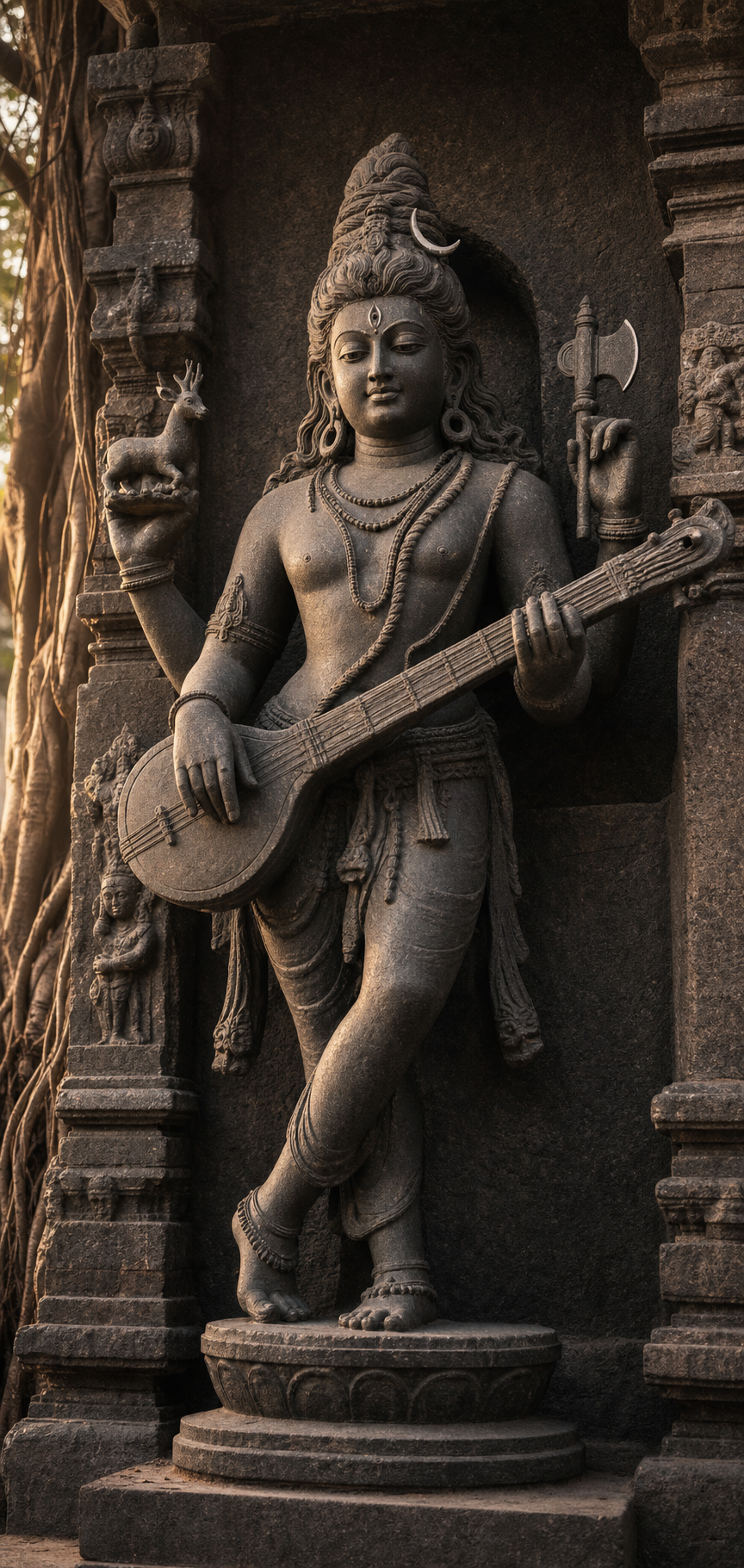
You turn a corner during temple circumambulation and find a serene, standing Shiva holding a vīṇā. The image is quieter than a performance scene, yet more active than the familiar seated Guru. Is this simply Shiva as a musician, or are you looking at a form of Dakshinamurti?
The safest answer comes from reading the whole composition. The instrument matters, but so do the Shaiva attributes, the standing posture, the southern location, and the signs of teaching. Once you know how those elements work together, Vinadhara Dakshinamurti becomes a coherent lesson in sound, silence, knowledge, and disciplined action.
Identify the form from a cluster of signs
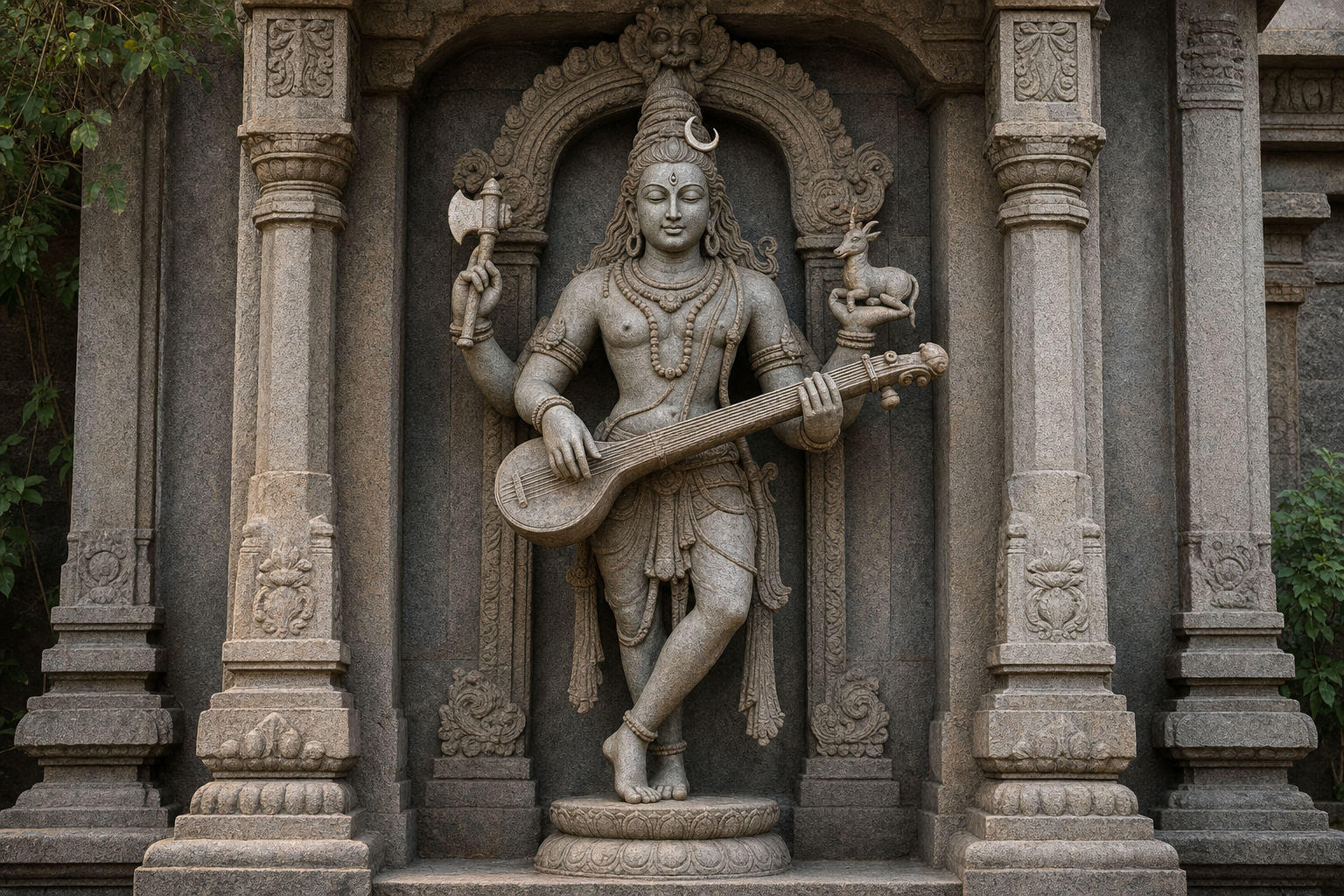
Do not identify Vinadhara Dakshinamurti from the vīṇā alone. Begin with three questions: What establishes that the figure is Shiva? What establishes the role of Guru? What distinguishes this particular mode of teaching? A strong identification answers all three.
- Look first for Shiva’s attributes. The jaṭā-mukuṭa, crescent moon, serpentine ornaments, sacred thread, and ascetic character of the garment establish the Shaiva identity. The sacred thread may itself be represented as a serpent, forming a nāga-yajñopavīta.
- Look for the pedagogical setting. Dakshinamurti traditionally occupies the southern devakoṣṭha, or exterior niche, of a South Indian Shiva temple’s sanctum. A banyan, receptive sages, or a subdued figure of ignorance can strengthen the identification, but not every surviving image includes all of them.
- Look at the posture. The Vinadhara figure is poised so that stability and movement coexist. He is not represented as an entertainer caught in theatrical motion. His balance belongs to a teacher whose inner stillness can enter action without being disturbed by it.
- Look for the defining instrument. The vīṇā changes the teaching mode. Shiva remains the silent Guru, but silence now becomes intelligible through resonance, rhythm, and measure.
Classical Shaiva iconography recognizes several modes of Dakshinamurti, including Jñāna, Yoga, Vyākhyāna, and Vīṇādhara. This prevents a common mistake: not every Dakshinamurti must hold a vīṇā, and not every representation of the Guru must be standing. The seated form remains more familiar in southern temple niches; the standing Vinadhara is a comparatively rare variant.
When the sculpture is damaged, record degrees of confidence rather than forcing certainty. Shaiva attributes plus a vīṇā and a southern pedagogical setting make a persuasive combination. An isolated instrument fragment or a single ornament does not. Iconographic identification is cumulative.
The standing Vinadhara gained visibility in South Indian stone and bronze from the late first into the early second millennium, with regional differences in stance, drapery, and instrument form. That broad history helps place the type, but it cannot date an individual object by itself. Dating still requires attention to the complete work and its archaeological or collection context.
Read each visible feature before interpreting it
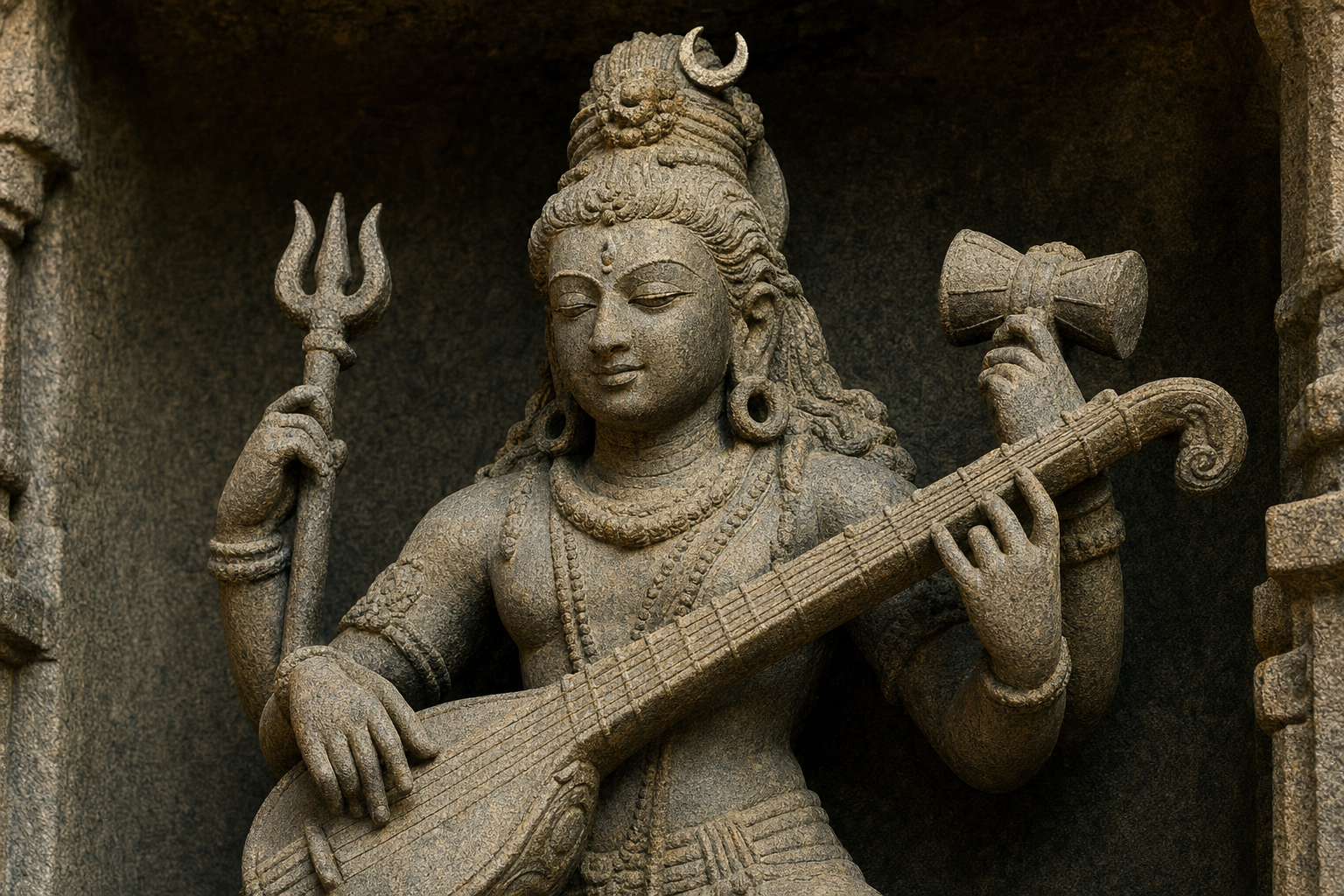
An icon can be read at three levels. First comes description: what is visibly present? Second comes identification: which established iconographic convention explains that combination? Third comes contemplation: what does the form invite you to understand? Keeping those levels distinct protects both scholarship and devotion.
| Feature | What to notice | What it contributes |
|---|---|---|
| Southern placement | The niche on the sanctum’s south-facing exterior wall | Dakshinamurti faces the direction associated with Yama and mortality, teaching freedom from fear through knowledge. |
| Jaṭā-mukuṭa and crescent | Matted locks arranged as a crown, with the lunar emblem where preserved | These establish Shiva’s identity before the vīṇā is interpreted. |
| Serpents and sacred thread | Serpentine ornaments or a nāga rendered as the yajñopavīta | They reinforce the union of ascetic power and sacred authority. |
| Standing balance | A stable posture adapted to holding the instrument | Still knowledge is shown entering embodied action. |
| Vīṇā | The defining instrument rather than a minor accessory | It signifies nāda, disciplined measure, embodied knowledge, and communication through vibration. |
| Banyan | The tree or an implied setting beneath it | It conveys enduring shelter and the inexhaustible refuge of wisdom. |
| Four sages | Sanaka, Sanandana, Sanātana, and Sanatkumāra in receptive positions | They establish the image as a relationship between Guru and prepared listeners. |
| Apasmara | A subdued dwarf-like figure when present | It represents forgetfulness, constriction, or ignorance overcome by knowledge. |
| Youthful serenity | A composed Guru whose authority is not expressed as age or strain | Insight is presented as timeless rather than merely accumulated information. |
The name Dakshinamurti also needs careful handling. The south is the primary visual and ritual orientation of the form. Sanskrit usage of dakṣiṇā as an honorarium offered to a teacher adds a suggestive secondary resonance, but it should not replace the directional meaning or be presented as the sole explanation of the name.
Separate established attributes from contemplative readings
The vīṇā is visibly present and identifies the Vinadhara mode. Its association with sacred sound is also central to the form. More detailed correspondences should be stated with greater care. The strings may be contemplated as disciplined vital energy, the bridge as measure, and the resonating spaces as the openness in which meaning arises. These are fruitful symbolic readings, not extra objects carved into the image.
- Describe without interpretation. Note posture, attributes, instrument, attendants, tree, pedestal, orientation, and condition.
- Identify by convention. Ask whether the combination fits Shiva as the vīṇā-bearing Guru more strongly than any isolated feature does.
- Interpret with proportion. Connect sound, knowledge, silence, and action only after the identification is secure. Mark optional or lineage-specific contemplations as such.
This method is especially useful in museums, damaged temple niches, and photographs stripped of architectural context. It keeps a beautiful interpretation from becoming a careless identification.
Understand why the silent Guru carries an instrument
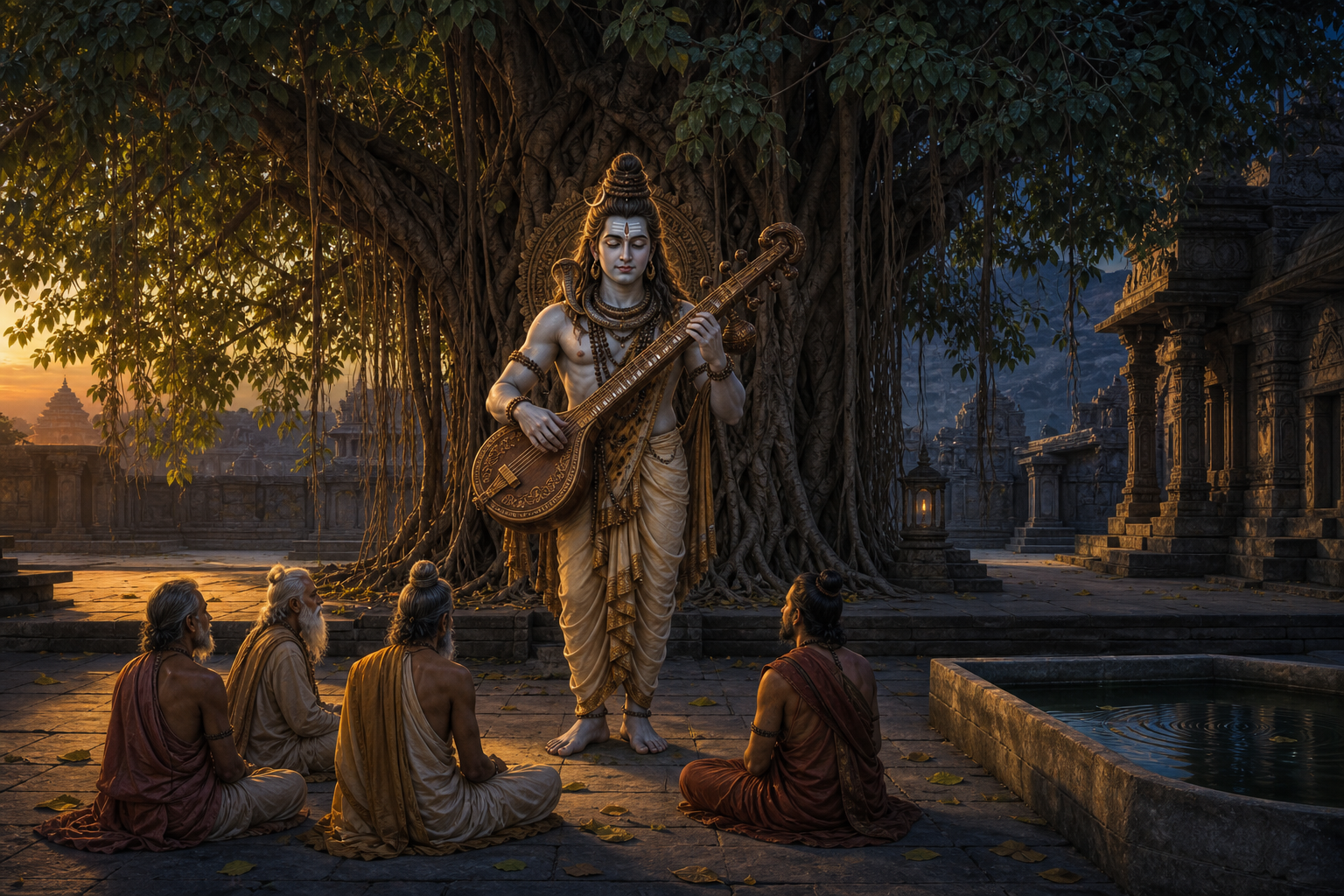
The apparent contradiction is the heart of the icon. Dakshinamurti is celebrated for mauna-vyākhyā, instruction through silence, yet Vinadhara Dakshinamurti holds an instrument made to produce sound. The two gestures do not compete. Silence is the ground from which meaningful sound emerges and the stillness into which it resolves.
This is why anāhata-nāda, the unstruck sound, is important to the form. It should not be reduced to an ordinary noise that happens to be faint, nor treated as a sensation you must manufacture. It names a subtler principle: audible patterns arise within an underlying field of awareness that is not itself exhausted by any particular note.
- The instrument teaches disciplined relation. A musical note depends on tuning, proportion, tension, resonance, and space. Knowledge likewise requires a mind capable of receiving and testing what it hears.
- The standing posture teaches integration. Wisdom is not confined to withdrawal. The Guru’s stability remains present while instruction becomes active and communicable.
- The movement from sound to silence teaches discernment. A note appears, continues, and fades. Awareness is present through all three moments. The icon directs attention toward that continuity.
Advaita Vedānta reads this continuity as a clue to the Self. Thoughts, perceptions, and sounds arise and subside, but consciousness is not merely one more passing event among them. The vīṇā therefore becomes an image of a mind brought into tune through inquiry: capable of expression, but no longer mistaking every fluctuation for its deepest identity.
The familiar sequence of śravaṇa, manana, and nididhyāsana makes the visual teaching practical. First you hear the teaching. Then you examine and reflect upon it. Finally, you allow sustained contemplation to remove the distance between an understood proposition and lived recognition. The sages at the Guru’s feet embody receptivity, but not passivity; their listening initiates a complete discipline of understanding.
A Shaiva Tantric reading adds the triad of icchā, jñāna, and kriyā: will, knowledge, and action. The standing form gives particular visibility to action, while the vīṇā suggests that expression must be tuned by knowledge rather than driven by untutored impulse. The resulting lesson is exacting. Right action is not mere activity. It is movement that has not lost contact with stillness.
A shared Dharmic grammar without erasing differences
You can recognize a wider Dharmic pattern here without pretending that distinct traditions teach an identical theology. Buddhist contemplative silence and chant both discipline attention. Jain sāmāyika and devotional song bring stillness and praise into a structured spiritual life. Sikh śabad-kīrtan places revelatory sound at the center of the devotee’s relation to the Guru. These parallels clarify why sound need not be the opposite of silence.
The differences still matter. Vinadhara Dakshinamurti belongs to a specifically Shaiva iconographic and theological world. Cross-traditional comparison is most useful when it reveals a shared question—how truth passes beyond concepts while still becoming hearable—without dissolving each path’s vocabulary, discipline, or understanding of liberation.
Approach the image as a pilgrim, student, or practitioner
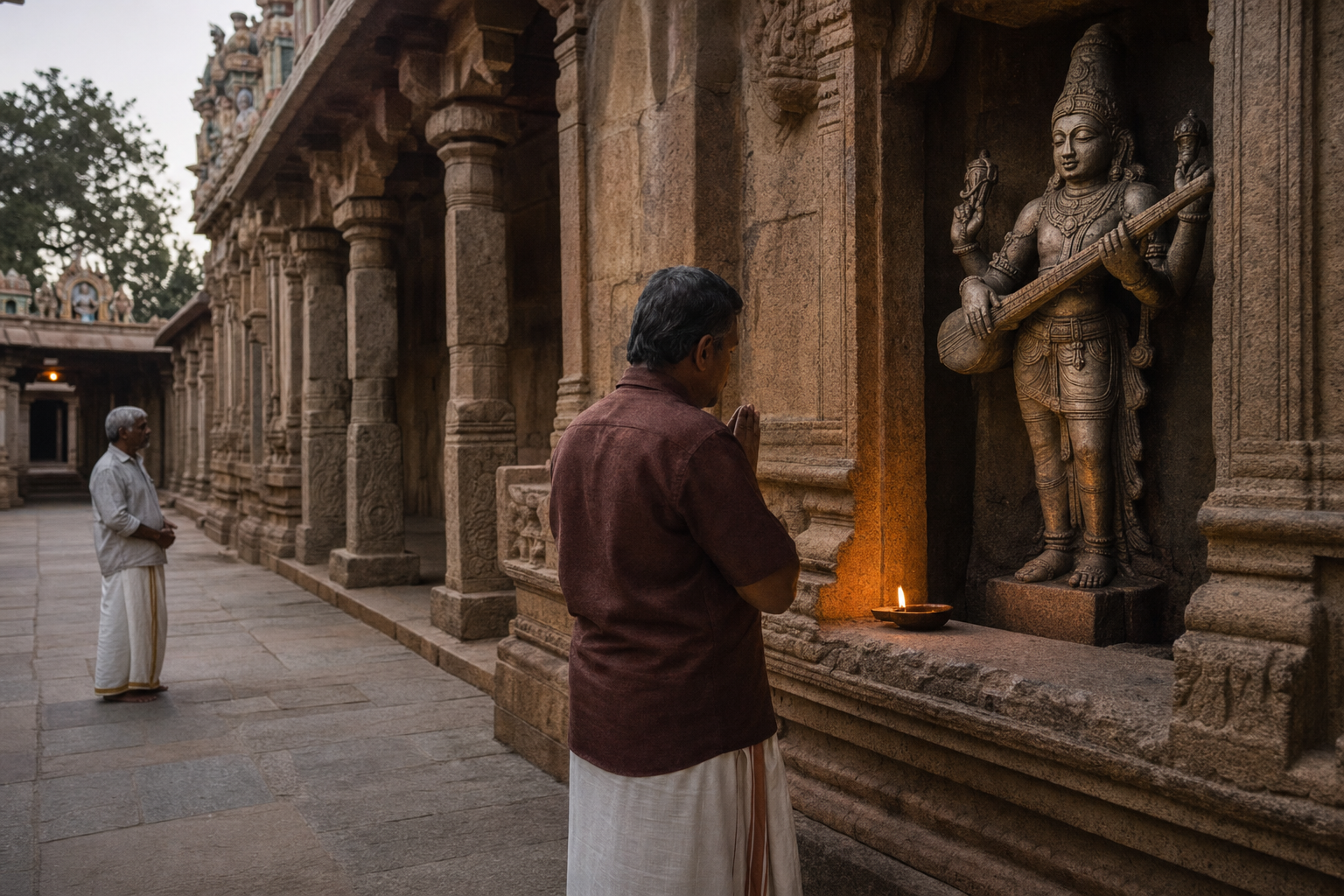
During a temple visit
The southern niche is part of a temple’s teaching architecture. If you are moving around the sanctum, resist the urge to treat it as a decorative interruption or a quick photographic stop. Let the change in direction and mood do some of the work.
- Locate the image precisely. Note whether it occupies the southern devakoṣṭha or appears elsewhere as an independent image, relief, frieze, or bronze.
- Establish Shiva’s identity. Find the jaṭā-mukuṭa, crescent, serpent ornaments, sacred thread, or other surviving Shaiva markers.
- Confirm the teaching mode. Look for the vīṇā, the poised stance, the banyan setting, receptive sages, or Apasmara. Remember that supplementary figures can be absent.
- Attend to balance before symbolism. Notice how the body supports the instrument without losing serenity. The visual equilibrium is itself part of the instruction.
- Listen to the transition. Hear whatever sound is actually present—bells, chant, footsteps, breath—and notice its return to quiet. Do not hunt for a dramatic inner phenomenon.
- Leave with one question. Ask where your own speech or action is out of tune with what you know. That question carries the icon beyond the niche.
Thursdays and Guru Pūrṇimā are widely observed occasions for Dakshinamurti worship, although the local temple calendar governs actual practice. Recitation of the Dakshinamurti Stotra attributed to Ādi Śaṅkarācārya, reflection on Upaniṣadic teachings concerning the Self, and a period of mauna are appropriate ways of entering the icon’s pedagogical world. Lamp, water, and leaves express clarity and sufficiency where local custom permits them; temple rules should determine what you offer and where.
When studying a sculpture or photograph
A useful record separates what the object shows from what you infer. This is more valuable than beginning with an elaborate theological label and making every detail fit it.
- Record the work’s location and orientation, if known. If the original architectural setting is unknown, say so.
- Mark the figure as standing or seated and describe how the instrument is supported.
- List only the Shaiva attributes that remain visible; do not silently reconstruct missing ones.
- Note the presence or absence of the banyan, four sages, and Apasmara without treating optional elements as mandatory.
- Distinguish stone, bronze, relief, frieze, or independent image when that information is available.
- Write your identification separately from your symbolic interpretation. Use terms such as probable or possible when damage or missing context warrants them.
This record also makes regional comparison more honest. Differences in drapery, stance, or the vīṇā’s form can reflect workshop and period choices without changing the central identity of Shiva as the Guru of sacred sound.
For personal sādhana
The icon points toward two practices that must remain together: attentive listening and deliberate inquiry. Listening without discernment can turn into fascination with sensation. Study without inward attention can become information that never changes conduct.
- Settle attention on the breath and the sounds already present. Let each sound arrive and pass without trying to prolong it.
- Notice the quiet in which successive sounds become distinguishable. Treat that quiet as a condition of listening, not as a prize to seize.
- Take one teaching concerning the Self, ignorance, or right action as śravaṇa rather than collecting many unrelated statements.
- Use manana to test what you heard. Ask what the teaching means, what it denies, and which assumptions in your life resist it.
- Remain with the clarified insight through nididhyāsana. The aim is steadiness, not the production of an unusual auditory experience.
- Translate the result into conduct. Choose speech, work, study, or service that brings action into better alignment with understanding.
This sequence reflects the icon’s own logic. The vīṇā is tuned before it communicates; the listener becomes receptive before knowledge matures; the standing Guru acts without abandoning stillness.
Key takeaways
- Identify Vinadhara Dakshinamurti through a constellation of evidence: Shiva’s attributes, the vīṇā, a poised teaching posture, and—where preserved—the southern Guru setting.
- Do not reject the identification merely because the banyan, sages, or Apasmara are absent. These elements support the reading but need not appear in every representation.
- Read the vīṇā as more than a musical accessory. It expresses nāda, measure, embodied knowledge, and the emergence of communicable teaching from silence.
- Keep visible description, conventional identification, and contemplative interpretation separate. That distinction improves both art-historical accuracy and devotional depth.
- Use śravaṇa, manana, and nididhyāsana as the practical key: receive the teaching, examine it, and allow it to shape awareness and conduct.
- Let the standing posture correct a narrow idea of spirituality. Realized stillness is not inertia; it can become precise, harmonious action.
The next time you meet this form, ask three questions in order: What makes this Shiva, what makes him Guru, and what does the vīṇā add? If you stay with those questions long enough to hear the quiet around them, the sculpture has already begun to teach.
References
