

If you are drawn to Dharmic ecological living, the difficult question is not whether you admire it. The question is what you will change after the admiration fades. Must you leave the city, build with mud, keep cows, or join an intentional community before your life can become meaningfully regenerative?
Govardhan Ecovillage in Maharashtra offers a more useful answer: let bhakti supply the motive, let sound design shape the method, and connect everyday choices so that water, food, energy, soil, waste, livelihood, and worship support one another. You do not need to reproduce the village. You need to understand its operating logic.
Bhakti turns conservation from a preference into seva
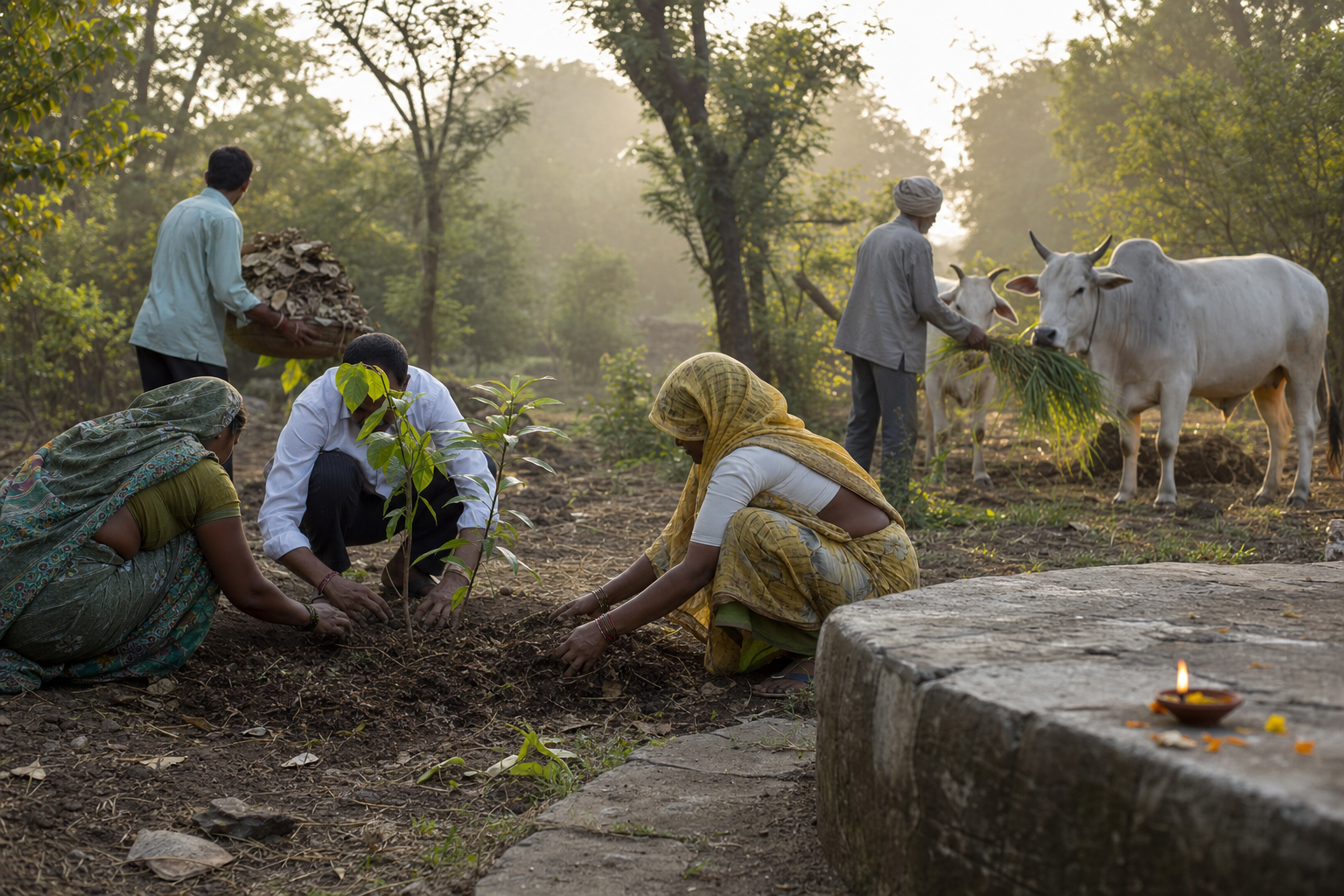
Many environmental habits fail at the point of repetition. Buying an efficient appliance is easy; using resources carefully month after month is harder. Installing a composter is visible; separating kitchen material cleanly every time is less glamorous. Technical systems matter, but they cannot supply their own motivation.
Bhakti changes the moral meaning of that repetition. Water is not merely a utility bill. Food is not merely inventory. Soil, animals, plants, and human labor are not disposable inputs. They belong within a sacred order that asks for gratitude, restraint, and responsible care. Bhakti-yoga, kirtan, mindful japa, reflective study, and seva can therefore sustain the attention on which ecological discipline depends.
This is where bhakti-centered ecology differs from decorative greenness. It does not place a devotional program beside a sustainability program and call the result integrated. It asks whether devotion changes how you purchase, cook, discard, build, cultivate, travel, and share.
You can test that connection with ordinary decisions. Before buying, ask whether the item is necessary, repairable, shareable, and likely to become difficult waste. Before throwing something away, ask whether it is edible surplus, reusable material, recyclable matter, or a biological nutrient. Before beginning an ecological project, ask who will maintain it after the enthusiasm passes. These questions give practical form to aparigraha, ahimsa, dana, and seva.
The same moral vocabulary can also create cooperation across Dharmic traditions. Hindu, Buddhist, Jain, and Sikh communities need not erase their distinct teachings to work together on non-harm, restraint, service, generosity, and care for a shared landscape. Vasudhaiva Kutumbakam becomes concrete when kinship with the world affects the drain, the dustbin, the field, and the electricity meter.
See a network of loops, not a collection of green features
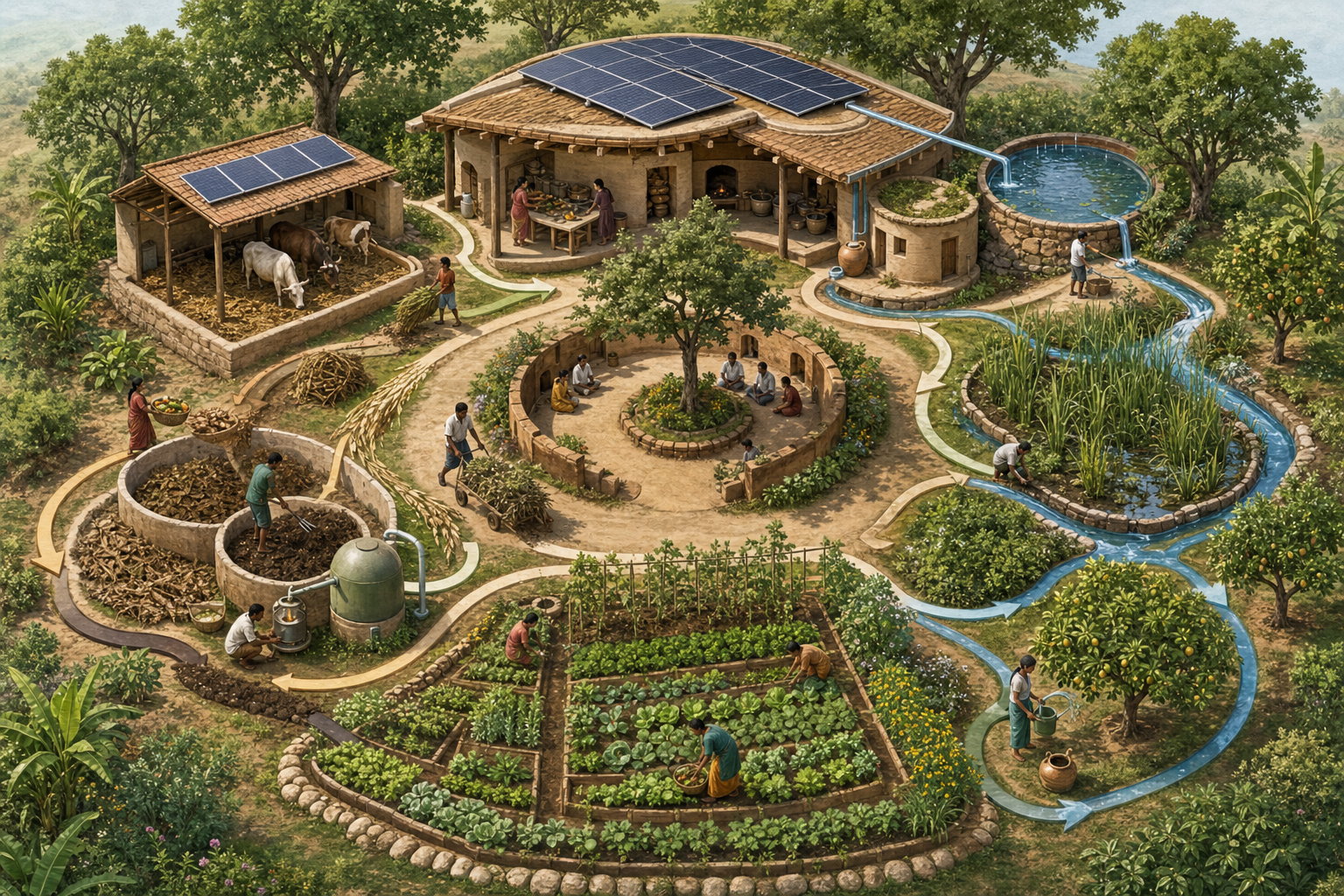
The most transferable lesson from Govardhan Ecovillage is whole-systems thinking. A solar array, an earthen wall, or a compost pile can be worthwhile on its own, but no isolated feature constitutes regenerative living. The stronger question is: where does each resource come from, where does it go, and can its next use reduce waste elsewhere?
| Resource stream | Practice at Govardhan Ecovillage | Principle you can transfer |
|---|---|---|
| Monsoon water | Rainwater harvesting, contour bunds and trenches, percolation features, and storage | Slow, spread, sink, and store water before treating runoff as a disposal problem |
| Greywater | Natural reed-bed treatment | Match water quality to its next safe use instead of assuming every task requires fresh water |
| Organic residues | Biodigesters and vermicomposting | Separate biological material early enough for it to become energy or soil fertility |
| Electricity | Solar photovoltaic generation | Reduce demand while shifting feasible loads toward decentralized renewable supply |
| Building comfort | Orientation, shade, courtyards, cross-ventilation, thermal mass, and locally appropriate materials | Use climate-responsive design before relying entirely on mechanical cooling |
| Farm nutrients | Mulching, composting, natural inputs, multi-cropping, gaushala systems, and Panchgavya practices | Build soil health through managed local cycles rather than treating fertility as a purchased commodity alone |
Notice how the loops reinforce one another. Organic matter becomes an input rather than mixed refuse. Better soil holds moisture and supports biological diversity. Climate-responsive buildings reduce energy demand before renewable generation is added. Water is handled across the landscape rather than only at the tap. Social infrastructure then carries the knowledge needed to keep each system working.
This also reveals weak imitations. A building made from natural-looking materials may still consume excessive energy. A community garden may import fertility while sending its own organic matter to landfill. Rooftop solar may lower grid demand while avoidable consumption continues unchecked. The test is not whether a project looks green. The test is whether it closes a meaningful loop without shifting the burden somewhere less visible.
Copy the principles at the scale you actually control

Your best starting point is neither the most impressive technology nor the most photogenic project. Begin with a resource stream you can observe and influence. Map where it enters your household or institution, how it is used, who handles it, and where it leaves. That map will usually expose a practical intervention.
In an apartment
Kitchen preparation waste is often the most visible stream. Separate biodegradable matter before it is contaminated by plastic, glass, cleaning chemicals, or sanitary waste. A balcony composter may be suitable where building rules, space, drainage, and ventilation permit it. If on-site composting is unsuitable, clean separation still makes collection by a community system more workable.
Your larger leverage may lie with the housing society. Ask for a water budget, an assessment of rooftop-solar feasibility, a review of organic-waste handling, and suitable planting or community-garden space. Do not ask only whether a system can be installed. Ask who will inspect it, clean it, record its performance, and respond when it fails.
In a house or on a plot
Study water movement before buying equipment. Identify roof runoff, hard surfaces, natural slopes, low points, existing vegetation, and possible storage. The aim is to retain useful rain, encourage appropriate infiltration, and prevent erosion or waterlogging. Local soil, rainfall, drainage, and building conditions matter, so rainwater structures require site-specific design.
For thermal comfort, begin with shade, airflow, openings, roof exposure, and the heat stored by walls and paving. Earth, stone, lime, and bamboo can be appropriate materials, but they are not universal recipes. Structural work, electrical systems, wastewater treatment, and load-bearing alterations need qualified local professionals. Bhakti does not replace engineering competence; it demands that competence be used responsibly.
In a temple, school, farm, or campus
Institutions can work across several connected streams, but they also need measurement. Useful indicators include harvested water compared with consumption, energy use per person, the renewable share of electricity, waste diversion, compost output, biodiversity observations, health, and participation. Choose measures that expose decisions rather than produce an ornamental report.
For example, a water budget can reveal whether harvesting is reducing demand or merely adding storage. Waste records can show whether segregation is improving or whether compostable matter still leaves with mixed refuse. Pollinator observations and vegetation transects can indicate whether a garden is supporting biodiversity rather than functioning only as landscaping. Participation records can reveal whether ecological seva is shared or resting on a few exhausted volunteers.
Training and livelihood matter as much as hardware. A reed bed that nobody understands, a digester without maintenance, or a garden dependent on unpaid enthusiasm will become fragile. Build skill transfer, named responsibility, and local livelihood opportunities into the project from the beginning.
Some practices should not be detached from their system. Govardhan Ecovillage’s gaushala and Panchgavya-based agriculture operate within managed relationships among cows, organic residues, cultivation, and soil. A cow-derived input is not automatically regenerative merely because it is traditional. Its sourcing, preparation, application, ecological effect, and safe handling still matter. The Dharmic principle is responsible relationship, not uncritical consumption of a product.
Build ecological discipline into your existing sadhana

A durable household practice needs a cue, an action, a responsible person, and a visible result. Your devotional rhythm already provides cues. The point is not to turn worship into a productivity device. It is to prevent your material habits from contradicting the values affirmed in worship.
- Name the restraint. Choose a clear household rule, such as separating all kitchen preparation scraps from mixed refuse or checking existing supplies before purchasing more.
- Connect it to a devotional cue. Let meal preparation cue careful segregation, let household worship cue attention to cleanliness and resource use, or let community kirtan be accompanied by an established opportunity for garden or maintenance seva.
- Give the work an owner. Shared values do not eliminate practical responsibility. Decide who empties, cleans, records, repairs, or contacts the service provider.
- Make the result visible. Observe the water retained, electricity used, organic matter composted, produce grown, or volunteers participating. Measurement should correct conduct, not feed vanity.
- Return the benefit to service. Share edible surplus, use compost to restore soil, teach the method to neighbors, or direct savings and labor toward a community need.
This pattern joins inner and outer practice without confusing them. Japa and reflection help you notice appetite, impatience, and possessiveness. Aparigraha limits accumulation. Ahimsa widens the circle of consequence. Dana redistributes surplus. Seva keeps necessary maintenance from being dismissed as menial work. Kirtan and collective learning turn private intention into a culture that can outlast individual motivation.
Joy also matters. Ecological living framed only as deprivation will struggle to become a stable community norm. Shared work, sacred music, learning, cultivation, and hospitality can make restraint socially meaningful. The desired result is not grim austerity but enoughness: taking what supports a good life, returning what can nourish the wider system, and refusing waste that comes from carelessness.
Key takeaways
- Govardhan Ecovillage is most useful as a systems model, not an architectural style to imitate.
- Bhakti gives ecological maintenance a durable motive by treating restraint, care, and repair as forms of seva.
- Start with a visible resource stream and trace its full path before choosing technology.
- Judge a project by the loop it closes, the burden it avoids shifting, and the people capable of maintaining it.
- Use water, energy, waste, soil, biodiversity, and participation measures to improve conduct rather than merely advertise virtue.
- Keep traditional ecological practices within their proper context; reverence should deepen technical responsibility, not suspend it.
Begin where devotion and material life already meet: the next meal you prepare, the next purchase you consider, or the next community gathering you help organize. Trace the relevant resource, choose the smallest loop you can genuinely maintain, and treat its care as seva. Once that loop works, connect it to the next one.
References
