
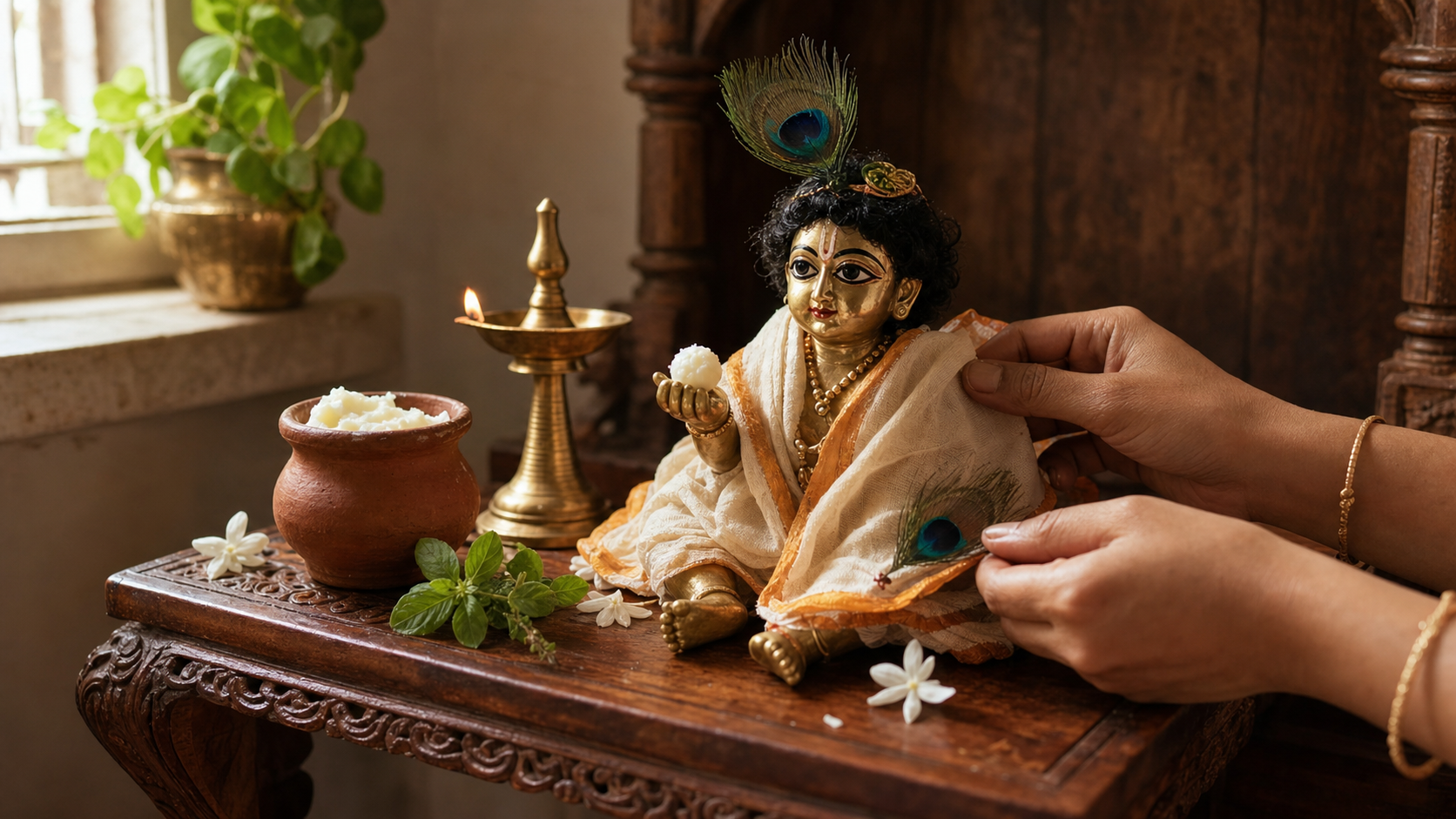
You may have welcomed Ladoo Gopal into your home and then wondered what the small murti actually asks of you. Is the child form mainly a beautiful reminder of Krishna’s childhood, or does keeping it imply a relationship, a routine, and a responsibility?
Vatsalya bhakti gives a clear answer. Ladoo Gopal invites you to approach the Divine through attentive care. The butter in his hand explains the quality of that care: offer what has been patiently refined, keep the heart soft, and let worship make you more dependable toward every being placed in your protection.
Vatsalya reverses the usual direction of prayer
Much religious practice begins with human need. You ask the Divine for protection, guidance, health, courage, or relief. Vatsalya does not reject those prayers, but it temporarily reverses their direction. Before asking Krishna to care for you, you ask whether Bala Krishna has been awakened, bathed, dressed, fed, comforted, and put to rest.
This reversal is the distinctive force of devotion expressed as parental affection. God has not ceased to be God, and the devotee has not literally become the source of divine existence. Krishna freely accepts the place of the dependent child so that love can operate without the distance normally created by majesty.
Rūpa Gosvāmi’s Bhakti-rasāmṛta-sindhu places vātsalya among five primary devotional rasas: śānta, or serenity; dāsya, or service; sakhya, or friendship; vātsalya, or parental affection; and mādhurya, or conjugal love. A rasa is more than a passing emotion. Protective affection becomes a stable devotional disposition through remembrance, practice, and sacred association.
That distinction matters in a home shrine. Feeling tenderness when you see Ladoo Gopal is a beginning, not the whole practice. Vatsalya matures when affection becomes reliable service. A beautiful garment offered occasionally may express love, but so can the quieter discipline of approaching the shrine attentively on an ordinary morning when there is no festival and no audience.
Vatsalya also changes how you understand divine power. In the mood of aiśvarya, you stand before the sovereign Lord with reverence. In the sweetness of mādhurya, that majesty is lovingly veiled so intimacy can grow. The parent does not spend every moment contemplating the child’s cosmic supremacy. The immediate concern is simpler: Is he comfortable? Has he eaten? What would give him joy?
If your prayer has become almost entirely a list of requests, add one act of seva with no request attached. Dress Gopal, offer food, recite a name, or sing a lullaby simply for his pleasure. That small change reveals whether you are treating the murti as a sacred relationship or only as a place to submit petitions.
The butter ball carries a complete lesson in bhakti
The round object in the familiar seated or crawling Bala Krishna image can look like a ladoo. Its deeper iconographic meaning, however, comes from Krishna’s makhan or navanīta līlā. This is the child who enters storerooms, reaches into butter pots, shares his treasure, and becomes known as Navanīta-chora, the thief of butter.
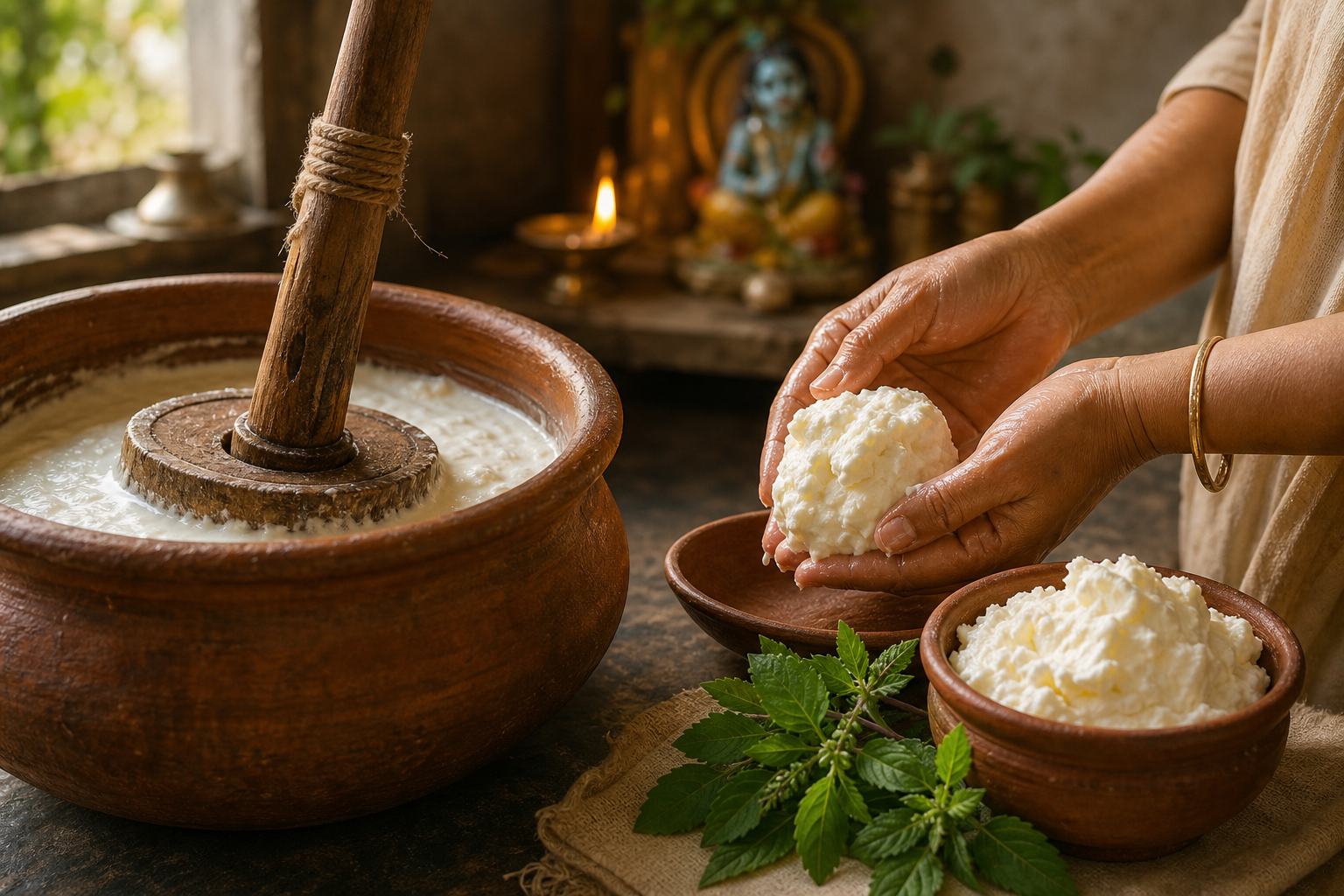
Butter first belongs to the lived world of Vraja. Cows, milk, curd, butter, and ghee sustained the pastoral community around Krishna. Butter therefore represents more than sweetness. It contains the work of tending animals, collecting milk, setting curd, churning it, and separating its richest part. When Gopal holds butter, he holds the concentrated fruit of nourishment, labor, and care.
The same substance also points toward yajña. Ghee, clarified from butter, feeds the sacred fire. The household food of Vraja and the ritual offering are not disconnected worlds: both depend on transforming nourishment into an offering. Gopal’s tiny palm joins the kitchen, the cowshed, the shrine, and the sacrificial fire in one economy of responsible abundance.
Churning adds an inner meaning. Butter does not appear merely because milk exists. Repeated, patient movement draws out what was present but dispersed. Sādhana works in a similar way. Repetition of the Divine Name, reflection on līlā, ethical restraint, and seva gradually gather a scattered mind around its essential love. Krishna takes the refined result, not because he lacks anything, but because offering that inner essence is how possessiveness loosens.
| What you see | What it recalls | What you can practice |
|---|---|---|
| Fresh butter | The carefully churned essence of milk | Offer the best fruit of steady effort, not whatever happens to be left over |
| Softness | A heart able to yield without becoming weak | Correct others without cruelty and serve without harshness |
| Whiteness | Clarity and purity of intention | Notice whether an offering is made for Krishna or for display |
| A complete sphere | Fullness, abundance, and non-fragmentation | Bring your work, food, family duty, and worship into one ethical life |
| Butter in a child’s hand | Divine delight in the essence produced by human care | Make ordinary household work part of seva |
No single symbolic definition needs to displace the others. The butter is real food within the Vraja līlā, the product of household labor, a precursor to ritual ghee, a sign of the softened heart, and an image of the essence brought forth through practice. Hindu symbols often remain powerful precisely because the material, ethical, emotional, and theological levels coexist.
This gives you a practical standard for naivedya. Makhan and mishri directly remember Krishna’s childhood play, but expense is not the measure of devotion. The better offering is one chosen carefully, prepared cleanly, given without waste, and received afterward as prasada. If dairy production presents an ahiṃsā concern for your household, seek a compassionate source or follow an acceptable alternative within your tradition. The point is not to display abundance while ignoring the suffering through which it was obtained.
Yaśodā’s rope explains why the Supreme accepts care
The Tenth Canto of the Bhāgavata Purāṇa provides the central narrative setting for vatsalya toward Krishna. His childhood is not merely background before the supposedly serious work of divine teaching begins. Feeding, bathing, protecting, chasing, correcting, and comforting him are themselves revelations of bhakti.
The Damodara līlā makes the theology unmistakable. After Krishna’s butter mischief, Yaśodā pursues him and tries to bind him to a mortar. Her effort is physical and personal. The mother who has glimpsed the universe within her child’s mouth nevertheless returns to the immediate duty of raising that child. Infinity is not denied; it is enfolded within intimacy.
Krishna’s consent to be bound is more important than the rope itself. The Absolute cannot be captured by ordinary force, yet the Lord allows parental love to bind him. Divine sovereignty remains intact, but it is expressed as the freedom to receive a devotee’s care.
This protects vatsalya from becoming mere sentimentality. Yaśodā does not prove her love by permitting every act without correction. She feeds Krishna, delights in him, pursues him when he is mischievous, and imposes a boundary. Vatsalya includes tenderness and responsibility. A parent who never protects, guides, or corrects is not practicing fuller love merely by feeling affection.
Nanda Mahārāja adds the paternal dimension of vigilance. His concern for ritual duties, community order, and the child’s safety shows that parental bhakti is not confined to emotional warmth. The people of Vraja also gather around Krishna protectively. Their shared guardianship turns family and village responsibility into sacred work.
During darśana, you can use the image to notice four relationships at once:
- The child is the limitless Divine appearing within a form you can approach.
- The butter is the essence produced by care, discipline, and nourishment.
- The mischief removes stiff formality and permits affectionate nearness.
- Your role changes from spectator or petitioner to attentive sevaka with parental feeling.
Hold those four together. If you see only omnipotence, the child may disappear behind abstraction. If you see only cuteness, the murti can become decoration. Vatsalya preserves divine transcendence while giving you a concrete way to love: notice a need, respond carefully, and remain present.
Build a home seva that affection can actually sustain
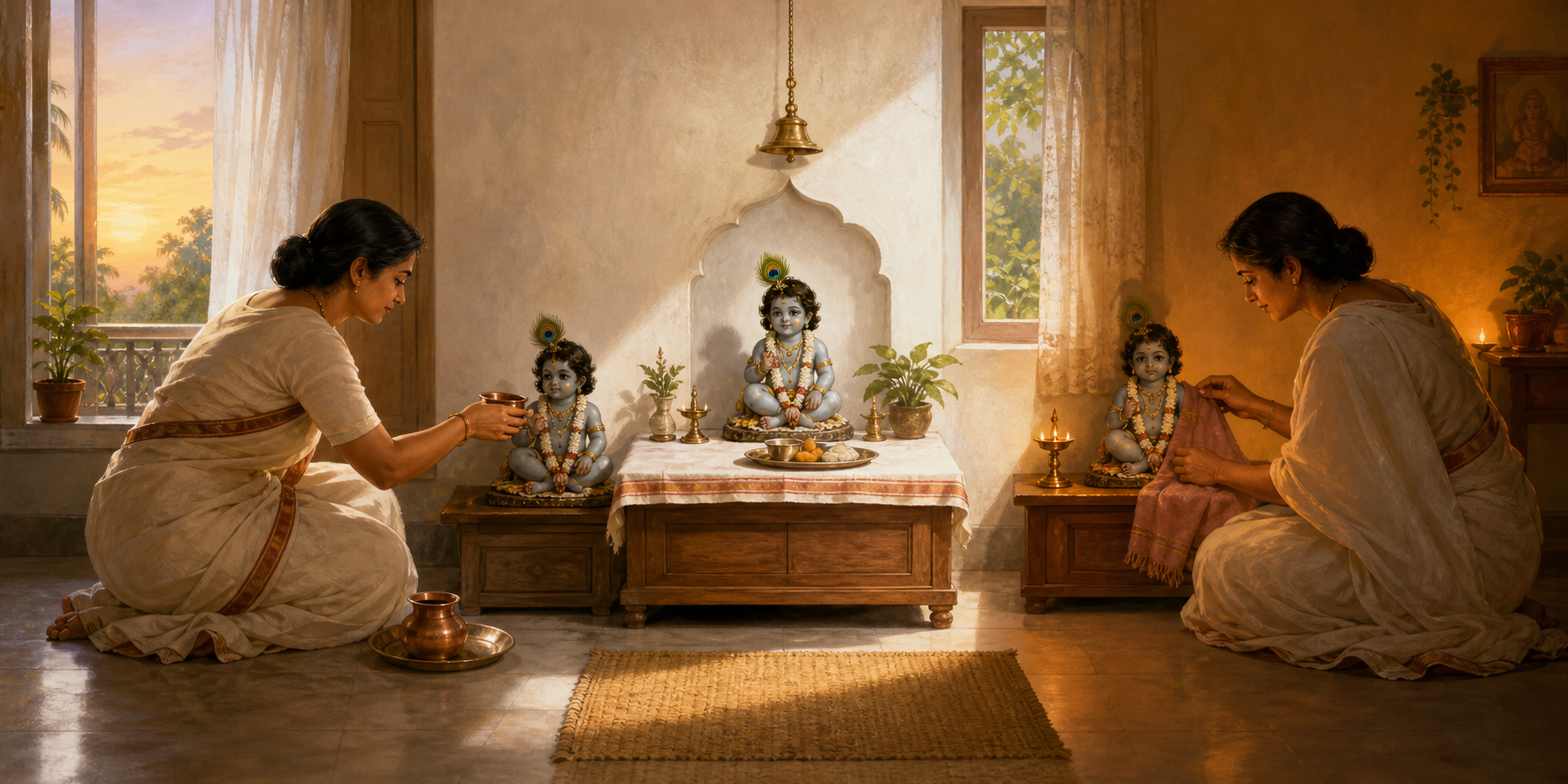
There is no single household schedule that overrides every family or sampradāya. Puṣṭimārga expresses child-centered seva through aṣṭayāma, the eight darśanas that accompany Śrīnāthji through awakening, adornment, meals, rest, and retirement. Gauḍīya Vaiṣṇavas give special attention to the Damodara līlā during Kārtika through lamps and the Damodarāṣṭakam. Śrī Vaiṣṇava devotion also treasures infant forms such as Vātapatraśāyī, the child resting on the banyan leaf.
If your family, temple, or guru has given you a seva method, that discipline should frame your practice. If you are beginning without an elaborate inherited routine, use a modest sequence you can perform respectfully and consistently:
- Welcome Gopal. Approach the shrine with ordinary cleanliness, greet him, and mentally shift from rushing past an object to attending to a person.
- Care for the form. Bathe or clean the murti only in the manner suitable for its material and your tradition. Dress and adorn Gopal without making ornament more important than attention.
- Offer nourishment. Makhan-mishri can recall the butter līlā. Other appropriate household naivedya can express the same principle when offered with care. Add Tulasi where your tradition permits it, and distribute the offering as prasada rather than wasting it.
- Give memory a voice. Recite a name of Bala Krishna, sing a kīrtana or lullaby, or narrate one childhood līlā. This prevents the routine from becoming silent maintenance detached from Krishna’s personality.
- Allow rest. Conclude deliberately instead of simply walking away when the visible tasks are finished. A gesture of putting the child to rest completes the parental rhythm.
The routine should be regular enough to form a relationship and small enough to remain honest. An ambitious schedule that generates resentment, fear, or repeated neglect does not become superior merely because it contains more items. Begin with what you can sustain, then expand during Janmāṣṭamī, Kārtika, Govardhan Pūjā, or other observances meaningful to your household.
Do not use a missed observance as a reason to abandon seva. Acknowledge the lapse, restore order, and resume respectfully. Vatsalya calls for responsibility, but its inner grammar is affection rather than panic. The discipline exists to make care dependable, not to make you afraid of the child you are trying to love.
Children in the household can participate in concrete ways: help select Gopal’s clothing, place Tulasi with guidance, listen to a līlā, sing, or share prasada. Give them a real responsibility appropriate to their ability rather than turning them into an audience for adult ritual. Vatsalya then becomes intergenerational learning through practice.
Keep one distinction clear. Costly śṛṅgāra may be beautiful, but purchasing is not the same as seva. The decisive question is what the act trains you to notice. If a simple offering makes you more attentive than an elaborate display, the simple offering may be doing more devotional work.
The final test of vatsalya lies outside the shrine
Ladoo Gopal does not need your care because divine power is deficient. You need the discipline of caring because it retrains attention. Feeding the child form teaches you to notice hunger. Dressing him teaches you to notice comfort and dignity. Singing to him teaches you to give time without demanding an immediate return.
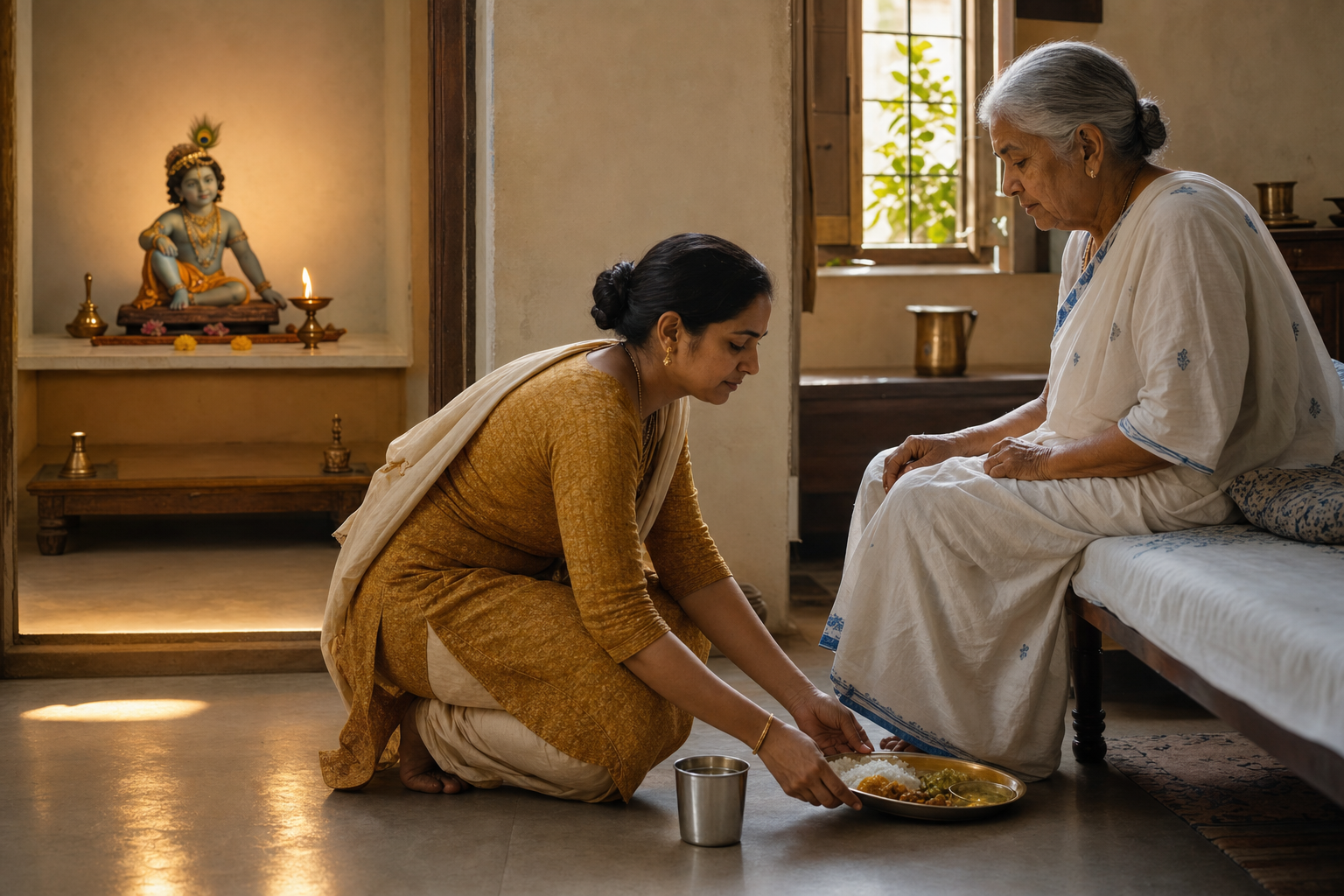
Those habits must eventually reach living beings. Vatsalya becomes ethically credible when it increases patience with children, steadiness toward elders, protection of animals, generosity toward people in distress, and respect for those who depend on you. If tenderness remains confined to the altar while actual dependents receive irritation or neglect, the practice has stopped at sentiment.
Food is one of the clearest tests. The butter symbol celebrates cows, nourishment, household labor, and sacred offering. It should therefore sharpen, not silence, questions about waste and avoidable harm. Dayā and ahiṃsā belong inside the meaning of the offering. Choose ingredients conscientiously, take only what will be used, and honor prasada by sharing it responsibly.
This movement from intimate care to wider compassion also makes vatsalya intelligible across the Dharmic family without erasing the differences among traditions. The Karaṇīya Mettā Sutta uses a mother’s protection of her only child as an image for boundless loving-kindness. Jain maitri-bhāvanā and anukampā cultivate friendship and compassion alongside ahiṃsā. Sikh Gurbani approaches the Divine through familial relationships including Mother, Father, Friend, and Beloved, while seva turns remembrance into service. Each path has its own theology and discipline, yet all refuse to separate spiritual refinement from the treatment of living beings.
Key takeaways
- Vatsalya bhakti approaches Krishna through parental care, shifting the devotional question from what you can receive to what you can lovingly offer.
- Ladoo Gopal’s butter recalls Vraja’s pastoral life, the labor of churning, the offering of ghee, a softened heart, and the refined essence of sādhana.
- Yaśodā’s binding of Krishna shows that divine majesty is not diminished by intimacy; the Supreme freely accepts the bonds of love.
- A sustainable seva can include greeting, appropriate cleaning and dressing, naivedya, remembrance through name or līlā, and a deliberate time of rest.
- The practice bears fruit when tenderness at the shrine becomes responsible care for children, elders, animals, guests, food, and anyone vulnerable to your choices.
At your next darśana, leave one request unspoken. Offer one carefully prepared thing for Gopal’s pleasure, remember one childhood līlā, and then carry that attention to one living being who depends on your care. That is where the butter in Krishna’s hand begins to reveal its full meaning.
References
- DharmaRenaissance Blog – Vatsalya Rasa: When God Becomes a Child, Parental Love at the Heart of Bhakti
- DharmaRenaissance Blog – Makhan in Krishna’s Hand: Unveiling the Profound Symbolism of Ladoo Gopal’s Butter
