
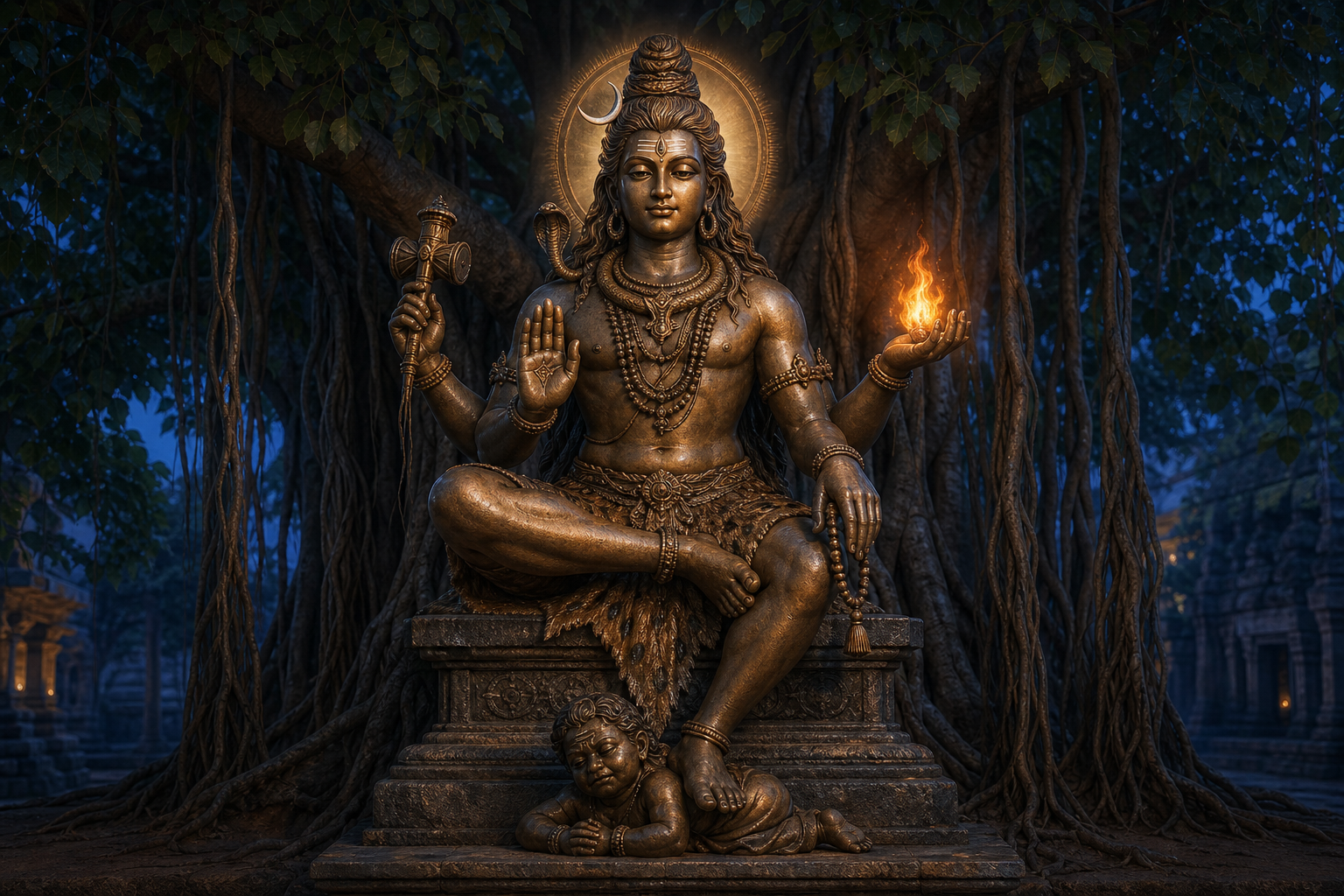
You may know Dakshinamurti as the serene guru beneath the banyan tree, yet feel unsure when the same figure holds fire or appears more intense. Is this Shiva as a destroyer, a wrathful guardian, or still the teacher who communicates through silence?
The decisive question is not, What is Shiva destroying? It is, What is being dissolved in the presence of knowledge? Read the posture, the foot, the hands and the face in that order. You will see that Samhara Dakshinamurti is fierce in function but compassionate in purpose: ignorance is removed so that recognition can arise.
Begin with the right meaning of samhara
Samhara means dissolution or withdrawal. In Shiva’s fivefold activity of srishti, sthiti, samhara, tirodhana and anugraha, it stands alongside emanation, maintenance, concealment and grace. These are not five unrelated divine jobs. They describe a continuous movement in which forms emerge, endure, recede, become hidden and receive the possibility of liberation.
Dakshinamurti is usually approached through anugraha, the grace of the guru. His Samhara form shows why grace sometimes feels like subtraction. A false certainty has to fall. A compulsive pattern has to lose its authority. Conceptual noise has to settle before silent knowledge can become evident. Samhara is therefore not the negation of reality. It is the withdrawal of avidya, limitation and bondage.
This distinction keeps you from turning the image into a celebration of violence. Fire does not signify rage merely because it burns. Here it concentrates, purifies and reduces experience to what cannot be discarded. In a tantric reading, it consumes vasanas, the latent impressions that keep reproducing the same perceptions and reactions. What remains is not an emptied life but clearer seeing.
The form also holds samhara and anugraha together. Dissolution is the operation; recognition is the gift. If an interpretation stops at destruction and never reaches knowledge, it has stopped halfway through the icon.
This grammar has resonances across the wider Dharmic family without making the traditions interchangeable. Buddhist disciplines value direct seeing beyond proliferating concepts. Jain practice understands liberation through the shedding of karmic obscuration. Sikh teaching directs the seeker beyond haumai through the Guru. Their metaphysical accounts differ, but each recognizes that freedom involves the removal of something that obstructs clear awareness. Samhara Dakshinamurti gives that civilizational intuition a distinctly Shaiva body.
Read the image from the ground upward
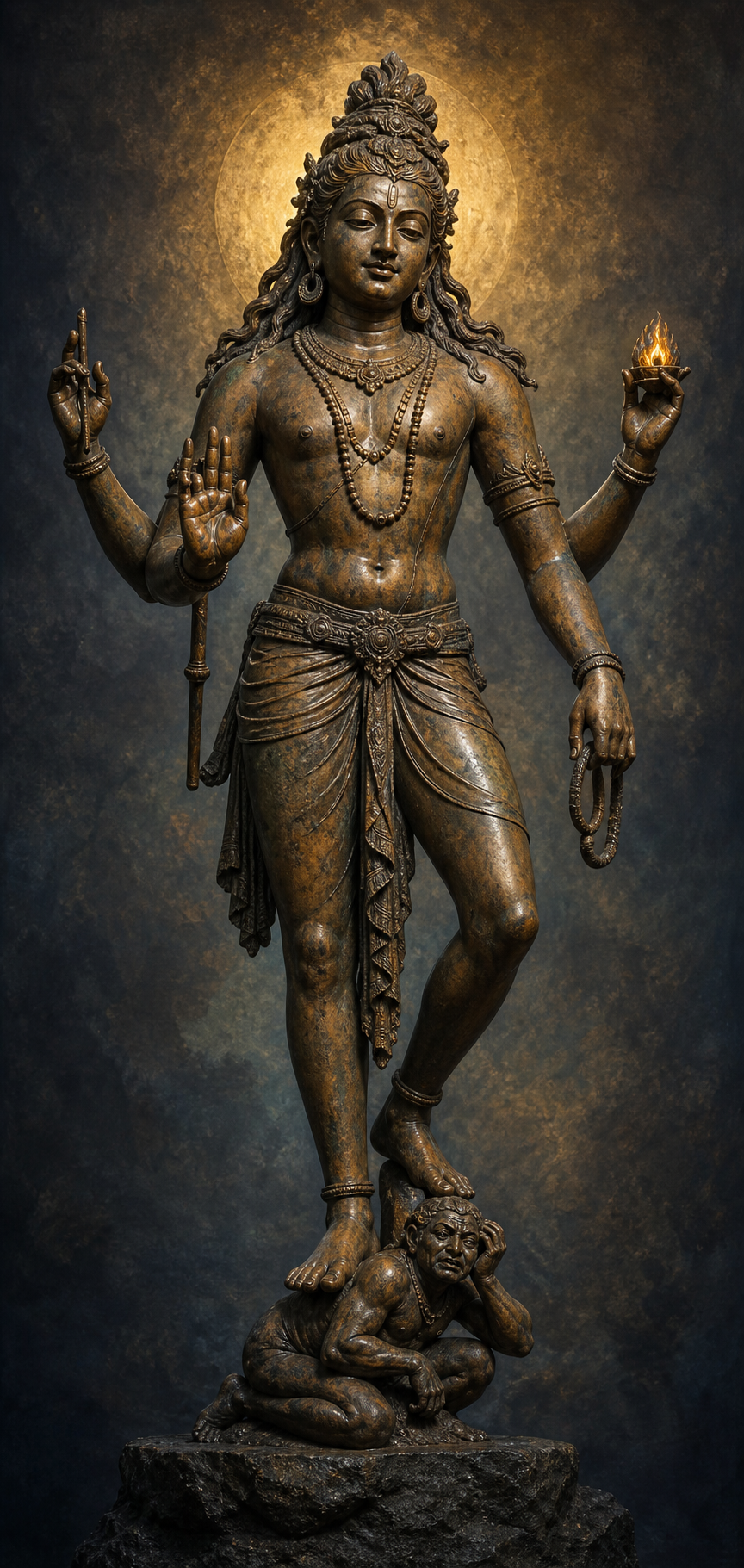
Do not try to identify this form from the flame alone. Regional conventions differ, and Samhara Dakshinamurti is not a uniformly standardized label across every Agamic, textual or sculptural tradition. Look for a cluster of signs. In a South Indian Shiva temple, first check the southern niche of the outer wall, the traditional position of Dakshinamurti. Then move visually from the figure’s foot to the canopy above him.
Apasmara: the condition that must remain under discipline
The right foot commonly rests upon Apasmara, the dwarf who personifies delusion and forgetfulness. Notice that Apasmara is subdued rather than treated as an enemy whose mere physical death would solve the problem. That detail changes the teaching. Forgetfulness is a recurring human possibility, so discernment cannot be performed once and then abandoned.
When you stand before the image, ask what currently behaves like Apasmara in your own attention. Choose something exact: resentment rehearsed after a conversation, distraction during japa, pride in being right, or an assumption you have not examined. The symbol becomes useful when delusion has a recognizable operation. A vague wish to eliminate negativity gives the mind nothing precise to observe.
The seat and banyan: authority without display
Dakshinamurti remains seated, often in lalitasana or virasana. The body may carry a slight torsion, and the matted locks may be active, but the fundamental posture is composed. This is contained dynamism: transformative force has not disturbed the centre from which it acts.
The banyan canopy signifies enduring transmission and knowledge unfolding across generations. Attendant rishis, when present, look upward in receptivity even though the guru appears youthful. The contrast is deliberate. Spiritual authority does not arise from biological age or ornamental rank. The youthful teacher communicates a knowledge that is not made old by time, while the banyan places that knowledge within lineage rather than private invention.
Sacred thread and restrained ornamentation reinforce the same priority. Look for learning, discipline and presence before splendour. If you are viewing a crowded panel, the seated youthful guru, banyan setting, sages and subdued Apasmara together are more reliable than any single hand attribute.
The hands: method, transformation and recognition
The hands tell you how the teaching works. Agni is the most direct Samhara signal: it represents the concentrated heat that removes obscuration. Yet fire should be read with the remaining attributes, each of which contributes a different part of the discipline.
- Agni: purification and reduction to essentials. Apply it inwardly to error, habit and misperception, not outwardly to a person you dislike.
- Akshamala: repetition made methodical. Insight is stabilized through sustained practice rather than a passing intensity.
- Palm-leaf manuscript: received teaching and transmission. Direct recognition does not make disciplined learning contemptible.
- Deer: the quick, unsettled movement of mind brought into steadiness.
- Trisula: controlled transformative power and, in a non-dual reading, the resolution of knower, known and knowing into undivided cognition.
- Naga: potent energy held under awareness rather than allowed to become chaotic.
- Damaru: the rhythmic power through which manifestation is articulated, placing dissolution within Shiva’s larger cosmic activity.
Chinmudra or a closely related teaching gesture may remain present even when fire supplies the Samhara emphasis. The joined thumb and forefinger direct the interpretation toward non-dual recognition. Dissolution is not the final message; it clears the obstruction to knowledge of the indivisible Self.
The face and hair: heat without loss of mastery
Finally, inspect the expression. Samhara Dakshinamurti generally retains the composure of the guru. Arched brows, animated jata, a sharpened gaze or a radiant aureole can increase the intensity, but the face does not ordinarily abandon serenity. This is tapas made visible: disciplined heat governed by insight.
A useful reading test is simple. If the lower part of the image shows ignorance under control, the middle shows a stable teacher, and the upper attributes show transforming knowledge, then the fierceness has an inward direction. The icon is not staging an emotional outburst. It is showing clarity strong enough to end confusion.
Distinguish Samhara from the teacher and the wrathful guardian
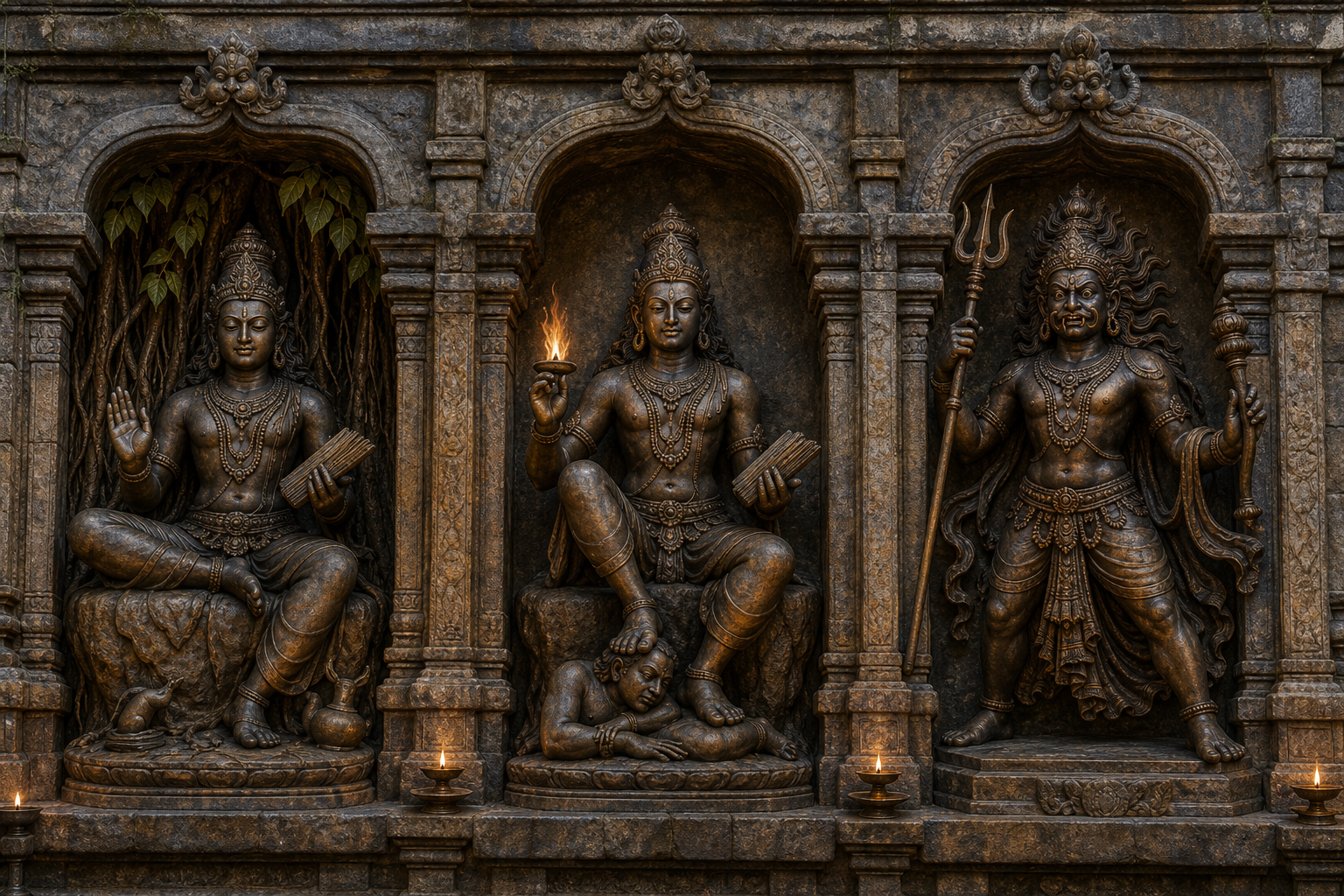
Confusion usually arises in two directions. You may mistake Samhara Dakshinamurti for the familiar Vyakhyana form because both are gurus, or for Bhairava because both can communicate formidable Shaiva power. Compare the whole visual argument rather than treating one attribute as a name tag.
| Feature | Vyakhyana Dakshinamurti | Samhara Dakshinamurti | Bhairava |
|---|---|---|---|
| Primary emphasis | Explanation and transmission of knowledge | Dissolution of the obscurations that prevent knowledge | Overtly formidable or wrathful Shaiva power |
| Basic posture | Seated guru | Seated guru, sometimes with contained bodily or hair movement | Not defined by the quiet teaching template |
| Expression | Youthful and serene | Serene but more incisive or thermally intense | May include unmistakably fierce traits such as fangs |
| Characteristic signs | Teaching mudra, rosary, manuscript, deer or damaru | Agni, with possible trisula or naga, while teaching signs may remain | Wrathful attributes such as skull garlands may appear |
| How to interpret the force | Knowledge is communicated | Error and latent conditioning are burned away | Terrible divine power is made explicit |
The boundary between the two Dakshinamurti modes is a difference of emphasis, not a separation between two unrelated deities. Vyakhyana teaches the truth; Samhara clears what prevents that truth from taking root. A sculpture may therefore retain the teaching mudra, manuscript or rosary while adding fire and greater intensity.
The distinction from Bhairava is equally important. A flame or active locks do not automatically turn the guru into a wrathful form. Check whether the seated posture, youthful face, sages, banyan and Apasmara still organize the composition. When they do, intensity remains inside the pedagogy of the guru.
Because prescriptions vary by region, lineage and period, treat a museum label or local temple identification seriously. Do not overrule a living tradition because an image lacks the combination you expected. Iconography is a grammar, not a mechanical checklist: context and relationships determine meaning.
Turn the icon into a disciplined contemplation
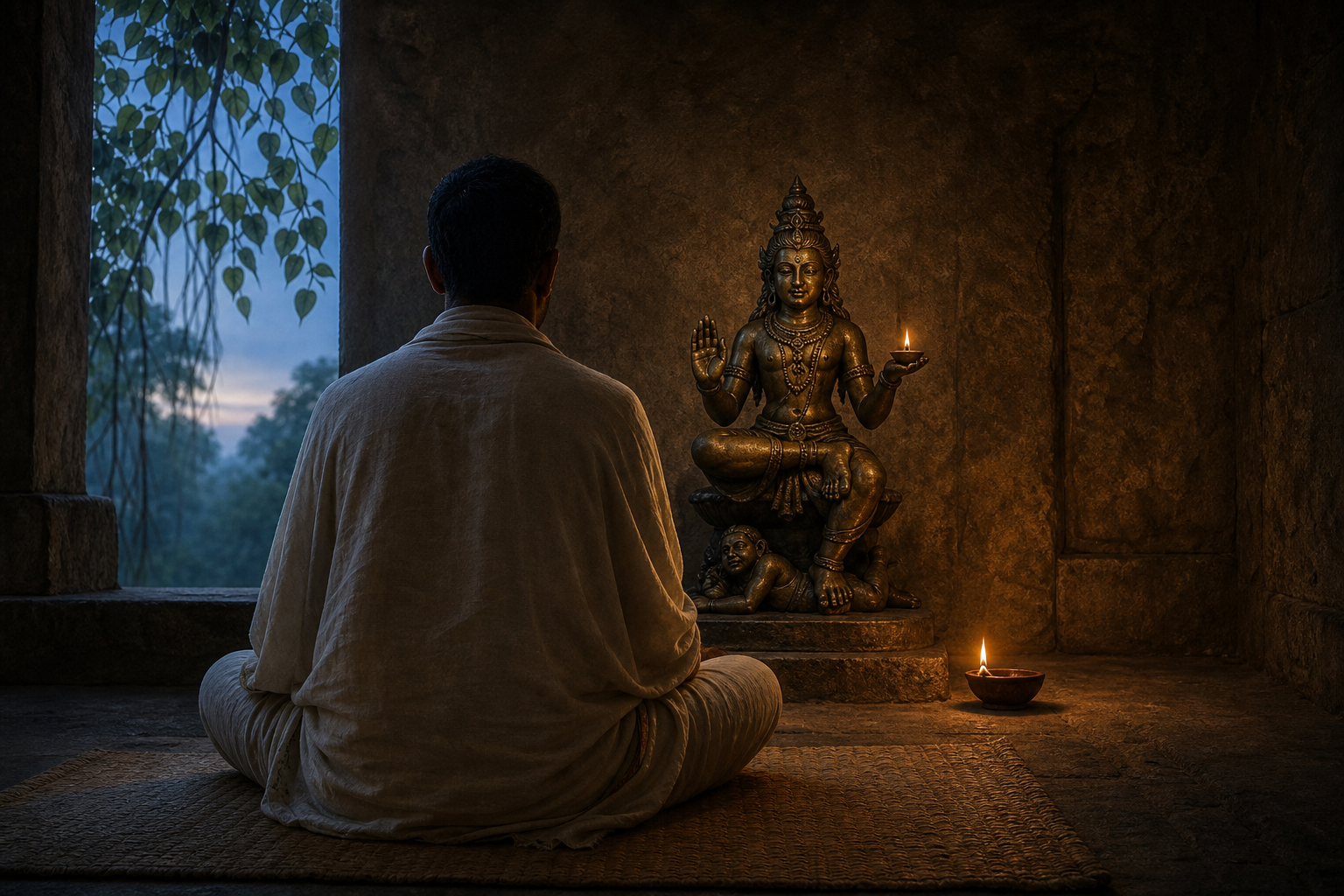
The image is designed to change the quality of attention, not merely to reward identification. Use the following sequence when you have a quiet moment before a shrine or a suitable image. Keep the exercise directed toward your own obscuration. Samhara contemplation is distorted when it becomes a fantasy about destroying opponents, rivals or unwanted parts of the world.
- Establish the direction of learning. Face south if your setting permits. Dakshinamurti’s southward orientation recalls inner knowledge, ancestry and transmission. If physical orientation is impractical, simply acknowledge the guru before beginning.
- Enter the shelter of the banyan. Visualize the canopy as the continuity of teaching. Let this correct the impulse to treat every spiritual impression as a private discovery detached from lineage.
- Name one Apasmara. Select one concrete pattern of forgetfulness operating now. Do not compile a catalogue of faults. One visible habit is more workable than a dramatic judgment against yourself.
- Place it beneath the foot. Imagine the pattern held in awareness without indulgence and without hatred. The foot represents stable discernment. Subduing the pattern means that it no longer dictates your next act.
- Bring in agni. See fire as the warmth of discrimination. Ask what is false, excessive or merely habitual in the pattern you named. Let the unnecessary element recede; do not use the visualization to suppress a fact you need to face.
- Complete the movement in chinmudra. Shift attention from the object being removed to the awareness in which the entire movement is known. Let the distinction between observer and observed soften without forcing an unusual experience.
- Rest in the resulting silence. Silence here means the subsiding of conceptual agitation, not simply the absence of sound. If thoughts return, notice whether they return with the same authority. The measure is greater clarity, not theatrical intensity.
You may accompany the contemplation with unhurried japa of Om Namah Shivaya, coordinated gently with the breath. The mantra supplies continuity when the mind wants to turn contemplation into analysis. Its role here is purification and recollection, not the production of a forced altered state.
The tantric interior map of samhara moves from the gross through increasingly subtle levels toward source. The loosening of habitual knots, the calming of rajasic agitation and tamasic inertia, and the emergence of sattvic clarity all describe stages of refinement. Even sattva is not the terminus: the icon points toward stillness beyond the play of the gunas.
If you are participating in temple worship, follow the temple’s Agamic practice rather than improvising a private ritual. Vibhuti, bilva leaves and clear water may be offered in Dakshinamurti worship, while observances connected with pradosha or Arudra and Thiruvadhirai can emphasize Shiva’s guru aspect. Local practice decides the actual alankara, offerings and recitation. Ask the priest or established practitioners when you are uncertain.
After contemplation, choose one ordinary action that expresses the insight. Pause before repeating the resentment you identified. Return to the neglected japa. Correct the unsupported assumption. Samhara becomes spiritually credible when something that previously governed you loses its command.
Key takeaways
- Samhara Dakshinamurti represents the dissolution of ignorance, limitation and habitual obscuration, not destruction for its own sake.
- Identify the form through a cluster: southern placement, seated youthful guru, banyan, sages, subdued Apasmara, transformative attributes and composed intensity.
- Agni is a strong Samhara signal, but fire must be read together with posture, expression, mudra and surrounding figures.
- Apasmara remains under the foot because forgetfulness requires continuing vigilance; the practical task is to recognize a recurring pattern before it acts through you.
- Chinmudra preserves the destination of the icon: dissolution culminates in recognition rather than emptiness or wrath.
- Regional and lineage differences matter, so use the iconographic grammar as a guide while respecting the identification maintained by the temple or tradition.
The next time you encounter Dakshinamurti, begin at the foot and let your gaze rise slowly. Name what must lose its hold, notice the fire that clarifies, and then return to the still face of the guru. The icon has done its work when you leave with less confusion and one clearer act before you.
References
